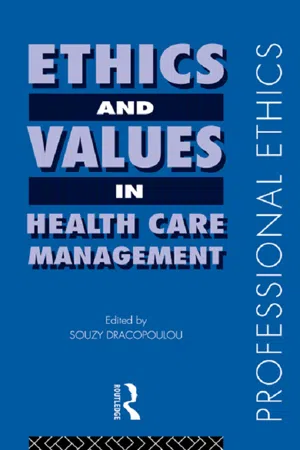
Healthcare management is a burning issue at the moment and this timely and topical book explores the ethical issues that arise in the context of healthcare management. Among the topics discussed are healthcare rationing, including an exposition and defence of the Qaly criterion of healthcare rationing and an examination of the contribution that ethical theory can make to the rationing debate, an analysis of how managers can be preoccupied with the goals of management and the values of doctors simultaneously, an outline of potential guidelines towards formulating a cohesion of healthcare management and ethical management and a reassessment of the role of healthcare professionals. Ethics and Values in Healthcare Management provides a valuable and much needed analysis of the ethical problems associated with healthcare management and offers some solutions towards ameliorationg healthcare organisations.
- 224 pages
- English
- ePUB (mobile friendly)
- Available on iOS & Android
eBook - ePub
Ethics and Values in Healthcare Management
About this book
Information
1 Ethics and Management – Oil and Water?
Andrew Wall
DOI: 10.4324/9780203010372-1
Books on medical ethics stream from the publishers but, to date, only one has appeared from a UK author which concentrates on health services managers and ethics (Wall 1989). Given the increasing role of managers in making rationing decisions, and in managing the accountability of their organisations as well as their responsibilities in controlling staff of all kinds, it is curious that there has not been more discussion on managers and their ethics.
So why is it that managers and ethics appear not to mix, to be like oil and water? Is management seen to be so intrinsically pragmatic as to be outside the scope of ethical debate? Some philosophers certainly seem to take the view that managers are somehow incapable of considering matters ethically (Loughlin 1994). Many managers are unable, Loughlin argues, to understand the basic intellectual concepts that have underpinned ethical debate for thousands of years. In reply, it is true that few managers will have studied philosophy except in the crudest manner. But that does not mean that they are not concerned with issues of right or wrong, or that they do not need to have a way of considering conflicting principles.
In today’s National Health Service (NHS), managers have been at the heart of crucial decisions which require ethical principles to be rehearsed. Notable has been the case of Jaymee Bowen, a ten-year-old child with a rare form of cancer requiring expensive treatment of uncertain efficacy. The issue, in 1995, was whether or not the health authority should fund the treatment. Using the argument that the proposed treatment had a poor record of success, the chief executive of the health authority told the public, through the media, that the health authority would not be funding further treatment. It appeared that he himself was instrumental in handling the process of debate and crucial in coming to that conclusion. This case demonstrated how central managers are to ethical decisions. This may be surprising to many. They might have expected that a doctor would have been the spokesperson for the decision or that the chairman of the health authority would have fronted public debate (Wall 1995).
Whether or not this case was handled in the most appropriate way, there remains a debate as to the legitimacy of managers to be centrally engaged in matters of medical priority setting. Are they adequately equipped to explore such issues given the popular view that managers are primarily interested in the financial consequences of decisions rather than in any other aspects?
This chapter attempts to discuss managers’ approaches to ethics and to explore in more detail whether or not they are capable of carrying the weight which seems, willy-nilly, to have been loaded upon their shoulders, in matters not only of safeguarding probity through proper administrative practice, but also in priority setting.
The Managers' World
Health service managers are practical people concerned with getting things done. Resolving problems and making decisions about the use of resources is what they are there for. If clinicians could resolve their own problems, managers would not be needed. Increasingly clinicians have not been able to handle organisational complexity, where conflicting views have to be reconciled. Despite this, doctors, nurses and other clinicians have remained suspicious of managers, attributing to them a set of values which are finance-based and overly compliant to the government of the day. Some clinicians go further and suggest that managers’ concern for patients is, at best, cursory. Managers, they say, seldom have to face the demanding patient and relative, and are therefore insensitive to the emotional and professional demands that these everyday interactions impose upon clinicians. But many managers are offended by this assumption that they are indifferent to patients’ needs. As will be shown later, in some areas of care, managers have led advances which have substantially improved the lives of patients.
Undoubtedly clinicians are pressurised by the expectations of their patients. Managers experience different, but equally demanding, pressures. The environment for them is tough and their role sometimes paradoxical. Not only do managers lack sympathy from the general public, they are often derided by their very masters, the government. Both major political parties, faced with criticism of the NHS, too often start by criticising the growth of the bureaucracy – the Conservatives’ ‘men in grey suits’ (sic – increasingly they are as likely to be women). Managers feel that this is particularly unjust given the implications of the National Health Service and Community Care Act 1990 which, by separating purchasers of health care from providers, has necessitated a large increase in managerial staff to make the system operable.
The 1990 Act exemplified the market ethos which was central to the Conservative Party’s thinking. This ideological change was not necessarily supported by managers at the time, but, as servants of the state, they espoused the ideology sufficiently in order to implement the changes. This was a manifestation of their public duty and it may be presumed that the managers would do the same with any political party whatever their policies. Nevertheless, this support for the Conservatives’ policies did not go down well with either clinical or support staff who largely opposed the changes in the years following the 1990 Act. Most staff felt that managers were not on their side. This had an adverse effect on staff morale.
Equally damaging to that sense of morale have been the changes in employment practice. In order to control finances, it is necessary to be able to adjust commitments speedily. The easiest way of doing this is to manipulate staffing levels. Therefore, if there is financial crisis, staff have to be reduced, and quickly. This has led managers to abandon some employment practices which are aimed at safeguarding the interests of the staff.
Ethically such actions have often been dubious and the effect is likely to be long term. If staff are treated as a commodity, they act accordingly and offer themselves in the market-place for the highest price they can command. Loyalty to the organisation has no place in such a transaction. Despite their current experience, many managers feel increasingly concerned that principles of good employment practice, which they will have learnt over many years, are still important.
So given the challenging environment managers now find themselves in, is there a place for ethics in the manager’s world?
Values
How do the values which managers hold affect their work? Are these values shared by all managers? Can these values be codified into a recognisable ethic? One way of exploring these questions is to use Donabedian’s (1980) well-known typology: input, process and outcome. What do we know about the intrinsic values that health service managers are likely to hold? How do they demonstrate them in their work and is the outcome the only way of judging whether they are appropriate or not?
Input
Where do people acquire their values? Presumably it is a mix of inculcated values from upbringing and more consciously acquired values matured by experience. For some, values may be largely defined by their religious belief, but for many others, values will be a melange prepared over their lives, not always consistent, and in the course of the working day probably not often articulated.
Managers in a classroom discussion away from the pressure of everyday decision-making, find it difficult to articulate their values until faced with dilemmas which will illustrate them. This supports the view that managers are essentially pragmatists and can only make sense of ethical issues within a specific set of circumstances. If this is so, guiding principles which hold good in all circumstances will have little meaning for them. Yet philosophical discussion in the field of biomedical ethics often relies on what Beauchamp and Childress (1994) have described as the ‘four principles approach’, an approach invoking the principles of autonomy, beneficence, non-maleficence and justice. Does this mean that there is a fundamental mismatch between the views of these pragmatic managers approaching every dilemma according to context and circumstance, and others, philosophers and clinicians, who prefer to be guided by a set of abstract principles which aim to ensure a degree of consistency of approach?
Even if this is the case (and it is dangerous to be dogmatic about such matters), is it problematic? The four principles provide guidance; they are not in themselves capable of indicating absolutely what should be done. So for instance, it is reasonable to hold the view that all dealings with patients should honour the principles of autonomy, beneficence and non-maleficence. Interpreted in context, this means that a patient has the right both to receive respect for their individuality and to expect that their interests will be furthered and will not be abused. But interpretation of these principles is by no means easy. For instance, suppose a case conference is set up to discuss the disclosure by a volunteer play assistant that a child of six has displayed inappropriate behaviour in class which suggests sexual abuse. Should the play assistant, as a non-professional and a volunteer who is not regulated by any code, be invited to the case conference, a professional forum? She might be unreliable and talk about what was discussed to neighbours and friends. The child’s right to confidentiality would then be betrayed. But despite this risk, the child’s interests might be best served by inviting the play assistant to give a first-hand account of what she observed. The parents also have rights in the matter. The ethical dilemma is to decide which principles predominate in meeting the child’s needs. How indeed are we to rank principles? Is confidentiality more important in this case than getting to the truth, even if there is a risk of a loss of confidentiality?
This example shows that principles help as benchmarks against which to judge specific cases. But to arrive at appropriate action there has to be discussion, transaction, and the judicious assessment of evidence. For managers, the sort of fundamentalism which suggests that principles are always true whatever the circumstances is of little use. Yet it sometimes seems that clinicians are happier with rules which prescribe a consistent course of action.
There are obviously considerable dangers in having no fixed point to govern conduct. If everything is contingent on circumstance, who will ever know what is right and what is wrong? Away from the daily care of patients, managers faced with the current (1996) political ideology may find it difficult to know how to address issues which arise from market competition. What to reveal and what to keep secret is a particular dilemma. Is it right that transactions about contracts for care should be discussed only in private by the Boards or, given that it is public money which is being used, does probity require such discussions to take place in public even when such revelations would effectively wreck any meaningful competition between providers? Which principles are to be observed? It is not surprising that managers find it difficult to decide what constitutes ethical behaviour.
Externally derived principles, whether those emanating from philosophers, clinicians or politicians, cannot be easily relied upon to guide a manager. Perhaps he or she is better advised by their own personal value system, however varied they may be between one manager and another. But some managers would maintain that what they believe personally is their own affair and is of a different order to how they behave at work. For others, personal conscience can spill over into the working situation, particularly in quasi-political situations where secrecy is the issue.
A manager can also be faced with resolving dilemmas of conscience among other staff. By law no nurse is required to assist in a termination of pregnancy, but a medical secretary who for similar reasons of concern did not wish to type letters about patients who had terminations, lost her case against unfair dismissal on the grounds that her personal beliefs were inappropriately expressed by her refusal to undertake this part of her work. There is a suspicion that once the law is called in to adjudicate on matters of conscience, the result is likely to be somewhat arbitrary.
Managers may themselves have to arbitrate and in such a role their own values will be crucial. Supposing a nurse refuses to assist with electro-convulsive therapy on the grounds that this particular treatment, although widely used, is not altogether understood and could be said therefore to be an assault on a patient. Should the manager support the nurse and remove him or her from that duty or should he or she tell the nurse that his or her role is to look after the patient? The nurse is not, after all, administering the treatment.
There can be no one answer. The manager, like anyone else, will largely act according to his or her own set of values. Unfortunately, many people, both clinical colleagues and the public more generally, are suspicious of managers’ own values precisely because they are usually undeclared. Managers in the health service are undoubtedly shy about speaking personally, but why should this be so? Their work is centred on helping others to be more effective, on solving others’ problems, on predicting and planning the future of the organisation or service; all of which activities allow little scope for putting their own values to the fore. But if this is their argument, managers may be misjudging the situation. Studies of effective leadership constantly show that the expression of values, of ideals, is one of the most commanding attributes of effective leaders.
There may be a more sustainable argument against the expression of personal values and that comes from the tradition of being a public servant, whose ethic demands the implementation of government policy. What would happen if personal beliefs were to interfere with this? We may have gone beyond the myth that public servants should have no political allegiance as that would be to deprive them of their democratic rights. But it is not considered appropriate for managers in public service to advertise their politics.
Understandable though this stance may be, it can be challenged. Undue compliance with government can be seen as lacking in integrity. Many NHS staff are critical that managers do not join them in demanding more resources. Such staff may assume that managers’ reluctance is self-interested because managers do not wish to offend those in power. Managers may not get the credit for honouring the principle that the duty of managers is to administer the system within the resources available; that this is a principle which demonstrates integrity of purpose.
Managers could probably do more to act as an effective agent between the government and the views of staff and communities. Some government policies are likely to have unfortunate results, so part of the duty of public service managers is to bring these to the attention of their superiors without suffering from threats of discipline for being disobedient. It must be a matter of concern that managers’ sense of their own integrity is not always strong enough to speak out against policies which are likely to fail. This may be because of the essentially adaptive nature of their role, which leads them to be pragmatic, operating, it may appear, from no fixed points of belief. Managers can correct this impression by demonstrating their concern for ethics through process – the second stage of Donabedian’s typology.
Process
Central to the managers’ role is their accountability to others. They have to answer to the public who have an expectation of a health service which will respond promptly to their needs. As has already been said, managers are also accountable to the government for the implementation of policy. But equally managers are accountable for procedures which ensure the proper use of public funds and ensure that the law is observed. It might be assumed that these obligations require health service managers to have a code of conduct. At the time of writing (1996) they are not so regulated although there has been an attempt by the managers’ professional body, the Institute of Health Services Management, to produce guidance in the form of a Statement of Primary Values (1994). Well intentioned, it falls into the trap of rhetoric and it might be said to have never been more than an attempt to recover esteem in the eyes of others.
For instance, the Statement says,’The mission of the Institute is to promote excellence in health services management in order to improve health and health care.’ But what are ‘excellence’ and ‘improvement’ other than ‘feelgood’ words? The Statement also suffers from problems of meaning: ‘Managers will respect and welcome diversity amongst patient, colleagues and the public.’ Tolerant and liberal in tone but meaningless out of a particular context. Indeed too much diversity could be detrimental if the issue is about the fair distribution of resources. The Statement goes on in a similar vein, making points with which it is difficult to demonstrate compliance, except in the most general way.
The problem for managers is that a professional code of conduct is not sustainable because managers are...
Table of contents
- Cover Page
- Half Title Page
- Series Page
- Title Page
- Copyright Page
- Contents
- List of illustrations
- List of Contributors
- Series editor's preface
- Introduction The place of ethics in health care management
- 1 Ethics and Management – Oil and Water?
- 2 Economics, Qalys and Medical Ethics A health economist's perspective
- 3 Should Managers Adopt the Medical Ethic? Reflections on health care management
- 4 Management, Ethics and the Allocation of Resources
- 5 Impossible Problems? The limits to the very idea of reasoning about the management of health services
- 6 Age as a Criterion of Health Care Rationing
- 7 Health Care in Poland Dilemmas of transformation
- 8 Ethics and the Management of Health Care in Greece A health economist's perspective
- 9 Regulation of the French Health Care System Economic and ethical aspects
- Index
Trusted by 375,005 students
Access to over 1.5 million titles for a fair monthly price.
Study more efficiently using our study tools.
Frequently asked questions
Yes, you can cancel anytime from the Subscription tab in your account settings on the Perlego website. Your subscription will stay active until the end of your current billing period. Learn how to cancel your subscription
No, books cannot be downloaded as external files, such as PDFs, for use outside of Perlego. However, you can download books within the Perlego app for offline reading on mobile or tablet. Learn how to download books offline
Perlego offers two plans: Essential and Complete
- Essential is ideal for learners and professionals who enjoy exploring a wide range of subjects. Access the Essential Library with 800,000+ trusted titles and best-sellers across business, personal growth, and the humanities. Includes unlimited reading time and Standard Read Aloud voice.
- Complete: Perfect for advanced learners and researchers needing full, unrestricted access. Unlock 1.5M+ books across hundreds of subjects, including academic and specialized titles. The Complete Plan also includes advanced features like Premium Read Aloud and Research Assistant.
We are an online textbook subscription service, where you can get access to an entire online library for less than the price of a single book per month. With over 1.5 million books across 990+ topics, we’ve got you covered! Learn about our mission
Look out for the read-aloud symbol on your next book to see if you can listen to it. The read-aloud tool reads text aloud for you, highlighting the text as it is being read. You can pause it, speed it up and slow it down. Learn more about Read Aloud
Yes! You can use the Perlego app on both iOS and Android devices to read anytime, anywhere — even offline. Perfect for commutes or when you’re on the go.
Please note we cannot support devices running on iOS 13 and Android 7 or earlier. Learn more about using the app
Please note we cannot support devices running on iOS 13 and Android 7 or earlier. Learn more about using the app
Yes, you can access Ethics and Values in Healthcare Management by Souzy Dracopolou in PDF and/or ePUB format, as well as other popular books in Medicine & Ethics in Medicine. We have over 1.5 million books available in our catalogue for you to explore.