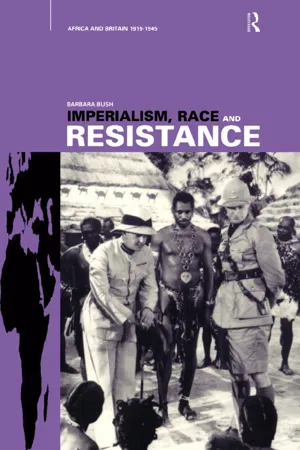
Imperialism, Race and Resistance marks an important new development in the study of British and imperial interwar history.
Focusing on Britain, West Africa and South Africa, Imperialism, Race and Resistance charts the growth of anti-colonial resistance and opposition to racism in the prelude to the 'post-colonial' era. The complex nature of imperial power in explored, as well as its impact on the lives and struggles of black men and women in Africa and the African diaspora.
Barbara Bush argues that tensions between white dreams of power and black dreams of freedom were seminal in transofrming Britain's relationship with Africa in an era bounded by global war and shaped by ideological conflict.
- 416 pages
- English
- ePUB (mobile friendly)
- Available on iOS & Android
eBook - ePub
About this book
1 Africa after the First World War
Race and imperialism redefined?
The welfare of Africa is a concern for the entire outside world.(George Louis Beer, 1919)
History will note that the European interest in Africa ... was immensely increased by the war and the establishment of the mandates system.(Margery Perham, 1931)
As colored men realised the significance of [the First World War], they looked into each other’s eyes and there saw a light of un-dreamed hopes. White solidarity was riven and shattered [and] fear of white power and respect for white civilisations dropped away like garments outworn.(Lotharp Stoddard, 1924)1
The First World War unleashed what Porter (1996) has termed the ‘predatory imperialism’ of Britain, France and Japan, but also Britain’s white Dominions lending support for the left’s arguments that it was an ‘imperialist war’, which could not have been fought and won without the colonial contribution. The Versailles Peace Settlement confirmed Britain as the supreme imperial power. Empire was vital to postwar recovery and economic survival in the troubled international economic climate between the wars. As Young (1997) points out, compared with the other great powers, Britain remained strong and successful up to 1939 and was fiercely competitive in trade, investment, shipping, insurance and new developments, such as radio and air transport. After 1929 a policy of imperial economic protectionism was pursued and Britain became increasingly dependent on imperial markets.2 But this ‘empire strengthening’ on a global scale is barely acknowledged in more common trope of a Britain weakened by war and economic instability. For Lloyd (1995) the inter-war years saw the ‘defeat of the imperial idea’, and in Tales From the Dark Continent (1979) an ex-member of the African Colonial Administrative Service (CAS) looks back on the Great War as bringing an end to an era of imperialism characterised by ‘supreme selfconfidence’ – a time when the British Empire was ‘cock of the world’. His memories echo contemporary ‘Decline and Fall’ interpretations that emphasised the ‘erosion of the collective image of the master race’ and the ‘general force of circumstances’, including the ‘ ... will of the oppressed’ in undermining empire.3
During the 1920s, India and the ‘white’ Dominions, including South Africa, appeared to generate most interest. A greater priority was placed on creating a buffer of white Dominions, reflected in the Empire Settlement Act of 1922, and from 1919 soldiers were given financial support for emigration throughout the ‘white’ empire to minimise unrest created by unemployed, demobbed soldiers.4 Africa is represented as a burdensome appendage and the ‘cinderella’ Colonial African Service (CAS), viewed as a financial ‘millstone’ round the neck of the Colonial Office, was unfavourably compared to the more prestigious Indian Civil Service (ICS). Recruits to the colonial service were described as ‘hollow men’ of the postwar ‘straw generation’ – disillusioned, materialistic and selfish – the anti-heroes of contemporary writers like Graham Greene and Joyce Cary.5 Writing in the 1930s, the Africanist, William Macmillan complained of the ‘abysmal ignorance’ and lack of interest in African affairs across the political spectrum. African studies were a low priority in universities, reflected in the ‘disproportionate’ number of women experts in the field, and an ‘abstention of masculine intellect’ was apparent until the postwar era when Africa became more politically important.6 But how accurate was this gloomy vision of the imperial mission in tropical Africa? As imperial uncertainties mounted in the Indian empire, Africa arguably became more important to sustaining Britain’s imperial prestige. Colonial administration was extended and streamlined, and any resistance was counteracted by a fierce determination to continue to bear the ‘burden’ in Africa. The outpouring of writings on colonial policy and the race problem furnish testimony to the tenacity of the imperial vision of Africa. In this ‘empire strengthening’, the US was, paradoxically, a major stimulus as an important imperialist competitor, but also an indispensable ally in the strengthening of ‘Anglo-Saxonism’, the powerful discourse of racial superiority central to the extension of Western imperial power. Britain and the US were also in harmony in confronting the ‘enemy without’ and ‘within’ posed by the left’s challenge to imperialism and capitalism.
A broader ‘global’ perspective, from the ‘heart of empire’, is thus crucial to interpreting the more localised and concrete interconnections between imperial policy, racist discourse and black resistance that are charted in the following chapters. This chapter, then, will first examine ‘empire strengthening’ strategies and Africa’s role in sustaining a strong ‘imperial consciousness’ in Britain. Second, it analyses contemporary Western conceptualisations of Africa and evaluates the link between power, knowledge and racial discourses which underpinned British imperialism. I focus next on the postwar settlement, which strengthened the international racial and imperial order, endorsed British ‘trusteeship’ (paternalistic administration by a civilised nation of less ‘advanced’ peoples until they were able to manage their own interests) and affirmed global ‘dreams of power’, which centred on Africa. The final section explores the significance of war and ‘empire strengthening’ in shaping the parallel sphere of black resistance and anti-imperialism – new ‘dreams of freedom’ inspired by Bolshevism, black consciousness and intellectual ‘anti-racism’ that interpenetrated the imperial labyrinths.
‘Empire strengthening’: race and ‘imperial consciousness’ in inter-war Britain
Analysing empire between the wars is highly complex. As Hobsbawm (1994) points out, never had Britain’s formal and informal empire been so extensive, but never had the rulers of Britain felt less confident about maintaining imperial supremacy. The spectrum of thought on empire ranged from deep pessimism to enduring optimism. Leonard Woolf, who had firsthand experience as an officer in the Colonial Service in Ceylon from 1904–11, argued that given the force of ‘anti-Westernism’, imperialism was no longer possible, and now the main question was whether it would be ‘buried peacefully or in blood and ruins’. Conversely, the academic, Hugh Egerton, promoted the ‘authoritative defence’ of what he calls the ‘sane imperialism’ provided by Lord Lugard’s The Dual Mandate in British Tropical Africa, (1922), the definitive elaboration of trusteeship. He acknowledges the ‘disillusion and distrust of colonial subjects in the aftermath of war’, but berates the ‘strong prejudice’ aroused in ‘some minds’ (particularly American) by the very words ‘empire’ and ‘imperialism’. Although bright university undergraduates might ‘sneer’ at empire, imperialism still had a role in ensuring the ongoing ‘orderly progress of native communities’.7
Imperialism after the war was more diffuse and complex, and neutralised by slippery concepts like ‘trusteeship’, ‘Commonwealth’ and ‘self-determination’. It was shaped by what Hobsbawn (1994) has termed the ‘Age of Catastrophe’, which was marked by instabilities in the international system, increasing globalisation, the disintegration of old patterns of social relationships and fears that Europe would be eclipsed by the ‘non-Western’ world. Marxist-Leninism had changed the meaning of imperialism, and Leonard Woolf argued that the only people who used the term were the critics of Western policy towards ‘backwards peoples’; many people, ‘particularly the most patriotic of imperialists’, now denied there was such a thing as imperialism, although the economic basis of imperialism had become ‘even clearer’.8 This was manifest in interconnections between political and economic power, which was reflected, for instance, in the extensive imperial economic interests of Conservative MPs. Strong defensive tactics were thus employed against new anti-imperialist challenges. The networks of power radiating from the influential Round Table Group were particularly crucial in this ‘empire strengthening’, but the powerful Freemasonry, which embraced members of the royal family, was also ‘hostile to all subversive and disintegrating forces within the empire’ and extended its influence among colonial elites.9
The Round Table Group (also called the ‘Cliveden Set’ or ‘Milner Kindergarten’ after Lord Alfred Milner, Colonial Secretary during the First World War) penetrated high politics and engineered important shifts in imperial thinking. Quigley (1981) suggests that the group evolved from a provision in a secret will made out by Cecil Rhodes in which he left a fortune to promote a ‘Society of the Elect’, modelled on the Jesuits. The journal, The Round Table (1910–), promoted Rhodes’ ideal of a ‘white commonwealth’ – a world united into a federal structure around the United Kingdom, the apogee of Anglo-Saxon culture and the most grandiose dream of imperial power yet articulated. The Round Table Group convened ‘imperial conferences’ to help promote this vision of a new liberal empire. However, there was an implicit racism in Rhodes’ ‘moral view’ of empire and liberal dictum of ‘equality for all civilised men’. As Pietersie (1991) points out, his ‘frontier mentality’ of race, which conceptualised the native as a child subject to a superior Anglo-Saxon ‘first race’, was seminal in the formulation of segregationist South African native policies and the reinforcement of the imperial colour bar.10
The work of the group was supported by the Rhodes Trust (administered by Milner), and its influence grew steadily from 1922–39, spearheaded by an ‘inner circle’ including Philip Kerr, Lionel Curtis, Milner and Lord Frederick Lugard. Secretaries of State for the Colonies and Dominions and arbiters of knowledge, such as Lord Hailey, whose role in African affairs will be discussed at a later point, and Reginald Coupland were also connected to the group. A web of power was thus created, linking official and academic circles interested in colonial affairs. The group had considerable influence in the League of Nations Union and in consolidating the ‘Anglo-Saxonism’ which linked British and US imperial missions. Pietersie (1991) emphasises the importance of Quigley’s neglected work in uncovering these powerful, but secret trans-Atlantic networks whose energies were channelled into strengthening Britain’s liberal and democratic empire as a weapon against Marxist-Leninism.11
Africa, regarded as safe and quiescent, a balm to the troubled imperialist, was central to this ‘empire strengthening’. During the First World War, African colonial economies were increasingly tailored to feed into world commodity markets, and royalties from mining companies became an increasingly lucrative source of income for colonial governments. By 1936, £1,222,000,000 was invested in Africa, £523,000,000 in South Africa, as opposed to £75,000,000 in Nigeria. Seventy per cent of all investments were in British Africa.12 Cain and Hopkins (1993) argue that Britain received the ‘lion’s share’ from imperialism in Africa, and by 1938 the tropical African territories contributed just over 3 per cent of Britain’s total exports. Although this may seem insignificant, they point out that profits from Africa met the needs of special interest groups and made a ‘useful if still modest contribution to settling Britain’s international accounts’. ‘Thus sustained’, they argue, ‘Britain demonstrated her determination not merely to keep her empire but also to enlarge it’ and gained ground despite fierce international rivalries. The Round Table imperial visionaries ensured that Africa stayed in the public eye, and the elaboration of the Colonial Service provided opportunities for the ‘gentlemanly’ order of the middle and upper classes, from colonial officers to anthropologists.13
In the arena of domestic politics there was broad consensus on empire in Africa. Although the Labour Party was not as bombastic on imperialism as the Conservatives, who represented direct vested interests, Labour had its own enthusiastic ‘Empire Socialists’. Leslie Haden-Guest, for instance, advocated a socialist ‘civilisation mission’ in Africa, immigration controls and separate development to prevent an uneducated and ‘excitable’ black proletariat succumbing to ‘communist propaganda’. Left-wing critics scorned this notion of ‘socialising’ the empire as on a par with ‘socialising slavery’, arguing that Labour was ‘no friend’ of colonial peoples.14 As Stedman Jones (1983) has argued, the radical culture of earlier working-class movements was neutralised in the latter part of the nineteenth century and an ‘enclosed and defensive’ working-class culture developed, which was reflected in virulent anti- Communism and passive acceptance of imperialism and the monarchy. The deep-seated racist attitudes which permeated all levels of British society ensured a preference for the white Dominions and an acceptance of the ‘backwardness’ of Africans.15
Such attitudes to race and empire were reinforced in popular culture. John Mackenzie (1986) has forcefully argued against historians who compartmentalise British and imperial history and claim that imperialism had no impact on the British ‘masses’, particularly after the First World War. Here he is supported by Cain and Hopkins (1993), who argue that the war ‘enhanced the importance and popularity of empire’, and additions made after 1919 provided a continuing sense of imperial mission. British national identities were still profoundly shaped by reference to the imperial hinterland and its colonial subjects, and pioneering research by Mackenzie and others has revealed how public awareness was heightened and greatly extended by novel techniques of publicity and propaganda, such as film and radio. Imperial sentiment and the notion of ‘citizens of empire’ was spread through the scouting and guiding movement, the imperial curriculum taught in schools and children’s books and comics.16 Traditions, including royal ceremonials, popular culture and the consumption of imperial products (see Illustration 2) generated an ‘imperial consciousness’ and confirmed racial and cultural superiority. Can we dismiss as ephemeral the continued celebration of Mafeking Night into the 1930s, the Imperial Exhibitions and Empire Games (first held in 1924) at the new Wembley Stadium, the increased public interest in Empire Day, 24 May (a half-day school holiday in Britain and marked by ceremony throughout the empire), and popular children’s games, like ‘Trading With The Empire’? Such ‘empire propaganda’, argued left-wing critics, helped secure the ‘patriotism and loyalty’ of the working classes and led to ignorance and apathy about real conditions, while reproducing dominant stereotypes about blacks.17
The new cultural power of film and radio was fundamental to imperial ‘propaganda’ in Britain and its colonies. In the 1930s, the media was mobilised officially and through private enterprise (the Cable and Wireless Company was formed in 1928). By 1939 there were nine million ‘wireless’ sets in Britain and, argues Hobsbawm (1994), the importance of the radio as a medium of mass information and propaganda was profound. From its inauguration in 1926, the British Broadcasting Corporation gave unswerving support to ‘monarch and empire’, and an empire service was started in 1932, the same year as the Christmas Day royal broadcasts were started. Its chairman, Lord Reith, was a staunch imperialist and patriot, and Empire Day specials were de rigueur. The Empire Day Movement also sponsored broadcasts to ‘children of the empire’.18 The main centre for imperial film production was the Empire Marketing Board (which also organised shopping weeks around Empire Day) until it was axed in 1933 due to government cuts. In 1935 the Imperial Institute took over the Empire Film Library and in 1936 its audiences – mostly school children – reputedly totalled over 4,000,000.19 Documentaries were shown to millions of people throughout the empire, although Hailey (1957) suggests that reactions of African audiences new to the medium were ‘not always that desired’ and film strips were cheaper and better understood. However, the establishment of the Colonial Film Unit in 1939, attached to the Ministry of Education in London, created local production units and prioritised films as a means of ‘fundamental education’.20
In the ‘Age of the Dream Palace’ popular films were particularly influential and Hollywood was seminal in projecting imperial and racial superiority. American films about Africa and empire, argues Richards (1984), were also popular in the US as they reaffirmed the white supremacist basis of American culture. For film makers, the empire was ‘good business’ and a Daily Express journalist declared that films like Sanders of the River were ‘far more successful at the box office than any equal amount of sophisticated sex nonsense’.21 Stam and Shohat (1994) argue that ‘Eurocolonial cinema’, as the ‘Eye of Empire’, could transform white spectators into ‘armchair conquistadors’, affirming a sense of vicarious power, but also inducing a deep ambivalence among colonised spectators viewing offensive representations of themselves. As Mackenzie (1988) points out, cinema involved a ‘world-view’ explicitly and implicitly rooted in imperial perceptions. Anything reflecting adversely on the British army, the white race or the prestige of British rule that could ‘inflame’ the native population was cut or banned. Films dealing with sex between white women and black or Asian men were regarded as particularly dangerous, and race pundits warned that passionate love scenes in cinemas degraded white women in African eyes.22
Such attitudes reflected a morbid obsession with the evils of interracial mixing which created the ugly trope of the dangerous ‘half-caste’ who threatened the important racial boundaries of empire. A preoccupation with interracial sex, which drew heavily on eugenicist and biological racist discourse, became a powerful ingredient of popular racism which extended even to critics of colonialism.23 This ‘sexual dimension of racism’ acted as an importa...
Table of contents
- Cover Page
- Title Page
- Copyright Page
- Illustrations
- Preface
- Acknowledgements
- Abbreviations
- Introduction: Why imperialism, race and resistance?
- 1 Africa after the First World War: Race and imperialism redefined?
- West Africa
- South Africa
- Britain
- Notes and references
- Bibliography
Trusted by 375,005 students
Access to over 1.5 million titles for a fair monthly price.
Study more efficiently using our study tools.
Frequently asked questions
Yes, you can cancel anytime from the Subscription tab in your account settings on the Perlego website. Your subscription will stay active until the end of your current billing period. Learn how to cancel your subscription
No, books cannot be downloaded as external files, such as PDFs, for use outside of Perlego. However, you can download books within the Perlego app for offline reading on mobile or tablet. Learn how to download books offline
We are an online textbook subscription service, where you can get access to an entire online library for less than the price of a single book per month. With over 1.5 million books across 990+ topics, we’ve got you covered! Learn about our mission
Look out for the read-aloud symbol on your next book to see if you can listen to it. The read-aloud tool reads text aloud for you, highlighting the text as it is being read. You can pause it, speed it up and slow it down. Learn more about Read Aloud
Yes! You can use the Perlego app on both iOS and Android devices to read anytime, anywhere — even offline. Perfect for commutes or when you’re on the go.
Please note we cannot support devices running on iOS 13 and Android 7 or earlier. Learn more about using the app
Please note we cannot support devices running on iOS 13 and Android 7 or earlier. Learn more about using the app
Yes, you can access Imperialism, Race and Resistance by Barbara Bush in PDF and/or ePUB format, as well as other popular books in History & African History. We have over 1.5 million books available in our catalogue for you to explore.