- 128 pages
- English
- ePUB (mobile friendly)
- Available on iOS & Android
eBook - ePub
The Student's Guide to Writing Essays
About this book
This text is divided into two sections: a core element focusing on basic skills which everyone needs to master in writing essays, and a subject-based section which takes the student to a more advanced level.
Information
Part I. Core Elements
Core Element 1: Writing Paragraphs About Problems and Solutions
DOI: 10.4324/9780203062210-1
Just to get you going, here are some samples of writing which aim to communicate the results of a new discovery in astronomy. Which do you think is the most effectively written, and why?
- People used to have problems discovering all about other planets because they are so tiny compared to stars which are much bigger than the Earth, like the sun for example. Also, because planets don’t give off light themselves they only only reflect it.Now though there’s a way round this because Dr Campbell and his colleagues use high-resolution spectroscopy to show how the light from stars changes, this light changes because planets you can’t see make them move.
- An unseen planet can cause a star to be pushed or pulled out of its path, which causes the light emitted by the star to vary. It always used to be difficult to detect new planets partly because they are so much smaller than stars and partly because they don’t, unlike stars, give off their own light. But if you can measure the variation in a star’s light, as Dr Campbell and his team did with their high-resolution spectroscopy technique, you can get round the problem.
- In the past, the search for other worlds has been hampered by two factors. First, planets are tiny objects compared with stars: for instance, the sun, a typical star, is 300,000 times more massive than the Earth. Second, planets do not shine but only reflect light dimly from stars.Dr Roger Campbell and his colleagues got round this problem by using high-resolution spectroscopy to measure accurately variation in a star’s light. Slight differences in a star’s light showed that many were being pushed and pulled out of their paths by unseen planets.
The passage you should have chosen was (c). In (a) there are badly constructed sentences, vague expressions, and a poor grasp of punctuation. Passage (b) uses more appropriate vocabulary but is not structured logically. Can you find some examples of such faults?
Now do the following exercises, based on passage (c), to explore what logical structure and appropriate language mean in practice. Here is passage (c) again:
In the past, the search for other worlds has been hampered by two factors. First, planets are tiny objects compared with stars: for instance, the sun, a typical star, is 300,000 times more massive than the Earth. Second, planets do not shine but only reflect light dimly from stars.
Dr Roger Campbell and his colleagues got round this problem by using high-resolution spectroscopy to measure accurately variations in a star’s light. Slight differences in a star’s light showed that many were being pushed and pulled out of their paths by unseen planets.
(The Observer, 5 July 1987, p.4)
Functions
- You’ll remember that we’re dealing with a ‘problem–solution’ pattern, which is a common one in academic writing. Which paragraph of passage (c) deals with the problem, and which one with the solution?
- The first paragraph of passage (c) contains three sentences, but two of them are doing the same job. What is that job?
- What job is the remaining sentence of the first paragraph of passage (c) doing?
- Now look at the second paragraph (of passage (c)). Which of the following describes the jobs performed by the two sentences in it?
- identify solution and give example of it
- identify solution and its application to the problem
- identify solution and re-state problem
Vocabulary and Grammar
- Where in passage (c) could you insert the following, without changing the meaning?
- which is
- themselves
- even
- Which of the following could you use instead of ‘hampered’(first sentence)?
- made difficult
- interfered
- obstructed
- Think of at least three words which you could use instead of ‘got round’, and at least another three which you could use instead of ‘showed’.
- What is the function of the colon (:) after ‘compared with stars’?
- it introduces specified additional information
- it ends the sentence
- it introduces a contrasting piece of information
- Why is there an apostrophe in ‘star’s light’?
- more than one star is being referred to
- it is an abbreviation for ‘star is light’
- it indicates that the light belongs to the star
- In passage (c), the construction ‘do not… but only’ (‘planets do not shine but only reflect’) is used to rule out an incorrect opinion. Using the same construction, rule out an incorrect opinion in your own field of study.
- Re-write the sentence beginning ‘Dr Roger Campbell’ so that it begins with ‘High-resolution spectroscopy’.
Writing to Format
- We know that passage (c) is divided into paragraphs, and that each paragraph contains sentences doing different jobs. Look at the two sets of rough notes printed below, and write them up using the paragraph structure of passage (c).
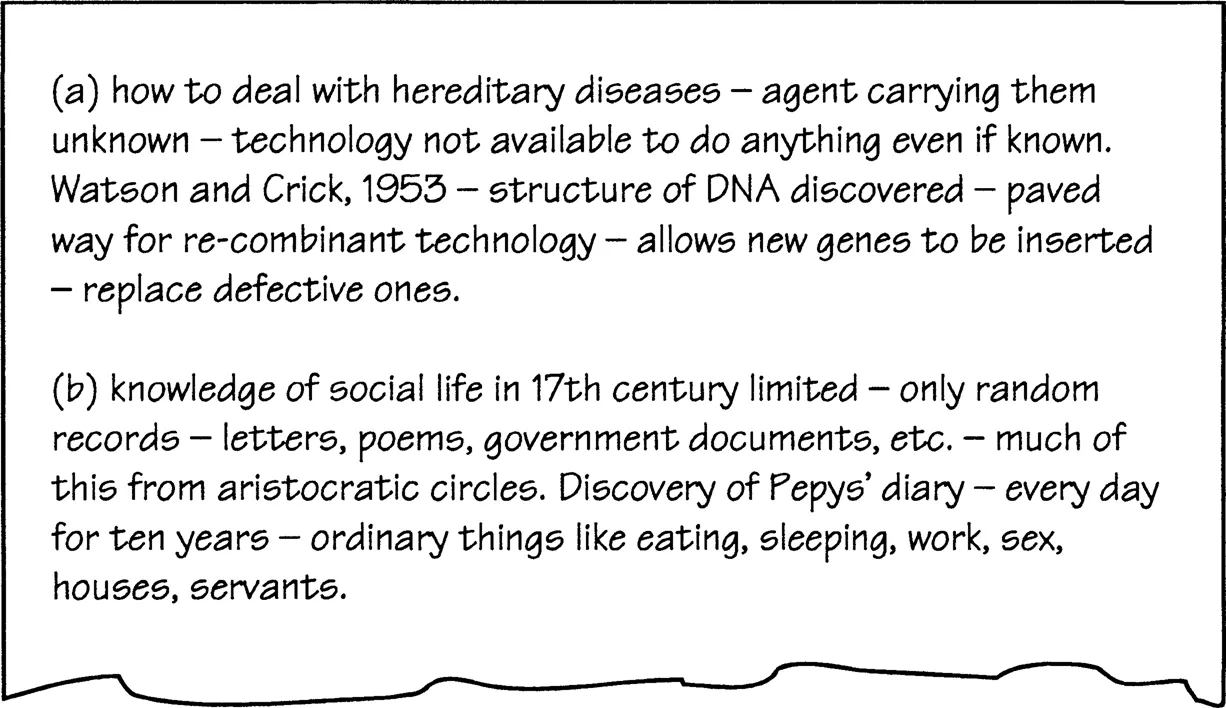
Finished? From these brief examples you’ll have learned that:
- paragraphs distinguish logically between aspects of a topic;
- paragraphs are structured, with each sentence doing a distinctive job.
Now for a slightly more substantial text.
All Western countries face a crisis in coping with the demands made on welfare provision by their growing elderly populations. The problem of resource scarcity is a real one. But perhaps not all countries have adopted so rigorously as Britain has the view that care should be based on the family model.
Scandinavia, for example, provides residential facilities for elderly people not wishing to remain at home or to live with their families, and those facilities are often available for use by local pensioners on a daily basis. Elderly people in the United States have developed communities of their own, supporting each other and running them by themselves, as their answer to increasing dependency. Some have argued against these ‘age-dense’ solutions, likening them to ghettos, but research suggests a high degree of consumer satisfaction.
Examples from other countries demonstrate that there are alternative ways of tackling the issues of caring and dependency. The family model of care with the high demands made on women and lack of choice and frequent loneliness for the dependents is not the only solution.
(New Society, 28 August 1987, p. 12)
Functions
- Overall, which is the ‘problem’ paragraph, and which the ‘solution’?
- How would you describe the job of the third paragraph? Does it:
- summarise the content of the first two paragraphs?
- re-define some aspect of the problem?
- focus on the specific difficulties of one potential solution?
- Look at the first paragraph. Like many orderly paragraphs in brief passages of this kind, it contains three sentences, each with a different function. How would you describe the functions of the first and third sentences?
- What is sentence two doing there, sandwiched in the middle?
- Now look at the second paragraph. The first two sentences share the same function. What is that?
- How would you describe the function of the third sentence (‘Some have argued…’) in paragraph two?
- illustrates an aspect of one solution
- raises an objection to a solution in order to dismiss it
- re-states the problem
Vocabulary and Grammar
- Where in the passage could you insert the following without taking anything out? What difference would you make to the meaning if you did?
- exclusively
- rapidly
- undoubtedly
- Which of the following could you use instead of ‘rigorously’?
- mindlessly
- single-mindedly
- ruthlessly
- ‘Rigorously’ is an adverb (a word that describes the way something is done), and ‘rigorous’ is an adjective (a word that describes an object or idea). There is also a noun, ‘rigour’. What is the rule that tells you how to spell the adverb and adjective correctly? Think of some more examples like this.
- In the second paragraph, the author places one phrase in inverted commas. Is this because:
- it is a conventional or jargon phrase?
- it is being quoted from a book?
- it is not true?
- What is the difference between ‘adopting’ a view and ‘holding’ a view?
- Look at the sentence beginning ‘Elderly people in the United States’. It falls into three parts:
- Elderly people in the United States have developed communities of their own,
- supporting each other and running them by themselves,
- as their answer to increasing dependency.
Can you describe the functions of the three parts? - Aspects of the solution are conveyed in the middle part of the sentence by two ‘-ing’ forms: ‘supporting each other and running them by themselves’. Now write a sentence based on the one above, using two or three ‘-ing’ forms to illustrate aspects of a solution.
- At the end of the first paragraph the author notes the special attention paid to a particular solution by Britain:not all countries have adopted so rigorously as Britain has the view that care should be based on the family model.Using information from a field of study you’re familiar with, write a sentence with the same structure.
- Re-write the sentence beginning ‘Elderly people in the United States’ so that it begins ‘Increasing dependency’.
Writing to Format
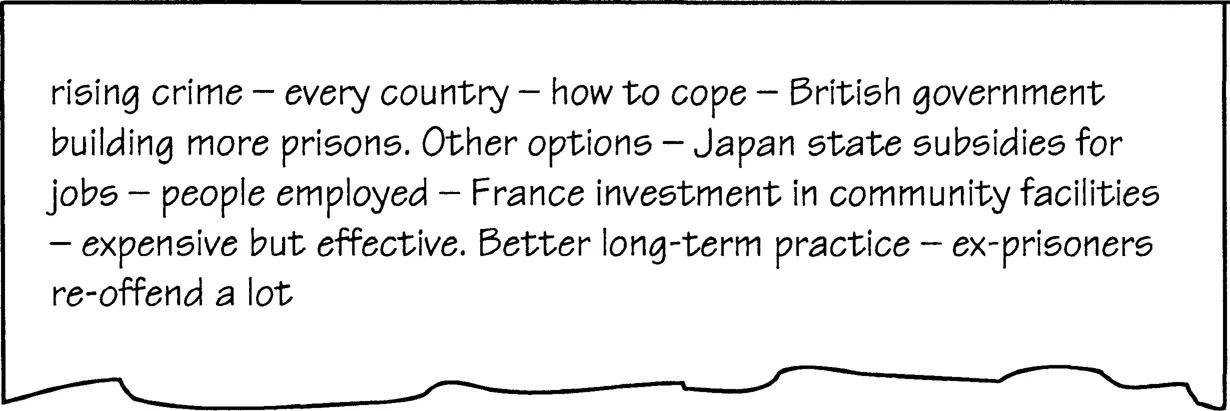
- As you did with the spectroscopy passage, write up the following notes, basing your structure on the passage about welfare for the elderly. Try to write three sentences per paragraph.
Core Element 2: Sentences
DOI: 10.4324/9780203062210-2
In Core Element 1 you were asked to re-write some sentences, changing them round so that they began differently. This is an important exercise because:
- you often have to change the subject of a sentence to reflect the focus or emphasis of your argument;
- it gives you practice in using different constructions, so improving your understanding of the difference between good and bad grammar.
In this section you’ll try some more exercises of this kind.
The rules of sentence construction in English would fill many books on their own. What we’ll do here is focus on a fundamental distinction that causes students and (by extension) their tutors a lot of trouble: the difference between a main clause and a subordinate clause. Look at this sentence:
In spite of the high price, George decided to buy the book because it would complete his collection, which was already the best in the country.
The principal action is ‘George decided to buy the book’. Everything else depends on that action, and without it the sentence would have no meaning. By contrast, if you deleted eith...
Table of contents
- Cover Page
- Half Title Page
- The Student's Guide Series from Routledge
- Title Page
- Copyright Page
- Contents
- Introduction
- Acknowledgements
- Part I. Core Elements
- Part II. Marking and Essays
- Key to Core Element 1
- Key to Core Element 2
Trusted by 375,005 students
Access to over 1.5 million titles for a fair monthly price.
Study more efficiently using our study tools.
Frequently asked questions
Yes, you can cancel anytime from the Subscription tab in your account settings on the Perlego website. Your subscription will stay active until the end of your current billing period. Learn how to cancel your subscription
No, books cannot be downloaded as external files, such as PDFs, for use outside of Perlego. However, you can download books within the Perlego app for offline reading on mobile or tablet. Learn how to download books offline
Perlego offers two plans: Essential and Complete
- Essential is ideal for learners and professionals who enjoy exploring a wide range of subjects. Access the Essential Library with 800,000+ trusted titles and best-sellers across business, personal growth, and the humanities. Includes unlimited reading time and Standard Read Aloud voice.
- Complete: Perfect for advanced learners and researchers needing full, unrestricted access. Unlock 1.5M+ books across hundreds of subjects, including academic and specialized titles. The Complete Plan also includes advanced features like Premium Read Aloud and Research Assistant.
We are an online textbook subscription service, where you can get access to an entire online library for less than the price of a single book per month. With over 1.5 million books across 990+ topics, we’ve got you covered! Learn about our mission
Look out for the read-aloud symbol on your next book to see if you can listen to it. The read-aloud tool reads text aloud for you, highlighting the text as it is being read. You can pause it, speed it up and slow it down. Learn more about Read Aloud
Yes! You can use the Perlego app on both iOS and Android devices to read anytime, anywhere — even offline. Perfect for commutes or when you’re on the go.
Please note we cannot support devices running on iOS 13 and Android 7 or earlier. Learn more about using the app
Please note we cannot support devices running on iOS 13 and Android 7 or earlier. Learn more about using the app
Yes, you can access The Student's Guide to Writing Essays by David Roberts,David (Lecturer in English Roberts in PDF and/or ePUB format, as well as other popular books in Education & Education General. We have over 1.5 million books available in our catalogue for you to explore.