eBook - ePub
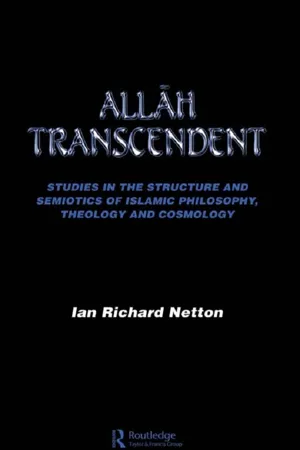
Allah Transcendent
Studies in the Structure and Semiotics of Islamic Philosophy, Theology and Cosmology
- 400 pages
- English
- ePUB (mobile friendly)
- Available on iOS & Android
eBook - ePub
Allah Transcendent
Studies in the Structure and Semiotics of Islamic Philosophy, Theology and Cosmology
About this book
Examines the role of God in medieval Islamic philosophy and theology in a new and exciting way. Renouncing the traditional chronological method of considering Islamic philosophy, Netton uses modern literary modes of criticism derived from structuralism, post-structuralism and semiotics.
Information
1
Introduction
THE FACES OF GOD
How many faces has God? Egyptologists have wrestled with the problem over many years in an effort to determine whether the ancient Egyptian pantheon was ultimately reducible to one supreme Being. Did Egypt, or at least some of its initiates and priests, believe that Isis, Osiris, Horus, Anubis, and a whole host of lesser known deities were really all aspects or ‘faces’ of the one almighty God? Many scholars, particularly in the nineteenth century, maintained that this was the case.Others later reacted against a purely monotheistic conception of deity, while Karl Beth in the early part of the twentieth century held that both monotheism and polytheism could be found in Egyptian thought. He also warned that neither label was really very helpful in highlighting the individual nature of Egyptian religion.1 The debate has continued into the present.
The theologies of ancient Greek religion and Hinduism present similar problems. From early times, concepts of one supreme God, and of many gods like Zeus, Apollo, and Hera, filled and intrigued the Greek mind. Thus the poet Xenophanes (fl. circa BC 570–470) observed: ‘God is one, greatest among gods and men, in no way like mortals either in body or in mind.’2 Furthermore, he particularly objected to the anthropo-morphism of Homer and Hesiod in their portrayal of the gods.3 Plato spoke of one God and several gods.4 As for Hinduism, Lawrence A. Babb has stressed that:
Ultimately, as the most casual student of Hinduism knows, all the gods and goddesses are ‘one’. This is a doctrine of genuine significance, and not merely an extravagance of bookish philosophers. It is a doctrine that is reiterated frequently in the texts, but illiterate villagers are equally fluent in maintaining that although there are many deities, and although they have different and sometimes contradic-tory characteristics, in the end all are the same and all are one. In a sense, the very lack of surface structure permits a deeper structure of another kind.5
Put another way, the multifarious forms of the one God – Krishna, Visnu, Rama and others – may be compared to ‘the same person appearing in cinemas or picture shows as different persons at one and the same time.’6
Islam, however, except in its most heretical forms, has not had to deal with such a problem. The tension between an intrinsic monotheism and an everyday polytheism, with a host of major and minor gods looking after each and every one of man’s activities in a variety of guises, has not occurred. There has been hardly any attempt to present Muhammad, ‘Alī, the other early caliphs, or even the proto-prophets of Islam like Abraham, as manifestations of the Deity.7 On the contrary, the utter humanity of Muhammad, a humanity unmagnified – pace the hadīth literature to the contrary – even by miracles save that of being the mouthpiece for the Qur’ān, has usually been emphasized.8
God is unequivocally one in orthodox Islam and the doctrine of His absolute unity (tawḥīd) is a major and constant leitmotiv in the Qur’ān, as well as in a huge corpus of Islamic writing. Polytheism (shirk) is roundly condemned as the most heinous and unforgivable of sins9 in an all-embracing censure that does not spare those heretical Christians who profess the doctrine of tritheism.10
Yet Islam too has had a problem of divine ‘faces’: not in the sense of a single deity divided up among, or represented by, many gods but simply in the fact that Muslims over the ages have regarded their one God in several widely differing ways. In this Islam is by no means unique. Christianity, for example, from its early days was forced to confront the problems of anthropomorphism and allegorization, to analyse what kind of God it was who was being worshipped, and decide how man could best speak about Him, and to work out exegetical norms for scripture that steered a happy medium between pure allegorization and gross literalism. What did the Bible really mean when it talked about God?
Some, like the great Biblical exegete Origen (circa AD 185 to circa AD 254) viewed scripture as ‘a patchwork of symbolism’11 and exalted the method of allegorical exegesis above all others. Origen,s native city of Alexandria became a centre for this particular approach to the sacred text. But the pendulum also swung the other way: the Antiochene theo-logians in the fourth and fifth centuries, like Diodore of Tarsus (icirca AD 330 to circa AD 390), later reacted, believing alle-gory to be, in Kelly,s words, ‘an unreliable, indeed illegitimate, instrument for interpreting Scripture.’12 There was also much speculation about the exact nature of the Deity: many of the early Fathers adhered to a doctrine of a totally transcendent God, beyond the imagination and comprehension of man. Thus Clement of Alexandria (circa AD 150 to circa AD 215) denied that God could feel emotions such as grief or joy and main-tained that anthropomorphic language was only used because of man’s weak intellect.13 Origen agreed that some description could be used ‘to guide the hearer’ but saw human language as basically quite inadequate to show the reality and attributes of God.14
Islam was confronted with similar problems: Muslims, like Christians, realized that they needed guidance in interpreting their scripture. For what did the Qur’ān mean exactly when it stated that God had a hand,15 or a face,16 and, in some way, was on a throne (thumma ’stawā ‘alā’ ’l-‘arsh)?17 Was the solution an unmindful anthropomorphism in which God was compared to His creation (itashbīh), with perhaps some allegorical interpret-ation (ta’wīl) of the grosser anthropomorphisms, or was it a rigorous stripping of God by the theologians of all human attributes (ta‘tīl)?18 This difficulty became a major fixation of the medieval Islamic scholastics, together with the equally thorny problem of free will and predestination.19 And, as M. S. Seale has so clearly demonstrated, much of the thinking of these early Islamic theologians, or at least its development, may well have been influenced by that of their patristic predecessors. Seale believes, for example, that the God of the Persian Jahm ibn Safwān (died AD 745) was ‘derived … through the media of the Church Fathers’ and ‘was closer to the Greek Absolute than to the God of the Qur’ān.’ Jahm’s whole theology was, indeed, profoundly influenced in Seale’s view by the Greek Christian theology of the Alexandrian Church Fathers.20
If we examine the multifarious debates and discussions of the theologians and the philosophers about the nature of God, we can identify at least four major ways in which He was perceived in medieval Islam.21 There was, firstly, what might be described as the Qur’ĀNIC model or ‘face’ of a God about whom very literal and anthropomorphic statements were sometimes made in scripture that were to be accepted as realities without further enquiry into their modality (bilā kayf).22 It was sufficient to realize that the exact nature of such features as God’s hand or eyes would be quite unlike any earthly hands or eyes. This was the classic stance of such theo-logians as Ahmad b. Hanbal (AD 780–855) and al-Ash‘ari (AD 873/4–935/6). Both were concerned to stress the reality of the anthropomorphic descriptions found in the Qur’ān. But logi-cally, their attitude of bilā kayf, or refusal to examine the mode of these descriptions, resulted in an intellectual cul-de-sac in which acceptance triumphed over analysis and incomprehen-sion over reason.23 The age old problem of the attributes of God cannot be said to have been solved by either theologian. Today it is no longer a live issue though, speaking very generally, we may note that it is the Ash‘arite position that has prevailed in the Islamic world.
There was, secondly, an ALLEGORICAL model or ‘face’ of God. The extremely physical anthropomorphic statements in the Qur’ān were to be considered as metaphors or allegories. This was the position held by many of the thinkers who became characterized by, or grouped under, the umbrella term ‘Mu‘tazilite’:
… this movement never produced a synthetic scheme of thought, nor even an eclectic system. Its raison d’être was not, in fact, the creation of a unified body of belief, but rather the interpretation of certain inherited doctrines in favour of a particular view of divine nature and human destiny, to which end the Mu‘tazilites made use of a heterogeneous lot of ideas borrowed for the most part from the various schools of Greek thought which they had come to know.24
But despite their several disagreements on points of doctrinal detail, most of the Mu‘tazilites were agreed on a non-literal mode of interpretation of much of the anthropomorphic data about God in the Qur’ān. Thus the Mu,tazilite theologian ‘Abd al-Jabbar ibn Ahmad (AD 936–102...
Table of contents
- Cover
- Half Title
- Full Title
- Copyright
- Contents
- List of Figures
- Preface and Acknowledgements
- Abbreviations
- 1. Introduction
- 2. Al-Kindī: The Watcher at the Gate
- 3. Al-Fārābī: The Search for Order
- 4. Ibn Sīnā’s Necessary and Beloved Deity
- 5. The God of Medieval Ismā’īlism: Cosmological Variations on a Neoplatonic Theme
- 6. Ishrāq and Waḥda: The Mystical Cosmos of Al-SuhrawardI and Ibn al-‘Arabī
- 7. Conclusion: The Vocabulary of Transcendence: Towards a Theory of Semiotics for Islamic Theology
- Bibliography
- Index
Trusted by 375,005 students
Access to over 1.5 million titles for a fair monthly price.
Study more efficiently using our study tools.
Frequently asked questions
Yes, you can cancel anytime from the Subscription tab in your account settings on the Perlego website. Your subscription will stay active until the end of your current billing period. Learn how to cancel your subscription
No, books cannot be downloaded as external files, such as PDFs, for use outside of Perlego. However, you can download books within the Perlego app for offline reading on mobile or tablet. Learn how to download books offline
Perlego offers two plans: Essential and Complete
- Essential is ideal for learners and professionals who enjoy exploring a wide range of subjects. Access the Essential Library with 800,000+ trusted titles and best-sellers across business, personal growth, and the humanities. Includes unlimited reading time and Standard Read Aloud voice.
- Complete: Perfect for advanced learners and researchers needing full, unrestricted access. Unlock 1.5M+ books across hundreds of subjects, including academic and specialized titles. The Complete Plan also includes advanced features like Premium Read Aloud and Research Assistant.
We are an online textbook subscription service, where you can get access to an entire online library for less than the price of a single book per month. With over 1.5 million books across 990+ topics, we’ve got you covered! Learn about our mission
Look out for the read-aloud symbol on your next book to see if you can listen to it. The read-aloud tool reads text aloud for you, highlighting the text as it is being read. You can pause it, speed it up and slow it down. Learn more about Read Aloud
Yes! You can use the Perlego app on both iOS and Android devices to read anytime, anywhere — even offline. Perfect for commutes or when you’re on the go.
Please note we cannot support devices running on iOS 13 and Android 7 or earlier. Learn more about using the app
Please note we cannot support devices running on iOS 13 and Android 7 or earlier. Learn more about using the app
Yes, you can access Allah Transcendent by Ian Richard Netton in PDF and/or ePUB format, as well as other popular books in Theology & Religion & Islamic Theology. We have over 1.5 million books available in our catalogue for you to explore.