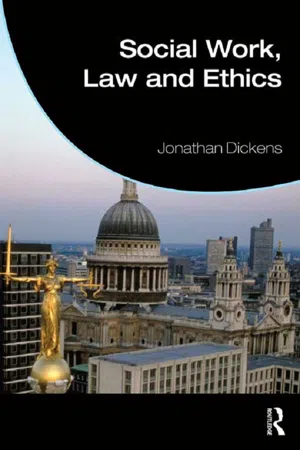
Law and ethics are two vital aspects of social work – all social workers need to practise according to the law and their codes of ethics and conduct. However, the relationship between the law and social work values and ethics is not without its tensions and this book takes a problem-based approach to explore the dilemmas and challenges that can arise.
The first part of the book sets out frameworks for thinking about the law and ethics, and how they relate to social work. It also introduces some of the big philosophical and sociological questions about the purposes of law and of ethics and how they relate to society more generally. In the second part, the book explores a series of areas where profound dilemmas arise – such as end-of-life decisions, respecting peoples' choices but ensuring their safety and that of others, responsibility and blame, making allowance for different cultural traditions and breaking confidentiality. In each of the problem-based chapters, this accessible text:
outlines the relevant law
discusses court judgments in leading cases
considers the implications of different ethical frameworks
pulls out key ethical questions and challenges for social work.
Social Work, Law and Ethics highlights what the law says and what it offers, what ethical principles are at stake, and what these imply for social work policy and practice. In this way, it uses real-life scenarios to analyse the dynamic interactions of social work, law and ethics. It is essential reading for all social work students.
Decisions about end of life care and dying raise fundamental questions about the value of human life, individual choice, professionals’ opinions and courts’ powers. This chapter examines the issues by discussing two types of case – the withdrawal of life-sustaining treatment from a seriously disabled infant, and cases of assisted suicide. The theme of choices, risks and best interests is continued in the next chapter, which discusses the dilemmas that arise when people have limited abilities to understand the consequences of their own decisions.
‘Life or death’ issues are often in the background, and sometimes the foreground, of social work decision-making. They will be familiar to social workers who work in hospitals or palliative care teams (Beresford et al., 2007; Reith and Payne, 2009). Social workers in other settings are also likely to come across them, at least from time to time, particularly those working with older people and mentally ill people, disabled children and adults, or children at risk of significant harm. When it comes to decisions about withdrawing treatment or assisted suicide, the people involved are likely to be users (or potential users) of social work services (people with disabilities, for example), and relatives under great stress who want the best for the person they love. Crucially, the important issues of choice, best interests and the powers and duties of the state are at the heart of all social work. The end of life angle is an extreme case that helps to expose some of the dilemmas of everyday social work practice.
Life-sustaining treatment
The law requires doctors to preserve the life of their patients, but this does not take precedence over all other considerations. They are not allowed to act with the primary intention of ending a person's life, even out of compassion, but there are times when their task is to ensure that people end their lives with dignity and as comfortably as possible. The principles that doctors have to follow are summarised in guidance from the General Medical Council (GMC, 2010).
There is no obligation to give treatment that is futile or burdensome, and treatment may be withheld or withdrawn if it is not considered clinically appropriate or in the patient's best interests. Assessing a patient's best interests involves weighing up the benefits, burdens and risks of further treatment (GMC, 2010). As far as practicable, such decisions should be made in consultation with the patient, colleagues providing care and if relevant with the person's family or nominated representative. There should be the opportunity for people to ask for a second opinion, or seek legal advice if they disagree, but the GMC guidance is to try to get people to talk about the issues, to reach consensus. If agreement is reached, there would not normally have to be a court hearing about it.
The principles and requirements of the Mental Capacity Act 2005 and the related Code of Practice (DCA, 2007a) apply when patients do not have capacity to reach decisions themselves. Mental capacity is discussed in more detail in Chapter 7.
A patient may refuse life-saving treatment, and if they are an adult with the mental capacity to make that decision, it must be respected. People without capacity may have given an ‘advance decision’ about refusing certain forms of treatment, and if this is considered valid and applicable it must be respected (ss. 24-6 of the Mental Capacity Act 2005). Advance decisions to refuse life-sustaining treatment must be in writing, specify the type of treatment and that the refusal applies even if life is at risk, and must be signed and witnessed. (Doctors must apply to court for authorisation to withhold life-sustaining treatment from patients in a vegetative state, or a minimally conscious state, if there is no advance decision: Court of Protection Practice Direction 9E paragraph 5; see W v M and Others [2011].)
In the case of an infant or child who lacks competence, it is the parents or others with parental responsibility who should normally make the decision, in consultation with the doctors. (See Chapter 7 for a discussion of ‘Gillick competence’, and whether the young person can make the decision themselves.) If there is a disagreement or uncertainty either of the parties (the doctors or the parents) may apply to the High Court, for it to decide the matter. The court will make its decision according to its assessment of the child's best interests.
The phrase ‘best interests’ takes us to the legal and ethical heart of the matter. Let us look at a real case to explore some of the issues in more depth.
When might it be right to allow a child to die?
Before reading further, take time to think about your answer to this question. Who should decide, and how? What are the key factors to consider? What are your initial views? Do they change as you think about it some more?
Box 6.1: Baby RB (2009)
This case involved a baby boy, referred to in the courts as ‘RB’, who was born in October 2008. The case was heard in the High Court in November 2009, when he was just over a year old (RB (A Child) [2009]). In the end the parents reached agreement about what should happen so the judge did not make a final judgment, but did give some ‘words of endorsement’ to their decision. You can read them on the BAILII website (http://www.bailii.org.uk). They are very moving. In terms of our reason–emotion pairing, they are carefully reasoned comments, as one would expect from a senior judge, but it would be quite wrong to say that there is no emotion or care in them (for other information about the case, see Day, 2009).
RB was born to a young couple in their twenties, and it was clear from shortly after his birth that he was very seriously disabled. He was diagnosed with a condition called congenital myasthenic syndrome (CMS), which prevents the effective transmission of messages from the brain to the muscles. Apart from being able to make small movements of his lower arms and hands, RB had little control over his limbs. He was never able to breathe without the aid of a ventilation machine, and had to be fed through a tube into his nostril. He could not have survived without continuous and invasive medical treatment, and was never able to leave the special care unit at the hospital.
RB's parents were described as ‘exemplary’ in their actions towards him, even though their own relationship ended during the course of the year. They spent long periods of time at his bedside, each and every day, doing what they could to care for him and stimulate him. After a year, though, the doctors and his mother agreed that the treatment needed to keep RB alive was causing him such pain and distress that it would be best to turn off the ventilator, knowing that this would lead to his death. His father disagreed. He argued that RB's brain was not affected by the condition, and that with suitable treatment he could have a good quality of life. He wanted RB to have an operation to allow more air to get into his lungs, so that he could go home with a portable ventilation unit. The doctors’ opinion was that this would risk more complications and more medical procedures, and bring more pain. The matter came to the High Court, for a hearing that lasted over a week. On the last day, the father changed his mind and agreed that the ventilator should be switched off.
Reading the judge's comments and the newspaper reports of the time, it is very hard to think the decision was wrong. Yet without criticising anyone involved in the case, there are grounds to stop and think about the implications. It is a ‘tip of the iceberg’ case, in two senses. One is that most cases like this do not come to court at all, because the parents and the doctors agree. This case brings submerged practices to light, so it is worth thinking about. Without any reflection on the people involved in this particular case, we know that patients’ rights are not always well-served in medical settings, especially disabled people (e.g. Mencap, 2007, 2102; Michael, 2008; JCHR, 2008). Read and Clements (2004) argue that court cases about withdrawing treatment to disabled children are litmus tests of attitudes towards disabled people more generally.
Second, the case makes us think about ‘slippery slope’ arguments. If we allow this child to die, what about another, who is nearly as severely disabled, but not quite? Perhaps it would be in that child's best interests to be allowed to die too. And if so, then what about another who is nearly as severely disabled as them, but not quite? And if them, what about the next one, and so on? Where is the cut-off point?
Choosing between healthy babies who are allowed to live and unhealthy ones who are left to die, takes us into some of the most frightening visions of a society that is oppressive and discriminatory. On the other hand, keeping people alive who are in continuing and great pain, when there is no prospect of relief or recovery, only continuing suffering (or people who are ‘brain dead’, in a vegetative state) – this is an equally frightening picture, just as much a society where rules reign over care and responsiveness to individual circumstances. But any decision to end treatment must be based on a careful assessment of the whole case and the patient's best interests.
The courts take a wide view of the patient's best interests. It is not just about the medical issues, but includes emotional and welfare matters. There is a strong presumption in favour of prolonging life, but this can be rebutted. The court has to weigh up all the factors. This includes the person's wishes and beliefs (or their assumed point of view), but without a valid and applicable advance decision these are not the determinative factor. The assessment must consider the levels of pain and suffering that the treatment may cause, and the likely consequences for their life after the treatment. No assumptions must be made about a person's quality of life, for example on the basis on their age or disability. For a full discussion of the best interests test for children, see the judgment in Wyatt and Another v Portsmouth NHS Trust and Another [2005].
Do the approaches in Chapters 4 and 5 shed any light on the case? They do not give us any easy answers, but they do give us a set of frameworks for evaluating the issues. Categorical approaches place high value on human life because of the principle of treating individuals as ends in themselves. The instinct would be to prolong life. However, keeping the child alive in this case, in pain and with no hope of improvement, seems contrary to his individual dignity. So it could be argued from a categorical point of view that withdrawing treatment is consistent with treating him as an end in himself. A utilitarian approach would weigh up the consequences of prolonging the child's life, in terms of the balance of pleasure and pain. On this basis the utilitarian instinct is likely to support the decision to withdraw treatment. However, thinking about it some more, the utilitarian balance sheet is not just about the individual child's happiness or discomfort. What about the wishes of the adults involved, and the wider consequences of this decision for social attitudes towards the care of disabled children? These also have to be taken into the calculation, so on reflection utilitarians may have more reservations about the decision than at first sight.
Looking at the case from the perspective of virtue ethics, the idea of good character puts the emphasis on the parents, to find a middle way between dedicated love and a blind love that does not see the costs to the child. It is a hard task – the mid-point is hard to define and hard to achieve. From a care perspective, the relationships are all important. The parents’ care and love for the child was commended by the court; but the ethical challenge might be, out of care and love, to let the child go.
The libertarian approach insists that there must be compelling grounds for the state to intervene in a private, family matter. The focus would be the legitimacy of the intervention, rather than the decision itself. The libertarian position is likely to split between its right and left wing versions. The more conservative side would set great store by the rights of the parents, and require strong evidence of the need to overrule them. In the case of RB, of course, the fact that the parents disagreed was why it came to court. In the end, when the father agreed with the doctors and the mother, the court respected this decision and did not make a judgment. Other libertarians may set greater store by the child's rights, but it would still be a high threshold before the state could impose a solution.
The radical and relativist positions raise some intriguing issues, even if not directly relevant to this particular case. A radical perspective might stress the importance of adequate funding, through general taxation, to support high-quality medical and social care services. It would be sceptical about approaches that reduce the issues to the choices of individuals (whether for or against preserving life), if there are inadequate services to support carers. It would also draw attention to the fact that disability and ill health are not evenly distributed across the social classes. Families with disabled children are more likely to be in the poorer socio-economic groups (Blackburn et al., 2010; Children's Society, 2011), which has i...
Table of contents
Cover Page
Half Title Page
Series Page
Title Page
Copyright Page
Contents
Boxes and tables
Cases
Acknowledgements
Introduction
Principles and frameworks
Questions and cases
Bibliography
Index
Trusted by 375,005 students
Access to over 1.5 million titles for a fair monthly price.
Study more efficiently using our study tools.
Frequently asked questions
Yes, you can cancel anytime from the Subscription tab in your account settings on the Perlego website. Your subscription will stay active until the end of your current billing period. Learn how to cancel your subscription
No, books cannot be downloaded as external files, such as PDFs, for use outside of Perlego. However, you can download books within the Perlego app for offline reading on mobile or tablet. Learn how to download books offline
Perlego offers two plans: Essential and Complete
Essential is ideal for learners and professionals who enjoy exploring a wide range of subjects. Access the Essential Library with 800,000+ trusted titles and best-sellers across business, personal growth, and the humanities. Includes unlimited reading time and Standard Read Aloud voice.
Complete: Perfect for advanced learners and researchers needing full, unrestricted access. Unlock 1.5M+ books across hundreds of subjects, including academic and specialized titles. The Complete Plan also includes advanced features like Premium Read Aloud and Research Assistant.
Both plans are available with monthly, semester, or annual billing cycles.
We are an online textbook subscription service, where you can get access to an entire online library for less than the price of a single book per month. With over 1.5 million books across 990+ topics, we’ve got you covered! Learn about our mission
Look out for the read-aloud symbol on your next book to see if you can listen to it. The read-aloud tool reads text aloud for you, highlighting the text as it is being read. You can pause it, speed it up and slow it down. Learn more about Read Aloud
Yes! You can use the Perlego app on both iOS and Android devices to read anytime, anywhere — even offline. Perfect for commutes or when you’re on the go. Please note we cannot support devices running on iOS 13 and Android 7 or earlier. Learn more about using the app
Yes, you can access Social Work, Law and Ethics by Jonathan Dickens in PDF and/or ePUB format, as well as other popular books in Social Sciences & Ethics & Professional Responsibility in Law. We have over 1.5 million books available in our catalogue for you to explore.