- 304 pages
- English
- ePUB (mobile friendly)
- Available on iOS & Android
eBook - ePub
About this book
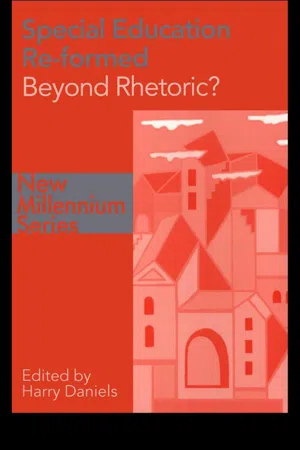
Brings together in one volume the perspectives of teachers, practitioners, researchers and important external bodies such as the LEA, and national organisations like the RNIB. Part of the New Millennium Series which takes stock of education now and predicts the shape of likely developments. The book asks leading authorities on Special Educational Needs to probe the issues currently topping the agenda, and to predict what will happen in SEN for the forseeable future. Useful for those working and training to work in special schools and mainstream schools.
Information
Section 1
Values
1 Inclusion in Education
From Concepts, Values and Critique to Practice
Brahm Norwich
Introduction
At one level it looks as though there are major changes going on within the field of educating students with disabilities and difficulties. There is a new government which has set education as its main focus for social policy, and the inclusion of students with disabilities and difficulties appears to be an important policy priority. At the time of writing we are waiting for policy developments following consultation over the Green Paper Excellence for All Children (DfEE, 1997). There have also been practical developments of innovatory practices and changing ways of thinking about the field over the last ten years, taking the introduction of the National Curriculum and the establishment of more autonomous school governance as the reference point. The term ‘inclusion’ has come into more common use than the term ‘integration’ in talking about increasing the involvement of students with disabilities and difficulties in the mainstream of education. There has also been an increasing interest in organizational and curriculum responses to diversity and a movement away from focusing on the individual student’s deficits.
However, at another level, there has been a growth of exclusions for disciplinary reasons, and increasing pressures from mainstream schools for Statements in response to what are seen as the increasing demands made by students with difficulties and disabilities. These trends have come to be seen as systemic responses to the increasing pressures placed on schools to demonstrate increased accountability for their practices and learning outcomes. As many commentators anticipated in 1988, the impact of the introduction of market-style changes to schooling has been to reduce overall school tolerance for challenging behaviour and children deemed difficult to teach. But these trends have to be set next to countervailing trends towards a steady decline in the proportions of students in special schools and legislation to reinforce the responsibilities of mainstream schools for their special provision through the SEN Code of Practice. To understand the current context of special educational provision, we need therefore to recognize this interplay and changing balance of social processes and forces. This clearly places the disability education field or special needs education within a national political context, where legislation, funding and social policy orientations are major influences on what goes on within local areas and neighbourhood schools.
In this chapter I will discuss some of the current conceptions of inclusion which are found in policy positions and papers and expressed in academic debates about the nature of field and its place within education more generally. I will restate some of the arguments which I have developed elsewhere (Norwich, 1990, 1993, 1996, 1998) for understanding the significance of the multiplicity of values in education and special education, and how these imply the presence of basic value dilemmas. I will argue that these value dilemmas become policy and practice decision-making dilemmas at different levels within the system, for legislators, for local authorities, for school managers and even for class teachers. The main aim of this chapter, however, is to illustrate how recognizing basic dilemmas within the field can be a spur to more creative and optimal ways of educating students with disabilities and difficulties.
The chapter will begin with a brief analysis of some current policy and conceptual positions on inclusion. These will be set in the context of a discussion of some research findings about professional perspectives about inclusion. I will then discuss current government educational policy in terms of the compatibility of its mainstream and special educational policies. This will focus in particular on school target-setting and its impact on educating students with disabilities and difficulties. This leads into a more general commentary and analysis of what is involved in pursuing excellence and improving schools if the full diversity of students is taken into account. I then review the key points of the difference dilemma perspective and connect it with other conceptual perspectives on the field. In the next section I consider and evaluate different forms of school inclusion by comparison with some other current perspectives on making mainstream schools more effective for all. Finally, I discuss some current models for developing more inclusive mainstream schools. I conclude by showing how these reflect particular approaches to the compatibility and balancing of key values, and consider some possible options for the future of special schools.
Perspectives on Inclusion
I start by contrasting key principles from the SEN Code of Practice, as an expression of current government policy (DfE, 1994), and the widely referenced Statement on special education from the Salamanca UNESCO conference (UNESCO, 1994). Among the Code of Practice principles is one which states that:
The needs of most pupils will be met in the mainstream and without statutory assessment or a Statement of SEN. Children with SEN, including those with Statements of SEN, should, where appropriate and taking into account the wishes of their parents, be educated alongside their peers in mainstream schools.
(DfE, 1994: section 1.2, 2)
This expresses a conditional commitment to inclusion which is also expressed in the more recent SEN Green Paper (DfEE, 1997), in talking about ‘inclusion of children with SEN within mainstream schooling wherever possible’. This shows continuity with the basic conditions set out in legislation from the original formulation in the Education Act 1981, which placed the onus on local education authorities (LEAs) to educate all children in the mainstream, subject to four key conditions:
- that the child’s special needs were being met,
- that this did not interfere with the education of other children involved,
- that it should be compatible with the ‘efficient’ use of resources, and
- that it took account of parental wishes.
These conditions can be seen to represent the interests of those involved: the child with a disability or difficulty in learning, his or her peers, the parents and the LEA responsible for deciding about special provision. They set the commitment to inclusion as hanging on the relative weighting of these potentially contrary factors. Another feature of the current government policy is that the onus is for inclusion in mainstream schools, not necessarily mainstream classes.
Although the Green Paper expresses support for the UNESCO Salamanca Statement on special educational needs, it is clear this UNESCO Statement goes well beyond the conditional government commitment to inclusion:
Every child has a fundamental right to education and must be given the opportunity to achieve and maintain an acceptable level of learning; Every child has unique characteristics, interests, abilities and learning needs;
Educational systems should be designed and educational programmes implemented to take account of the wide diversity of these characteristics and needs;
Those with special educational needs must have access to regular schools which should accommodate them within a child-centred pedagogy capable of meeting their needs;
Regular schools with this inclusive orientation are the most effective means of combating discriminatory attitudes, creating welcoming communities, building an inclusive society and achieving education for all; moreover they provide effective education for the majority of children and improve the efficiency and ultimately the effectiveness of the entire system.
Educational systems should be designed and educational programmes implemented to take account of the wide diversity of these characteristics and needs;
Those with special educational needs must have access to regular schools which should accommodate them within a child-centred pedagogy capable of meeting their needs;
Regular schools with this inclusive orientation are the most effective means of combating discriminatory attitudes, creating welcoming communities, building an inclusive society and achieving education for all; moreover they provide effective education for the majority of children and improve the efficiency and ultimately the effectiveness of the entire system.
(UNESCO, 1994: viii, section 2)
It is clear that there are different conceptions about inclusion which have a very significant bearing on the extent and nature of educational provision for students with disabilities and difficulties. Bailey (1998) from an Australian context outlines a definition which would reflect the perspectives of many in this country, too:
Inclusion refers to being in an ordinary school with other students, following the same curriculum at the same time, in the same classrooms, with the full acceptance of all, and in a way which makes the student feel no different from other students.
(Bailey, 1998: 173)
This definition focuses on two key aspects,
- physically being in the same place and doing the same as other students, and
- social acceptance and belonging.
‘Inclusion’ in this sense is usually contrasted with the now less used term integration, which is seen to reflect physical placement in the mainstream and the expectation that the student assimilates, as it is said, to the unchanged mainstream system. By contrast, in inclusion the mainstream school accommodates and restructures to respond to the needs of students (Ainscow, 1995). Whether integration was actually used to imply a lack of adaptation and response can be doubted, but it is clear that the force of the newer term ‘inclusion’ is to focus on systemic school adaptation and not just individuals separately.
However, Booth (1996) has criticized concepts of inclusion and inclusive education which purport to describe an ideal state or aim. He argues that reference to inclusive schools implies that inclusion is an attainable state and that good practice can be identified. Booth believes that there are few examples of inclusive schools which include all children from the neighbourhood, and therefore that it is better to think in terms of inclusion as an ‘unending set of processes’. For Booth, inclusion:
comprises two linked processes: it is the process of increasing the participation of students in the cultures and curricula of mainstream schools and communities; it is the process of reducing exclusion of students from mainstream cultures and communities
(Booth, 1996: 96)
This definition takes a position on two of four dimensions of inclusion (inclusion as process and as connected to exclusion) which Booth and Ainscow (1998: 234) identify:
- as unending or as state;
- as linked or separate from exclusion;
- as limited to some taken-for-granted kinds of exclusion or applicable to all kinds of exclusion;
- as applied to limited groups (vulnerable, disabled) or to all students’ participation.
For these authors, inclusion is not only an unending process connected to exclusion, but also applies to all kinds of exclusion and is not limited to students with disabilities and difficulties. In adopting this stance they are attempting to redefine the field of educating students with disabilities and difficulties – special education – in terms of the processes of inclusion and exclusion.
Booth is aware that this attempt to broaden the focus of inclusion – making schools responsive to all students, not just those with disabilities and difficulties – goes against positions within the disability movement to concentrate on inclusion and disability (Oliver, 1992). And he tries to detract from a focus on disability by suggesting that certain groups might not wish to have this term applied to them. However, the term ‘disability’ has changed over the last decade and is now used in legislation (Disability Discrimination Act) to include wider difficulties, while members of the disability movement have also come to adopt it. Though there may be differences between professionals and members of the disability movement about causal models of disability and there are areas of uncertainty about the range of disability, this does not undermine the importance of the disability focus and interest. I have chosen to use the reference ‘disability and difficulties’ in this chapter to talk about this focus. In doing so, I understand the connections between this focus and a focus on other disadvantaged and oppressed groups subject to discrimination, such as ethnic minorities and gender groups, and smaller groups such as travellers and pregnant teenage girls. It is also important to recognize that there are similar uncertainties about range, membership and identity for all these groups. This is relevant to attempts to undermine a disability focus and to incorporate it into a wider group defined in terms of the general processes of exclusion and inclusion.
This attempt to incorporate and even to dissolve a specific disability focus can be seen to reflect an interest in inclusion as a general social and political value. But as such, inclusion acts as a complex and abstract value, like equality or justice, which cannot be simply applied to the many areas and contexts of teaching and learning, let alone other areas of social life. This is because, like equality, there are different aspects and features of what is meant by inclusion and inclusiveness. Inclusion theorists, like those quoted above, imply that students have a right to be part of the mainstream but also a right to positive evaluation and respect. This is evident in the justifications for increasing participation and for reducing exclusion. But in addition to the right to participate and the right to respect, there is also an implied right to individually relevant learning. This emerges in the value placed on schools being ‘responsive to differences between all students’ (Booth et al. al., 1998: 224). If inclusive values are considered to underpin these three broad kinds of rights for all, then it becomes clear that inclusion – and, by implication, exclusion – are complex values over which there will be uncertainties about their applicability. For example, if the right to be part of the mainstream means being in the same ...
Table of contents
- Cover Page
- Title Page
- Copyright Page
- Figures and Tables
- Introduction
- Section 1: Values
- Section 2: Pedagogic Concerns
- Section 3: Individuals and Groups: Learning Together
- Section 4: Pressure Groups
- Notes On Contributors
Trusted by 375,005 students
Access to over 1.5 million titles for a fair monthly price.
Study more efficiently using our study tools.
Frequently asked questions
Yes, you can cancel anytime from the Subscription tab in your account settings on the Perlego website. Your subscription will stay active until the end of your current billing period. Learn how to cancel your subscription
No, books cannot be downloaded as external files, such as PDFs, for use outside of Perlego. However, you can download books within the Perlego app for offline reading on mobile or tablet. Learn how to download books offline
We are an online textbook subscription service, where you can get access to an entire online library for less than the price of a single book per month. With over 1.5 million books across 990+ topics, we’ve got you covered! Learn about our mission
Look out for the read-aloud symbol on your next book to see if you can listen to it. The read-aloud tool reads text aloud for you, highlighting the text as it is being read. You can pause it, speed it up and slow it down. Learn more about Read Aloud
Yes! You can use the Perlego app on both iOS and Android devices to read anytime, anywhere — even offline. Perfect for commutes or when you’re on the go.
Please note we cannot support devices running on iOS 13 and Android 7 or earlier. Learn more about using the app
Please note we cannot support devices running on iOS 13 and Android 7 or earlier. Learn more about using the app
Yes, you can access Special Education Reformed by Harry Daniels in PDF and/or ePUB format, as well as other popular books in Education & Education General. We have over 1.5 million books available in our catalogue for you to explore.