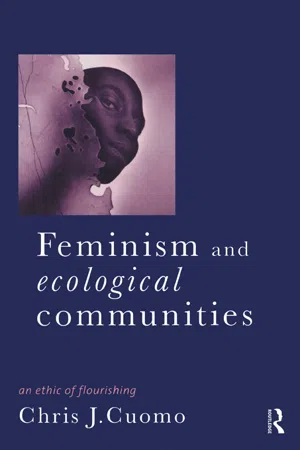
Feminism and Ecological Communities presents a bold and passionate rethinking of the ecofeminist movement. It is one of the first books to acknowledge the importance of postmodern feminist arguments against ecofeminism whilst persuasively preseenting a strong new case for econolocal feminism.
Chris J.Cuomo first traces the emergence of ecofeminism from the ecological and feminist movements before clearly discussing the weaknesses of some ecofeminist positions. Exploring the dualisms of nature/culture and masculing/feminine that are the bulwark of many contemporary ecofeminist positions and questioning traditional traditional feminist analyses of gender and caring, Feminism and Ecological Communities asks whether women are essentially closer to nature than men and how we ought to link the oppression of women, people of colour, and other subjugated groups to the degradation of nature.
Chris J.Cuomo addresses these key issues by drawing on recent work in feminist ethics as well as teh work of diverse figures such as Aristotle, John Dewey, Donna Haraway adn Maria Lugones. A fascinating feature of the book is the use of the metaphor of the cyborg to highlight the fluidity of the nature/culture distinction and how this can enrich econfeminist ethics and politics.
An outstanding new argument for an ecological feminism that links both theory and practice, Feminism and Ecological Communities bravely redraws the ecofeminist map. It will be essential reading for all those interested in gender studies, environmental studies and philosophy.
- 184 pages
- English
- ePUB (mobile friendly)
- Available on iOS & Android
eBook - ePub
Feminism and Ecological Communities
About this book
Information
The Ecofeminist Project
DOI: 10.4324/9780203003190-1
Man seeks in woman the Other as Nature and as his fellow being. But we know what ambivalent feelings Nature inspires in man. He exploits her, but she crushes him, he is born of her and dies in her; she is the source of his being and the realm that he subjugates to his will; Nature is a vein of gross material in which the soul is imprisoned, and she is the supreme reality; she is contingence and Idea, the finite and the whole, she is what opposes the Spirit, and the Spirit itself … Woman sums up Nature as Mother, Wife and Idea; these forms now mingle and now conflict, and each of them wears a double visage.Simone de Beauvoir
In this chapter I introduce, with broad strokes, the ecofeminist project – a project which includes all consciously feminist attempts to articulate and address links between feminist and environmental concerns. Upon setting out, I ought to make clear that there is no one, unified, paradigmatic ecofeminist perspective, movement, or work. However, there clearly is a collection of efforts and positions, related as much by family resemblance as by commonalities, that are suitably characterized as part of an ecofeminist project. These positions share, at least, intentions that are explicitly both feminist and environmentalist, although their implicit understandings of feminism and environmentalism, women and nature, oppression and liberation, can vary widely.
In following chapters, I will be most interested in ecological feminism, a cluster of perspectives that constitutes a subcategory of the ecofeminist project, and which is noteworthy in its emphasis on the similarities and relationships between and among various forms of oppression, exploitation, and domination. Where some ecofeminist projects focus on similarities between the objects of oppression, say ‘women’ and ‘nature,’ ecological feminists maintain that these similarities are philosophically and practically significant in so far as they evidence patterns of domination. For example, some object-attentive ecofeminists see both women and nature as inherently feminine and therefore oppressed by masculine or phallocratic regimes of meaning and power. These ecofeminists tend to respond to cults of masculinity by upholding femininity as the superior mode of being.
In contrast, ecological feminists argue that both women and nature are considered and constructed as feminine, that the inextricability of masculinity and femininity as concepts and as cultural products make it impossible to reclaim one without assuming the other, and that ‘femininity’ is a potent tool for domination and control in general. Ecological feminists point out that there is a logical inconsistency in some versions of ecofeminism, because ecofeminists who cling to femininity fail to question the dualisms which, I will illustrate below, the ecofeminist project so vehemently rejects. So ‘femininity,’ and other features (embodiment, mystery, resistance to reason) supposedly shared by subjugated beings and classes, are problems to be scrutinized, not qualities to be uncritically celebrated. While ecological feminists may end up valuing some of those features, they do so because the features are valuable or useful, not merely because of their associations with the oppressed. In addition, ecological feminists believe that emphasizing the similarities between women and natural states or entities maintains a lack of attention to the ways in which men are natural beings, and women are also dominators and oppressors.
This chapter is about the ecofeminist project in its broadest terms – including ecological feminist and other ecofeminist approaches. Although it is not a history of ecofeminism, the following pages are meant to provide a sense of the relationships between ecofeminist projects and other strains of feminist and environmental thought, and of how ecological feminism in particular has developed as questions about the nature of gender and the solidity of nature have become more perplexing.
Constructing Connections
Feminist writers and activists began explicitly articulating abstract analyses and practical politics that paid close attention to the similarities and connections between patriarchal mistreatment of women and the mistreatment of nature in the 1970s. 1 The work of these feminist thinkers, and activists similarly concerned with connections between ‘women and nature,’ has come to be known as ecofeminist, marking a distinction between specifically environmentalist feminisms and those concerned solely with women’s interests, and human oppression. A foundational aspect of ecofeminism is the belief that for feminism adequately to address the realities and specificities of women’s oppression, we must pay explicit attention to how that oppression relies on and fuels the devaluation and exploitation of nonhuman, ‘natural’ beings and entities. While many ecofeminists describe their work as an expansive feminism, they also challenge ecological and environmental approaches that do not look at gender, race, class, or the connections among destructive ideologies and practices. Thus ecofeminists place themselves at the crossroads of feminist, anti-racist, and environmentalist movements, as well as critiques of capitalism, heterosexism, homophobia, and other forms of oppression based on the dualistic construction and maintenance of inferior, devalued, or pathologized/naturalized Others.
Ecofeminist writing emerged from feminist movements in the 1970s, but the versions of feminism grounding ecofeminist positions are as varied as feminist thought itself. Although in The Dialectic of Enlightenment (1993) Theodor Adorno and Max Horkheimer introduced a critical theory concerning the role of reason and technology in creating intermingled systems of domination, European and American feminists (including Francois d’Eubonne, Ynestra King, Mary Daly, Susan Griffin, Barbara Deming, and others involved in the Women’s Peace Movement) were among the first to discuss in print the deep conceptual connections between men’s mistreatment of women and what some called ‘the rape of the Earth.’ Citing connections between the mistreatment of women and the mistreatment of nonhuman nature, and rejecting women’s traditional roles as housekeepers, Mary Daly wrote,
Rachel Carson, whose credibility was weakened by her sex, was greeted with superficial attention and deep inattentiveness. Ecologists today still deny her recognition, maintaining dishonest silence. Meanwhile the springs are becoming more silent, as the necrophilic leaders of phallotechnic society are carrying out their programs of planned poisoning for all life on the planet.I am not suggesting that women have a ‘mission’ to save the world from ecological disaster. I am certainly not calling for female Self-sacrifice in the male-led cause of ‘ecology.’(Daly 1978: 21)
While these white women were certainly not the first to notice connections between environmental degradation and women’s mistreatment, they were committed to constructing a feminism that addressed these connections specifically. Feminists who first drew attention to connections among the mistreatment of women, animals, and nature, took these entities at face value, and to a large degree relied on common discursive understandings instead of questioning the accuracy and universality of categories like ‘woman’ and ‘nature.’ To many contemporary feminists, their reliance on these categories seems naive and romantic, and denotes a lack of critical attention to the fluidity of concepts, identities, and meaning. At the same time, it is clear that despite their use of Enlightenment rhetoric and spiritualistic imagery, early ecofeminists questioned given norms, descriptions, and boundaries around ‘woman,’ ‘nature,’ and ‘human.’ This occurred in the context of a tradition of feminist reclamation and an emerging feminist literary aesthetic that drew powerful connections between women, or females, and the natural world. From a variety of cultural identities, poets, novelists, and activists stressed the ‘naturalness’ of women’s bodies and perspectives,women’s tendency toward involvement in relational, ‘private sphere’ activities, and the revolutionary potential of these tendencies. 2
look at mei am not a separate womani am a continuanceof blue skyi am the throatof the sandia mountainsa night wind womanwho burnswith every breathshe takesJoy Harjo
Every time a sister learns that she is not born to live in a world of fear, to be dominated, every time a sister sits down with a glass of water in front of her and understands that she is intimately tied to water and that all life is tied to water she is gradually building an inner strength that gives her armour to go out and fight the world.Luisah Teish
What good will one woman never again using plastic bags doin the face of tons of plutonium, recombinant DNAa hundred thousand rapists?What good does it do that I feed my daughter organic ricepurple beets, never sugar?What good that I march with other womenand we yell WOMEN UNITEDWILL NEVER BE DEFEATEDbanshees into the night?These things will not save my daughter … .And I want to save her.Oh Mother of us all, I am a mother tooI want to save her.Ellen Bass
Elizabeth Dodson Gray’s anti-hierarchical Green Paradise Lost, Susan Griffin’s Woman and Nature and Carolyn Merchant’s The Death of Nature were published between 1978 and 1981, Leonie Caldecott and Stephanie Leland’s Reclaim the Earth appeared in 1983, and ecofeminist issues and theories were subsequently visible in various feminist and lesbianfeminist journals and periodicals. Merchant’s The Death of Nature, published in 1980, presented a systematic account of the effects of the scientific revolution on conceptions of women and nature. Her work provided historical and scientific arguments to justify the leanings of many feminists toward a sense of solidarity with the nonhuman world, and toward theory that analyzed women’s oppression as part of a larger scheme of domination, mistreatment, and exploitation. This scheme was described variously as a rape mentality, a patriarchal mindset, a drive to conquer, and power-over thinking. None the less, it wasn’t until the late 1980s and early 1990s that books specifically devoted to ecofeminist theory began to appear. Healing the Wounds: The Promise of Ecofeminism and Reweaving the World: The Emergence of Ecofeminism were early collections of ecofeminist theory. Numerous books and scholarly discussions followed. 3
Though the Marxist and New Left backgrounds of many feminists resulted in attention to matters of class exploitation, and there was varying attention to race, the most developed positions in early ecofeminist work looked simply at gender, as though ‘woman’ could be sliced away from race, sexuality, and other identities and social locations. One reason for this mistaken conception of ‘woman’ is the fact that the working assumption for many white feminists has been that looking at ‘race’ means looking at racism, or looking at women of color, as though race is not always relevant in gender, as though white women are not products of racialist constructions, and as though the maintenance of the category ‘white’ is not significantly related to dualistic norms regarding nature and culture. In feminism in general, issues of race did not begin to be adequately fleshed out until women of color began to bring them to the table. The words of doris davenport, written in 1981, often still apply.
We experience white feminists and their organizations as elitist, crudely insensitive, and condescending. Most of the feminist groups in this country are examples of this elitism … It is also apparent that white feminists still perceive us as the ‘Other,’ based on a menial or sexual image: as more sensual, but less cerebral; more interesting, perhaps, but less intellectual; and more oppressed, but less political than they are.(1983: 86)
Difficult Intersections
In The Death of Nature, Carolyn Merchant illustrates how, historically, conceptualizations of nature in science and religion have dramatically shaped the form and force of human impact on natural entities and communities. Merchant and others identify Baconian thought as the culmination of a gradual, multifaceted shift from thinking of nature as imbued with spiritual force to thinking of it as inert matter. This shift interwove with and enabled the development of forms of science unhindered by a previous tendency to respect, however fancifully, many aspects of nonhuman organic life. The ‘turn’ away from seeing nature as enchanted, mysterious, and fecund, enabled the development of scientific systems that regarded natural entities and phenomena as under the jurisdiction of man. As a result, technology, science, and other material practices and institutions instrumentalized nonhuman entities. That is, they defined and interacted with the natural world primarily as an instrument for human manipulation, consumption, and speculation, as a sphere of being in which nothing possesses the special qualities that would make it worthy of moral respect. They thereby strengthened stalwart conceptual divisions between human and nonhuman reality, and the devaluation of nature.
But, of course, Baconian science did not occur in a social vacuum. Placing the work of this ‘father of modern science’ in its political and economic context, Merchant also traces the ways in which his descriptions and metaphors were influenced by violence against women, specifically the inquisition of women accused of witchcraft throughout Europe during the early seventeenth century.
For you have but to follow and as it were hound nature in her wanderings, and you will be able when you like to lead and drive her afterward to the same place again. Neither am I of opinion in this history of marvels that superstitious narratives of sorceries, witchcrafts, charms, dreams, divinations, and the like, where there is an assurance and clear evidence of the fact, should be altogether excluded … howsoever the use and practice of such arts is to be condemned, yet from the speculation and consideration of them … A useful light may be gained, not only for a true judgment of the offenses of persons charged with such practices, but likewise for the further disclosing of the secrets of nature. Neither ought a man to make scruple of entering and penetrating into these holes and corners, when the inquisition of truth is his whole object – as your majesty has shown in your example.(1980: 168)
By investigating the ways in which negative constructions of femininity and hence women’s subordinate roles, identities, and material circumstances were interwoven with the devaluation of nature, historical work sets the stage for ecofeminist philosophical inquiry. It also lends support to feminists’ long-standing tendencies to draw attention to connections among male-dominated science, technology, the destruction of the natural world, and the oppression of women and members of other feminized, naturalized, and subjugated gro...
Table of contents
- Cover Page
- Half Title Page
- Title Page
- Copyright Page
- Dedication
- Contents
- Acknowledgements
- Introduction Thinking at the Crossroads
- Prelude Situating Ecological Feminism
- 1 The Ecofeminist Project
- 2 Feminist Ethics and the Value of Nature
- 3 So as to Flourish The Goals of Ecological Feminism
- Interlude On Ethics without Purity
- 4 Selves, Systems and Chaos
- 5 Not so Static after All Ecological Feminism and Anti-Essentialist Criticism
- 6 Considering the Problems in Ecofeminism
- 7 Activism that is not One
- reference
- Index
Trusted by 375,005 students
Access to over 1.5 million titles for a fair monthly price.
Study more efficiently using our study tools.
Frequently asked questions
Yes, you can cancel anytime from the Subscription tab in your account settings on the Perlego website. Your subscription will stay active until the end of your current billing period. Learn how to cancel your subscription
No, books cannot be downloaded as external files, such as PDFs, for use outside of Perlego. However, you can download books within the Perlego app for offline reading on mobile or tablet. Learn how to download books offline
Perlego offers two plans: Essential and Complete
- Essential is ideal for learners and professionals who enjoy exploring a wide range of subjects. Access the Essential Library with 800,000+ trusted titles and best-sellers across business, personal growth, and the humanities. Includes unlimited reading time and Standard Read Aloud voice.
- Complete: Perfect for advanced learners and researchers needing full, unrestricted access. Unlock 1.5M+ books across hundreds of subjects, including academic and specialized titles. The Complete Plan also includes advanced features like Premium Read Aloud and Research Assistant.
We are an online textbook subscription service, where you can get access to an entire online library for less than the price of a single book per month. With over 1.5 million books across 990+ topics, we’ve got you covered! Learn about our mission
Look out for the read-aloud symbol on your next book to see if you can listen to it. The read-aloud tool reads text aloud for you, highlighting the text as it is being read. You can pause it, speed it up and slow it down. Learn more about Read Aloud
Yes! You can use the Perlego app on both iOS and Android devices to read anytime, anywhere — even offline. Perfect for commutes or when you’re on the go.
Please note we cannot support devices running on iOS 13 and Android 7 or earlier. Learn more about using the app
Please note we cannot support devices running on iOS 13 and Android 7 or earlier. Learn more about using the app
Yes, you can access Feminism and Ecological Communities by Christine Cuomo in PDF and/or ePUB format, as well as other popular books in Social Sciences & Ethics & Moral Philosophy. We have over 1.5 million books available in our catalogue for you to explore.