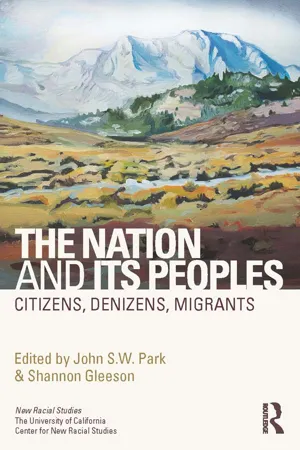
With this volume, The University of California Center for New Racial Studies inaugurates a new book series with Routledge. Focusing on the shifting and contradictory meaning of race, The Nation and Its Peoples underscores the persistence of structural discrimination, and the ways in which "race" has formally disappeared in the law and yet remains one of the most powerful, underlying, unacknowledged, and often unspoken aspects of debates about citizenship, about membership and national belonging, within immigration politics and policy. This collection of original essays also emphasizes the need for race scholars to be more attentive to the processes and consequences of migration across multiple boundaries, as surely there is no place that can stay fixed—racially or otherwise—when so many people have been moving. This book is ideal as required reading in courses, as well as a vital new resource for researchers throughout the social sciences.
- 312 pages
- English
- ePUB (mobile friendly)
- Available on iOS & Android
eBook - ePub
About this book
Information
PART I
History
CHAPTER 1
“The Filipinos Do Not Need Any Encouragement From Americans Now Living”
On Dilemmas of Teaching and Being Taught Ethics Under Unethical Conditions
This essay proceeds through a comparative analysis of two strategically disparate texts separated by gulfs of time and space. What makes the comparison viable is how these texts are resonant due to their capacities to express the power and limits of the educational apparatus in an imperial context. Those texts are 1) a published 1933 “lesson plan for ethical reading” by an elementary school teacher in Baguio City in the U.S. colony of the Philippines, and 2) a late twentieth-century Asian American/Pacific Islander literary text that dramatizes a punishing failure by the indigenous to abide by those ethical, and imperialist, demands.
In the age of high imperialism, that is, before the crisis of legitimacy of empire, empire had been synonymous with modernity and its projects. When the post in postcolonial emerged along with and occasioned the post in postmodern, a consensus over a singular vision of development was presumably cast away.2 Nevertheless, continuities abounded across the often violent shift to the postcolonial, from economic practices to political players to cultural values to myriad institutions, secular and otherwise. These continuities are perhaps most strongly preserved in the educational systems established under the auspices of formal imperial relations, such that education might be said to have replaced empire as being synonymous with modernity and its projects. In other words, support for universal education can be progressive, support for empire cannot. Through an examination of Asian American cultural production alongside the discourse of U.S. empire, this essay explores the meanings and contradictions of the civilizing mission, and in doing so argues that the continuities of conceptions of education across the American Century draw out what we would now call neoliberalism.
Conscientization of the Miseducated
That imperialism could be cast as a form of liberation is perhaps the great irony of the United States’s post-1898 colonial adventure. The irony of the situation is that the very act of liberation is premised on domination by the liberators.3 This irony is given institutional form through the installation of an educational system premised on teaching liberal ideas to those the founders are simultaneously colonizing, as in the case of the United States and the Philippines after 1898. “The [Philippine] educational system introduced by the Americans had to correspond, and was designed to correspond, to the economic and political reality of American conquest… The most effective means of subjugating a people is to capture their minds,” wrote Renato Constantino, in his 1968 polemic, “The Miseducation of the Filipino.”4 Toward overtly nationalist ends, Constantino pointedly revisits not only the role of education and subject formation in colonialism and its afterlives, but perhaps more fundamentally the premises on which the terms of failure that an educational system depends. The legitimation of failure is a necessary component in the process of pacification and incorporation by education, that is to say, the failure of the colonial student to prosper in school implicitly affirms social, economic, cultural, and political failures in a broader sense that would come from, as one source Constantino refers to puts it, “the dangers of premature independence.” Constantino is after all emphasizing miseducation, not education. And to fail at colonial miseducation, understood as such, may be a pathway to meaning-ful decolonization. And to succeed at colonial education can then mean that “a people’s” mind has been successfully captured and they have therefore been subjugated. The crucial epistemic shift that needs to happen is the delegitimation of colonialism and its institutions, in a condition of putatively postcolonial independence. The educational system, rather than being a means of decolonization, is not only the potent residue of colonialism, but also a new formation of hegemony.
Asian America has been dogged by the spotlighted spectacle of educational success. The main manifestation of this perception, and therefore a target for critique, has been the so-called model minority myth.5 From cultural politics to presistent debates on educational reform, the often vexed place of Asian Americans in relation to educational success and presumably concomitant prosperity has been a motif and a progressive narrative of successful students who revolt against that success emerges as a hopeful development. For instance, Lisa Lowe perceptively analyzes Monique Truong’s 1991 short story “Kelly” to appreciate how Asian American cultural politics illuminates the stakes of pedagogical scenes in Boiling Springs, South Carolina recollected by a Vietnamese former refugee writing from her perch at Yale.6 The narrator and protagonist, Thuy Mai, rightly critiques the geopolitics and microagressions of Mrs. Hammerick’s classroom, yet we learn that such conditions did not ultimately prevent Thuy Mai from a Yale education and the presumed benefits that such training and certification make possible, as well as from the critical consciousness and standard written English skills that the first-person narrative exhibit. Indeed, the ability to thrive under the conventional (colonial) terms while also exhibiting a critical commitment to subverting those terms is a motif in the history of anticolonial movements, often embodied by their very founders and ambivalent heroes.
What then is to be made of those who fail under conventional (colonial) terms of education? Here Lowe’s generative formulations around subject formation and narratives of development—in both individualist and political economy terms—are helpful for appreciating the stakes of Asian American cultural politics. Lowe draws attention to the myriad ways in which a notion of the “abstract citizen” emerges and is affirmed both by conspicuous success and failure to inhabit that political, juridical, and cultural space of the citizen and a subject of the nation. And the failures can be recognized not merely as failures but as contradictions that critique and undermine the viability of the idea and actuality of the abstract citizen, and express alternative epistemologies that therefore call for alternative institutions of recognition.
In Asian American literature, classrooms in Hawaii have been an especially prominent and revealing site for these dramas of neocolonial subject formation, from Milton Murayama and Darrell Lum to R. Zamora Linmark and Lois Ann Yamanaka. The colonial classroom functions as a telling allegory and concrete instrument of colonial incorporation, its legacies and its futures, from Utopian to dystopian. Each dramatized failure can be read either as a case for the ongoing civilizing mission or its illegitimacy. One such case, that I shall revisit in greater detail at the end of this essay, is Darrell Lum’s 1980 short story, “Primo Doesn’t Take Back Bottles Anymore,” a brief and literally virtuosic depiction of Rosario Kamahele, a homeless per-son on Oahu on the verge of losing his main mode of engagement with the Honolulu economy, redeeming discarded beer bottles. The six-page story makes visible the cracks in the educational system and the social safety nets that brought Rosa to this point. We see the story of a failure, but one that should be recognized with a postcolonial appreciation of the miseducation of the colonized and the potential emergence of critique. We see then that a critique of education, especially by one who has flunked out of it, can be repurposed as a critique of empire.
With the scandalous 2011 viral videos of the UC-Davis campus police pepper-spraying student demonstrators and of UCLA student Alexandra Wallace bemoaning “Asians in the library” at UCLA, the failures of the educational apparatus to serve its constituents and therefore legitimate its function have become disturbingly evident. And with substantial fee hikes and the continued defunding of public education, concerns about educational access and the role of public education have urgently re-emerged. Under these challenging conditions, a re-examination of conceptions of education in colonial contexts shows us that these contestations and crises may be more the rule than the exception. Specimens of U.S. imperial education allow us to explore the changes and persistences in the social, cultural, and political role of education, in part to assess, as scholar Meg Wesling has recently and persuasively done,7 the proposition that colonial education is more the template for mainstream American letters rather than its marginal expansion. While this essay makes no attempt to be a comprehensive history of colonial education in U.S. empire, it does look at ways in which the ends of empire and the ends of education have converged, and continue to do so, across changes in conceptions and practices of empire and of education.
The Neoliberalism of “Encouragement”
In a speech delivered on August 8,1900, in Indianapolis, to the Notification Committee informing him of his nomination to the U.S. Presidency, William Jennings Bryan took the opportunity to articulate his platform on the leading political issue of the moment: imperialism. Indeed, the title of the speech was “Imperialism.”8 In that speech he makes the following observa-tion: “The Filipinos do not need any encouragement from Americans now living.” The “now living” qualifier is what manages to allow him to preserve the panoptical exceptionalism of the United States as a Winthropian “citty upon a hill. The eies of all people are uppon us.” To wit, Bryan goes on the say, “Our whole history has been an encouragement, not only to the Filipinos, but to all who are denied a voice in their own government.” And in doing so, he like other anti-imperialists, intimates a relationship of identification and equivalence with Filipinos and others similarly dispossessed, rather than erecting an imperial vision premised on an inherently heirarchical and racialized color line between colonized and colonizer. We might recognize this strategy as that of neoliberalism, an approach to world order that may have lost the political contest of 1900 as the pro-imperialist McKinley was re-elected; but neoliberalism has gone on to win the longer, slower political, economic, and cultural contest of what Giovanni Arrighi has called “the long twentieth century,” and Henry Luce “the American Century.”
In the free marketplace of ideas, Bryan is banking on the notion that “our whole history” will somehow “encourage” the Filipinos and therefore achieve the objective that the imperialists and anti-imperialists share: the incorporation of the periphery into the modern world system. Where they differ is on the means. Put bluntly if somewhat reductively, the pro-imperialists advocate colonialism with direct and formal governance, while the anti-imperialists put faith in the idea that the Filipinos will choose to ally and align themselves with the United States.
In the short term, which would mean the era of direct U.S. colonial rule of the Philippines, the formal approach was implemented, including the establishment of a substantial and pervasive primary education system. Meanwhile the informal approach carried on, albeit abetted by and abetting the formal. Luce, in “The American Century” (Life, February 17,1941) provides a telling conception how this approach works:
… American jazz, Hollywood movies, American slang, American machines and patented products, are in fact the only things that every commun...
Table of contents
- Cover
- Half Title
- Titles of Related Interest from Routledge
- Title Page
- Copyright Page
- Table of Contents
- List of Illustration
- List of Tables
- Preface
- Acknowledgments
- Race and Immigration: An Introduction
- Part I History
- Part II Race, Agency, Identity
- Part III Institutions and Structures
- List of Contributors
- Index
Trusted by 375,005 students
Access to over 1.5 million titles for a fair monthly price.
Study more efficiently using our study tools.
Frequently asked questions
Yes, you can cancel anytime from the Subscription tab in your account settings on the Perlego website. Your subscription will stay active until the end of your current billing period. Learn how to cancel your subscription
No, books cannot be downloaded as external files, such as PDFs, for use outside of Perlego. However, you can download books within the Perlego app for offline reading on mobile or tablet. Learn how to download books offline
We are an online textbook subscription service, where you can get access to an entire online library for less than the price of a single book per month. With over 1.5 million books across 990+ topics, we’ve got you covered! Learn about our mission
Look out for the read-aloud symbol on your next book to see if you can listen to it. The read-aloud tool reads text aloud for you, highlighting the text as it is being read. You can pause it, speed it up and slow it down. Learn more about Read Aloud
Yes! You can use the Perlego app on both iOS and Android devices to read anytime, anywhere — even offline. Perfect for commutes or when you’re on the go.
Please note we cannot support devices running on iOS 13 and Android 7 or earlier. Learn more about using the app
Please note we cannot support devices running on iOS 13 and Android 7 or earlier. Learn more about using the app
Yes, you can access The Nation and Its Peoples by John Park,Shannon Gleeson in PDF and/or ePUB format, as well as other popular books in Social Sciences & Discrimination & Race Relations. We have over 1.5 million books available in our catalogue for you to explore.