eBook - ePub
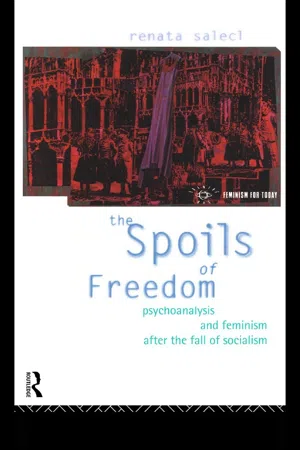
The Spoils of Freedom
Psychoanalysis, Feminism and Ideology after the Fall of Socialism
- 176 pages
- English
- ePUB (mobile friendly)
- Available on iOS & Android
eBook - ePub
The Spoils of Freedom
Psychoanalysis, Feminism and Ideology after the Fall of Socialism
About this book
The rise of nationalist, racist and anti-feminist ideologies is one of the most frightening repercussions of the collapse of socialism. Using psychoanalytic theories of fantasy to investigate why such extremist ideologies have taken hold, Renata Salecl argues that the major social and political changes in post-communist Eastern Europe require a radical re-evaluation of notions of liberal theories of democracy. In doing so she offers a new approach to human rights and feminism grounded in her own active partipation in the struggles, first against communism and now against nationalism and anti-feminism.
Information
Part I
The fall of socialism . . .
Chapter 1
The fantasy structure of war The case of Bosnia
Kant wrote that the world-historical significance of the French Revolution resided not in the immediate reality of the events in Paris, but in the enthusiasm this passionate attempt to realize freedom aroused in the eyes of the impassive observers composed of the educated, enlightened public in France and all around Europe. The actual events in Paris may have been horrifying, propelled by the most repulsive passions, yet the effects of these events on the enlightened public throughout Europe bear witness to the tendency towards freedom as an anthropological and world-historical fact. For Kant what mattered in such an historical moment
is simply the mode of thinking of the spectators which reveals itself publicly in this game of great revolutions, and manifests such a universal yet disinterested sympathy for the players on one side against those on the other, even at the risk that this partiality could become very disadvanteous for them if discovered, owing to this universality.1
(Kant, 1992: 153)
The same displacement from the event’s immediate reality to its perception by the impassive observers, i.e. registered in the symbolic network (the Lacanian ‘big Other’), determines also the signification of the violent anti-immigrant outbursts in Germany since the summer of 1992. This signification resides in the fact that the neo-Nazi pogroms met with approval or at least silent ‘understanding’ in the entire political spectrum – even the Social Democratic Party politicians used the attacks as the grounds for reassessing Germany’s liberal immigration laws. In this shift in the Zeitgeist the real danger lurks: such a shift lays the ground for the possible hegemony of an ideology that perceives the presence of ‘aliens’ as a threat to national identity, as the principal cause of antagonisms that divide the political body.
Particularly in need of attention is the difference between ‘postmodern’ racism, which now rages throughout Europe, and the more traditional form of racism. The older style of racism was direct and brutal – ‘the others’ (Jews, Blacks, Arabs, Eastern Europeans . . . ) are lazy and violent, they are plotting against us, eroding the substance of our national identity, etc. The new racism is ‘reflective’, which is why it can appear under the guise of its very opposite, of anti-racism. Etienne Balibar (1991) baptized this new attitude ‘meta-racism’, on account of its reliance on the theory of anthropological culturism. As Balibar says, ‘there is no racism without theory’. Because every racist complex expresses ‘a violent desire for immediate knowledge of social relations’, it has to invent theories which are immediately intelligible to the masses (Balibar, 1991: 19). For old racism, racial difference was biologically determined, whereas ‘meta-racism’ no longer regards races as isolatable biological units and is always ready to concede that races are the products of contingent historical circumstances. For Balibar, this new ‘differential racism’ is actually ‘racism without races’; it perceives racial tensions only in terms of incompatible cultural differences, life-styles, traditions, etc. But the fact is that in this racism culture itself functions as a ‘natural’ determinative force: it locks individuals and groups a priori into their cultural genealogy. ‘Meta-racism’ perceives cultures as fixed entities and tries desperately to maintain ‘cultural distances’. This racism ‘at first sight, does not postulate the superiority of certain groups or peoples in relation to others but “only” the harmfulness of abolishing frontiers, the incompatibility of life-styles and traditions’ (Balibar, 1991: 21). At the same time, this new racism differentiates cultures as ‘universalistic’ and ‘progressive’ on the one hand and ‘particularist’ and ‘primitive’ on the other. The first, ‘progressive’ types of cultures are usually of European origins, while the second, ‘primitive’ types are exotic, tribal cultures, which we might admire or have an anthropological interest in, but always keep at a distance.2
How, for example, would a ‘meta-racist’ react to a neo-Nazi attack on Turkish women? After expressing his repulsion at the neo-Nazi violence and sincerely condemning it, he would be quick to add that these events, deplorable as they are, must be located in their context. They are a perverted expression of a real problem, namely that in our contemporary Babylon the experience of belonging to a clearly delimited ethnic community which provides meaning for the individual’s life is fast losing ground. The true culprits are, therefore, the cosmopolitan proponents of ‘multiculturalism’ who advocate the mixing of races and thereby set off natural self-defence mechanisms. In short, ‘meta-racism’ legitimizes apartheid as the ultimate form of anti-racism, as an effort to prevent racial tensions and conflicts.3 Because the ‘meta-racist’ does not speak any more about actual races, he calls people of other cultural traditions ‘immigrants’ and seeks to establish a new form of apartheid by changing liberal immigration laws. Here we have an exemplary case of what Lacan has in mind when he asserts that ‘there is no metalanguage’: the distance between meta-racism and racism is void; metaracism is racism pure and simple, and it is all the more dangerous for posing as its own opposite, advocating racist measures as the very means of fighting racism.
On a different level, we encounter the same paradox in the Western media’s coverage of the war in Bosnia. A striking contrast emerges between this reporting and the reporting on the Gulf War in 1991. During the Gulf War, news reports featured the standard ideological personification: instead of providing information on social, political or religious trends and antagonisms in Iraq, the media ultimately reduced the conflict to a quarrel with Saddam Hussein, Evil Personified, the outlaw who excluded himself from the civilized international community. Even more than the destruction of Iraq’s military forces the true aim of the Gulf War was presented as psychological, as the humiliation of Saddam who had to ‘lose face’.4 In the case of the Bosnian war, however, notwithstanding isolated cases demonizing the Serbian president Miloševic, the predominant attitude reflects that of the quasi-anthropological observer. The media outdo one another in giving us lessons on the ethnic and religious background of the conflict; traumas hundreds of years old are being replayed and acted out, as if, in order to understand the roots of the conflict, one has to know not only the history of Yugoslavia but the entire history of the Balkans from mediaeval times.5 Or as a journalist says: ‘The history of all the southern Slavs in the Balkans is a tangled tragedy of mass rape and barbaric slaughter, the product of the kind of ethnic hatred that perhaps only people who are closely related to each other could nurture so well for so long’.6 In the Bosnian conflict, it is therefore not possible simply to take sides, to name evil, to assign blame, because we are dealing with ‘irreconcilable warring tribes’.7 One can only patiently try to grasp the background of this savage spectacle, so alien to our system of civilized values . . . 8
Such an approach involves an ideological mystification even more cunning than the demonization of Saddam Hussein. Assuming the comfortable attitude of a distant observer, and evoking the allegedly intricate context of religious and ethnic struggles in the Balkans enables the West to shed its responsibility towards the Balkans, i.e. to avoid the bitter truth that, far from simply being an eccentric conflict, the Bosnian war is a direct result of the failure of the West to grasp the political dynamic of the disintegration of Yugoslavia. The logic is therefore ultimately the same as that of meta-racism: what we have is the effective tolerance and, thus, support of ‘ethnic cleansing’, under the guise of its opposite, the distance of an impartial observer.
What the West does not want to recognize is that Yugoslavia ‘died’ several times before it officially disintegrated. Although symbolic death usually comes after real death, for example with the burial of the dead, in the case of Yugoslavia, symbolic death took place before the final collapse of the country. Because ‘Yugoslavia’ as such functioned as a floating signifier, which each of its constitutive nations incorporated into their own political discourses in different ways, the moment of the symbolic death of the country arrived for different Yugoslav nations at different times. For the Serbs, this event occurred in 1974, when the constitution gave full autonomy to the Serbian provinces of Vojvodina and Kosovo; for the Albanians, the symbolic death of Yugoslavia came in 1989, when they lost their autonomy; for the Slovenes and the Croats it came with the disintegration of communism when half of Yugoslavia formed a multi-party system but the other half remained communist.
One of the most dramatic symbolic deaths came in 1991, after the federal army occupied Slovenia, when mothers all over Yugoslavia began to protest against the war and demanded their sons’ return from service in the army. Several things are striking about this protest. First, the discourse changed significantly: young soldiers, who were previously referred to as men (since entering the army traditionally marked the initiation of a boy into manhood) were suddenly renamed as children in order to encourage identification with the purity of the mother–child relationship, which supposedly transcends all ideological or national struggles. Second, it was surprising how the Slovene mothers gave their full support to the Serbian mothers’ call for their sons’ return, even though the Slovenes perceived the Serbs as the principal aggressors.
But as soon as the Serbian mothers arrived in Slovenia to get their sons out of the army the supposed universality of maternal feelings collapsed as a result of national identification.9 When the army ideologues convinced the Serbian mothers that their sons were fighting against the national enemy of the Serbs, the mothers quickly changed their minds and let their sons stay in the army. When, not long after the war in Slovenia, the army, which was perceived as the principal guarantee of the transnational character of the Yugoslav federation, openly took the side of the Serbs, this signified the final symbolic death of Yugoslavia.
WAR AND THE FANTASY STRUCTURE OF THE HOMELAND
How does it happen that in war all human relations get distorted and only national identification prevails? What exactly is the logic of war? As Elaine Scarry (1985) has pointed out, the motives which usually trigger war (the urges for freedom, national sovereignty, possession of territory, etc.) are not linked to the logic of the war itself, to its inner structure. In a way these motives remain outside of the war: different motives are at work before the war starts (as an excuse for war) and after it finishes (as something that was accomplished by the war); but during the war itself these motives play a secondary role. When war begins the ideological excuse for it ‘materializes’ itself in the body of the soldier that has to be killed or in the building that has to be destroyed. As Elaine Scarry emphasizes, the inner logic of war concerns the contest over who will be quicker to inflict injury on the other. Although death and injury are presented as by-products of war, they are actually its only aim. However, in harming the enemy, the aim is not so much to cause it material loss, to capture its territory, or destroy its political system. The true aim is to destroy the very way the enemy perceives itself, the way it forms its identity.
I cannot fully agree with another thesis developed by Elaine Scarry, the thesis that war starts when a ‘country becomes a fiction for its population’ (Scarry, 1985: 131). The fact is that a country is always already a kind of fiction: a country is not only ‘a piece of land’, but a narration about this land. In the language of psychoanalysis, a country (or fatherland, motherland, homeland) could be defined as a fantasy. What does this mean?
In Lacanian psychoanalysis, fantasy is linked to the way people organize enjoyment (jouissance), the way they structure their desire around some traumatic element that cannot be symbolized. Fantasy gives consistency to what we call ‘reality’.10 Social reality is always traversed by some fundamental impossibility, by an ‘antagonism’ which prevents reality from being fully symbolized. It is fantasy that attempts to symbolize or otherwise fill out this empty place of social reality. Fantasy thus functions as a scenario that conceals the ultimate inconsistency of society.
In the fantasy structure of the homeland, the nation (in the sense of national identification) is the element that cannot be symbolized. The nation is an element in us that is ‘more than ourselves’, something that defines us but is at the same time undefinable; we cannot specify what it means, nor can we erase it. We may even say that the nation is linked to the place of the Real in the symbolic network.11 In Lacanian psychoanalysis, the Real is a dimension which is always missing, but which at the same time always emerges; this elusive dimension, which society tries to incorporate in the symbolic order and thus neutralize, always exceeds society’s grasp. Even though the social symbolic order is oriented towards a homeostatic equilibrium, it can never attain this state because of this alien, traumatic dimension at its core. It is precisely the homeland that fills out the empty place of the nation in the symbolic structure of society. The homeland is the fantasy structure, the scenario, through which society perceives itself as a homogeneous entity.
The aim of war is to dismantle the fantasy structure of the enemy country. The aggressor tries to destroy the very way the enemy perceives itself, the way it makes national myths about certain territory, the way it takes this territory (or political system) as something sacred, as a symbol of its existence. This is why the aggressor does not intend merely to impose its beliefs on the enemy’s beliefs. The aggressor’s primary aim is to destroy the enemy’s belief and to dismantle the enemy’s identity. Thus when the Serbs occupied a part of Croatia, their aim was not primarily to capture Croatian territory but to destroy the Croatian fantasy about that territory. The Serbs forced the Croats to redefine their national identity, to reinvent national myths and to start perceiving themselves in a new way, without linking their identity to the same territories, as they had done before.12
In war, the destruction of fantasy takes place by inflicting injury upon the enemy. We could say that in war the Real gets inscribed in the wound the soldier receives in battle. When the aggressor attacks, he tries to injure or kill the enemy soldier, insofar as some surplus resides in him – the element that makes him the enemy, a member of the other nation, etc. The soldier who is wounded in war will find, throughout the course of his life, that his very existence becomes organized around this wound. If the soldier recovers, the memory of the wound will make him a loyal citizen; his heroism will be interlaced with the wound and he will be honoured by the state because of the wound. If the soldier should be permanently disabled, the wound will receive an even greater symbolic meaning because it will always remain visible as a mark of sacrifice for the country. And if the soldier dies, his death will be an heroic death, a death worth dying.13
What do we find, if we analyse the war in Bosnia and Herzegovina with the help of this theoretical apparatus? First of all, it is significant that in this case we do not have the usual fantasy construction regarding the nation. At the beginning of the war, Muslims still organized their fantasy scenario of the homeland around the idea of Yugoslavia: they were the only ones who took literally the transnationality of the Yugoslav federation and believed in the notion of ‘brotherhood and unity’. The whole existence of Bosnia and Herzegovina was, in a way, a realization of the socialist aim to erase the element of the nation from social organization. The Muslims persisted in this transnational attitude even after their towns had been bombed; they did not want to call the attacker by his name, they did not want to give him a national connotation. Thus at the beginning of the war, the aggressors were referred to as ‘criminals, hooligans’, and only much later were they named Chetniks or Serbian nationalists.
The inhuman persecution14 of the Muslims by the Serbs reveals, among other things, how disturbing it is for the aggressor to find no fantasy structure of the homeland on the side of the Muslims. It is as if the Serbs cannot bear that the Muslims do not organize their fantasies of the homeland on national grounds. This is why the Serbs are desperately trying to create the impression of the enemy’s nationalist and religious extremism by naming the Muslims ‘fighters of Jihad’, ‘green berets’ or ‘Islamic fundamentalists’. By torturing Muslims, the Serbs are actually trying to provoke Muslim fundamentalism. Thus the primary aim of the Serbs is to belittle the Muslims’ religious identity by ruining their mosques or by raping young Muslim women.15
If the aim of the war is to destroy the fantasy structure of the whole population, the aim of rape, as is the aim of any other form of torture, is to shatter the fantasy structure of the individual. Rape is for Muslim women an especially horrible crime because their religion strictly forbids any sexual contact before marriage; for a young Muslim woman, rape thus has the meaning of a symbolic death. The very way Muslim women are being raped, the very fact that rape is seen by the aggressors as a kind of a ‘duty’ to be performed on the captured woman, reveal how the aggressor aims to destroy precisely that aspect of the individual woman’s fantasy structure that touches her religious and sexual identity. These attacks aim at dismantling the very frame through which a Muslim woman perceives the outer world and herself as consistent, the way she organizes her identity and the identity of her world. Rape as a form of punishment always aims at humiliating the victim, at ruining her world, so that, to vary Rorty’s formula, she w...
Table of contents
- COVER PAGE
- TITLE PAGE
- COPYRIGHT PAGE
- SERIES PREFACE
- ACKNOWLEDGEMENTS
- INTRODUCTION
- PART I: THE FALL OF SOCIALISM . . .
- PART II: . . . AND ITS IMPLICATIONS FOR THE THEORY OF IDEOLOGY
- CONCLUSION
- NOTES
- SELECT BIBLIOGRAPHY
Trusted by 375,005 students
Access to over 1.5 million titles for a fair monthly price.
Study more efficiently using our study tools.
Frequently asked questions
Yes, you can cancel anytime from the Subscription tab in your account settings on the Perlego website. Your subscription will stay active until the end of your current billing period. Learn how to cancel your subscription
No, books cannot be downloaded as external files, such as PDFs, for use outside of Perlego. However, you can download books within the Perlego app for offline reading on mobile or tablet. Learn how to download books offline
Perlego offers two plans: Essential and Complete
- Essential is ideal for learners and professionals who enjoy exploring a wide range of subjects. Access the Essential Library with 800,000+ trusted titles and best-sellers across business, personal growth, and the humanities. Includes unlimited reading time and Standard Read Aloud voice.
- Complete: Perfect for advanced learners and researchers needing full, unrestricted access. Unlock 1.5M+ books across hundreds of subjects, including academic and specialized titles. The Complete Plan also includes advanced features like Premium Read Aloud and Research Assistant.
We are an online textbook subscription service, where you can get access to an entire online library for less than the price of a single book per month. With over 1.5 million books across 990+ topics, we’ve got you covered! Learn about our mission
Look out for the read-aloud symbol on your next book to see if you can listen to it. The read-aloud tool reads text aloud for you, highlighting the text as it is being read. You can pause it, speed it up and slow it down. Learn more about Read Aloud
Yes! You can use the Perlego app on both iOS and Android devices to read anytime, anywhere — even offline. Perfect for commutes or when you’re on the go.
Please note we cannot support devices running on iOS 13 and Android 7 or earlier. Learn more about using the app
Please note we cannot support devices running on iOS 13 and Android 7 or earlier. Learn more about using the app
Yes, you can access The Spoils of Freedom by Renata Salecl in PDF and/or ePUB format, as well as other popular books in Social Sciences & Philosophy History & Theory. We have over 1.5 million books available in our catalogue for you to explore.