eBook - ePub
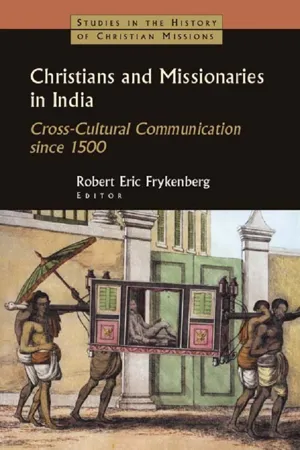
Christians and Missionaries in India
Cross-Cultural Communication since 1500
- 432 pages
- English
- ePUB (mobile friendly)
- Available on iOS & Android
eBook - ePub
About this book
The assumption that Christianity in India is nothing more than a European, western, or colonial imposition is open to challenge. Those who now think and write about India are often not aware that Christianity is a non-western religion, that in India this has always been so, and that there are now more Christians in Africa and Asia than in the West. Recognizing that more understanding of the separate histories and cultures of the many Christian communities in India will be needed before a truly comprehensive history of Christianity in India can be written, this volume addresses particular aspects of cultural contact, with special reference to caste, conversion, and colonialism. Subjects addressed range from Sanskrit grammar to populist Pentecostalism, Urdu polemics and Tamil poetry.
CHAPTER ONE
Introduction: Dealing with Contested Definitions and Controversial Perspectives
ROBERT ERIC FRYKENBERG
With due apologies to those who study Christians in other parts of India, evidence, examples, and illustrations in this introduction are largely restricted to South India, which is best known to the author.
Not surprisingly, the pervasive assumption that Christianity in India is noth-ing more than a Western, European, or “colonial” imposition is again open to challenge.1 Nevertheless, despite this being so, many of those who think and write about India all too often forget, or else are unaware of the fact, that Christianity has always been, in some measure, a non-Western religion; that in India this has always been so; and that there are now more Christians in the “non-West” (Africa and Asia) than in the West. Recognizing that, until very recently, most studies of Christians in India have been heavily Eurocentric, both in content and in tone, chapters contained within this volume attempt to subject this long-standing bias to closer scrutiny and provide perspectives that are more Indocentric. Realizing that many more studies, yielding deeper and wider understandings, of many different Christian communities in India will be needed before a truly comprehensive history of Christianity in India can be written, each chapter here is an attempt to address some particular as-pect of cultural cross-contact and communication with special reference to With due apologies to those who study Christians in other parts of India, evidence, exam-ples, and illustrations in this introduction are largely restricted to South India, which is best known to the author. Christians in India. Subjects addressed range from histories of Sanskrit gram-mar and modern scientific knowledge to histories of populist Pentecostalism, Urdu polemics, and Tamil poetry.2
Interestingly, relationships between India’s Christians and questions about caste, conversion, and colonialism have always been complex and con-voluted. Simplistic conflations between Christians and colonialism, conver-sion, or caste have almost invariably resulted from confusing complex forms of dual identity. These have themselves reflected confused manifestations of cultural ambiguity and ambivalence, not to mention manifold verities within each Christian community of India. Exactly how such confusions have come about has needed to be studied more closely. The common thread running through all of the studies presented within this volume is an argument that, despite intrusions from the West and from Christians of the West, from cul-tures that were alien and foreign, most Christians of India have continued to retain their own distinct cultural identities. These identities have remained, in most respects, clearly and predominantly Indian.
Communication, lack of communication, and failures of communication lie at the very heart of every chapter presented in this volume. Failures of com-munication, as we know, can be accidental or inadvertent. Failures can also be due to ineptitude or ignorance. There are times, however, when barriers to communication have been deliberately erected. When this has happened, spe-cial ciphers or codes of encryption have served to inhibit or restrict the free or full flow of information, either partially or totally. Miscommunication, misin-formation, or obfuscation, in such circumstances, are not mere accidents. Se-crecy has been the form, and the name, for the purposeful prevention of com-munication or for the deliberate withholding of information. As a barrier to communication, this has often arisen from attempts to create or retain special preserves of power. Even when full and accurate communication has been in-tended, there have been occasions when access and tools to do so were not ade-quate or available, when communication has been far from perfect.
Christians, from their earliest beginnings some two thousand years ago, have always been obliged to communicate their faith and to convey the Word of God to others. The “mission” of accurately communicating the gospel, of spreading it to the far ends of the earth, was and is an imperative. This mis-sion, as enjoined and made mandatory for all true believers, has never been rescinded. Since, in India, this imperative has always extended beyond the constraints of caste and culture, the “alien” and “intrusive” features of com-munication, as the quintessential missionary activity, have always been, in some measure, unavoidable.
Yet, at the same time, essential as it has always been to communicate the Word of God to all mankind, Christianity, unlike other major religious tradi-tions, has never possessed a single “sacred language.” Despite attempts to the contrary, no single tongue nor script has ever been allowed to achieve or hold a privileged status above all others, at least for very long. Rather, as reflected in the historic episode known as the “Day of Pentecost,” when the apostles “began to talk in many different tongues, as the Spirit gave them power of utterance” so that among devout Jews in Jerusalem “from countries every nation under heaven, each heard what was spoken in his own language,”3 every language has held the potential of being sacred. Since language itself is viewed as a gift of God, by implication all languages and all cultures have been, in a theological sense, potentially equal. All have been “redeemable.” Each individual or com-munity and, by inference, each vehicle of communication is a part of “creation in progress ”As such, each has been capable of becoming more perfect and pure (or sacred). In the words of Yale Professor Lamin Sanneh, “Christianity tri-umphs by the relinquishing of Jerusalem or any fixed universal centre, be it geo-graphical, linguistic or cultural, with the result that we have a proliferation of centres, languages and cultures within the Church. Christian oecumenism is a pluralism of the periphery with only Christ at the centre.”4 His words echo those of Bishop Vedanayagam Azariah of Dornakal who, in 1932, wrote: “The religion of Christ is one of the most dynamic factors in the world. It always bursts its boundaries, however strong and rigid those boundaries may be. It re-fuses to be confined to any one race, class, or caste. It seeks to embrace all.” 5
Refining Concepts and Definitions
Problems related to communication remain close to the very heart of the task of conveying the Christian message within each of the world’s cultures. For this reason, the pivotal concepts, or sets of concepts, used within chapters of this volume will be no more useful than the sharpness with which they are defined. As tools of analysis, definitions are descriptions that identify and de-limit precise properties or explain exact meanings of given words, terms, and phrases and of the concepts and entities that they purport to represent. Con-cepts, as abstractions, each contain a general idea or notion, an “invented” re-ceptacle or formation of thought. Well-defined concepts are the essential tools that make clear communication possible. Even when arbitrarily set, they can serve as benchmarks, as heuristic devices, or as instruments by which one can measure or understand things more precisely. Thus, however abstract or apparently reductive or simplistic some definitions may seem to be, they are elements of conceptual apparatus without which it is difficult to attain en-lightenment or achieve broader understandings. Without them, assessments of events concerning relations between various kinds of cultures within India become impossible. For our purposes, among various specific sets of con-cepts that are of special concern, what it is meant by the term “Christian” needs to be defined. Without a baseline definition of what it means to be “Christian” — both in the sense of a delimiting adjective and in the sense of an identifying or named entity (or noun) — understanding of relations within cultures and between communities of India becomes impossible. Thus, for purposes of this volume, distinctions need to be made: between things “Christian” and things “colonial”; between things “Christian” and “caste” or other elements deeply imbedded or institutionalized within “Hindu” culture; and between what is “Christian” and “conversion” (or “proselytism”).
Controversies over the Terms “Christian ”
“Christians, and ”Christianity”
As already indicated, much depends upon whether a concept is used as a modifying adjective, something that qualifies something else, or whether that concept is used as denoting a primary noun (namely, as a subject or object). When used to modify something else, the word “Christian” is a term of di-minishment.6 It is subject to something else and is subordinated to it. Things “Christian” — Christian missions, Christian individuals, Christian institu-tions, or Christian activities — pertain to things concerned with or defined by faith in a person and in the gospel (or “good news”) delivered to his fol-lowers. As a term of identity, “Christian” pertains both to belief and to rela-tionship with the person at the center of that belief. Things Christian are sub-ordinate — to Jesus the Messiah (Christ) and to his commands. This identifying subordination can be either individual and personal or institu-tional and communal. Followers are commanded to spread “the good news” about “the faith.”7 This faith itself is a “gift.”8 This news, in essence, was and is this: that each person is made in the likeness of God (however tainted that likeness may have become); that each person is of such intrinsic worth as to prompt a divine act of redemption (atonement by God-in-Christ in the sacri-fice of himself); and that divine grace thereby enables anyone to gain direct access to an everlasting relationship with God. This news, carried in heart and mind, expressed by every tongue and pen, is at the core of what Christian means. To be Christian embodies this subjection.
“Christianity”9 (and Christian missions), therefore, in basic theological and historical terms, has consisted of individualized and institutionalized ex-pressions of such belief. It embodies both commitment and obligation. It is the continuous, ongoing, and still unfinished work by God within the heart and mind of each person and within the culture of every people. This work, carried out through the agency of imperfect human beings, both as individu-als and as institutions, is an ongoing process. In every age and in every place on earth, persons converted or turned around by the agency of God’s Spirit have been obliged to carry this message to those who have not yet received it. This obligation, as embodied in the Great Commission, is deemed to be the ultimate Christian mandate. As such, it still remains in force. The history of things Christian consists of attempts to understand exactly how well this im-perative has or has not been carried out within the contexts of mundane hu-man affairs.
Yet, one of the most lingering, persistent, and stubborn misperceptions, both in India and in the West, is the notion that Christianity is essentially Eu-ropean and that European religion has traditionally been Christian. Of course, neither of these notions is true. Contradictions arising from such misconceptions are so manifold that they need hardly be elaborated upon further. It is sufficient to be reminded that the long westward movement from Antioch by which peoples of Europe gradually became Christian was far from complete as late as 1500; and also that, in the ante-Nicene centuries, a no less significant eastward movement was carrying the Christian faith to peoples of Persia, India, and China, as also to peoples of Africa. Christianity in the nonWestern world was already strong long before the Great Councils began to codify the institutions of a Latin Christian culture. Developments in the West in no way mitigated or nullified the various forms of Eastern Christianity that had already become established. It is also important to remember that, by the very time that Christianity in Europe was becoming, at least for a time, the re-ligion of the West, its very ascendancy in the West was already beginning to go into retreat — and that this retreat came largely as a result of influences from the non-Western world. Thus, reference points for perceptions about the future of Christians in the world now seem to lie, more and more, in Af-rica and Asia (if not also in Latin America). Meanwhile, the stereotype of Christianity as Western continues to survive and to be repeated, over and over. Such being the case, if the full story about the nature of Christians in history is to be properly understood, scholars need to more fully explore the entire complex of different Christian cultures, each with its own separate his-tory, among every people of the world.
Controversies over “Colonialism” and Its Conflations
“Colonialism” is a modern concept. Indeed, it has become common within the historiography of India only during the past forty years. As such, it is now far removed from the original root term used in ancient times within the con-texts of Roman imperial history. 10 As it is now commonly used, and in many ways misused, as also neatly simplified within the Marxian lexicon, and as then spread within the secular academy (in arts, humanities, and social sci-ences), media, and government, the term itself has become a synonym for co-ercion, domination, and exploitation, especially and often specifically, of peo-ples everywhere by peoples and institutions of the West. It also denotes oppression by any “alien” and “foreign” forces or rulers (again, especially by Western: European and American oppressors). Its meaning has been further expanded, moreover, so as to imply acts of oppression by ruling elites of any kind and in any circumstance, but especially those within, or stemming from, the capitalist West.
Colonialism, in short, is more of a rhetorical device than a precise, scien-tific tool. It is part of a technology for denigrating, shaming, and shunning. It applies to anything that is perceived to be politically incorrect. Anything per-ceived as a form of institutionalized (or systemic) inhumanity can be so la-beled, whether or not there is evidence that this is or was actually so. Any-thing seen as “damage” inflicted by one group of humans upon another group of humans, either individually or institutionally, often by use of de-meaning stereotypes about “lesser” forms of human life, or even upon the life or breath of an inanimate ecological environment itself, is seen as suffering from colonialism. The term, obviously, has become a convenient device for labeling, demonizing, or assigning collective guilt. It has ther...
Table of contents
- Cover
- Half Title
- Studies in the History of Christian Missions
- Full Title
- Copyright
- Contents
- Contributors
- 1. Introduction: Dealing with Contested Definitions and Controversial Perspectives
- 2. Christians in India: An Historical Overview of Their Complex Origins
- 3. First European Missionaries on Sanskrit Grammar
- 4. Country Priests, Catechists, and Schoolmasters as Cultural, Religious, and Social Middlemen in the Context of the Tranquebar Mission
- 5. Tanjore, Tranquebar, and Halle: European Science and German Missionary Education in the Lives of Two Indian Intellectuals in the Early Nineteenth Century
- 6. Christianity, Colonialism, and Hinduism in Kerala: Integration, Adaptation, or Confrontation?
- 7. Constructing "Hinduism": The Impact of the Protestant Missionary Movement on Hindu Self-Understanding
- 8. Receding from Antiquity: Hindu Responses to Science and Christianity on the Margins of Empire, 1800–1850
- 9. "Pillar of a New Faith": Christianity in Late-Nineteenth-Century Punjab from the Perspective of a Convert from Islam
- 10. Missionaries and Print Culture in Nineteenth-Century Assam: The Orunodoi Periodical of the American Baptist Mission
- 11. The Santals, Though Unable to Plan for Tomorrow, Should Be Converted by Santals
- 12. Christian Missionaries and Orientalist Discourse: Illustrated by Materials on the Santals after 1855
- 13. Glimpses of a Prominent Indian Christian Family of Tirunelveli and Madras, 1863–1906: Perspectives on Caste, Culture, and Conversion
- 14. Social Mobilization among People Competing at the Bottom Level of Society: The Presence of Missions in Rural South India, ca. 1900–1950
- 15. From Pentecostal Healing Evangelist to Kalki Avatar: The Remarkable Life of Paulaseer Lawrie, alias Shree Lahari Krishna (1921–1989) — A Contribution to the Understanding of New Religious Movements
- 16. Praising Baby Jesus in Iyecupiran Pillaitamil
- Index
Trusted by 375,005 students
Access to over 1.5 million titles for a fair monthly price.
Study more efficiently using our study tools.
Frequently asked questions
Yes, you can cancel anytime from the Subscription tab in your account settings on the Perlego website. Your subscription will stay active until the end of your current billing period. Learn how to cancel your subscription
No, books cannot be downloaded as external files, such as PDFs, for use outside of Perlego. However, you can download books within the Perlego app for offline reading on mobile or tablet. Learn how to download books offline
Perlego offers two plans: Essential and Complete
- Essential is ideal for learners and professionals who enjoy exploring a wide range of subjects. Access the Essential Library with 800,000+ trusted titles and best-sellers across business, personal growth, and the humanities. Includes unlimited reading time and Standard Read Aloud voice.
- Complete: Perfect for advanced learners and researchers needing full, unrestricted access. Unlock 1.5M+ books across hundreds of subjects, including academic and specialized titles. The Complete Plan also includes advanced features like Premium Read Aloud and Research Assistant.
We are an online textbook subscription service, where you can get access to an entire online library for less than the price of a single book per month. With over 1.5 million books across 990+ topics, we’ve got you covered! Learn about our mission
Look out for the read-aloud symbol on your next book to see if you can listen to it. The read-aloud tool reads text aloud for you, highlighting the text as it is being read. You can pause it, speed it up and slow it down. Learn more about Read Aloud
Yes! You can use the Perlego app on both iOS and Android devices to read anytime, anywhere — even offline. Perfect for commutes or when you’re on the go.
Please note we cannot support devices running on iOS 13 and Android 7 or earlier. Learn more about using the app
Please note we cannot support devices running on iOS 13 and Android 7 or earlier. Learn more about using the app
Yes, you can access Christians and Missionaries in India by Robert Eric Frykenberg in PDF and/or ePUB format, as well as other popular books in History & Ethnic Studies. We have over 1.5 million books available in our catalogue for you to explore.