eBook - ePub
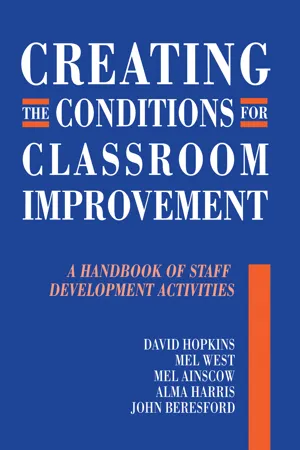
Creating the Conditions for Classroom Improvement
A Handbook of Staff Development Activities
- 124 pages
- English
- ePUB (mobile friendly)
- Available on iOS & Android
eBook - ePub
Creating the Conditions for Classroom Improvement
A Handbook of Staff Development Activities
About this book
First published in 1998. The research, practice and staff development activities in this book have come out of the Improving the Quality of Education for All project (IQEA), which emphases the importance of enhancing internal conditions in schools by building upon existing good practice. Materials developed to promote school-level conditions have already been described in a companion volume- Creating Conditions for School Improvement. It is, however, necessary to modify the conditions with the classroom, as well as those at the level of the school, if school improvement strategies are to have their full impact on student achievement. This book articulates a complimentary set of 'classroom conditions;, and gives INSET providers the activity materials to implement them.
Information
CHAPTER 1
Improving the Quality of Education for All
Introduction
During the past seven years or so we have been working closely with schools in East Anglia, North London, Yorkshire, Humberside, the East Midlands, as well as Iceland, Puerto Rico and South Africa on a school improvement and development project known as Improving the Quality of Education for All (IQEA). The overall aim of the project is to strengthen the schools’ ability to provide quality education for all its pupils by building upon existing good practice. In so doing, we are also producing and evaluating a model of school development, and using the opportunity of collaboration with schools in the IQEA network to conduct a long-term investigation into the processes of school change and student achievement.
As we work with schools within the framework of a national reform agenda we are committed to an approach to educational change that focuses on student achievement and the school's ability to cope with change. We refer to this particular approach as school improvement. We regard school improvement as a distinct approach to educational change that enhances student outcomes as well as strengthening the school's capacity for managing improvement initiatives. In this sense school improvement is about raising student achievement through focusing on the teaching/learning process and those conditions which support it.
The IQEA school improvement project works from an assumption that schools are most likely to strengthen their ability to provide enhanced outcomes for all pupils when they adopt ways of working that are consistent with both their own aspirations as a school community and the current reform agenda. Indeed, the schools we are working with are using the impetus of external reform for internal purposes as they navigate the systemic changes of recent years.
At the outset of IQEA we attempted to outline our own vision of school improvement by articulating a set of principles that provided us with a philosophical and practical starting point. These principles were offered to schools as the basis for collaboration in the IQEA Project. In short, we were inviting the schools to identify and to work on their own projects and priorities, but to do so in a way which embodied a set of ‘core’ values about school improvement. These principles represent the expectations we have of the way project schools pursue school improvement. They serve as an aide-memoire to the schools and to ourselves.
Improving the Quality of Education for All - principles
The five principles of IQEA are:
• School improvement is a process that focuses on enhancing the quality of students’ learning.
• The vision of the school should be one which embraces all members of the school community as both learners and contributors.
• The school will see in external pressures for change important opportunities to secure its internal priorities.
• The school will seek to develop structures and create conditions which encourage collaboration and lead to the empowerment of individuals and groups.
• The school will seek to promote the view that enquiry and the monitoring and evaluation quality is a responsibility which all members of staff share.
Although we feel that the operation of these principles can create synergy around change (i.e. together they are greater than the sum of their parts), they characterise an overall approach rather than prescribe a course of action. The intention is that they should inform the thinking and actions of teachers during school improvement efforts and provide a touchstone for the strategies they devise and the behaviours they adopt.
The principles emphasise what we know from experience, as well as from the research on student achievement and school effectiveness, that the greatest impact on student progress is achieved by those innovations or adaptations of practice that intervene in, or modify, the learning process. Changes in curriculum, teaching methods, grouping practices and assessment procedures have the greatest potential impact on the performance of students, and so provide a key focus for school improvement efforts.
Unfortunately the implementation of those changes that positively affect the learning of students is very difficult to achieve. This is because, as Michael Fullan (1991) has pointed out, educational changes that directly impact on the learning of students usually involve teachers in not only adopting new or additional teaching materials, but also in:
• acquiring new knowledge
• adopting new behaviours (e.g. new teaching styles)
• and, sometimes in modifying their beliefs or values.
The implementation ‘dip’
It is exactly because change is a process whereby individuals need to ‘alter their ways of thinking and doing’ that most changes fail to progress beyond early implementation. It is this phenomenon that Fullan (1991) has graphically referred to as ‘the implementation dip’. This incorporates that constellation of factors which creates the sense of anxiety and those feelings of incompetence so often associated with relearning and meaningful change. This is the phase of dissonance, of ‘internal turbulence’, that is as predictable as it is uncomfortable. Many research studies have found that without a period of destabilisation, successful, long-lasting change is unlikely to occur. The implications for school improvement is that conditions need to be created within the school that ensure that individuals are supported through this inevitable but difficult and challenging process.
Conditions for classroom improvement
This is why we have found that within the IQEA Project, school improvement works best when a clear and practical focus for development is linked to simultaneous work on the internal conditions within the school. Conditions are the internal features of the school, the ‘arrangements’ that enable it to get work done. Without an equal focus on conditions, even development priorities that directly affect classroom practice quickly become marginalised. Examples of the conditions that support school improvement are: collaborative planning, staff development, enquiry and reflection, and the involvement of students. Experience of the IQEA Project suggests that work on these conditions results in the creation of opportunities for teachers to feel more powerful and confident about change.
The IQEA approach to school improvement is based on our experience that effective change strategies focus not only on the implementation of school-selected policies, or chosen initiatives, but also on creating the conditions within schools that can sustain the teaching/learning process. A previous book in this series, Creating the Conditions for School Improvement, focused primarily upon creating the school-level conditions for improvement (Ainscow et al. 1994).
As our work has progressed, we have found it necessary to establish certain conditions within the classroom alongside those at the level of the school. We have recently been elaborating such a set of classroom conditions designed to assist teachers in facilitating the learning of all students. In this book we present our initial conceptualisation of those classroom conditions which we have found necessary for sustainable school improvement.
Who is the book for?
In writing this book we have had in mind the teacher, or indeed groups of teachers, interested in classroom-level change and development. In some cases such individuals may have assumed responsibility for development work in the school. It may be a head, or deputy, the appraisal or curriculum coordinator, the person in charge of staff development, or of drawing up the school's development plan. It may even be a head of department or faculty who has a clear view of effective teaching and wishes to extend this view by working with colleagues. In short, this book is for anyone in a school who is taking responsibility for some form of development activity.
What does the book do?
This book is not about what changes should be introduced into a school but instead it focuses upon creating the conditions for supporting those changes which lead to improvement in the classroom and the school. To be effective at managing change, schools and teachers need to modify the internal conditions of the classroom at the same time as introducing changes in teaching or the curriculum. The book therefore provides ideas and materials to help colleagues in school to create such conditions in classrooms and offers a strategic approach to staff development.
How should the book be used?
This book is not a step-by-step guide to classroom improvement. In our experience such ‘quick-fix’ approaches, although superficially attractive, rarely work in practice. Although schools can use similar broad approaches and strategies to develop, there is no one way that is right for every school. Consequently, the book provides different starting points and strategies for teachers in varying contexts and situations. These staff development resources are intended to be used within the context of the school's own aspirations. A key task of those using the suggestions and materials provided here will be to decide which of them are most suitable and for what purpose.
How is the book organised?
As part of our work with schools we have identified six key conditions necessary for effective classroom development. The bulk of the book is taken up with describing in individual chapters what these conditions are, and in presenting staff development exercises on how they can be encouraged. Prior to this in-depth look at the classroom conditions, we present a brief account of our current school improvement work and a rationale for the ‘conditions’ approach. At the end of the book we make some suggestions as to how a school can develop its own school and classroom improvement strategy.
Some people may find it helpful to read the book cover to cover as an introduction to classroom improvement. Others, having a clear idea of where they are going, may wish just to plunder it for staff development activities. Both are fine by us – we hope that the book is organised sufficiently clearly to allow for both approaches, as well as those in between.
Where do the ideas come from?
This book is based on our school improvement work which we have been pursuing in various guises and in different combinations of collaboration since the late 1980s. Although we are, for some of our life, university teachers, we also work intensively with schools as facilitators of the change process; there are now almost a hundred schools in our network. As a consequence the book is grounded in practice, but also tested by reference to the available research evidence. Those who are interested in pursuing these ideas further should consult our other texts on this subject, e.g. School Improvement in an Era of Change (Hopkins et al 1994) and Improving the Quality of Education for All (Hopkins et al 1996), which both give a more theoretical perspective, but also provide many practitioner accounts of school-based work on the improvement conditions.
It is appropriate therefore that this second practical handbook is about ‘creating the conditions for classroom improvement’. Despite the abundance of policy initiatives and change efforts, too little of it positively affects classroom practice. We hope that this book will help in some way to get those useful and helpful changes behind the classroom door.
CHAPTER 2
Creating the conditions for classroom improvement
Introduction
We have already noted that one of the early findings from the IQEA Project was that school improvement works best when a clear and practical focus for development is linked simultaneously to work on the internal conditions of the school This led us to develop and test a strategy for school improvement based on such a twin focus. As we have also noted, the conditions identified during the early phases of the project were related to school-level conditions, or the school's management arrangements, although of course many of the schools’ priorities were classroom-based (Hopkins et ah 1994). But, in line with contemporary school effects research, we too were finding that it is necessary to modify the conditions within the classroom, as well as those at the level of the school, if school improvement strategies are to fully impact on student achievement (Creemers 1994, Joyce and Showers 1995, Joyce et al 1997). We have therefore been elaborating a set of class-room conditions that enable teachers to facilitate the learning of all students. In this chapter we outline our ‘conditions’ approach to school improvement and then present an initial conceptualisation of the classroom conditions necessary for a sustainable school improvement strategy.
Rationale
The research on both school and teacher effects draws on similar epistemological models to generate knowledge. Put simply, they follow a process-product research design. High levels of student achievement are identified and ‘backward mapped’ to identify those school and teacher characteristics that correlate with high levels of student outcome. This research effort has over the past twenty years yielded impressive results and given us rich and detailed descriptions of the characteristics of effective schools and classrooms.

For those of us committed to improving as well as understanding the effectiveness of schools and classrooms, the research on school and class-room effects has one major weakness. Because the relationship between these characteristics and student outcomes is one of association, it tells us little about how one affects the other.
Conditions
It is the hiatus between the school/teacher characteristics on the one hand, and enhanced levels of student achievement on the other, that provides the focus for our work. We work from an assumption that there are a set of intervening variables operating at the school and classroom level that mediate between the characteristics of effecti...
Table of contents
- Front Cover
- Title Page
- Copyright
- Contents
- Acknowledgements
- 1 Improving the Quality of Education for All
- 2 Creating the conditions for classroom improvement
- 3 Authentic relationships
- 4 Boundaries and expectations
- 5 Planning for teaching
- 6 Teaching repertoire
- 7 Pedagogic partnerships
- 8 Reflection on teaching
- 9 The journey of classroom improvement
- 10 An invitation ...
- Appendix: The classroom conditions rating scale
- References and further reading
Trusted by 375,005 students
Access to over 1.5 million titles for a fair monthly price.
Study more efficiently using our study tools.
Frequently asked questions
Yes, you can cancel anytime from the Subscription tab in your account settings on the Perlego website. Your subscription will stay active until the end of your current billing period. Learn how to cancel your subscription
No, books cannot be downloaded as external files, such as PDFs, for use outside of Perlego. However, you can download books within the Perlego app for offline reading on mobile or tablet. Learn how to download books offline
Perlego offers two plans: Essential and Complete
- Essential is ideal for learners and professionals who enjoy exploring a wide range of subjects. Access the Essential Library with 800,000+ trusted titles and best-sellers across business, personal growth, and the humanities. Includes unlimited reading time and Standard Read Aloud voice.
- Complete: Perfect for advanced learners and researchers needing full, unrestricted access. Unlock 1.5M+ books across hundreds of subjects, including academic and specialized titles. The Complete Plan also includes advanced features like Premium Read Aloud and Research Assistant.
We are an online textbook subscription service, where you can get access to an entire online library for less than the price of a single book per month. With over 1.5 million books across 990+ topics, we’ve got you covered! Learn about our mission
Look out for the read-aloud symbol on your next book to see if you can listen to it. The read-aloud tool reads text aloud for you, highlighting the text as it is being read. You can pause it, speed it up and slow it down. Learn more about Read Aloud
Yes! You can use the Perlego app on both iOS and Android devices to read anytime, anywhere — even offline. Perfect for commutes or when you’re on the go.
Please note we cannot support devices running on iOS 13 and Android 7 or earlier. Learn more about using the app
Please note we cannot support devices running on iOS 13 and Android 7 or earlier. Learn more about using the app
Yes, you can access Creating the Conditions for Classroom Improvement by David Hopkins,Michael Fielding,John Beresford,Mel Ainscow,Mel West in PDF and/or ePUB format, as well as other popular books in Education & Education General. We have over 1.5 million books available in our catalogue for you to explore.