- 208 pages
- English
- ePUB (mobile friendly)
- Available on iOS & Android
eBook - ePub
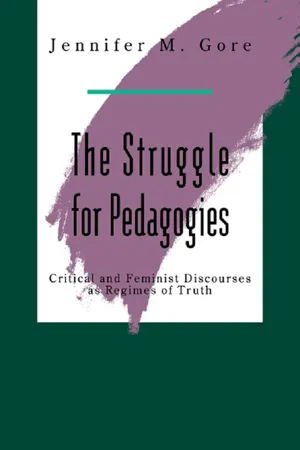
The Struggle For Pedagogies
About this book
Jennifer M. Gore examines, analyses and offers directions for the debate between critical pedagogy and feminist pedagogy, one of the fiercest within education theory.
Information
ONE
Introduction
I'm not into this regimented reflective stuff. (Scott, course journal, 1987).
This book has its origins in my attempts to practice radical pedagogy in teacher education. Despite my consistent struggles to feel confident that what I was doing in my classes was “right,” Scott's journal entry was, and still is, a powerful statement of the inconsistencies and difficulties of radical pedagogical practice. My initial reaction to his comment was to view him as a recalcitrant student, unwilling to see the value of reflective journal keeping (see Gore, 1990a). At the same time, I questioned my understandings of radical pedagogy, assuming that I must have missed something, that I had not quite grasped what it meant to do radical pedagogy. I turned to the literature of radical pedagogy hoping to find “truth” there.
The direction and clarity I sought were not forthcoming. Rather, my recent immersion in critical and feminist pedagogy texts and my experiences as teacher and as student in classes framed by critical or feminist pedagogy “principles,” helped me to see that the problem Scott highlighted was much larger than any recalcitrance on his part or ignorance on mine.
I would instead argue that there are many dimensions to what I call the struggle for pedagogies. In this study, I focus on discursive formations and discursive practices, on the construction of objects, statements, concepts, and strategies with sufficient regularity to enable the naming of discourses. In particular, this is an examination of the contemporary discourses of critical pedagogy and feminist pedagogy. I am using “discourse” in a poststructuralist sense where the concern is to answer such questions as “How does discourse function?” “Where is it to be found?” “How does it get produced and regulated?” “What are its social effects?” In short, discourse in this sense is not a question of meaning or of method, but a description of function. My focus is therefore on practices within institutions and disciplines through which intellectuals participate in the formation and functioning of the discourses of critical and feminist pedagogy.1
There are four issues with which I want to introduce my analysis of critical and feminist pedagogy discourses: first, the ambiguities around “pedagogy” generally and around “critical pedagogy” and “feminist pedagogy,” specifically; second, what I see as the fragmentation of these discourses; third, the institutional locations of these discourses both in the academy and in schools, that position critical and feminist pedagogy within broader discourses of social regulation and within a certain intellectual “will to truth”; fourth, what could be called the continuing marginality of critical and feminist pedagogy discourses as they seem only minimally to impact mainstream educational policy and practice, and teacher education. In this chapter, I introduce each of these issues and begin to situate them in social theoretical discussions about power and knowledge. I also outline the ways in which these issues will be carried through as themes and as direction for the remainder of the book.
While my own practice provided the impetus for this study, and is presented as its context, reasons for analyzing the internal relations of power and knowledge in the discourses of critical and feminist pedagogy extend beyond my own practical educational interests. I have become increasingly conscious of the marginal status of these radical pedagogies within the educational community at large, and within teacher education more specifically: it is clear their material impact on what takes place in the name of education in either schools or universities is limited. While it is possible to point to all kinds of external social and political conditions to explain the marginality (such as the predominance of neo-conservative politics in the 1980s), I have come to believe that reasons can also be found within the discourses of radical pedagogy. The reasons I consider internal to these discourses, which might be associated with their continued marginality, circulate around what I see as the discourses' dominating effects and their regimes of truth. Given these radical discourses' proclaimed allegiance to “empowerment” and “freedom,” mainstream educators, it seems to me, would be justified in seeing these discourses as hypocritical or at least inconsistent. This situation, as it contributes to the struggle for radical pedagogies, is of concern to me. Therefore, this detailed exploration of contemporary discourses of critical and feminist pedagogy aims to strengthen the discourses both internally and in relation to other educational discourses. My concern about radical pedagogy discourses is similar to a concern articulated by the editors of Telos (1981–82) a decade ago: “critically theorizing about society, which once seemed so important because it would explain the world to itself…now appears to be only theory again since it reaches no ‘material base’” (p. 115).
CONSTRUCTIONS OF “PEDAGOGY”
What is meant by the term “pedagogy”? Etymologically, the term refers to the science of teaching children. Some have called for a strict application of the term pedagogy to the teaching of children, which has led to the emergence of a body of educational literature on “andragogy,” the science of teaching adults. Some feminist educators suggest the term “gynagogy” for the teaching of or by women, citing and rejecting the early usage of “pedagogue”: “a man having the oversight of a child or youth … an attendant slave who led a boy to school…a schoolmaster” (Klein, 1987, p. 187). Klein (1987) “compromises” with the term “feminist teaching practice.” While these constructions are based on whom is taught, most commonly “pedagogy” is used interchangeably with “teaching” or “instruction” referring, with various degrees of specificity, to the act or process of teaching. Frequently, as in my current institution's Department of Pedagogical Studies, “pedagogy” is linked with so-called positivistic approaches to educational science.2
Of specific interest here, when the term is attached to particular sociopolitical approaches, we find “progressive pedagogy,” “radical pedagogy,” “critical pedagogy,” “feminist pedagogy,” “socialist pedagogy,” and others. These approaches have roots in particular political and theoretical movements and are variously constructed as oppositional to “mainstream” or “traditional” schooling practices and theories. In particular, a “critical social science” view of pedagogy has given rise to various critiques of, and alternatives to, “mainstream” pedagogy. Unlike approaches to pedagogy rooted in ostensibly positivistic and phenomenological thought, “critical” approaches focus on pedagogy as constitutive of power relations, making power a central category of their analysis. One strand of critical work has concerned itself with the development of theories of the pedagogical relation as a power relation (e.g., Bernstein, 1975, 1986, 1990; Bourdieu and Passeron, 1977). Another strand has focused on “pedagogy as possibility” and has been concerned with developing a discourse of “critical pedagogy” (e.g., Freire, 1973; Giroux, 1988a; McLaren, 1989; Shor, 1980; Simon, 1987). With roots in feminist political movements, some scholars have argued that schooling is patriarchal (e.g., Clarricoates, 1981; Grumet, 1988a, Kelly and Nihlen, 1982) and are working towards the articulation and practice of “feminist pedagogies” (e.g., Lewis, 1990a; Maher, 1985a; Morgan, 1987; Mumford, 1985; Schniedewind, 1985).
Unlike “mainstream” pedagogical discourses, the critical and feminist work on pedagogy has addressed “macro” issues in schooling, such as the institutions and ideologies within which pedagogy is situated. Beginning from the premise that schooling is not neutral, critical and feminist approaches to pedagogy emphasize their own social vision(s) for education and schooling, in an attempt to connect the macro and micro. While the dualisms created by such analytical oppositions as macro and micro, social vision and instruction, may be useful to begin to understand differences in arguments about pedagogy, they do not reflect the empirical realities of pedagogy. For instance, those approaches that emphasize instruction also contain within them a social vision, perhaps not an explicit vision, but often one that is based on notions of individual development and socialization. Hence, as Felman (1982) comments: “Every pedagogy has historically emerged as a critique of pedagogy” (p. 24); each pedagogy is never only a new set of instructional ideas.
While one could argue that the term “pedagogy” (indeed, any term) has no single meaning in and of itself, and that meaning is always struggled over and determined as it is constructed by particular discourses, I want to argue here for a particular, yet broad meaning for the term “pedagogy,” which includes both instruction and social vision. In so doing, I enter into the struggle for meaning in a way which allows me to pose a particular critique of discourses of radical pedagogy while retaining my commitment to, and struggles with, classroom practice. According to Lusted (1986), pedagogy, as a concept,
draws attention to the process through which knowledge is produced. Pedagogy addresses the “how” questions involved not only in the transmission or reproduction of knowledge but also in its production. Indeed, it enables us to question the validity of separating these activities so easily by asking under what conditions and through what means we “come to know”. How one teaches…becomes inseparable from what is being taught and, crucially, how one learns, (pp. 2–3)
This focus on the process of knowledge production—on “how” (as how connects to what and why, etc.)—is the meaning I wish to ascribe to “pedagogy” for the purposes of this book. This meaning is not the same “how” of pedagogy that is often associated with “methods” courses in teacher education programs. Rather, following Lusted, it is a kind of focus on the processes of teaching that demands that attention be drawn to the politics of those processes and to the broader political contexts within which they are situated. Therefore, instruction and social vision are analytical components of pedagogy; insofar as the concept implies both, each requires attention.
The meaning I ascribe to “pedagogy” is consistent with the political underpinnings of much radical educational discourse; that is, this particular notion of pedagogy, with its concern for how and in whose interests knowledge is produced and reproduced, shares the concerns of radical educational discourse. Thus, my analysis of radical pedagogies is intended as a critique that allies with the critical and feminist discourses, and offers itself in a general spirit of support. I am committed to the kinds of projects these discourses support, which oppose oppressive gender, race, class, and other social formations, and attempt to facilitate more “democratic” and “emancipatory” schooling for all. Hence, the immediate practical problem undergirding this study is how to use radical pedagogies, whose projects I support, in my own practice as a teacher educator, when these discourses seem to offer minimal assistance in responding to criticisms like Scott's. That is, as Scott identified, some of my difficulties as a teacher educator were located in the instructional act. I struggled to actualize the rhetoric of “radical” teacher education in the details of classroom practice, both in terms of specific content and in terms of instructional strategies.
It is helpful here to elaborate the meaning of pedagogy. If pedagogy is understood as the process of knowledge production, it follows that discourses of radical pedagogy can be seen to have at least two pedagogies: (1) the pedagogy argued for (the claims made about the process of knowledge production in radical pedagogy) and (2) the pedagogy of the argument (the process of knowledge production evident in the argument itself). Scott identified inconsistencies between the pedagogy I was arguing for and the pedagogy of my argument. One theme of this book is to explore possible inconsistencies in the pedagogies of critical and feminist pedagogy discourses. As an example, consider a discourse of radical pedagogy which makes schools its object. To construct such a discourse in a way that would place the burden for change on teachers, but would not offer concrete guidance for what teachers could actually do to facilitate such change, the discourse would seem both partial and hollow. While naming a discourse (that addresses a social vision, but neglects instructional aspects) “pedagogical”, might have strong rhetorical value among teachers (in legitimating the academic and her/his discourse to other teachers) this approach could both deny and mystify the experiences of teachers, rather than affirm or interpret them. Attention to politics and pedagogy does not necessarily arrive at the politics of pedagogy. The distinction I have drawn here, between the pedagogy of the argument and the pedagogy argued for, provides a central lens for this study whereby, as I shall elaborate in Chapter 3, the pedagogy of the argument becomes a major point of my critique.
FRAGMENTED DISCOURSES
At this point, I want to clarify the objects of my study that I have referred to as “discourses of radical pedagogy” or “critical and feminist pedagogy discourses.” First, I have deliberately limited the focus of this study to an analysis of those discourses which claim to focus centrally on pedagogy, and which also claim to be constructing pedagogies; that is, those discourses that guided my practice as a teacher educator, discourses which are rooted in particular political and theoretical traditions that resonate with my own dissatisfactions regarding “mainstream” educational approaches. This delimitation also emerges from my concern that insufficient attention has been paid to pedagogy, in its broad sense of social vision and instruction. Second, while many attempts have been made to develop alternative pedagogies (consider, for example, the work of Dewey and Kohl),3 my focus is on contemporary discourses of radical pedagogy: discourses which hold academic currency to the extent that they appear in academic journals, are discussed in university departments, and are at stake at professional meetings. Specifically, I address discourses of “critical pedagogy” and discourses of “feminist pedagogy.” (I will discuss limitations of these decisions in Chapter 2).
Addressing the range of contemporary academic work that claims the label “critical pedagogy” or “feminist pedagogy” requires an analysis of fragmented discourses. The following chapter explores the various strands of feminist and critical pedagogy which, at the moment, constitute these fragmented discourses. Briefly put, I will outline four strands of radical pedagogy that are distinguished by the various emphases each place on instruction and social vision in the name of pedagogy. (Of course, each has at least some implication both for instruction and for social vision). I identify a strand of feminist pedagogy that emphasizes instructional aspects of pedagogy, emerging primarily from Women's Studies; a strand of feminist pedagogy that emphasizes implications of feminist social visions for education, emerging from Schools of Education; a strand of critical pedagogy that emphasizes a critical social and educational vision, found primarily in the work of Henry Giroux and Peter McLaren in Education; and a strand of critical pedagogy which, in relation to the other strand of critical pedagogy, places more emphasis on instructional practices, found mainly in the work of Paulo Freire and Ira Shor (originally formulated outside the context of Schools of Education).
In Chapter 2, I elaborate the fragmentation and differentiation among discourses of critical and feminist pedagogy. For example, the field of radical pedagogy seems more overtly characterized by a lack of engagement than by disagreement between discourses. That is, rather than addressing the different discourses within radical pedagogy itself, each strand of radical pedagogy tends to situate itself in opposition to dominant/traditional educational theories and practices, each asserting itself as a new alternative. I will argue in Chapter 2 that there is little conversation (in terms of published dialogue) between the feminist pedagogy that emerges out of Women's Studies and the feminist pedagogy that emerges out of Education; there is little dialogue between Freire and Shor, and Giroux and McLaren; and there is virtually no communication between those who practice and/or write about critical pedagogy and those who practice and/or write about feminist pedagogy.
Despite the differences within and between discourses of critical and feminist pedagogy, an examination of their central claims, in terms of the pedagogy argued for, reveals a great number of commonalities. Both critical and feminist pedagogical discourses emphasize student experience and voice (e.g., Berry and Black, 1987; Freire, 1968; Giroux, 1988a; Lewis, 1988, 1990a; McLaren, 1989; Shor, 1980), assert the objectives of self and social empowerment toward broader social transformation (e.g., Culley, 1985; Giroux, 1988a; McLaren, 1988a; Shor and Freire, 1987; Shrewsbury, 1987a), speak about teachers' authority and struggle with the contradictions inherent in the notion of authority for emancipation (e.g., Bright, 1987; Friedman, 1985; Giroux, 1988a; Morgan, 1987; Shor and Freire, 1987; Spelman, 1985), are linked to po...
Table of contents
- Cover
- Half Title
- Full Title
- Copyright
- Dedication
- Contents
- Acknowledgements
- Preface
- 1. Introduction
- 2. Critical Pedagogies and Feminist Pedagogies: Adversaries, Allies, Other?
- 3. Regimes of Truth
- 4. Authority and Empowerment in Feminist Pedagogy
- 5. Authority and Empowerment in Critical Pedagogy
- 6. Regimes of Pedagogy
- 7. A Re-assembling for Practice in "Radical" Teacher Education
- Notes
- References
- Index
Trusted by 375,005 students
Access to over 1.5 million titles for a fair monthly price.
Study more efficiently using our study tools.
Frequently asked questions
Yes, you can cancel anytime from the Subscription tab in your account settings on the Perlego website. Your subscription will stay active until the end of your current billing period. Learn how to cancel your subscription
No, books cannot be downloaded as external files, such as PDFs, for use outside of Perlego. However, you can download books within the Perlego app for offline reading on mobile or tablet. Learn how to download books offline
Perlego offers two plans: Essential and Complete
- Essential is ideal for learners and professionals who enjoy exploring a wide range of subjects. Access the Essential Library with 800,000+ trusted titles and best-sellers across business, personal growth, and the humanities. Includes unlimited reading time and Standard Read Aloud voice.
- Complete: Perfect for advanced learners and researchers needing full, unrestricted access. Unlock 1.5M+ books across hundreds of subjects, including academic and specialized titles. The Complete Plan also includes advanced features like Premium Read Aloud and Research Assistant.
We are an online textbook subscription service, where you can get access to an entire online library for less than the price of a single book per month. With over 1.5 million books across 990+ topics, we’ve got you covered! Learn about our mission
Look out for the read-aloud symbol on your next book to see if you can listen to it. The read-aloud tool reads text aloud for you, highlighting the text as it is being read. You can pause it, speed it up and slow it down. Learn more about Read Aloud
Yes! You can use the Perlego app on both iOS and Android devices to read anytime, anywhere — even offline. Perfect for commutes or when you’re on the go.
Please note we cannot support devices running on iOS 13 and Android 7 or earlier. Learn more about using the app
Please note we cannot support devices running on iOS 13 and Android 7 or earlier. Learn more about using the app
Yes, you can access The Struggle For Pedagogies by Jennifer Gore in PDF and/or ePUB format, as well as other popular books in Éducation & Éducation générale. We have over 1.5 million books available in our catalogue for you to explore.