Occupational Health Services
  1. 472 pages
  2. English
  3. ePUB (mobile friendly)
  4. Available on iOS & Android
eBook - ePub
Available until 14 Apr |Learn more

About this book

Workers and their families, employers, and society as a whole benefit when providers deliver the best quality of care to injured workers and when they know how to provide effective services for both prevention and fitness for duty and understand why, instead of just following regulations.

Designed for professionals who deliver, manage, and hold oversight responsibility for occupational health in an organization or in the community, Occupational Health Services guides the busy practitioner and clinic manager in setting up, running, and improving healthcare services for the prevention, diagnosis, treatment, and occupational management of work-related health issues. The text covers:

  • an overview of occupational health care in the US and Canada: how it is organized, who pays for what, how it is regulated, and how workers' compensation works
  • how occupational health services are managed in practice, whether within a company, as a global network, in a hospital or medical group practice, as a free-standing clinic, or following other models
  • management of core services, including recordkeeping, marketing, service delivery options, staff recruitment and evaluation, and program evaluation
  • depth and detail on specific services, including clinical service delivery for injured workers, periodic health surveillance, impairment assessment, fitness for duty, alcohol and drug testing, employee assistance, mental health, health promotion, emergency management, global health management, and medico-legal services.

This highly focused and relevant combined handbook and textbook is aimed at improving the provision of care and health protection for workers and will be of use to both managers and health practitioners from a range of backgrounds, including but not limited to medicine, nursing, health services administration, and physical therapy.

Frequently asked questions

Yes, you can cancel anytime from the Subscription tab in your account settings on the Perlego website. Your subscription will stay active until the end of your current billing period. Learn how to cancel your subscription.
No, books cannot be downloaded as external files, such as PDFs, for use outside of Perlego. However, you can download books within the Perlego app for offline reading on mobile or tablet. Learn more here.
Perlego offers two plans: Essential and Complete
  • Essential is ideal for learners and professionals who enjoy exploring a wide range of subjects. Access the Essential Library with 800,000+ trusted titles and best-sellers across business, personal growth, and the humanities. Includes unlimited reading time and Standard Read Aloud voice.
  • Complete: Perfect for advanced learners and researchers needing full, unrestricted access. Unlock 1.4M+ books across hundreds of subjects, including academic and specialized titles. The Complete Plan also includes advanced features like Premium Read Aloud and Research Assistant.
Both plans are available with monthly, semester, or annual billing cycles.
We are an online textbook subscription service, where you can get access to an entire online library for less than the price of a single book per month. With over 1 million books across 1000+ topics, we’ve got you covered! Learn more here.
Look out for the read-aloud symbol on your next book to see if you can listen to it. The read-aloud tool reads text aloud for you, highlighting the text as it is being read. You can pause it, speed it up and slow it down. Learn more here.
Yes! You can use the Perlego app on both iOS or Android devices to read anytime, anywhere — even offline. Perfect for commutes or when you’re on the go.
Please note we cannot support devices running on iOS 13 and Android 7 or earlier. Learn more about using the app.
Yes, you can access Occupational Health Services by Tee L. Guidotti,M. Suzanne Arnold,David G. Lukcso,Judith Green-McKenzie,Joel Bender,Mark A. Rothstein,Frank H. Leone,Karen O'Hara,Marion Stecklow, Tee L. Guidotti,M. Suzanne Arnold,Paula Lantsberger in PDF and/or ePUB format, as well as other popular books in Medicine & Health Care Delivery. We have over one million books available in our catalogue for you to explore.

Information

Publisher
Routledge
Year
2012
Print ISBN
9780415502818

1
The Occupational Health Care System

Tee L. Guidotti
Occupational health services are those health care services primarily concerned with managing injuries and illnesses that arise from work and maintaining the health of people at work or those who were at one time injured or exposed to a hazard while on the job. There are four essential elements to the mission of occupational health services:
  • Prompt and effective care for injuries and illness arising out of work.
  • Documentation of the cause of the injury or illness and its relationship to work, for purposes of compensation and future prevention.
  • Management of chronic conditions that are aggravated or affected by the work environment.
  • Management to promote health, productivity, and well-being.
The value added by occupational health professionals is not limited to the management of work-related disorders, as important as that is. It also comes from preventive programs, guidance to the employer on health affairs, problem-solving, risk management, careful documentation as the foundation for fair and equitable compensation, and productivity gains for the employer. From the point of view of the worker, this translates to better health, better and more sustainable benefits, fewer risks, better outcomes, better protection from hazards, and income security.
Box 1.1 summarizes issues that face virtually all employers in North America and that define the core mission of the occupational health service.

Occupational Health Care is a Separate System

In the US and Canada, as in many countries, occupational health services are provided by a separate and parallel health care system that shares many of the same providers with the general health care system but has a different payment mechanism and managers. The occupational health care system is driven by workers’ compensation and management issues and is self-contained and more or less insulated from broader health care financing issues, except as they affect the price of clinical services in the market.
Most health professionals think of occupational health care as a subset of the general health care system or an alternate payer system. However, this is not accurate because the occupational health care system is not only separately financed but is driven by different factors (chiefly economic and technology trends), and organized around different principles than general health care, principally prevention and compensation. If occupational health
Box 1.1 Occupational Health Issues Faced by Most Employers
  • Health care for employees, insurance being the obvious expense and wellness and health promotion being a proactive strategy
  • Health care for employees injured on the job (in some states employers have the right to specify which doctor sees the employee first)
  • Preventing work-related injury and illness by identifying and controlling hazards in the workplace
  • Preventing work-related injury and illness by monitoring the experience of workers over time
  • Preplacement medical evaluation for new hires
  • Accommodation for health problems and impairment (compliance with Americans with Disabilities Act)
  • Communication with health care providers to ensure an early and safe return to work for injured employees, whether the injury was work-related or personal
  • Evaluating workers’ compensation claims and tracking experience with work-related injuries and disease
  • Certification of “serious” illness in an employee or dependent (under the Family and Medical Leave Act)
  • Return to work and fitness for duty
  • Certifying sickness absence
  • Managing “presenteeism” (when an employee comes to work but is not functioning effectively due to health problems)
  • Health promotion and wellness, for the employees’ benefit and to improve sustainable productivity
  • Drug screening and how to manage it without disrupting the workplace and risking ethical, legal, and privacy problems
  • Product safety and liability and the due diligence required of a producer
  • Protecting the health of employees in company-run facilities, such as cafeterias and canteens
  • Defending against “toxic tort” lawsuits and third-party legal actions
  • Environmental hazards and managing the risk and liability beyond simple compliance with EPA regulations
  • Compliance with federal and state regulations for occupational health (not all of which are OSHA).
services are compared to other payers and organized systems in health care in the US, it would be about the third or fourth largest health care sector, after private health care, Medicare, the US Military Health System, and possibly the Veteran’s Administration. The uncertainty comes from the absence of data on employers’ direct payment for services. Expenditures by employers are not publicly disclosed and so are invisible to the rest of the health care system. The workers’ compensation component of the occupational health care system looks smaller than it really is because service provision is fragmented by state and province and large parts of it, such as the appeals mechanism, are invisible to the average health professional. On the other side, the cost of occupational health and safety management effort within the plant and the aggregate total of payment from employers for direct health services are business expenses not routinely reported or tracked and therefore not publicly visible. Provision of occupational health services in the community is fragmented among different providers, most of which do not identify themselves as specializing in occupational health, and is often informally provided (such as fitness for duty evaluations) or casual, as a small part of a private practice, and so providers typically have a low profile in their community.
Occupational health services are paid for by either workers’ compensation (universally called “workers’ comp”) carriers or directly by employers. Some companies are self-insured and so pay directly either way. However, there is a hidden subsidy from the general health care system to workers’ compensation because costs for many disorders arising from work are absorbed in the general health care system. This happens most often because patients do not declare that the disorder is work-related, because the occupational association is not recognized, or because the effort made to file a claim is not attractive to the injured worker (particularly after retirement or for noise-induced hearing loss claims). Major insurers and managed care organizations search diligently for cases that might be work-related, because their expenses for those cases can be pushed over to workers’ compensation. This issue becomes particularly acute in long-term disability, when the workers’ compensation carrier and the long-term disability (LTD) carrier sometimes come to a standoff over whether a case is or is not work-related. On the other hand, there is an offset in the other direction, probably much smaller, in that personal health problems may be misclassified as work-related, often unintentionally but sometimes intentionally. The most often-cited example is weekend sports injuries that are declared on Monday morning as work-related, although how often that really happens is unclear. The latter offset is a source of continuing controversy, particular in low back pain and musculoskeletal disorders associated with repetitive strain.
Workers’ compensation typically pays for medical care and income replacement for injuries and illnesses arising on the job, using funds derived from insurance premiums paid by employers (see Chapter 2). Workers’ compensation is state-based in the US (with systems for federal employees, the District of Columbia, and US possessions, and special systems for interstate and maritime workers, there are 60 workers’ compensation systems in total) and province-based in Canada (13, counting the territories and federal employees). Some disorders that arise from activities off the job, such as sports injuries, are misclassified as work-related, sometimes by intent, but the evidence is clear that far more disorders, especially illnesses, are not recognized as work-related, especially when they arise after retirement.
Employers pay directly for preventive services, fitness-for-duty evaluations (see Chapter 22), health promotion and wellness programs (see Chapter 30), and specialized services, such as consulting and medicolegal expert work (see Chapter 32). Much of this is directed at managing and mitigating costs in the workers’ compensation system but increasingly employers are making what they consider a strategic investment in a healthy and productive workforce.
In the US and Canada (but not in some countries), the same medical providers generally attend to both occupational and nonoccupational cases. For most practitioners, nonoccupational cases constitute the great majority of their practice. The needs of the occupational health care system are very specific, particularly with respect to documentation, but it reimburses at a rate roughly equal to or only slightly higher than Medicare (US) or general health care (called “Medicare” in Canada). This means that few practitioners make an effort to become accomplished at managing the occupational dimensions of cases. Those few who do have usually developed streamlined, high-volume, well-integrated practices that manage workers’ compensation documentation efficiently and manage individual cases intensively through rehabilitation and return to work.
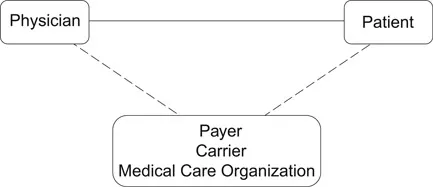
Figure 1.1 Relationship between the patient and the physician in the general health care system is modified by the third-party payer but remains primary in personal health care. (From The Praeger Handbook of Occupational and Environmental Medicine © Tee L. Guidotti. Reproduced with permission of ABC-Clio, LLC, all rights reserved.)
The path followed by the US and Canada is not the only way that occupational health services can be organized. In France, occupational health care is provided by well-organized specialized medical groups. In Finland, the occupational medicine physician is the primary care provider for working-age adults, performing a role much like the general or primary care internist in North America. In many developing countries, occupational health services have been the foundation for general health care in newly urbanized or settled areas of industrial development, as was true in North America in times past. For example, railroads and large employers such as Kaiser Permanente built much of the American health system and many of its most important institutions. Much of the health care system in the Middle East, Mexico, and Venezuela was built on the employee and dependent services infrastructure of the oil industry. Occupational health services sponsored by government have also been provided as part of a centrally-managed health care system in Quebec and Kuwait and in the socialist era in Eastern Europe and China.
The occupational health care system is built on different assumptions than the general or personal health care system. In a traditional fee-for-service setting, the primary relationship is that between physician and patient (the traditional “physician–patient relationship”), with the managed care organization, insurance carrier or other third-party payers influencing that traditional role (Figure 1.1). The degree to which third parties affect the physician– patient relationship has been very controversial and much debated but there is no real debate that the traditionally exclusive one-on-one physician–patient relationship of the past is over, at least in North America.
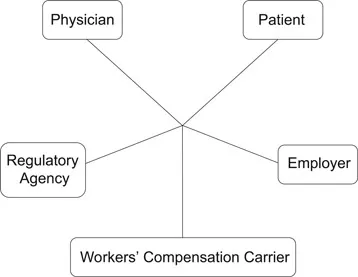
In occupational health care in North America, the number of players with a legitimate interest in the case and with influence on its management includes, at a minimum, the physician, the patient, the employer, a government regulatory agency (such as the Occupational Safety and Health Administration, OSHA), and the workers’ compensation carrier (Figure 1.2). The physician’s relationship to the patient is fundamentally the same but modified by other relationships and is governed by very explicit rules and procedures within the system which are designed to protect the legitimate interests of the employer and the carrier and by government regulation. The physician often acts outside the physician– patient relationship (see Chapter 3), reporting to the employer or to the carrier rather than on behalf of the individual patient. Among these agencies, information circulates subject to legal requirements, with accepted rules of confidentiality and authority for decisions and responsibility for compensation according to the role of each player.
Figure 1.2 In the occupational health care system, the treating physician is essential but only one element in a network in which information about the specific injury, responsibility, and authority is shared with others, including the employer, the workers’ compensation carrier, regulatory agencies (such as OSHA), and often workers’ advocates. (From The Praeger Handbook of Occupational and Environmental Medicine © Tee L. Guidotti. Reproduced with permission of ABC-Clio, LLC, all rights reserved.)

Organization of Occupational Health Services

Occupational health services can be divided into “on site” and “off-site” facilities and services. For a century, in-plant services dominated the delivery of occupational health care. Then, in the 1980s, major corporations more or less in unison adopted a set of congruent management policies that were applied to functions outside the company’s core business:
  • Outsourcing. Corporate medical departments were closed and the services were contracted out to practitioners outside the employer’s organization. This trend had the paradoxical effect of increasing the total number of occupational health professionals and the proportion based in the community. However, the trend resulted in a reduction of influence within companies, less engagement in the employer’s specific needs, and loss of familiarity with the workplace. Some employers are now recruiting again because they have found that they need sufficient in-house capacity to manage contractors and to deal with internal matters.
  • Delayering. Probably the most significant trend of all, delayering reduced or eliminated the upper- and middle-management layers of the company in order to streamline the organization, shorten the communications link, improve accountability, and increase efficiency. This trend was particularly important because these organizations lost the senior level of management that had been most familiar with occupational health services and its value proposition. Since outsourcing removed occupational health services from view and since the value of occupational health is rarely taught in business schools, new Master of Business Administration (MBA)-level managers almost never know how to manage occupational health services or how they contribute, unless they happen to have prior experience.
  • Downsizing. Downsizing was the trend toward drastic reduction in the size of organizations, to the minimum required to conduct business. The objective was to boost profitability, force gains in productivity, and to streamline operations. Later, this was modified to “right-sizing,” reducing the workforce to the optimum required to do business. With a much smaller workforce, many employers saw no need to maintain in-house occupational health services.
  • Devolution. Some employers substituted occupational health nurses for physicians or assigned reporting accountability for contract physicians to non-physicians, for functions that did not require a medical license. Many physicians were alarmed at the time and believed that nurses were taking their jobs, which led ...

Table of contents

  1. Cover
  2. Title
  3. Copyright
  4. Dedication
  5. Contents
  6. List of Figures
  7. List of Tables
  8. List of Boxes
  9. List of Exhibits
  10. List of Contributors
  11. Preface
  12. 1 The Occupational Health Care System
  13. 2 Workers’ Compensation
  14. 3 Occupational Health Law
  15. 4 Occupational Safety and Health Regulation
  16. 5 Ethics
  17. 6 Corporate and In-House Occupational Health Services
  18. 7 Global Occupational Health
  19. 8 Strategic Planning
  20. 9 Hospitals and Medical Groups
  21. 10 Staffing and Personnel
  22. 11 Facilities and Equipment
  23. 12 Office Procedures
  24. 13 Records
  25. 14 Professional Preparation and Training
  26. 15 Marketing
  27. 16 Services and Service Lines
  28. 17 Quality and Performance Indicators
  29. 18 Benefit and Cost Analysis
  30. 19 Primary Care-Level Clinical Services
  31. 20 Periodic Health Surveillance and Monitoring
  32. 21 Hazard Evaluation and Management
  33. 22 Fitness for Duty
  34. 23 Equal Access
  35. 24 Absence and Leave
  36. 25 Independent Medical Evaluation
  37. 26 Impairment Assessment
  38. 27 Drug and Alcohol Testing
  39. 28 Employee Assistance Programs
  40. 29 Psychological Health and Safety
  41. 30 Health Promotion
  42. 31 Emergency Management at the Enterprise Level
  43. 32 Medicolegal Services
  44. Appendix 1: An Occupational Health Audit
  45. Appendix 2: A Reference Bookshelf for an Occupational Health Service
  46. Index