![]()
1
Monstration
One day, I was walking down one of the wide tree-lined streets of Adelaide, the provincial city where I live in Australia, when I spied some graffiti. These two armed figures calling for ‘Brains’ were surprising. They brought to mind the graffiti art of the sixties and seventies known as the radical stencil movement, that began with the student-led revolution in France in 1968. Quick, cheap, mobile and easily reproducible, stencils were a perfect medium for plastering the streets with revolutionary pictograms and slogans. They often had a violent tinge to them, like the endlessly repeated image of one man holding a pistol to the head of another, underwritten by the word ‘Capitalism’. Zombie manifestations often draw on the mantras and icons of left-wing causes of the past – like the zombie chant: ‘What do we want? Brains! When do we want them? Now!’ Could this zombie graffiti have a revolutionary ancestry? If so, I had to wonder what the underlying idea or cause at work was here. I also wondered if this was the work of a sole zombieobsessed graffitist plastering the city’s telegraph poles with the zombie mantra: ‘BRAINS’, or was the ever-spreading zombie obsession building its own sub-culture in the churchy and rather elegant city of Adelaide?
My first answer to these questions came some time later at the annual zombie parade. Adelaide prides itself on not having started life as a penal colony and it also boasts a less blood-spattered colonial past than the rest of Australia, which some say explains its pronounced gentility. Surprise then to find Adelaidean zombies in the street in their thousands. This was no small zombie parade but a monstration equal to any of the zombie festivals being held in far more troubled cities across the world. Adelaide might not be Atlanta, Seattle or Pittsburgh (Brown, 2011) – cities fighting it out to claim the title of ‘zombie capital of the world’ – but here, as elsewhere, zombies were on the move.
It’s easy to assume that zombies find their following amongst the young and frivolous. Not so. Zombies are a dead menace when it comes to breaking down all kinds of barriers. On the screen they’ve shown a complete disregard for generic boundaries and at the Adelaide zombie parade they were showing scant regard for demographic boundaries. They were young and old, straight and queer, alone, in groups and en famille. As I walked through the crowds it was clear that here were people from both the Southern ‘burbs’ and the beau quartier. A few possessed an art school cool; others were proudly ‘bogan’.1 Some quaffed blood from champagne flutes; others chewed on bones as they chugged down a ‘tinny’.2
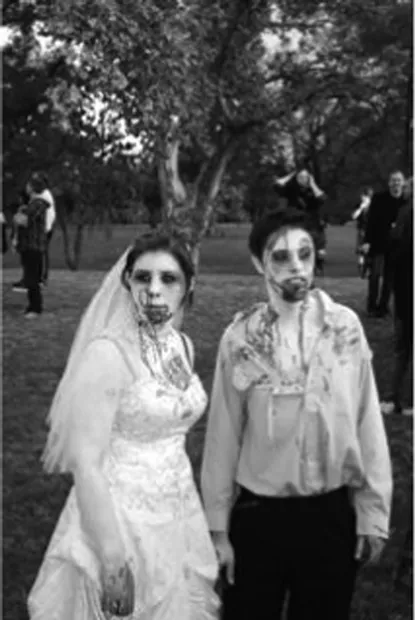
Zombies are the parvenus of the undead lacking the long ancestry of their vampire cousins – the modern Zombie only really takes form in Romero’s first film Night of the Living Dead (1968) – but these latter-day creatures were claiming a literary lineage that stretched back for centuries. Alongside the familiar shuffling figures of zombie notoriety – zombie doctors and nurses, zombie brides and their blood-spattered grooms, teddy-bear clutching zombie kids and their hungry mums, all the everyman and everywoman zombies of everyday life – there were Zombies cast from the entire character repertoire of text and screen. Bonneted and blood smeared, Elizabeth Bennet chewed wantonly on Mr Darcy’s edible bits. Zombie Snow-White and zombie Bo-Peep picnicked alongside Zombie hobbits and Hogwartians. Zombie soldiers of every epoch shared blood with their more familiar prototypes – zombie Nazis and zombie marines. A zombie Christ sprinkled blessings on a Japanese zombie flower girl who could have been one of those ravaged wanderers in the aftermath of Hiroshima. And, most strange of all, real life mums and dads paraded their real life kids as zombie offspring in gore-splattered cowboy suits and fairy dresses. These people were not just playing dress-ups with the walking dead, they were playing dress-ups with history, morphing the literal and literary past through the lens of the zombie fantasy as if to prove that everything – past, present and future – could be zombified. Given that the zombie narrative is all about an apocalyptic future, this reaching back into the past was a bit of a puzzle. I decided to put it on my list of bewildering things that need to be understood about zombies today. This list – beginning with the question, ‘What is a zombie?’ – has been proliferating for some time.
Bewilderment
When I first started watching zombie films about a decade ago, it was during a time in my life – I would have to say a very bad time in my life – when being hurled into the chaotic and violent world of a zombie film made me feel, frankly, at home. My own world had crumpled suddenly and I was surviving – just. Someone, the One, was acting like a zombie, and keeping myself and my children afloat in this strange new world of torn meanings felt like surviving a zombie apocalypse. Back then, The Zombie Survival Guide (Brooks, 2003) had not yet been written, so I made do with watching movies. Night after night, I would nurse myself to sleep with the comfort found in the dark, decombusting world of zombie.
In every zombie fiction (post-1968) there’s a moment, I call it the zombie moment, when a choice is offered to the protagonist: smash in the head of your husband, mother, sister, brother, child, or lover, or join them in a zombie embrace. It’s a situation all too familiar to anyone who’s been through a nasty divorce. Love in the universe of zombie is, to borrow Zygmunt Bauman’s (2003) term, in a ‘liquid’ state.3 No bond can endure a bite and the price of nostalgia is evisceration. Characters in zombie fictions have to respond to this changed emotional register with great alacrity lest enduring love translates into zombification. As Selina tells Jimmy in 28 Days Later (2002): ‘If someone gets infected you’ve got between ten and twenty seconds to kill them. It might be your brother or your sister or your oldest friend. It makes no difference.’
Figure 1.1 Zombie wedding, zombie parade, Adelaide, October 2012.
When survivors in zombie fictions step back from their loved ones – with a cricket bat in hand – it’s not just romantic love but the whole language and social organisation of love and family that is brought into question. This gesture – smashing in the head of the one you love – is repeated ad infinitum in zombie fictions as if its repetition could make habitable the intensity of the emotional violence that has become part of the everyday language of love. Sociologists argue the toss over whether the increased chaos of our emotional lives is creating new possibilities for ‘pure relationships’ (Giddens, 1992: 2), or new ways of making familial bonds, but zombie fictions deliver us into the raw violence of the divorce statistics. In a zombie fiction everyone is ultimately alone or at least bound for loneliness as one after another of the social bonds that bind them to others are lost to the zombie embrace. From my viewing point a decade ago, the ‘zombie embrace’ was an exercise in reality testing. Like all those survivors in a zombie fiction desperate to hold onto love or refind it in a new form, the cricket bat kept swinging. Love in the world of zombie is all about hungering for love but being hunted as meat: wanting love but ending up with blood on your hands.
German social theorist Ulrich Beck (Beck and Beck-Gernsheim, 2001: 203) calls the family ‘a zombie category’ arguing that it derives from nineteenth-century social institutions that have been superseded and yet still exert a powerful hold on our imaginary lives. In Beck and Beck-Gernsheim’s (2001) thesis, we don’t have a choice any longer to be ‘for others’ because our most intimate others are under an equal compulsion to be ‘for themselves’. They posit an unerotic and asexual contradiction at work fuelling the battleground of sexual relations.
Individualisation is tearing intimate relations apart, forcing each of us to adopt individual solutions to life strategies; with the breakdown of traditional social identities the antagonism between men and women over gender roles emerges at the very heart of social relations:
The ideal image conveyed by the labour market is that of the completely mobile individual regarding him/herself as a functioning flexible work unit, competitive and ambitious, prepared to disregard the social commitments linked to his/her existence and identity. This perfect employee fits in with the job requirements, prepared to move on whenever necessary.
(Beck and Beck-Gernsheim, 1995: 6)
Survivors in zombie fictions are always moving on. They take the ideal of the unfettered mobile modern worker to new heights as they travel across the country stripped of their homes, families and communities. Families are the first to disintegrate in the zombie apocalypse. The film 28 Weeks Later (2007) opens with a romantically engaged couple embracing as they prepare a communal meal in their boarded up farmhouse. Seconds later the zombies have battered down the doors and the man elects to save himself rather than defend his wife. The drama ensues from this first moment of betrayal when he chooses himself over the bonds of love and family. Reunited with his children they refuse to believe their mother is a zombie and return to their familial home to find her – in an ambivalent state. She is showing signs of zombification but is still human enough to entice the father to re-embrace her – giving her the opportunity for a revengeful bite. Zombified, the father becomes a rage-filled saturnine monster hunting down his children as if the only drive left in him is to destroy everything that grounds him to who he was and to who mattered to him in his earlier incarnation of a self bound to others. Sociologists of the family tend to quibble over just how faulty the modern family is contesting theoretic narratives such as Beck and Beck-Gernsheim’s (1995) as unduly pessimistic but zombie fictions are on the side of the pessimists.
Men in zombie films – even the human ones – tend to resume a primal state, a monstrous masculinity unbound by any collective or ethical imperative to serve social rather than singular needs. These monstrous men exercise a powerful dominion over women enforcing their return to domestic and sexual subservience, as if the apocalypse holds out the great promise that men will return to dominance and women to all fours. It’s a bewildering and fearful scenario or an exciting promise – depending on which side of the sexual divide you fall on. But from my side the question is: Why does the past shadow the future in the form of a regression to this most primitive division of a patriarch in dominion over all other men and in possession of all women? Are dead social forms merely sleeping and waiting their moment to reawaken? What if women are once again sexual commodities to be traded by men, and men are once more a band of brothers cowering under the threat of a primal father? And what else might re-emerge from the past if all the dead social forms start walking again? In zombie fictions the aftermath of the zombie apocalypse is always anterior to the present and the future is already captured by the past.
Zombie combusts in a world of fragmented lives, failed intimacies, uncertain futures and phobic discourses. Unemployment, the collapse of the meanings and values in which one’s identity is grounded, and the grief of a broken marriage – are the everyday crises of late modernity. In modernity, humans lose the consolation of religion and the shared identity of communal life, becoming ‘individuated objects, isolated in space, and set in motion according to universal “laws of nature” devoid of intention or design, and blind to their consequences’ (Ferguson, 1995: 10). In late modernity, even those forms of connectedness that modernity invented (nation, party, union, family), are shattering, leaving newly individuated subjects to quilt a meaningful life from a fragmenting yarn. Life in the late modern world holds few sureties. To be modern, as Zygmunt Bauman (2004) argues, is to be permanently at risk of falling prey to the unresolvable waste-disposal problem of modernity. It is to live in fear of being disembedded, atomised and at risk of being rendered waste: by redundancy; by the dissolution of bonds (families, communities, shared belief structures); or by the collapse that comes in the wake of radical, incessant change – of governments, states, borders, economies and environments.
As I write, another tsunami and another earthquake have hit Japan, a typhoon has killed over a thousand people in the Philippines, and a freak hurricane has devastated Auckland. Here in Adelaide the mercury mounts and, as we know from recent history, an incredibly dry country burns incredibly fast. 4Few nations have been untouched by the global sweep of these environmental catastrophes – so portentous in their grim warning of future horror. To be alive today is to live permanently in what Ulrich Beck defines as a globalised risk society (Beck, 1992). The threatening forces of modernisation are no longer localised. Hazards which used to assault local environments now threaten the planet affecting all humanity and all human life – unforeseen, imperceptible and beyond rational control. Nuclear fission, radioactive waste, the destruction of environments, fires, floods and freak storms, the death of forests, the chemical hazards of mass commodity production create a habitus of risk in which even the world’s most affluent are unable to protect themselves from the boomerang effect of unforeseen consequences and must dwell in a global state of doubt (Beck, 1992). Continuous war is the backdrop to this impending sense of doom. The twenty-first century has seen no end to the wars, death camps and gulags that killed 70 million in the horrorscapes of the twentieth century. The death toll continues to mount in a new century that opened with the longest war in US history (Bergen, 2011).
George Steiner (2001: 1–2) evokes this contemporary state as the end of the idea of beginning in a lost horizon of hope: ‘We have no more beginnings … inhumanity is, as far as we have historical evidence, perennial.’ As in Benjamin’s reading of Klee’s Angelus Novus, Steiner (2001: 17) faces the past and sees only wreckage upon wreckage, but, unlike Benjamin, Steiner finds futurity itself – the if, shall and will of the future tense that the human species alone inhabits – in radical doubt:
To repeat: violence, oppression, economic enslavement and social irrationality have been endemic in history, whether tribal or metropolitan. But the twentieth century has, owing to the magnitude of massacre, to the insane contrast between available wealth and actual misère, to the probability that thermonuclear and bacterial weapons could, in fact, terminate man or his environment, given to despair a new warrant. It has raised the distinct possibility or a reversal of evolution, of a systematic turnabout towards bestialisation. It is this which makes of Kafka’s Metamorphosis the key fable of modernity or which, despite Anglo-Saxon pragmatism, renders plausible Camus’ famous saying: ‘the only serious philosophical question is that of suicide’.
For Steiner this crisis is grammatical. The future tense is indispensable to the ‘language animal’, it is what enables us to live in the face of the incomprehensibility of individual death; it is our ‘passwords to hope’, a semantic force which in every use negates the limits of mortality and inculcates the idea of hope through the idea of the future (Steiner, 2001: 5). But the vision is bleak.
Zombie fictional scenarios seem to concur. In lieu of the modernist maxim ‘make it new’ zombie fictional works drive the future into a cul-de-sac of no return. They hold out no promise, no hope, only the working through of what it is that makes the present an endless prolepsis of ruin. They seem to be inviting us into a pleasurable anticipation of the nothing that is coming as if reiterating the Lacanian quip, ‘Why have something when you can have nothing?’ And yet in this celebration of a future fall they turn on the present expostulating, critiquing, adumbrating with the energy of a utopic visionary as to why the present is failing the future.
Critics often find zombies’ excursions into political critique burdensome as if zombie texts should stick to providing increasingly graphic and hyperreal scenes of exploding and disembowelling bodies. But political and social critique whether overt or covert, is as integral to the genre as is its splatterfest. Since its genesis in Romero’s Night of the Living Dead (1968), the modern zombie genre has interspersed its prophetic vision of an apocalyptic future with a ‘socio-political through-line’ (cited in Yakir, 1977: 60). In its famous last scene viewers are thrown out of the absurd condition of being holed-up in an abandoned farmhouse surrounded by ravenous dead people to the horror-scape of 1960s American race relations. Ben, the film’s black protagonist, survives a night of hell only to be shot and tossed on a bonfire by an all-white civil guard. In the Cuban film Juan of the Dead (2012), the government organises a manifestation against the ‘dissidents’ (i.e. the zombies) threatening to undermine the revolution but manifestation turns into a monstration as the red flags drown in blood. In Zombie Strippers (2008) the gyrations of rotten and decomposing women incite a sexual frenzy in their male onlookers and a desire on the part of the women onlookers to be the object of desire. Both men and women eagerly feed themselves to the zombies in a parody of today’s pursuit of how to become the desirable thing. Even in its most excessive moments of violent dismemberment the zombie genre is puzzling through what it means to be human today.
This unfolding open-ended dialogue with catastrophe (past, present and future), gives zombies an almost imperial power vis-à-vis other genres. No less mobile in the fictional world than they are in modern discourse, the zombie genre has undergone a generic explosion cannibalising other genres and infiltrating fictional forms from literary classics to crime thrillers and historical romances. Generic zombie forms continue to proliferate, there are zombie westerns, zombie animé, zombie porn, zombie chic lit, zombie queer, to mention just a few. Few popular series on television today are without a zombie reference. In the medieval television fantasy Game of Thrones (2011) zombies, or ‘white walkers’, are the ghouls of a mythic past returning to threaten the present. In the fourth season of the drug thriller Breaking Bad, a series about a local chemistry teacher turned drug dealer, the protagonist Walter White finally blows up lethal drug baron Gus, but not without a horrifically mutilated Gus rising from the rubble in mimicry of the walking dead (in the episode ‘Face Off ’, 2011). Even the acclaimed and multi-award-winning television drama In Treatment (2008) has its gesture to zombies, when the tension between troubled psychoanalyst Paul Western and his clinical supervisor and therapist...