- 352 pages
- English
- ePUB (mobile friendly)
- Available on iOS & Android
eBook - ePub
About this book
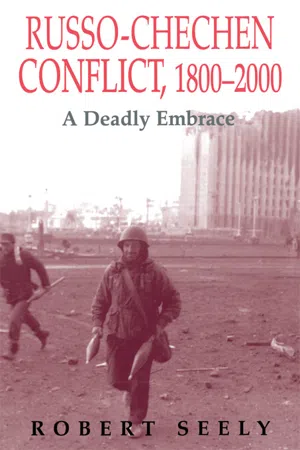
In 1994, the mountain territory of Chechnya was witness to the largest military campaign staged on Russian soil since World War II. The Russo-Chechen war is examined within the context of the bitter history between the two peoples, culminating in the expression of conflict from 1994-1996.
1
INTRODUCTION
In 1991, the small mountain territory of Chechnya was an almost unknown part of the Soviet Union, one of a myriad of hidden regions on its political and geographic fringes. Three years later, the territory was the target of the largest military campaign staged on Russian territory since the Second World War. The Chechen capital Grozny, established in the late eighteenth century as a frontier town for the expanding Russian empire, experienced a level of destruction not seen on the European landmass since the fall of Berlin in 1945. Tens of thousands of refugees fled south from Grozny and other cities into the mountains. Thousands more civilians, many of them elderly Russians, were killed by the Russian armed forces that had ostensibly come to save them from ethnic bloodshed. By the summer of 1996, and in circumstances of military humiliation unrivalled since the First World War, the Kremlin pulled out its 40,000-strong army. It had been defeated and demoralized by bands of armed guerrillas who numbered a fraction of the size of Russia's forces.
Three years later, Russian forces were ordered back into Chechnya, and again, in an attempt to subdue relatively small numbers of Chechen guerrillas, they bombarded from land and air dozens of Chechen settlements, killing hundreds, if not thousands, of civilians in the process. As this book goes to print, that battle, in which the protection of civilians has been all but ignored, is still raging.
This book charts the often bitter and bloodthirsty history between Russia and the Chechens, and seeks to explain why the latest outbreak of warfare between the two peoples took place and what its importance was to Russia. While I hope that both students and academics will find this work useful, the book is equally aimed at the lay reader interested in events either in Chechnya, the Caucasus or the Russian Federation.
Like most conflicts, the Chechen war was caused by the failure of politicians and soldiers to achieve their aims by peaceful means. Russian leaders failed to provide stability in Chechnya, while proving unable to deny Chechens practical independence. Chechen leaders offered their people neither a stable and defensible political framework outside the Russian Federation, nor some kind of workable modus vivendi within it.
The book is divided in two. The first part (Chapters 2–4) provides an overview of the major events which have taken place since the two peoples came into contact with each other two centuries ago, and explains the deep vein of hostility and incomprehension that a significant number of Chechens have, if not for Russians personally, then for the Russian state. It examines how Russia chose to colonize the north Caucasus mountain range, and how ethnic groups there chose to resist.
Dudayev's limited appeal to his own people was largely dependent on his role as the first ruler of an independent Chechen territory since the 1850s. Full-scale Russian colonization of the Caucasus began roughly 200 years ago and since then Chechens have rarely lived happily under Russian rule. When given the opportunity they have voted with their weapons – and lives – to state their claim to independence. Groups of Chechens raised rebellion against Moscow continually between 1815 and 1860; 17 times between 1860 and 1917; between 1917 and 1925; and during the late 1930s and 1940s. In 1944, Chechen relations with the Russian authorities reached a nadir when the Soviet Politburo decided to deport the entire Chechen population to central Asia. This traumatic event left roughly half of all Chechens dead and imposed a stigma which the Chechens waited for five decades to avenge. Most of the current generation of Chechen leaders were raised in conditions of impoverished captivity in central Asia.
The second part, roughly two-thirds of the book (Chapters 5–10), investigates the more immediate causes of the Russo-Chechen war of 1994–96. It charts the influence of Chechnya on the course of Russian politics, and shows that events in Moscow were at least as great an influence on the decision to go to war as events in Chechnya. For Western observers, the author makes a series of points, both in this chapter and from Chapter 5 onwards, about the nature of Soviet politics and the successes and failures of the transition from Soviet-era values to the politics of Boris Yeltsin and the new Russian state which emerged after 1991.
Chapter 4 examines the events in 1991, both in Moscow and in the northern Caucasus. Chechnya – or at least some of the political factions within it – declared independence from the Russian Federation in the autumn of 1991, weeks after the August putsch in Moscow which saw Boris Yeltsin famously jump on top of a tank and pledge to fight for the future of a democratic Russia against Soviet loyalists plotting the overthrow of President Mikhail Gorbachev. Three days after Yeltsin's declaration the Moscow coup collapsed through its own weakness, sounding the end of the Soviet Union. Although Gorbachev emerged safely from forced captivity in his Crimean dacha, his authority had been fatally weakened. During the coup Russia and the other 14 union republics – the major constituent parts of the USSR – all declared or reaffirmed their independence from the Soviet state.1
Boris Yeltsin's new Russian leadership promised a break from the failures and oppression of the Soviet era. Russia quickly accepted the independence of the three Baltic states – Lithuania, Estonia and Latvia – which had been seized illegally by the USSR on the eve of the Second World War. From 1992 onwards, the Kremlin also appeared to accept the independence of the 11 other Union republics which ringed Russia.
However, neither Yeltsin nor any Russian leader could countenance Chechen independence. The titular ethnic groups in the Union republics that declared independence may have harboured nationalist resentment towards Russia, but legally they were opting out of the Soviet Union, not the Russian Federation. By accepting the independence of the Union republics when he became the undisputed leader of Russia at the end of 1991, Yeltsin was accepting – albeit in a reluctant way – their legal right to secede from the Soviet Union. If he had acquiesced to Chechnya's independence from the Russian Federation, Yeltsin would have taken the process of territorial unravelling a step further by introducing it within his newly independent state. There were 19 other autonomous republics within the Russian Federation, along with other territories which might also have been tempted to demand independence for ethnic or political reasons. Yeltsin feared that accepting the independence of Chechnya would have been a de facto recognition that the process of state disintegration which had destroyed the Soviet Union would continue within the Russian Federation.
Yet if Russia had no intention of granting independence to Chechnya, it was too feeble to run out of Grozny the Chechen rebels loyal to a bizarre Soviet air force general, Dzkhokhar Musayevich Dudayev, who had seized power. An attempt in December 1991 to oust Dudayev before his regime had had time to settle failed in humiliating circumstances. The general emerged as vanquisher of the Russian army.
Although Russia's initial failure to oust him boosted the general's popularity among his fellow Chechens, Dudayev failed miserably as a politician. Chapter 5 examines how he managed to cling to power, and the possible reasons why he was able to agree to a retreat of the Russian army from Chechnya in one of the more extraordinary and murky episodes in the immediate aftermath of the USSR's collapse.
One of the most powerful factors which created the conditions for conflict in Chechnya in 1994 was the vicious rivalry for power between Boris Yeltsin and the Speaker of the Russian Parliament, Ruslan Khasbulatov, an ethnic Chechen. Chapter 6 examines the battle for power between the two. Linked to the fight between Yeltsin and Khasbulatov is one of the general points argued in this book – that political battles between individuals and groups in the Soviet Union were played out not in the semi-transparent field of party politics, but in part through the manipulation of rival ethnic groups on the political fringes of the Soviet Union. The manipulation of ethnic rivalries was a key tool by which authoritarian opponents of reform in the Soviet Union undermined Gorbachev's quasi-democratic initiatives in the late 1980s and early 1990s. This tactic was continued in Chechnya and other territories within the Russian Federation, and union republic territories which had been part of the Soviet Union.
In Chapter 7, allegations that Dudayev profited from Chechen links to powerful criminal/political/business ‘pyramids’ in Russia, which gave Moscow's leaders an incentive to ignore the Chechen chaos, are investigated. For some of the most powerful groups in Russia, a piece of Russian Federation territory, without Russia's already lax law or indolent police, was a useful thing to have. One of the most important, and depressing, trends in Russian politics examined here is the intertwining of criminal, business and political power, and accusations that the Chechen war was not so much a Clausewitzian case by other means, as gangsterism by other methods. One person who kindly gave an extended interview for this book, Galina Starovoytova, has since been assassinated.
The book investigates the role of the Russian armed forces in the crisis, examining also the incremental increase of the military's power since 1991, its failed attempt to retain some form of unified military structure within the former Soviet Union, and its role in both attempting to ferment, and later to control, armed conflict in the Caucasus.
In Chapters 8, 9 and 10, Russia's military performance is recounted and examined. Although the Soviet Union's military power was always likely to be stronger on paper than in reality, the war, graphically covered by television and in the press, reinforced how far standards in Russia's armed forces had collapsed. The invasion of Grozny is likely to serve as a model for how not to attack an occupied city. The Soviet Union did not lack experience in this field. In the Second World War, its armed forces liberated hundreds of towns and cities from Nazi Germany. More recently, the Soviets had staged a highly successful commando operation at the beginning of the invasion of Afghanistan in 1979 yet, when columns of slow-moving Russian armour rolled into Chechnya in December 1994, Russian military commanders clearly believed the republic would be subdued by nothing more than an overwhelming show of force by conscript troops – the tactics that had been used to crush the anti-Soviet uprising in Czechoslovakia in 1968 known as the ‘Prague Spring’. Instead of a few Molotov-cocktail-throwing students, Russian forces faced marauding gangs of skilled Chechens who picked off infantry carriers and tanks alike with sophisticated equipment, often purchased directly from Russian soldiers. Russian conscript troops who were not burned to death or shot down as they escaped their armoured death traps huddled together in panic and near-starvation in pockets throughout the city. The national humiliation discredited Yeltsin for months, and was accompanied by fears in Russia that the invasion of Chechnya was part of a wider campaign by powerful political, military and political figures around Yeltsin to undermine Russia's fragile constitution and install the president as dictator.
CHECHEN BACKGROUND: LAND AND PEOPLE
Chechnya is in the northern Caucasus region, now a southern Russian border territory. The southern half of Chechnya lies in the Caucasian mountain range. The region to which the mountains give their name runs roughly 500 miles, east to west, from the Caspian Sea to the Black Sea, and, north to south, from the Russian steppe to the Iranian and Turkish borders. In prehistoric days, population shifts brought tribes through the Caucasus on their way to eastern and central Europe. Most moved on, some settled. The mountain valleys that gave protection to the migrating tribes also cut them off from the world outside. As a result, the region is one of the most ethnically and linguistically diverse in the world, comprising over 40 ethnic groups, 30 languages and both Christian and Muslim (and, until the nineteenth century, Mazdeanist and animist) religions.
In the words of one Caucasus scholar:
The Caucasus was the key to the defense of the Islamic world, a land bridge between two seas, a link between two continents, open to the vast Eurasian steppe on the north, highroad to the Fertile Crescent to the south; it is a region where cultures have crossed and clashed for millennia. But it has also developed its own cohesiveness and regional unity: it is more than a mere geographical concept.2
By examining Greek and Roman myths about the origin of man, some scholars have speculated on whether the Caucasus was the seat of civilization, predating Babylon and Egypt, and that the first Atlantic Ocean was actually an enlarged version of what is now the Caspian Sea, while the Garden of Eden was situated just south of the northern Caucasian range.3 The Greeks believed that fire and metallurgy were discovered in the Caucasus. Early Arab geographers called the region jebel al-alsan, the mountain of languages.4
Landlocked Chechnya, which constituted the bulk of Checheno-Ingushetia, was one of an obscure pack of republics within the southern rim of the Russian Federation. In political terms, these autonomous republics were of little importance. They were small, poor and generally ignored. If one compares the Soviet Union to a matrushka doll, where each doll contains a smaller doll within, the Russian Federation was within the Soviet Union, and Checheno-Ingushetia was within the Russian Federation. Ingushetia, which spun off from the Checheno-Ingushetian republic to form its own autonomous republic in 1992, lies to the west of Chechnya's current borders.
The northern Caucasian region is the last remaining part of the Russian empire's nineteenth-century imperial acquisitions still within the boundaries of the European landmass of the Russian Federation. The 1989 Soviet census put the population of areas now in Chechnya at 1,084,000 people; this comprised 715,000 Chechens, 269,000 ethnic Russians and 25,000 Ingush. Further reference to the purpose of these ethnic republics will be made in the next section of the book; suffice it to say for now that the existence of these ‘republics’ was not based on their high ethnic populations. Ethnic Russians made up 67.6 per cent of the population of the non-Russian republics in the region, and remained culturally aloof from indigenous north Caucasians. Rarely, for example, did Russians speak the language of the ethnic group in whose republic they lived.
Apart from Chechnya, the region contained several other mountainous or semi-mountainous ‘ethnic’ territories. These were Dagestan to the east of Chechnya, North Ossetia, Kabardino-Balkaria, Karachaevo-Cherkessia, and Adygeia to the west. In their poverty and instability, a number of these non-Russian republics share a similar history to the Chechens. Most of these territories have seen violent disputes since 1991. North of the ‘ethnic’ northern Caucasus are three ethnically Russian regions which have historically been included in the northern Caucasus map and which had sizeable Cossack populations – Krasnodar, Stavropol and Rostov. Georgia, which was a full Union republic and therefore on a par with the Russian Federation, lay to the south of Chechnya below the southern Caucasus range. Georgia has been independent (to a degree) since 1991.
Throughout the Russian Federation, the indigenous ethnic groups were in most cases a minority within their ethnic territory. In Tatarstan, for example, by 1989 Russians constituted 43.5 per cent of the population and Tatars 48.5 per cent, while the majority of ethnic Tatars lived outside ‘their’ republic. Only 1.7 per cent of Jews lived in the Jewish Autonomous Region. Out of all 30 autonomous territories within Russia, the homeland's titular ethnic group was in a majority in only eight – the northern Caucasus territories of Dagestan, Checheno-Ingushetia, North Ossetia and Kabardino-Balkaria included.5 In most smaller territories, ethnic Russians were in a majority. In only one territory, Dagestan, where ethnic Russians made up 9.2 per cent of inhabitants, did they constitute less than 25 per cent of the population. The average population size of the titular ethnic group in all 30 territories was 37.6 per cent, while the average figure for ethnic Russians in those territories was 45.7 per cent.6
The non-Russian republics were united by low levels of industrialization. Before the collapse of the Soviet Union, over half the budgets of the north Caucasus republics were dependent on direct subsidy. They also had high rural populations: 43 per cent of the region's population was rural as compared to 26 per cent for the Russi...
Table of contents
- Front Cover
- Half Title
- Book Series
- Title Page
- Copyright
- Contents
- List of Illustrations
- Series Editor’s Preface
- Preface
- 1 Introduction
- 2 First Encounters
- 3 The Twentieth Century
- 4 Battles in the Centre: Coups in Chechnya
- 5 Dudayev’s Regime: The Handover of Soviet Military Hardware
- 6 From the October Putsch to the Chechen War
- 7 Guns, Oil, Drugs, Power: Other Theories about the War
- 8 The Military Operation
- 9 New Year’s Eve Attack on Grozny
- 10 The War in the Mountains
- 11 Epilogue
- Afterword: The Second Russo-Chechen War
- Bibliography
- Index
Trusted by 375,005 students
Access to over 1.5 million titles for a fair monthly price.
Study more efficiently using our study tools.
Frequently asked questions
Yes, you can cancel anytime from the Subscription tab in your account settings on the Perlego website. Your subscription will stay active until the end of your current billing period. Learn how to cancel your subscription
No, books cannot be downloaded as external files, such as PDFs, for use outside of Perlego. However, you can download books within the Perlego app for offline reading on mobile or tablet. Learn how to download books offline
Perlego offers two plans: Essential and Complete
- Essential is ideal for learners and professionals who enjoy exploring a wide range of subjects. Access the Essential Library with 800,000+ trusted titles and best-sellers across business, personal growth, and the humanities. Includes unlimited reading time and Standard Read Aloud voice.
- Complete: Perfect for advanced learners and researchers needing full, unrestricted access. Unlock 1.5M+ books across hundreds of subjects, including academic and specialized titles. The Complete Plan also includes advanced features like Premium Read Aloud and Research Assistant.
We are an online textbook subscription service, where you can get access to an entire online library for less than the price of a single book per month. With over 1.5 million books across 990+ topics, we’ve got you covered! Learn about our mission
Look out for the read-aloud symbol on your next book to see if you can listen to it. The read-aloud tool reads text aloud for you, highlighting the text as it is being read. You can pause it, speed it up and slow it down. Learn more about Read Aloud
Yes! You can use the Perlego app on both iOS and Android devices to read anytime, anywhere — even offline. Perfect for commutes or when you’re on the go.
Please note we cannot support devices running on iOS 13 and Android 7 or earlier. Learn more about using the app
Please note we cannot support devices running on iOS 13 and Android 7 or earlier. Learn more about using the app
Yes, you can access The Russian-Chechen Conflict 1800-2000 by Robert Seely in PDF and/or ePUB format, as well as other popular books in History & Military & Maritime History. We have over 1.5 million books available in our catalogue for you to explore.