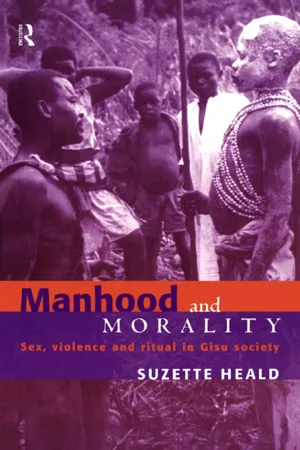
'An impressive and meticulously crafted African ethnography, which has theoretical and practical relevance for understanding masculinity and violence in general'- David Parkin, Professor of Anthropology, Cambridge University Manhood and Morality explores issues of male identity among the Gisu of Uganda and the moral dilemma faced by men who define themselves by their capacity for violence. Drawing extensively on twenty years of fieldwork and on psychological theory the book covers: circumcision
Oedipal feelings
witchcraft
deviance
joking
sexuality
and ethnicity.
This ethnographic study challenges our preconceptions of manhood, especially African virility, inviting a wider re-evaluation of masculinity.
- 208 pages
- English
- ePUB (mobile friendly)
- Available on iOS & Android
eBook - ePub
About this book
Information
1
INTRODUCTION
This book results from a long-standing dialogue with the Gisu of Uganda, a dialogue which began in the field and proceeded through an interrogation of my fieldnotes as I have attempted to bring different forms of understanding to their life as it was lived in the late 1960s. It consists of a series of essays on the interpretation of ritual, violence, sexuality and ethnicity.
The title of the collection, Manhood and Morality, does not imply a consistent pairing or equation of the terms, but two interwoven perspectives found in these essays. It seems necessary to state this partly because, teaching at the moment in Botswana, my male colleagues on hearing the title of the volume collapsed into laughter and I was teased for weeks. This reaction took me aback. Why did my colleagues not see men as ‘moral’? Was there something distinctive about Tswana cultural constructions of gender that prompted such mirth? True, women here, if only by their church membership and attendance, seem to have preempted the moral high ground and the ‘youth’ are seen as increasingly unaffected by the strictures of the old sexual morality and averse to taking the advice of their elders. Or was it a more general reaction? Something, perhaps, to do with the ambiguous relationship of young men in many cultures with regard to morality? If any one is going to have licence, it might be thought that it is they. But, a further factor was that these Tswana men were also academics. Was it then something in the current intellectual climate that created such an incongruous note?
With these questions on my mind, I turned again to the burgeoning new literature on masculinity. There, too, I found little in the way of an explicit moral dimension. Rather it tends to focus on the difficulties of ‘being male’, of living up (or more appropriately, down) to the cultural models of masculinity which are deemed to have hegemonic power (Brod, 1987; Carrigan et al. 1987; Cornwall and Lindisfarne, 1994; Connell, 1995). Under the influence of feminism, the theme of masculinity is now seen as inseparable from power; from male dominance and from the structures of society and its serving ideologies which have ensured the legitimisation and reproduction of that power. In the realm where all discourses are deconstructed, the idea of ‘moral man’ dissolves from a number of angles. In so far as an upright man can be identified with the privileges exercised within the established patriarchal order, he indeed is the ‘problem’. Such men cannot be seen as ‘moral’, for their power over women, over resources, symbolic as well as material, runs against the new ideals of gender equality and democratic egalitarianism. The pater familias is a very wobbly figure and can no longer stand as a repository of virtue. Indeed, the tendency in the new ‘men’s studies’ has been to focus on the variant forms of masculinity, with gay studies at one end of the spectrum (with its drag queens and bath houses) challenging sexual stereotypes and orthodoxies, and rogue males at the other, with research into the more macho images portrayed by ‘laddism’ or soccer hooliganism. Ideas of masculinity, far from assuming a unitary form, are now seen as fractured into a diversity of images and lived out in a multitude of ways.
Modern trends, whatever their origin, coalesce to reflect a sociology that privileges power as an explanatory concept, rather than the old Durkheimian view of culture as a moral order. In the 1960s, when the influence of the Frankfurt school began to be felt in Anglophone scholarship, the dictum, ‘the personal is political’, uniting the private (and, for Marcuse, the psychic) conflict with the public one, led to a focus on political action. Over time, this has largely displaced morality as a term in sociological discourse, associated as it is with a time before the gendered nature of power became a dominant issue and thus open to direct contestation. Wherever we look, the values by which it was thought we once lived are shown to serve interests not our own. Cultural orders are displayed as a series of multi-layered perspectives; sets of resources, adopted to further the interests of particular subjects, though often beyond their knowing.
Against this trend, the anthropological call for multi-vocality, for other voices to be heard, has an ironic ring since agency—the ability of people to establish their own meanings—is constantly challenged by textual approaches which deny them the authorship of their own narratives. So, just as the ‘subject’ has been decentred, so too have the terms by which such subjects live. Thus ‘morality’, as a word, has become suspect, a possible cover for entrenched privilege. So it now seems necessary to restate that the terms in which these debates about gendered identity are played out—and continue to unravel—are essentially moral. They are about the distribution of rights and privileges; about the nature of ethical action and the arenas in which that is displayed, judged and reflected upon. They are also about the very constitution of the person. And so, unfashionably perhaps, I will keep this concept, since it covers the terrain I wish to follow better than any other. It has another advantage in that as the abstractions of academic discourse get ever more removed from the terms of life, it provides a necessary link with lived worlds and living words.
This book takes up one particular aspect of this problem, in which the power that men claim—indeed own—is problematised not only in the observer’s analysis but in terms of the Gisu’s own self-conceptions. Manhood and morality are indeed inimical in so far as the characteristics of men are seen to pose difficulties for moral—that is ‘good’ — action. The morality about which I am talking in these essays is, however, not about issues of laxity or licence. It is about the moral dilemmas faced by men, whose very definition and self-conception is in terms of a capacity for violence. What it is to be a man, a legitimate man, is the burning issue for, like any hegemonic model, it defines in turn its own deviant forms of masculinity. These can be seen to be created at both ends of the spectrum, among men seen to be without the requisite violence and in those deemed to have too much.
Each chapter engages with a different issue in anthropology but a common thread of argument runs through them. The book turns first to Gisu circumcision ritual. This ritual may be said to establish the ‘problem’ for, in valorising masculinity as a symbol of ethnicity, it operates to define men as ‘dangerous’. Located in the nature of men, violence thus becomes a fixed point with which the Gisu grapple with the problems posed by social living. Operating in a situation which recognises little authority, either indigenous or imposed, the argument is that Gisu ethics addresses the problem of social control through the necessity for self-control. Self-assertion as the right of all men is thus coupled with restraint as the mark of the social self. This gives a particular understanding of African selfhood in the context of male egalitarianism in which the use and control of force is at the disposal of all. Most dramatically represented in the circumcision rituals (see Chapters Two — Four), it has a bearing on the reaction to crime with the criminal seen to be ‘out of control’ (see Chapter Five), and on the nature of divination as a sub-rosa technique for counteraction and vengeance (see Chapter Six). It then takes a different form in the consideration of the moral discourses embodied in kinship, sexuality and gender relationships (see Chapters Seven and Eight).
The chapters in this book all deal with a particular discourse of masculinity and its power to set the moral agenda. The general argument is that this is not necessarily in a way that is comfortable for men as the privileged gender. The attribution of violence is profoundly ambivalent. Might only sometimes equals right and, even where it does, its legitimacy and limits are open to question. As already implied, in the West, as the older codes of masculinity have come under threat, a crisis of masculinity is now more apparent than one involving women. And the attribution of men with the powers of destructive violence again provides a touchstone. In recent years, the assumption of childhood innocence has been rudely disturbed by highly publicised cases of child murderers, just as the assumption of gentle girls as opposed to unruly and truculent boys has coloured the way in which the behaviour of children is judged and punished. It is boys and not girls who fill the institutions of juvenile correction; it is men—particularly black men— and not women who fill the prisons for violent criminal offences. There is a ‘crisis on our streets’ shout the newspaper headlines. The police adopt the tactics of zero-tolerance, as do teachers in hard-pressed inner city schools. Both claim success, a little dent in the mounting toll of street crime. At the same time, parents, psychologists and educationalists worry about the socialisation of boys: why are they not turning out right? Parents are informed of the need for special compensatory socialisation, to make boys more like girls, that is more relational and empathetic. Teachers are urged to be less punitive in reaction to their ‘naughtiness’, redefining it perhaps as ‘attentiondeficit disorder’. And some wonder, amid all this, how, if boys are no longer to be allowed to be boys, they might at the same time preserve any pride in their masculinity?
That male violence is both lauded and feared is a commonplace in the discourses on masculinity. Often representing normative power, it is always in danger of running out of control into marginal, transgressive and destructive forms. The interest of this particular ethnographic example is the extreme way in which violent power is located in men, a source of their rights but also, I argue, a source of self-knowledge and responsibility. As such, it forms one of the basic parameters for moral discourse, both at an explicit level as recognised in the nature of moral judgements, and in the fears which colour everyday life. The Freudian adage that ‘man is wolf to man’ holds also the idea that man is wolf to himself. Men fear their own violence, their own violent responses and the onus throughout, therefore, is upon self-control. The good man is one who is his own master, and can master himself as well.
In this context, it is important to stress that issues of morality are not just about the power to do good and the difficulties of so doing. That, we might say, is the arena of the moral philosophers. More tangibly, in most social situations, they focus upon the power to do harm. Of course, such danger is not necessarily seen solely in terms of physical violence. A common African patterning is of covert female malevolence opposing overt male violence, with the latter often rendered as righteous. Indeed, going back to the Tswana example with which I started, in the course of writing I came to realise that I might have badly misinterpreted the reaction. Thinking about the Gisu, I had jumped to the wrong conclusion. For it is quite possible that the morality of men is not questioned in Botswana to anything like the same extent; indeed, men who control the public sphere are seen as the upholders of public morality and responsible action. Adulthood for both genders indeed is defined as ‘being responsible’ but the emphasis on female responsibility carries a symbolic load largely missing from that of men. Women’s very involvement with life processes, with the hidden powers of fecundity and death—in a common southern African idiom—generates a dangerous ‘heat’ which is opposed to the ‘cool’ activities of men (Comaroff, 1985). Stereotypically, women are also associated with witchcraft.
Cultural orders are built upon such asymmetries, and it goes to the heart of personhood and agency. Yet, the Gisu example alerts us also to the different ways such asymmetries are realised. There is no necessary complementarity. Among the Gisu, we could say that the human powers of men and women are portrayed on a single scale, in which men’s power of anger and destructive violence dominates the moral discourse so that they carry the burden of responsibility, and women to a large extent slip through the net. Women’s fertility here is not associated with polluting power and their access to witchcraft is also deemed less harmful. Also, in this moral universe, women appear to have considerably more negotiative freedom than men, since ‘harmless’ if not actually equating with ‘blameless’, at least renders it void. For these men, who have seen through the fear of death and come out with the scars that prove it, a man is rarely held to have just cause to fear a woman.
As Howell (1997) makes clear, the idea of morality in anthropology too easily slides into a more general concept of culture. If there is a distinctive anthropological approach, it perhaps lies in the linking of moralities with indigenous ideas of the person, as first argued by Read (1955). There are, indeed, good reasons for tying morality to persons, for the standards of conduct expected of different members of a society differ, as do the evaluative modes that apply to their transgressions. The idea of double standards has become the accepted vision of patriarchal orders, with its assumption of the penalisation of women who are denied the rights and liberties of men. This, of course, goes for the Gisu as well. There too, women gain access to livelihood—in this case, land—only through their relationships to men. There too, their jural rights are curtailed. But morality is never just a matter of double standards; it always involves multiple ones, with children held less responsible than adults, and so on. In this sense, all moralities are relative, within as well as without.
In turn, as has been said, it is not just a question of responsibility, for what colours this issue more than any other is the question not of agency but of danger. Thus, a second distinctive contribution can be traced to Mary Douglas. Her (1966) theory of taboo, concentrating on the defining power of danger, was at the same time a discourse on the nature of morality. Morality could be understood as being about the good, the bad and the dangerous. Yet, the dangers of the cosmos were not invariably used to support the dominant status system; they could undermine as easily as underline. Everything, she argued, needed to be read in context, and specifically in the context of action, where concepts become tactics as they are put to multifarious uses, with sometimes ironic effects.
The chapters which follow illustrate what one might call the twists and turns of the ethnographer’s task, as I have attempted to bring different forms of understanding to Gisu cultural practice. In one way or another, all the chapters deal with the paradoxes of culture, with the way schemas for living create, through the very imposition of given types of meaning, intractable moral dilemmas. These are dealt with not only at what might be called the practical level of daily life, in explicit precept and the problems of moral choice, but at an existential level in the way they are depicted in the collective texts of Gisu life, in the very patterning of kinship, as well as in belief and ritual. In an attempt to get beneath the surface, to grasp the subjective dimension in culture, the chapters all move from structural to phenomenological and psychological forms of understanding.
Yet, this very ethnographic craft leaves one at the same time with many loose ends. Partly, these derive from the themes still there in one’s fieldnotes, annotated now by an attenuated set of memories. Partly, they derive from changes in disciplinary perspectives, which force one back to reconsider one’s interpretations, again, and yet again. But, they also result in changes to that Gisu world itself, more influenced now by the globalising forces of modernity than they were Thirty years ago. What, for example, does one make of the recent astonishing case of a man who, in a defiant act of renunciation of his Gisu identity, invented (and legally registered) a whole new tribe? Or, the sheer resilience of the practice of Gisu circumcision? What is the nature of the tradition which continues with such strength? And, above all, what does one make of this particular gendering of ethnicity? These are the issues that I take up in the final chapter to this volume on tribal rites and tribal rights.
2
THE MAKING OF MEN
The relevance of vernacular psychology to the interpretation of a Gisu ritual
Introduction
In 1909 the Rev. J.B.Purvis wrote of the Gisu people of Eastern Uganda that they ‘distinguish themselves as a race apart from others by the name Basani, i.e., men, whilst all men of uncircumcised nations are called Basinde, i.e., boys’ (Purvis, 1909:271). In modern Uganda the idea of the Gisu as a nation of circumcised men remains as strong as ever.1 The biennial circumcision ceremonies act as both a focus for such sentiment and a dramatic display of its power. From the blowing of horns which ushers in the circumcision year to the final aggregation ceremonies during the following December the entire ritual cycle takes about a year. The actual operations are performed in August, in strict order of clan precedence, with the clan where the practice is believed to have originated cutting their boys first. The day after, the circumcisors move to the next clan territory and so on throughout Bugisu. At their height it would be no exaggeration to claim that the festivities involve the entire population of the district—some 500,000 people— from the young children carried along with the circumcision dancing parties to the elderly who are visited as relatives of the novices, approached for guidance on ritual matters, or act as spectators. At the centre are the novices, with the ordeal of circumcision acting not only to validate their own claim to status as adult men but also to demonstrate the values of the entire community.
When a ritual has this significance for a people, it is important to inquire into what values are being affirmed and why a single ritual complex is so charged. Jean La Fontaine has addressed herself to the focal character of the rituals on a number of occasions and sought the answer in the social and, specifically, the political implications the rituals have for the individual and the community.2 To take an example, one key feature is the fact that the rituals confer immediateadult status on the initiate. He ‘becomes an independent member of society and a member of his lineage on equal terms with his father’ (La Fontaine, 1967:253). This jural independence is matched by his right to economic independence; circumcision entitles him to gifts of land and bridewealth from his father, the effective wealth a man needs to establish an independent household. For the son, then, she writes, the ceremony is the ‘Open Sesame to independence’ (ibid.: 253), and this she has emphasised creates stress in the father and son relationship. In a system where power is related to wealth, ‘the careers of father and son are linked in that they depend on the use of the same resources, and in that, as a man provides for more and more of his adult sons, so his political power diminishes’ (ibid.: 254). Victor Turner, in his article on Gisu circumcision, endorses this conclusion and, more sweepingly, claims that circumcision gains its emotive force as a culturally focal symbol because it ‘represents an irresoluble conflict between disparate world views. On the one hand, the universalistic and egalitarian ethos of an age-set system; and, on the other, the localised particularism and gerontocratic authoritarianism of a narrowly patrilineal system’ (Turner, 1969:243). Since age-set systems have a tendency towards gerontocracy the terms of this contrast seem odd. Nevertheless, it can be agreed that there is an opposition between the ideals of essential equality of adult men and the system of authority that is implied in patrilineal transmission and hierarchic ranking in terms of age and genealogical seniority. Such conflict undoubtedly enters into the situation of circumcision and accounts for some of the specific characteristics of the ritual, both formal and informal.
Whether circumcision draws its emotive force from such a conflict is another matter. In the British structural tradition, both La Fontaine and Turner tend to treat questions of values in terms of social-structural principles. But if this makes us wiser to the social context and politicojural correlates of circumcision, we are no nearer understanding the specific connotations of the Gisu concept of manhood. To this end I would argue that we should take more seriously the explicit aims of the ritual. We need to ask what the Gisu perceive as happening to the boys through the ordeal of circumcision, and what change is achieved that makes the denotation ‘man’ appropriate thereafter.
In a number of writings, Geertz has expressed his dissatisfaction with the failure of the British structural approach to give adequate consideration and autonomy to the cultural level of belief.3 The resulting danger is that it ‘takes for granted what most needs to be elucidated’ (Geertz, 1966:42). His is a call for a more serious phenomenology where culture is seen to structure the psychological field in which the individual acts. In the particular context of rites de passage lack of consideration of this—the missing middle term—has led to a tendency to make a too-easy jump from ethnographic observation to classification as an instance of transition ritual without grasping the specific nature of the transition as it is perceived by the people themselves. It is, in part, a question, as Rosaldo has said, of ‘giving local contexts their due account’ (1980:261). And this is not simply a matter of detail, of filling out the permutations of theme, but intrinsic to the nature of the activity. As La Fontaine (1977:422) has commented, analyses which have followed the model set out by Van Gennep have tended to restrict the evidence to give a limited and unidimensional reading. Thus, similarity of social function—the formal conveyancing of the individual from one defined social position to another—has led to an emphasis on similarity of form. Yet the imagery of boundaries, crossings, passages and transitions which has been seen to accompany the recognition of status changes is not always enlightening. Indeed, it may lead not only to a false systematisation but prove also to provide a misleading set of metaphors. In the Gisu case, the rites do not just display a static drama of form but are more importantly concerned with a dynamic changing of ...
Table of contents
- Cover Page
- Title Page
- Copyright Page
- Acknowledgements
- 1: Introduction
- 2: The Making of Men
- 3: The Ritual Use of Violence
- 4: Every Man a Hero
- 5: Witches and Thieves
- 6: Divinatory Failure
- 7: Joking and Avoidance, Hostility and Incest
- 8: The Power of Sex
- 9: Tribal Rites and Tribal Rights
- Notes
- Bibliography
Trusted by 375,005 students
Access to over 1.5 million titles for a fair monthly price.
Study more efficiently using our study tools.
Frequently asked questions
Yes, you can cancel anytime from the Subscription tab in your account settings on the Perlego website. Your subscription will stay active until the end of your current billing period. Learn how to cancel your subscription
No, books cannot be downloaded as external files, such as PDFs, for use outside of Perlego. However, you can download books within the Perlego app for offline reading on mobile or tablet. Learn how to download books offline
Perlego offers two plans: Essential and Complete
- Essential is ideal for learners and professionals who enjoy exploring a wide range of subjects. Access the Essential Library with 800,000+ trusted titles and best-sellers across business, personal growth, and the humanities. Includes unlimited reading time and Standard Read Aloud voice.
- Complete: Perfect for advanced learners and researchers needing full, unrestricted access. Unlock 1.5M+ books across hundreds of subjects, including academic and specialized titles. The Complete Plan also includes advanced features like Premium Read Aloud and Research Assistant.
We are an online textbook subscription service, where you can get access to an entire online library for less than the price of a single book per month. With over 1.5 million books across 990+ topics, we’ve got you covered! Learn about our mission
Look out for the read-aloud symbol on your next book to see if you can listen to it. The read-aloud tool reads text aloud for you, highlighting the text as it is being read. You can pause it, speed it up and slow it down. Learn more about Read Aloud
Yes! You can use the Perlego app on both iOS and Android devices to read anytime, anywhere — even offline. Perfect for commutes or when you’re on the go.
Please note we cannot support devices running on iOS 13 and Android 7 or earlier. Learn more about using the app
Please note we cannot support devices running on iOS 13 and Android 7 or earlier. Learn more about using the app
Yes, you can access Manhood and Morality by Suzette Heald in PDF and/or ePUB format, as well as other popular books in Medicine & Health Care Delivery. We have over 1.5 million books available in our catalogue for you to explore.