- 432 pages
- English
- ePUB (mobile friendly)
- Available on iOS & Android
eBook - ePub
Electronic Media Management, Revised
About this book
The fifth edition of a classic text features important updates that reflect the enormous changes that have taken place in recent years - the Internet as an important information transmission format that is here to stay and convergence among media. This edition features thorough discussions on the Internet and convergence, as well as reflects the latest information on broadcast and cable regulations and policies. It also includes a fresh batch of case studies, and study questions. As in previous editions, this book also covers management theory, audience analysis, broadcast promotion, and marketing.
1
Broadcast Station Management
This chapter examines broadcast station management by
• defining management and tracing the roots of today’s management thought and practice
• identifying the functions and roles of the broadcast station general manager and the skills necessary to carry them out
• discussing the major influences on the general manager’s decisions and actions
As the year 2000 approached, many Americans were preoccupied with the projected havoc that the so-called “millennium bug” would inflict. They were flooded with predictions that the computer, the revolutionary technology that controls the nation’s transportation, utilities, banking, and many other institutions, would plunge society into chaos. And all because programmers had failed to anticipate the consequences—when a new century began—of identifying years only by their last two digits. In the event, of course, the new millennium began as the old one had ended, with only isolated problems.
That the dire predictions proved to be unfounded may be attributed to the fact that decision makers throughout the country acted. They digested the facts, contemplated the alternatives, formulated plans, and implemented them. In other words, they managed change.
Managing change is a way of life for broadcast station managers, who have to contend routinely with a shifting public policy climate and accelerating technological innovation. But that is only one of the challenges they confront. Like any other business, the station must be operated profitably if it is to survive and satisfy the financial expectations of its owners. At the same time, it must respond to the interests of the community it is licensed to serve by the Federal Communications Commission (FCC). Balancing the private interests of owners and the public interest of listeners or viewers is a continuing challenge.
A broadcast station engages in many functions. It is an advertising medium, an entertainment medium, an information medium, and a service medium. To discharge those functions in a way that satisfies advertisers, audiences, and employees is an additional challenge. Another challenge grows out of the increasingly competitive environment in which broadcast stations operate.
Internet and satellite radio are alternatives to radio stations, whose average weekly listenership is down two hours from the late 1990s.
Television station managers face continuing competition from wired cable, which added more than five million subscribers between 2000 and 2005.1 In the same period, direct broadcast satellite (DBS) services more than doubled their penetration of TV households to 19 percent.2 Add to the mix digital video recorders (DVRs), videocassette recorders (VCRs), digital video disk (DVD) players, the Internet, and other content-reception devices, and it is easy to understand why managers conclude that they face unprecedented competition.
Responsibility for a station’s operation is entrusted by the owners to a chief executive, usually called the general manager. As a result of the explosion in in-market consolidation of radio stations in the 1990s, many general managers found themselves running multiple stations or “clusters.” Typically, they are called market managers. This chapter will look at the functions and roles of the person charged with ultimate responsibility for the fate of a broadcast operation, be it a stand-alone or part of a cluster.
First, however, it will be helpful to consider what management is, as well as the evolution of management thought and practice during the lifetime of broadcasting.
MANAGEMENT DEFINED
If you were to ask a group of people what management means, chances are that each would offer a different definition. That is not surprising, given the diversity and complexity of a manager’s responsibilities.
Schoderbek, Cosier, and Aplin define it as “a process of achieving organizational goals through others.”3 Resource acquisition and coordination are emphasized by Pringle, Jennings, and Longenecker: “Management is the process of acquiring and combining human, financial, informational, and physical resources to attain the organization’s primary goal of producing a product or service desired by some segment of society.”4 Others view it from the perspective of the functions that managers perform. For example, Carlisle speaks of “directing, coordinating, and influencing the operation of an organization so as to obtain desired results and enhance total performance.”5
Mondy, Holmes, and Flippo expand those functions and underline the importance of people, as well as materials: “Management may be defined as the process of planning, organizing, influencing, and controlling to accomplish organizational goals through the coordinated use of human and material resources.”6 That is the definition that will be used in this book.
EVOLUTION OF MANAGEMENT THOUGHT
It is tempting to think of management as a comparatively modern practice, necessitated by the emergence of large business organizations. However, as early as 6000 B.C., groups of people were organized to engage in undertakings of giant proportions. The Egyptians built huge pyramids. The Hebrews carried out an exodus from Egyptian bondage. The Romans constructed roads and aqueducts, and the Chinese built a 1500-mile wall. It is difficult to believe that any of these tasks could have been accomplished without the application of many of today’s management techniques.
To understand current management concepts and practices requires familiarity with the evolution of management thought. It traces its start to the dawn of the twentieth century, when the foundations of what later would be called broadcasting were being laid. Just as broadcasting has evolved, so has systematic analysis of management. The dominant traits of different managerial approaches have been identified and grouped into so-called schools. The first was the classical school of management.
THE CLASSICAL SCHOOL
Classical management thought embraces three separate but related approaches to management: (1) scientific management, (2) administrative management, and (3) bureaucratic management.
Scientific Management
At its origin, scientific management focused on increasing employee productivity and rested on four basic principles:
• systematic analysis of each job to find the most effective and efficient way of performing it (the “one best way”)
• use of scientific methods to select employees best suited to do a particular job
• appropriate employee education, training, and development
• responsibility apportioned almost equally between managers and workers, with decision-making duties falling on the managers
The person associated most closely with this school is Frederick W. Taylor (1856–1915), a mechanical engineer, who questioned the traditional, rule-of-thumb approach to managing work and who earned the title “father of scientific management.”
Taylor believed that economic incentives were the best motivators. Workers would cooperate if higher wages accompanied higher productivity, and management would be assured of higher productivity in return for paying higher wages. Not surprisingly, he was criticized for viewing people as machines.
However, his contributions were significant. Management scholar Peter Drucker attributes to Taylor “the tremendous surge of affluence … which has lifted the working masses in the developed countries well above any level recorded before.”7 Job analysis, methods of employee selection, and their training and development are examples of ways in which principles of scientific management are practiced today.
Administrative Management
If Taylor was the father of scientific thought, the French mining and steel executive Henri Fayol (1841–1925) can lay claim to being the father of management thought. While Taylor looked at workers and ways of improving their productivity, Fayol considered the total organization with a view to making it more effective and efficient. In so doing, he developed a comprehensive theory of management and demonstrated its universal nature.
His major contributions to administrative theory came in a book, General and Industrial Management, in which he became the first person to set forth the functions of management or, as he called them, “managerial activities”:
• Planning: Contemplating the future and drawing up a plan to deal with it, which includes actions to be taken, methods to be used, stages to go through, and the results envisaged.
• Organizing: Acquiring and structuring the human and material resources necessary for the functioning of the organization.
• Commanding: Setting each unit of the organization into motion so that it can make its contribution toward the accomplishment of the plan.
• Coordinating: Unifying and harmonizing all activities to permit the organization to operate and succeed.
• Controlling: Monitoring the execution of the plan and taking actions to correct errors or weaknesses and to prevent their recurrence.8
To assist managers in carrying out these functions, Fayol developed a list of 14 principles (Figure 1.1). He did not suggest that the list was exhaustive, merely that the principles were those that he had needed to apply most frequently. He warned that such guidelines had to be flexible and adaptable to changing circumstances.
Figure 1.1 Fayol’s 14 principles of management.
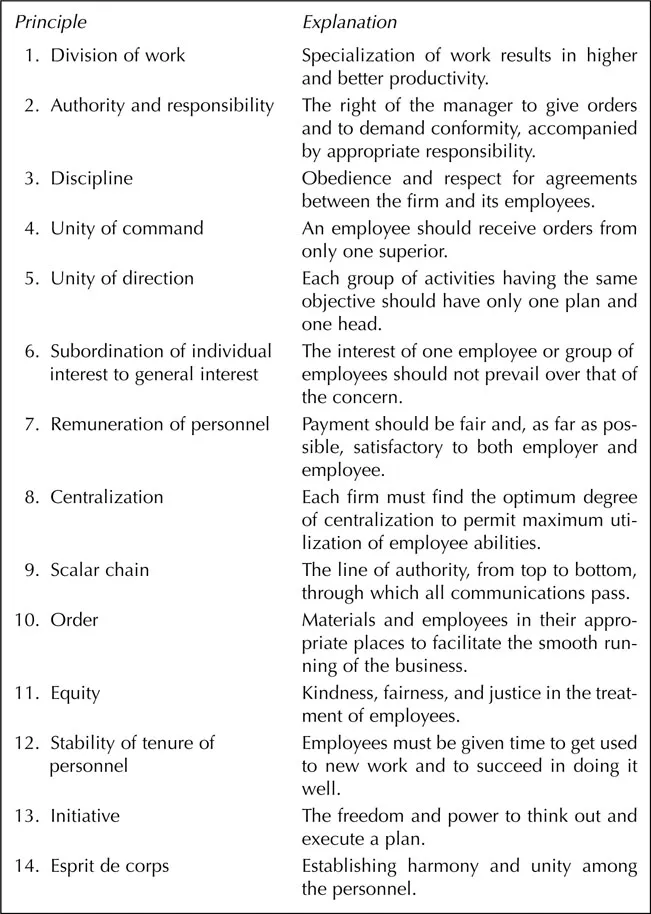
(Source: Henri Fayol, General and Industrial Management. Translated by Constance Storrs. London: Sir Isaac Pitman and Sons, 1965, pp. 19–42. The explanations have been paraphrased.)
Fayol’s contributions may appear to be merely common sense in today’s business environment. However, the functions of planning, organizing, and controlling that he identified are still considered fundamental to management success. Many of his principles are incorporated in business organization charts and, in the case of equity, are enshrined in law.
Bureaucratic Management
At the same time that Taylor and Fayol were developing their thoughts, Max Weber (1864–1920), a German sociologist, was contemplating the kind of structure that would enable an organization to perform at the highest efficiency. He called the result a bureaucracy and listed several elements for its success. They included:
• division of labor
• a clearly defined hierarchy of authority
• selection of members on the basis of their technical qualifications
• promotion based on seniority or achievement
• strict and systematic discipline and control
• separation of ownership and management9
It is unfortunate that contemporary society associates the word bureaucracy with incompetence and inefficiency. While it is true that a bureaucracy can become mired in rigid rules and procedures, Weber’s ideas have proved useful to many large companies that need a rational organizational system to function effectively, and they have earned him a berth in the annals of management thought as “the father of organizational theory.”
Contributors to the classical school of management concerned themselves with efforts to make employees and organizations more productive. Their work revealed several of ...
Table of contents
- Cover
- Halftitle
- Title
- Copyright
- Contents
- Preface
- Acknowledgments
- CHAPTER 1. BROADCAST STATION MANAGEMENT
- CHAPTER 2. FINANCIAL MANAGEMENT
- CHAPTER 3. HUMAN RESOURCE MANAGEMENT
- CHAPTER 4. BROADCAST PROGRAMMING
- CHAPTER 5. BROADCAST SALES
- CHAPTER 6. BROADCAST PROMOTION AND MARKETING
- CHAPTER 7. BROADCAST REGULATIONS
- CHAPTER 8. MANAGING THE CABLE TELEVISION SYSTEM
- CHAPTER 9. PUBLIC BROADCAST STATION MANAGEMENT
- CHAPTER 10. ENTRY INTO THE ELECTRONIC MEDIA BUSINESS
- Appendix A. TV Parental Guidelines
- Appendix B. Excerpt from Membership Drive Producer’s Manual
- Glossary
- Bibliography
- Index
Trusted by 375,005 students
Access to over 1.5 million titles for a fair monthly price.
Study more efficiently using our study tools.
Frequently asked questions
Yes, you can cancel anytime from the Subscription tab in your account settings on the Perlego website. Your subscription will stay active until the end of your current billing period. Learn how to cancel your subscription
No, books cannot be downloaded as external files, such as PDFs, for use outside of Perlego. However, you can download books within the Perlego app for offline reading on mobile or tablet. Learn how to download books offline
Perlego offers two plans: Essential and Complete
- Essential is ideal for learners and professionals who enjoy exploring a wide range of subjects. Access the Essential Library with 800,000+ trusted titles and best-sellers across business, personal growth, and the humanities. Includes unlimited reading time and Standard Read Aloud voice.
- Complete: Perfect for advanced learners and researchers needing full, unrestricted access. Unlock 1.5M+ books across hundreds of subjects, including academic and specialized titles. The Complete Plan also includes advanced features like Premium Read Aloud and Research Assistant.
We are an online textbook subscription service, where you can get access to an entire online library for less than the price of a single book per month. With over 1.5 million books across 990+ topics, we’ve got you covered! Learn about our mission
Look out for the read-aloud symbol on your next book to see if you can listen to it. The read-aloud tool reads text aloud for you, highlighting the text as it is being read. You can pause it, speed it up and slow it down. Learn more about Read Aloud
Yes! You can use the Perlego app on both iOS and Android devices to read anytime, anywhere — even offline. Perfect for commutes or when you’re on the go.
Please note we cannot support devices running on iOS 13 and Android 7 or earlier. Learn more about using the app
Please note we cannot support devices running on iOS 13 and Android 7 or earlier. Learn more about using the app
Yes, you can access Electronic Media Management, Revised by Peter Pringle,Michael F Starr in PDF and/or ePUB format, as well as other popular books in Business & Management. We have over 1.5 million books available in our catalogue for you to explore.