- 512 pages
- English
- ePUB (mobile friendly)
- Available on iOS & Android
eBook - ePub
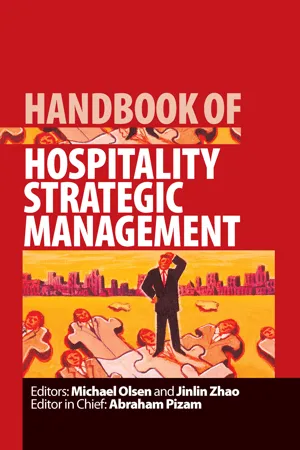
Handbook of Hospitality Strategic Management
About this book
Handbook of Hospitality Strategic Management provides a critical review of mainstream hospitality strategic management research topics. Internationally recognized leading researchers provide thorough reviews and discussions, reviewing strategic management research by topic, as well as illustrating how theories and concepts can be applied in the hospitality industry. This book covers all aspects of strategic management in hospitality.
The depth and coverage of each topic is unprecedented. A must-read for hospitality researchers and educators, students and industry practitioners.
Part OneStrategy in general
CHAPTER 1Travel 2015: scanning the environment—the next big thing in travel and tourism
1President, Forecasting International Arlington, VA, USA
2Professor & ARAMARK Chair of Global Strategy & Development, Hotel, Restaurant & Institutional Management, Lerner College of Business & Economics, The University of Delaware and Conti Distinguished Professor at the Pennsylvania State University's School of Hotel, Restaurant and Recreation Management Newark, DE
3Research Associate, Forecasting International Arlington, VA, USA
DOI: 10.4324/9780080914343-2
Introduction
Travel and tourism form one of the largest and fastest growing industries, both in the United States and throughout the world. This sector also is changing rapidly. In this chapter (which has been adapted from a forthcoming book of the name: Travel 2015: The Next Big Thing in Travel and Tourism), the senior authors—one a prominent and widely respected forecaster, the other ARAMARK Chair of Hotel and Restaurant Management at the University of Delaware—offer a clear-eyed and compelling look into the future of this diverse field. In addition, they provide tools with which readers can begin to make useful forecasts for their own companies and careers.
This is a chapter to examine the future of tourism, travel, transportation, and related services.
Overview
The travel and tourism industry is accustomed to good times. Yet for some years, travel suffered. And because it was unprepared for adversity, it suffered more than it needed to. Today, prosperity has returned, but there are warning signs that we still could see another period of declining travel and pinched revenues. This chapter will tell readers what lies in the future and provide an introduction to forecasting, a critical management tool for turbulent times.
The terrorist attacks of September 11, 2001, more than decimated the travel industry. International tourism to the U.S. plunged by 70%. Even such evergreen attractions as Disney World, Washington, and Las Vegas were forced to cut back, and profits collapsed throughout the industry. In the United States, airlines alone laid off an estimated 100,000 workers. Travelrelated firms in Europe and Asia suffered similar declines. More recently, SARS and hostility over Europe's position on the Iraq war have aggravated this already-grim situation.
These problems could not have been avoided, but it might at least have been possible to prepare for them. In 1994, author Marvin Cetron and his colleagues at Forecasting International carried out a study of terrorism for the Pentagon. Their report, Terror 2000, specifically predicted events that to many people then seemed unthinkable. These included a massive assault on the World Trade Towers, an attack on the Pentagon using a commandeered airplane, and the delivery of simultaneous blows by Muslim extremists against widely separated targets. If this study had been undertaken for the hospitality industry, the implications would have been obvious; hotel, resort, and airline executives at least could have managed their resources to weather the coming storm.
Those insights—still vitally important in the post-9/11 world—are only a small part of what this chapter has to offer. This chapter will tell readers what to expect in the travel and tourism industry for the rest of this decade. In this book, we will examine both general issues, such as the state of the economy and the supply of suitable workers, and specific trends that are now changing important industry sectors. We will cover hotels and resorts, airlines, cruise lines, and other aspects of this field. In addition, we will reveal the specific trends that Forecasting International uses to make its forecasts and tell readers how they can be used to predict their own futures.
The pressing need to look ahead is a lesson that many people have learned well in recent years. Economic boom and bust, technological change, international competition, terrorism, and other predictable forces have destroyed some industries, created others, and left none untouched. No one at the level of middle management or above, and no student preparing for a career, can do his job without keeping one eye on the future.
We believe that many executives, teachers, and students in the travel and tourism industry will be eager for an advance look at the years ahead. The next few years will be a challenging time, and these potential readers will need all the help we can offer them.
Part I: common concerns for the hospitality industry
Forecasting, a quick introduction
There is nothing arcane, or even particularly difficult, about anticipating what is to come. However, sound forecasting does require a good sense of what is going on in the world, the ability to look at new information objectively, and some practice at relating general trends to the specific conditions of an industry or company. This chapter will explain the strengths and limitations of forecasting and introduce the methods by which Forecasting International arrives at its insights. This will serve to reassure sceptical readers that the predictions made in this book are worth listening to.
Money matters
The single greatest factor shaping the future of the travel and tourism industry is the condition of the U.S. economy. When Americans are prosperous, the world's hotels, airlines, cruise ships, and destinations flourish as well. When Americans feel poor, the impact is felt around the world. Regionally, the economies of Europe and Japan have similar influence on this consumer-sensitive industry. In the years ahead, the economies of China and India will become nearly as influential as that of the United States.
Forecasting International has long believed that the U.S. economy would be generally strong through at least this decade, with only temporary, relatively mild interruptions. The post-9/11 recession has done nothing to change that view, and current data indicates that a healthy recovery has begun. This augurs well for the travel and tourism industry through at least 2010. Beyond that, the health of the economy depends significantly on federal tax and spending policies in ways that we will make clear.
For other economies, the picture is mixed. We will make concrete forecasts for them late in the production schedule.
Grey power
Throughout the developed world, populations are growing older. The elderly live longer, thanks to healthier living and better medical care, and the vast Baby Boom generation, now nearing retirement, is being followed by much smaller generations. By 2025, the number of people age 15–64 in Germany, Italy, Japan, and Spain—among other countries—will see doubledigit declines, while the number of elderly grows rapidly. Japan has the highest average longevity in the world and a birth rate so low that by 2050 its population is expected to decline by 30%, while the senior population grows to nearly 37% of the total. Thus, in 2025 more than 18% of the American population will be age 65 or older, up from 12% today. Throughout the world, the ranks of 60-year-olds and older are growing 1.9% per year, 60% faster than the overall world population. People over 65 made up only 15% of the population in the developed world in 2000, but will goasis:row to 27% of the population in the next half-century.
Add to this the growing concentration of wealth among seniors, thanks to their longer time for earning and investment and the contribution of social security benefits in most of the developed world, and we see a trend that will have a profound impact on hospitality and travel. More and more of the hospitality industry's guests will be seniors. Many will be healthier than their parents and grandparents were at the same age, and they will demand more active, adventurous vacations than previous generations of seniors could endure, much less enjoy. Yet others will be frail or sickly and will need care and assistance that destinations are accustomed to providing. And all are likely to require special accommodations for their changing needs. Hotels will require arthritis-friendly handles on doors and faucets—levers, rather than knobs—brighter lighting, and signs that are easier to read, with larger lettering and less clutter. Restaurants will need to provide meals with more intense flavours suited to the declining acuity of older palates. And personnel throughout the industry will require training to attend better to the needs of the elderly. These and other changing demands will be a continual challenge to travel and tourism.
Personnel
The supply of entry-level and low-wage workers is shrinking throughout the developed world, while the travel and tourism industry continues to need ever more inexpensive, personable, and well-trained people to care for its guests. In the years ahead, the industry will meet this problem by recruiting from among retirees and other relatively underutilized groups of potential employees. Inevitably, it also will recruit from younger generations of workers, whose values and expectations vary significantly from those of their parents, older siblings, and company superiors. Finally, new educational techniques and certification opportunities will change the process of training new employees and teaching them the corporate culture. Many companies will find themselves teaching many of their new hires English as a second language. All these factors will modify personnel and management practices in important and sometimes unexpected ways.
Impact of new travel technology
In the next few years, airliners will goasis:row larger, faster, and more efficient. Cruise ships will become larger, more efficient, and better equipped with high-tech amenities such as instant Internet access. The United States may finally begin to replace regional air travel with high-speed rail. “Intelligent” highways will speed ground transportation throughout the developed world. Rail, too, is becoming ever more important for middle-distance travel as high-speed rai...
Table of contents
- Cover Page
- Half Title Page
- Title Page
- Copyright Page
- Table of Contents
- List of contributors
- Acknowledgements
- Preface
- Part One Strategy in general
- Part Two Strategy as investments in competitiveness
- Part Three Core competencies
- Part Four Functional competencies
- Part Five Decision-making
- Part Six Implementation
- Part Seven Strategy and multiunit issues
- Conclusion
- Index
Trusted by 375,005 students
Access to over 1.5 million titles for a fair monthly price.
Study more efficiently using our study tools.
Frequently asked questions
Yes, you can cancel anytime from the Subscription tab in your account settings on the Perlego website. Your subscription will stay active until the end of your current billing period. Learn how to cancel your subscription
No, books cannot be downloaded as external files, such as PDFs, for use outside of Perlego. However, you can download books within the Perlego app for offline reading on mobile or tablet. Learn how to download books offline
Perlego offers two plans: Essential and Complete
- Essential is ideal for learners and professionals who enjoy exploring a wide range of subjects. Access the Essential Library with 800,000+ trusted titles and best-sellers across business, personal growth, and the humanities. Includes unlimited reading time and Standard Read Aloud voice.
- Complete: Perfect for advanced learners and researchers needing full, unrestricted access. Unlock 1.5M+ books across hundreds of subjects, including academic and specialized titles. The Complete Plan also includes advanced features like Premium Read Aloud and Research Assistant.
We are an online textbook subscription service, where you can get access to an entire online library for less than the price of a single book per month. With over 1.5 million books across 990+ topics, we’ve got you covered! Learn about our mission
Look out for the read-aloud symbol on your next book to see if you can listen to it. The read-aloud tool reads text aloud for you, highlighting the text as it is being read. You can pause it, speed it up and slow it down. Learn more about Read Aloud
Yes! You can use the Perlego app on both iOS and Android devices to read anytime, anywhere — even offline. Perfect for commutes or when you’re on the go.
Please note we cannot support devices running on iOS 13 and Android 7 or earlier. Learn more about using the app
Please note we cannot support devices running on iOS 13 and Android 7 or earlier. Learn more about using the app
Yes, you can access Handbook of Hospitality Strategic Management by Michael Olsen,Jinlin Zhao in PDF and/or ePUB format, as well as other popular books in Business & Business Strategy. We have over 1.5 million books available in our catalogue for you to explore.