- 272 pages
- English
- ePUB (mobile friendly)
- Available on iOS & Android
eBook - ePub
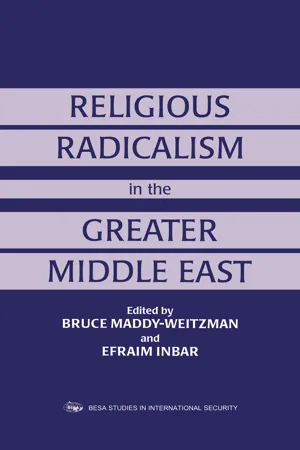
Religious Radicalism in the Greater Middle East
About this book
This collection offers a political analysis of religious radicalism in the Greater Middle East - comprising the Middle East, Central Asia and North Africa. The contributors present various conceptual perspectives including international relations, Middle East studies and political sociology.
Information
Egypt’s Struggle against the Militant Islamic Groups
ELIE PODEH
This study deals with the militant Islamic challenge to the Egyptian regime during the early 1990s. The article analyzes the militant Islamic groups’ modes of operation and the regime’s counter-measures. This analysis leads to the conclusion that although the Islamic groups are a major source of instability in Egypt, their ability to overthrow the government and to establish an Islamic order is doubtful. The militant Islamic groups would be able to pose a viable alternative to the regime only if they could overcome the disputes among themselves, broaden their socioeconomic infrastructure, penetrate the army and find a charismatic leader capable of attracting and leading the masses.
Historical Background
In the summer of 1983, Egyptian Interior Minister Hasan Abu Basha suggested that ‘the phenomenon of radical religious groups is gradually disappearing’1 His statement followed the execution of President Anwar al-Sadat’s assassins, members of an Islamic militant group called al-Jihad. Twelve years later, in June 1995, during a visit to Ethiopia, President Husni Mubarak barely escaped an assassination attempt, presumably carried out by one of the Egyptian militant Islamic groups.2 This episode clearly demonstrated that these groups still pose a serious threat to the stability and legitimacy of the regime.
The Islamic movement in Egypt has been the subject of numerous studies.3 The abundance of such efforts, concentrating on the historical and sociological dimensions of the Islamic movement, were primarily motivated by Egypt’s political and cultural centrality in the Arab and Muslim worlds.4 This article attempts to shed new light on the confrontation between the regime and the Islamic militant movement during the early 1990s by focusing on the latter’s modes of operation and on the regime’s counter-measures.
The main argument of this article is that although the militant Islamic groups are still a major source of instability in Egypt, their ability to overthrow the government and to establish an Islamic order based on the shari‘a is very much in doubt. Moreover, several drastic measures taken by the regime against these groups during recent years (1993–95) served to undermine their infrastructures.5 Consequently, the threat to the regime may arise from a different front: the veteran Muslim Brotherhood (al-Ikhwan al-Muslimin), a grass-roots movement which has advocated a non-violent struggle against the regime and has therefore attracted many followers in Egypt. This last point however, is not the focus of this chapter, as it requires a separate study.6
John Esposito suggested three causes for the regional resurgence of Islam. First, secular nationalism has failed to provide a common identity or a strong base of legitimacy for the secular regimes in light of the residual effects of European colonialism, continued dependence on the West and the disastrous results of the 1967 War – which crippled the Arab nationalist movement. Second, many states inadequately responded to their respective societies; they failed to achieve economic self-sufficiency or to slow the rapidly widening gap between the haves and have-nots. And third, the 1973 October War and the accompanying oil embargo created a new-found sense of pride and power. Thus, the inability of the secular Arab leaders to respond to these extreme psycho-social developments fostered the development of a ‘third way’, an Islamic option distinct from capitalism or communism.7 Ansari and Auda furthered the sociological analysis of the Islamic resurgence by noting that it was a consequence of ‘the breakdown of traditional solidarities and communal ties under the impact of urbanization or rural migration into the cities’.8
In general, the Egyptian model coincides with these analyses: the legacy of British colonial rule; excessive dependence, first on the Soviet Union, and subsequently on the United States; harsh economic and social realities, a product of both ‘Abd al-Nasir’s nationalization and Sadat’s ‘open door’ policies; the former’s humiliating defeat in 1967 and the ideological vacuum that was created with the receding influence of pan-Arabism. Taken together, these developments have served as a catalyst for the rise of Islam in Egypt since the late 1960s.
The most significant Islamic group in modern Egypt, the Muslim Brotherhood, was founded by Hasan al-Bana in 1928.9 The suppression of this movement by ‘Abd al-Nasir in the mid-1950s (following its attempt to assassinate him) left an ideological vacuum that was filled by Sayyid Qutb, whose writings attracted many young followers during the 1960s. In his famous booklet Ma’alim fi al-Tariq (Milestones), Qutb called for the overthrow of the ‘infidel’ ‘Abd al-Nasir’s regime and for the formation of an Islamic state based on the shari‘a.10 His militant ideology, which found a receptive ear among the Egyptian dispossessed, led to his execution in 1966. Nevertheless, Qutb’s ideology remained a powerful force, serving as a guide for many devoted Muslims. It also filled the ideological vacuum that resulted from the decline of ‘Abd al-Nasir’s pan-Arabism and the difficulties associated with Egypt’s harsh economic reality; many Egyptians adopted Qutb’s violent prescription for remedying the society. By 1981, the proliferation of militant Islamic groups attested to the gravity of the challenge facing the regime.
Al-Jihad, one of these militant Islamic groups, clearly demonstrated the severity of the Islamic threat when they assassinated President Sadat in October 1981. However, the Islamic movement was not in a position to seize power and, apart from a short-lived rebellion in Asyut, the transfer of authority to the vice-president, Husni Mubarak, went smoothly. With the arrest of many militant activists, the government succeeded in subduing the internal opposition.
The harsh steps against the militants were successful for only a short period. After a relative lull of three years, the Islamic militant groups reorganized according to a three-stage process. The first (1984–87) witnessed a new wave of Islamic assertiveness and scattered, small-scale violence, although it was easily quelled by Egypt’s security forces. The second (May 1987–June 1992) involved an escalation of violent Islamist activity. It was sparked by the radical al-Jama’a al-Islamiyya’s failed assassination attempt against Interior Minister Abu Basha. This activity was directed mainly at Christian Copts and at public figures, and clashes between the security forces and the Islamic groups spread from their strongholds in Upper Egypt to the slums of Cairo. Despite the harsh methods instituted by two successive interior ministers, Zaki Badr and ‘Abd al-Halim Musa, the religiously inspired strife did not significantly subside. The third, current, phase commenced in June 1992, with the assassination of liberal writer Faraj Fuda and sporadic terrorist attacks on tourists in Upper Egypt. These were followed by a series of terrorist incidents in October that led, inter alia, to the death of a British tourist, signaling the beginning of an all-out confrontation between the government and the Islamic radical opposition. The death toll resulting from political violence during the years 1991–1994 is estimated at 571 with many more injured.11
Mapping the Islamic Groups
Surveying the Islamic groups in Egypt is difficult due to their avowed secrecy and the government’s deliberate attempt to downplay their importance. Nonetheless, the main lines of their activities can be discerned. An in-depth report in the Egyptian weekly, Sabah al-Khayr, suggested a division based on ideological and organizational trends: the salafi – al-Ikhwan al-Muslimin or the Muslim Brotherhood; jihadi – al-Jama’a al-Islamiyya and al-Jihad groups; and takfiri – the veteran al-Takfir wa al-Hijra; al-Tawaqquf wal-Tabayyun or al-Najun min al-Nar; al-Shawqiyyun and al-Najun min al-Nasr groups.12
They all share the goal of establishing a new social and political order based on Islam, although they differ on how this goal should be realized. Their target is to counter what they refer to as ‘Westoxication’.13 The Muslim Brotherhood, usually classified as a ‘moderate’ or ‘conservative’ Islamic movement, pointedly objects to the use of violence against the regime or the people. It believes in gradual, peaceful change inasmuch as violence is prohibited by the shari‘a.14 By contrast, the jihadi and takfiri groups, considered to be ‘radical’ militants, advocate armed struggle against the ‘secular’ regime by invoking the concepts of jahiliyya (pre-Islamic idolatrous society), al-hakimiyya (God’s sovereignty), and al-takfir (branding with atheism).15 The takfiri groups are the most extreme, regarding the whole of Egyptian society as ‘infidel’ (kafir), and therefore completely disengaging themselves from it. These ideological positions have had an important bearing on the scope of the violence employed by each faction. While the jihadi groups aim at targets associated with the regime and at foreigners, the takfiri groups make no distinction between the regime and the ordinary population. Despite important differences between the Muslim Brotherhood and the militant Islamic groups, the two sides reportedly have an implicit agreement ‘not to exchange verbal abuse’.16
Many members of the jihadi and takfiri groups share similar backgrounds. These organizations normally recruit urban-based, young individuals from the lower-middle class and from the margins of society – the unemployed, poor and uneducated. The make-up of these organizations also includes unemployed university graduates, usually of technical and scientific education. Some are former members of the Muslim Brotherhood, have served time in prison or have an inclination toward clandestine activity. Many activists come from Upper Egypt, a region that has experienced social unrest as a result of rapid urbanization. The members of these groups are imbued, in Dekmejian’s words, with ‘deep conviction, sense of mission, and readiness for martyrdom’.17
Structural differences exist between the takfiri and the jihadi groups. Membership in the takfiri groups is insulated from society and provides a total environment of activity under the leadership of a single, frequently charismatic leader. Decision making and implementation in the jihadi groups, though, is more flexible due to the fact that the organization is headed by a collective leadership in which local leaders (amirs) enjoy a relatively wide latitude. This informal and uncentralized nature of the organization has enabled the jihadi groups to survive massive government crackdowns.18
The two most important jihadi groups, al-Jihad and al-Jama‘a, share a similar ideology, and their pattern of activity appears to be similar as well. Historically, the Jama‘a has dominated the fundamentalist scene ever since Sadat’s assassination and al-Jihad’s almost...
Table of contents
- Front Cover
- Half Title
- About BESA
- Title Page
- Copyright
- Contents
- Preface
- Introduction
- ISLAMIC REGIMES
- ISLAMIC OPPOSITION MOVEMENTS
- AT THE CORE OF THE REGION
- AT THE PERIPHERY
- INTERNATIONAL RAMIFICATIONS
- About the Contributors
- Index
Trusted by 375,005 students
Access to over 1.5 million titles for a fair monthly price.
Study more efficiently using our study tools.
Frequently asked questions
Yes, you can cancel anytime from the Subscription tab in your account settings on the Perlego website. Your subscription will stay active until the end of your current billing period. Learn how to cancel your subscription
No, books cannot be downloaded as external files, such as PDFs, for use outside of Perlego. However, you can download books within the Perlego app for offline reading on mobile or tablet. Learn how to download books offline
We are an online textbook subscription service, where you can get access to an entire online library for less than the price of a single book per month. With over 1.5 million books across 990+ topics, we’ve got you covered! Learn about our mission
Look out for the read-aloud symbol on your next book to see if you can listen to it. The read-aloud tool reads text aloud for you, highlighting the text as it is being read. You can pause it, speed it up and slow it down. Learn more about Read Aloud
Yes! You can use the Perlego app on both iOS and Android devices to read anytime, anywhere — even offline. Perfect for commutes or when you’re on the go.
Please note we cannot support devices running on iOS 13 and Android 7 or earlier. Learn more about using the app
Please note we cannot support devices running on iOS 13 and Android 7 or earlier. Learn more about using the app
Yes, you can access Religious Radicalism in the Greater Middle East by Efraim Inbar,Bruce Maddy-Weitzman in PDF and/or ePUB format, as well as other popular books in Theology & Religion & Military & Maritime History. We have over 1.5 million books available in our catalogue for you to explore.