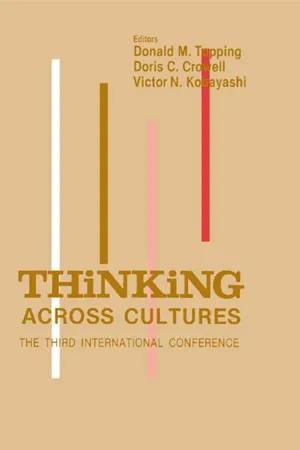
This volume compares and contrasts contemporary theories of cognition, modes of perception, and learning from cross-cultural perspectives. The participants were asked to consider and assess the question of whether people from different cultures think differently. Moreover, they were asked to consider whether the same approaches to teaching and development of thinking will work in all cultures as well as they do in Western, literate societies.
eBook - ePub
Thinking Across Cultures
The Third International Conference on Thinking
- 512 pages
- English
- ePUB (mobile friendly)
- Available on iOS & Android
eBook - ePub
Thinking Across Cultures
The Third International Conference on Thinking
About this book
Information
Topic
EducationSubtopic
Education GeneralI
THINKING ACROSS CULTURES
Many of the papers presented at the Third International Conference on Thinking related in one way or another to the overarching theme of the conference—thinking across cultures, a theme that was chosen by the Conference Committee in an effort to focus attention on alternative cognitive patterns and problem solving strategies found in non-western cultures. The 7 papers in this section were chosen for their particular relevance to this theme.
The section begins with Jose Buscaglia's insightful views on “Cultural Psychology: Understanding the Riddle of Unbalanced Development,” a paper presented by one of Puerto Rico's leading sculptors who addresses the danger of the "colonizing transfer" when teaching across cultures, which too often results in a cultural imbalance and dependency.
David F. Lancy's paper, “An Information Processing Framework for the Study of Culture and Thought,” raises the very important question about the possibility and reliability of attempting to measure intelligence across different cultures and languages, given the fact that most research on cognitive processing has been conducted in what he terms a “functionalist” framework, which, he argues, does not allow for cognitive processes that do not fit the standard mold. After showing examples from three widely divergent cultures (Micronesian, Kalahari Desert, Eskimo) of different patterns of concept formation, Lancy urges us to reconsider our notions of what constitutes efficient information processing. This may also be in-terpreted as a plea for westerners to rid themselves of their ethnocentric cultural blinders.
The following two papers present very different perspectives on contrasting, and sometimes conflicting worldviews, which might be described as analytic versus holistic. Michael Palmer's paper, “Fiction as a Tool for Cross-Cultural Thinking and Teaching,” draws on the science-fictional works of Ursula K. LeGuin to illustrate the possibility of alternative approaches to the understanding and interpretation of cultures, even one as remote from our own as that of the Kesh, a fictionalized society that has managed to strike a balance between the analytic and holistic views of the world.
Norman Watson, Larry Zimmerman, and Patricia Peterson treat the same theme with data from their work with American Indians, who represent “substantial world view differences” from the dominant Anglo culture. In their paper, “The Present Past: an Examination of Archaeological and Native American Thinking About Law and Time,” the authors show how difficulties in cross-cultural communication and understanding can be caused by differences in perception of such things as time and the origins and authority of oral versus written law.
The two following papers focus on learning styles of Polynesian children in different settings. Corey Muse presents his findings on possible cultural influences on Samoan children raised in different cultural environments in Washington state and Western Samoa. In “A Study of Samoan Children on Eleven Cognitive Tasks,” he looks at the question of whether different cultural settings are a significant factor in the learning abilities and strategies of his Samoan subjects
Gisela Speidel, Dale Farran, and Cathie Jordan report on their research which was designed to identify and quantify differences in learning strategies among children from different cultural backgrounds. Their paper, “On the Learning and Thinking Styles of Hawaiian Children,” suggests that there is a marked correlation between the visual learning styles of Hawaiian children and their home environment, which stand in marked contrast with the verbal learning practices of children reared with a more literate orientation.
The last paper in this section, “Cultural Patterns of Cognition Reflected in the Questioning Styles of Anglo and Navajo Teachers,” is a summary of a symposium presented at the Conference by Sheida White, Roland Tharp, Cathie Jordan and Lynn Vogt. This report differs from the others inasmuch as it focuses on teachers rather than students in the classroom situation. What it shares with the others, however, is the conclusion that there are strong indications of different cognitive patterns coming from traditionally oral as opposed to literate cultures. In this paper the authors go a step further and suggest that these observed differences may indicate different degrees of hemispheric dominance.
1
Cultural Psychology—Understanding the Riddle of Development
José Buscaglia
San Juan, Puerto Rico
San Juan, Puerto Rico
Let me state first that I come from another psychological dimension—one among the many collective states of mind that share, with considerable difficulty, the world we live in. In spite of the various degrees of socioeconomic plight, all of Latin America can be considered part of the so-called Third World. By the same token, the dominant language, the historical and political development, and the basic cultural characteristics that prevail in this region are sufficiently similar so that its peoples share come basic problems in development.
We view development here as an outcome of the process of learning and the transmission of knowledge, goals, and attitudes. As Jerome Bruner (1986) states, “Most learning in most settings is a communal activity, a sharing of the culture.” Furthermore, “The power to recreate reality, to reinvent culture is where a theory of development must begin its discussion of mind.” Therefore, the nature of culture as the product of man's intelligent behavior must precede any discussion of the Latin American problem.
From an epistemological perspective we stand at ground zero in understanding how cultural diversity originates. A possible analytical perspective can be derived by observing, as I have for many years, the behavior of the freeranging nonhuman primates, in this case the macaca mulatta colonies at Cayo Santiago, the Primate Research Laboratory of the University of Puerto Rico. It is my conviction that we became humans without ceasing to be placental mammals and primates. The added capacity to diversify behavior gave us a new repertoire of tools to invent cultures with all the socioeconomic consequences of dominant and subordinate systems.
Two evolutionary principles must be established to shed some light on the matter of how this diversity of behavior among members of the same human species became possible.
First, all ascending evolutionary processes, from their cosmic origin through chemical evolution and on to biological evolution, proceed from more simple to more complex structures, from less to increased numbers of component parts. The more simple structures that remain and that have stabilized in their corresponding ecological niches are not only the oldest, but also those that have remained marginal to the less stable and more active processes of evolution. The most significant ascending evolutionary process seems, at the moment, to be centered on the human species. Moreover, humans have reached the level in which we can move beyond our own biological limitations by means of all kinds of scientific and technological prosthetic devices that amplify our range of action. It is precisely the invention, use, and control of these suprabiological devices that have widened, at a global level, the gap between the developed and underdeveloped.
Second, greater structural complexity implies greater possibilities of behavior. More complex biological entities tend to diversity their behavior in direct proportion to the complexity of their biological structures. Thus, the most complex and modifiable biological structure, at least in our planet, is the cortex of the human brain. Dr. Albert Galaburda, Director of the Beth Israel Neuroanatomical Laboratories, has been gathering increasing evidence of both the complexity and the modifiability of the brain cortex at the cytoarchitectonic level of analysis, and shows how the human brain is largely lateralized for special cognitive functions (Galaburda, 1983).
Ontogenetic lateralization, particularly between the 16th and 24th week of gestation, neurologically predisposes the individual to develop specific trends in his cognitive style which become reinforced by the dominant thinking style set by the cultural environment. It seems that brain development at the fetal state and postnatal brain development reach a level of attuned synchronization via a process of mutual reinforcement. Paredes and Hepburn (1976) point out that there are at least two qualitatively distinct logical processes with their corresponding organic structures in the cerebral cortex, and that these multiple processes may account for the culture-and-cognition paradox.
This added neuroanatomical capacity for multiple and simultaneous processing systems came into being as a process of adaptation which, in consequence, assigns specific functions to human intelligence and contributes to the diversified repertoire of culturally bound behaviors. The particular role of cultural diversity in relation to human evolution must, therefore, be clarified if one is to focus on issues of learning in and out of specific cultural models.
The primary catalyst that moved early primates to become human seems to have been a question of numbers. (As we see later on, this explains some of the most serious problems human civilization is confronted with today.) With the help of the "first signaling system" a primate troop can maintain its social cohesiveness up to the point where the members of the troop can (through direct visual contact) identify each other. What then, if by the amplification of power to process and retain information, primates could respond to an internalized visual field and build upon it verbal equivalents particular to the troop in order to evoke images not immediately present in the environment? What if through these symbolic expressions they could set into motion sequences of mental visual images among its members with a certain sense of casualness, that is, in a narrative mode of communication?
I present the concept that alongside the build-up of a “second signaling system” a third and a fourth signaling system developed as the first and the second systems respectively became internalized. As the visual field became autonomous to operate at a mental level (third signaling system), so did the encoded signals of language, allowing not only the self but others to hold internal dialogues (fourth signaling system) in the setting established or constructed by the third signaling system (the inner imagining process).
The key for understanding how these newly acquired mental processes ended up producing culture, technology, and high level thinking skills is the increase in speed and frequency of cortical arousal. Under the four-leveled signaling system previously mentioned, the cortex becomes constantly activated, thus increasing dentrine arborization and synaptic connections. The mental constructs constantly being built and recreated under this new relationship between subject and objects of perception gave rise to the human stream of consciousness with the self as the main spectator, the main actor, and the potential or hypothetical doer. The mental landscapes created by the third signaling system set the stage where the signals from the fourth system establish dialogues with the self and others in parallel to conscious awareness, at the thresholds of awareness, as well as at the various stages of oneiric activity
As a consequence of the aforementioned principles, the state is then set for the acquisition of both cumulative knowledge, as such, and those cultural encasements in which the information is transmitted or interpreted in attunement with the intents and sociohistorical background of those the individual comes in contact with in what Vygotsky has called the "Zone of Proximal Development" (Bruner, 1986). Let me add that as important as the human contact may be in the Zone of Proximal Development, we must also include within this parameter the particular external landscape and all objects and symbols of human creation including art forms, architecture, designs, and man-created environments. All these became active elements in the collages of mental activity that gave rise to cultural diversity.
It becomes important to point out that most of these elements, both human or human-made, that appear in the Zone of Proximal Development tend to be particular to the given circumstances in which learning is taking place. That is to say, they tend to be, to a greater or lesser degree, culturally tinted. As Robert Sternberg (1986) points out in his triarchic theory, intelligent behavior must be defined in context and in the real world environment that is relevant to one...
Table of contents
- Cover
- Half Title
- Full Title
- Copyright
- Contents
- An Introduction to Hawaiian Thought, Mo’olelo
- Introduction
- PART I: THINKING ACROSS CULTURES
- PART II: LANGUAGE AND COGNITION
- PART III: THINKING: PHILOSOPHICAL CONSIDERATIONS
- PART IV: ANIMAL COGNITION
- PART V: EMPIRICAL STUDIES OF THINKING
- PART VI: INFANT COGNITION
- PART VII: THE TEACHING OF THINKING
- Author Index
- Subject Index
Trusted by 375,005 students
Access to over 1.5 million titles for a fair monthly price.
Study more efficiently using our study tools.
Frequently asked questions
Yes, you can cancel anytime from the Subscription tab in your account settings on the Perlego website. Your subscription will stay active until the end of your current billing period. Learn how to cancel your subscription
No, books cannot be downloaded as external files, such as PDFs, for use outside of Perlego. However, you can download books within the Perlego app for offline reading on mobile or tablet. Learn how to download books offline
Perlego offers two plans: Essential and Complete
- Essential is ideal for learners and professionals who enjoy exploring a wide range of subjects. Access the Essential Library with 800,000+ trusted titles and best-sellers across business, personal growth, and the humanities. Includes unlimited reading time and Standard Read Aloud voice.
- Complete: Perfect for advanced learners and researchers needing full, unrestricted access. Unlock 1.5M+ books across hundreds of subjects, including academic and specialized titles. The Complete Plan also includes advanced features like Premium Read Aloud and Research Assistant.
We are an online textbook subscription service, where you can get access to an entire online library for less than the price of a single book per month. With over 1.5 million books across 990+ topics, we’ve got you covered! Learn about our mission
Look out for the read-aloud symbol on your next book to see if you can listen to it. The read-aloud tool reads text aloud for you, highlighting the text as it is being read. You can pause it, speed it up and slow it down. Learn more about Read Aloud
Yes! You can use the Perlego app on both iOS and Android devices to read anytime, anywhere — even offline. Perfect for commutes or when you’re on the go.
Please note we cannot support devices running on iOS 13 and Android 7 or earlier. Learn more about using the app
Please note we cannot support devices running on iOS 13 and Android 7 or earlier. Learn more about using the app
Yes, you can access Thinking Across Cultures by Donald M. Topping,Doris C. Crowell,Victor N. Kobayashi in PDF and/or ePUB format, as well as other popular books in Education & Education General. We have over 1.5 million books available in our catalogue for you to explore.