- 656 pages
- English
- ePUB (mobile friendly)
- Available on iOS & Android
eBook - ePub
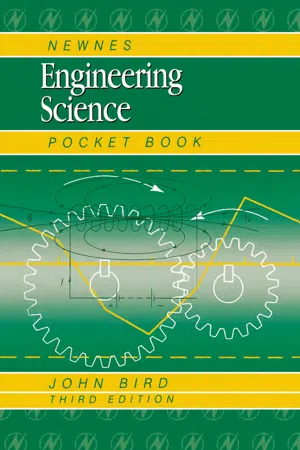
Newnes Engineering Science Pocket Book
About this book
Newnes Engineering Science Pocket Book is a uniquely versatile and practical tool for a wide range of engineers and students. All the fundamentals of electrical and mechanical engineering science and physics are covered, with an emphasis on concise descriptions, key methods, clear diagrams, formulae and how to use them. John Bird's presentations of this core material puts all the answers at your fingertips.
The contents of this book have been carefully matched to the latest Further and Higher Education syllabuses so that it can also be used as a revision guide or a quick-access source of underpinning knowledge. Students on competence-based courses such as NVQs will find this approach particularly refreshing and practical.
This book and its companion title, Newnes Engineering Mathematics Pocket Book, provide the underpinning knowledge for the whole range of engineering communities catered for by the Newnes Pocket Book series. These related titles include:
Newnes Mechanical Engineer's Pocket Book (Timings)
Newnes Electrical Pocket Book (Reeves)
Newnes Electronic Engineer's Pocket Book (Carr & Brindley)
Newnes Radio and RF Engineer's Pocket Book (Carr & Davies)
Newnes Telecommunications Engineer's Pocket Book (Winder)
Previous editions of Newnes Engineering Science Pocket Book were published under the title Newnes Engineering and Physical Science Pocket Book.
Information
Part One General Engineering Science
1 SI Units
DOI: 10.4324/9780080479705-1
Units
The system of units used in engineering and science is the Système Internationale d’Unités (International system of units), usually abbreviated to SI units, and is based on the metric system. This was introduced in 1960 and is now adopted by the majority of countries as the official system of measurement.
The basic units in the S.I. system are listed below with their symbols:
| Quantity | Unit |
|---|---|
| length | metre, m |
| mass | kilogram, kg |
| time | second, s |
| electric current | ampere, A |
| thermodynamic temperature | kelvin, K |
| luminous intensity | candela, cd |
| amount of substance | mole, mol |
Prefixes
S.I. units may be made larger or smaller by using prefixes that denote multiplication or division by a particular amount. The six most common multiples, with their meaning, are listed below:
| Prefix | Name | Meaning | |
|---|---|---|---|
| T | tera | multiply by 1 000 000 000 000 | (i.e. × 1012) |
| G | giga | multiply by 1000 000 000 | (i.e.× 109) |
| M | mega | multiply by 1 000 000 | (i.e × 106) |
| k | kilo | multiply by 1 000 | (i.e × 103) |
| m | milli | divide by 1 000 | (i.e × 10–3) |
| μ | micro | divide by 1 000 000 | (i.e × 10–6) |
| n | nano | divide by 1 000000 000 | (i.e × 10–9) |
| P | pico | divide by 1 000 000 000 000 | (i.e × 10–12) |
Length, area, volume and mass
Length is the distance between two points. The standard unit of length is the metre, although the centimetre, cm, millimetre, mm and kilometre, km, are often used.
Area is a measure of the size or extent of a plane surface and is measured by multiplying a length by a length. If the lengths are in metres then the unit of area is the square metre, m2
Conversely, 1 cm2 = 10–4 m2 and 1 mm2 = 10–6 m2
Volume is a measure of the space occupied by a solid and is measured by multiplying a length by a length by a length. If the lengths are in metres then the unit of volume is in cubic metres, m3
Conversely, 1 cm3 = 10 −6 m3 and 1 mm3 = 10 −9 m3
Another unit used to measure volume, particularly with liquids, is the litre, l, where 1 l = 1000 cm3
Mass is the amount of matter in a body and is measured in kilograms, kg.
Derived SI Units
Derived SI units use combinations of basic units and there are many of them.
Two examples are:
Table of contents
- Cover Page
- Half Title Page
- Title Page
- Copyright Page
- Contents
- Preface
- Part One General Engineering Science
- 1 SI Units
- 2 Density
- 3 Scalar and Vector Quantities
- 4 Atomic Structure of Matter
- 5 Chemical Reactions
- 6 Standard Quantity Symbols and their Units
- Part Two Mechanical Engineering and Physical Science
- 7 Speed and Velocity
- 8 Acceleration
- 9 Force, Mass and Acceleration
- 10 Centre of Gravity and Equilibrium
- 11 Forces Acting at a Point
- 12 Simply Supported Beams
- 13 Shearing Force and Bending Moments
- 14 Bending Stress
- 15 Linear and Angular Motion
- 16 Friction
- 17 Waves
- 18 Interference and Diffraction
- 19 Light Rays
- 20 Work, Energy and Power
- 21 Potential and Kinetic Energy
- 22 Simple Machines
- 23 The Effects of Forces on Materials
- 24 Tensile Testing
- 25 Hardness and Impact Tests
- 26 Measurement of Strain
- 27 Linear Momentum and Impulse
- 28 Torque
- 29 Heat Energy
- 30 Thermal Expansion
- 31 The Measurement of Temperature
- 32 Pressure in Fluids
- 33 Measurement of Pressure
- 34 Ideal gas Laws
- 35 Properties of Water and Steam
- 36 Surface Tension and Viscosity
- 37 Fluids in Motion
- 38 Measurement of Fluid Flow
- 39 Simple Harmonic Motion and Natural Vibrations
- Part Three Electrical Engineering Science
- 40 An Introduction to Electric Circuits
- 41 Resistance Variation
- 42 Chemical Effects of Electricity
- 43 Series and Parallel Networks
- 44 Capacitors and Capacitance
- 45 Magnetic Circuits
- 46 Magnetic Materials
- 47 Electromagnetism
- 48 Electromagnetic Induction and Inductance
- 49 Magnetically Coupled Circuits
- 50 Electrical Measuring Instruments and Measurements
- 51 Semiconductor Diodes
- 52 Transistors
- 53 D.c. Circuit Theory
- 54 Alternating Voltages and Currents
- 55 Single-phase Series a.c. Circuits
- 56 Single-phase Parallel a.c. Circuits
- 57 D.c. Transients
- 58 Operational Amplifiers
- 59 Three-phase Systems
- 60 Transformers
- 61 D.c. Machines
- 62 A.c. Motors
- 63 Revision of Complex Numbers
- 64 Application of Complex Numbers to Series a.c. Circuits
- 65 Application of Complex Numbers to Parallel a.c. Networks
- 66 Power in a.c. Circuits and Power Factor Improvement
- 67 A.c. Bridges
- 68 Series Resonance and Q-factor
- 69 Parallel Resonance and Q-factor
- 70 Introduction to Network Analysis
- 71 Mesh-current and Nodal Analysis
- 72 The Superposition Theorem
- 73 Thévenin's and Norton's Theorems
- 74 Delta-star and Star-delta Transformations
- 75 Maximum Power Transfer Theorems and Impedance Matching
- 76 Complex Waveforms
- 77 A Numerical Method of Harmonic Analysis
- 78 Dielectrics and Dielectric Loss
- 79 Field Theory
- 80 Attenuators
- 81 Filter Networks
- 82 Modulation
- 83 Transmission Lines
- Index
Trusted by 375,005 students
Access to over 1.5 million titles for a fair monthly price.
Study more efficiently using our study tools.
Frequently asked questions
Yes, you can cancel anytime from the Subscription tab in your account settings on the Perlego website. Your subscription will stay active until the end of your current billing period. Learn how to cancel your subscription
No, books cannot be downloaded as external files, such as PDFs, for use outside of Perlego. However, you can download books within the Perlego app for offline reading on mobile or tablet. Learn how to download books offline
We are an online textbook subscription service, where you can get access to an entire online library for less than the price of a single book per month. With over 1.5 million books across 990+ topics, we’ve got you covered! Learn about our mission
Look out for the read-aloud symbol on your next book to see if you can listen to it. The read-aloud tool reads text aloud for you, highlighting the text as it is being read. You can pause it, speed it up and slow it down. Learn more about Read Aloud
Yes! You can use the Perlego app on both iOS and Android devices to read anytime, anywhere — even offline. Perfect for commutes or when you’re on the go.
Please note we cannot support devices running on iOS 13 and Android 7 or earlier. Learn more about using the app
Please note we cannot support devices running on iOS 13 and Android 7 or earlier. Learn more about using the app
Yes, you can access Newnes Engineering Science Pocket Book by John Bird in PDF and/or ePUB format, as well as other popular books in Technology & Engineering & Construction & Architectural Engineering. We have over 1.5 million books available in our catalogue for you to explore.