Using and Applying Mathematics at Key Stage 1
eBook - ePub

Using and Applying Mathematics at Key Stage 1

A Guide to Teaching Problem Solving and Thinking Skills

  1. 72 pages
  2. English
  3. ePUB (mobile friendly)
  4. Available on iOS & Android
eBook - ePub

Using and Applying Mathematics at Key Stage 1

A Guide to Teaching Problem Solving and Thinking Skills

About this book

All pupils - able children included - need to be taught strategies to enable their thinking skills to progress. They also need help with developing different approaches to problem solving. A sustained piece of work that requires perseverance, logical strategies, and refinement of method and extension of the original task is not the same as a straightforward quick-fix type problem. Both types of problem solving need to be taught. This book presents a series of activities that can be used with whole classes to provide a curriculum for the teaching of problem solving and the development of thinking skills. Each tried and tested investigation is clearly explained with ideas on how to introduce the task to a class, full solutions and resource sheets.

Activities include making 10p: a task to encourage systematic listing; tables and chairs: working systematically and spotting patterns; polygons and polyhedra: investigating diagonals, triangles, faces, edges and vertices; hidden faces: investigating different shapes and sizes of dice; and pond borders: investigating area and perimeter.
Frequently asked questions

Yes, you can cancel anytime from the Subscription tab in your account settings on the Perlego website. Your subscription will stay active until the end of your current billing period. Learn how to cancel your subscription.
At the moment all of our mobile-responsive ePub books are available to download via the app. Most of our PDFs are also available to download and we're working on making the final remaining ones downloadable now. Learn more here.
Perlego offers two plans: Essential and Complete
  • Essential is ideal for learners and professionals who enjoy exploring a wide range of subjects. Access the Essential Library with 800,000+ trusted titles and best-sellers across business, personal growth, and the humanities. Includes unlimited reading time and Standard Read Aloud voice.
  • Complete: Perfect for advanced learners and researchers needing full, unrestricted access. Unlock 1.4M+ books across hundreds of subjects, including academic and specialized titles. The Complete Plan also includes advanced features like Premium Read Aloud and Research Assistant.
Both plans are available with monthly, semester, or annual billing cycles.
We are an online textbook subscription service, where you can get access to an entire online library for less than the price of a single book per month. With over 1 million books across 1000+ topics, we’ve got you covered! Learn more here.
Look out for the read-aloud symbol on your next book to see if you can listen to it. The read-aloud tool reads text aloud for you, highlighting the text as it is being read. You can pause it, speed it up and slow it down. Learn more here.
Yes! You can use the Perlego app on both iOS or Android devices to read anytime, anywhere — even offline. Perfect for commutes or when you’re on the go.
Please note we cannot support devices running on iOS 13 and Android 7 or earlier. Learn more about using the app.
Yes, you can access Using and Applying Mathematics at Key Stage 1 by Elaine Sellers,Sue Lowndes in PDF and/or ePUB format, as well as other popular books in Education & Education General. We have over one million books available in our catalogue for you to explore.

Information

1
Rocket to the Moon

The task

Play this as a game:
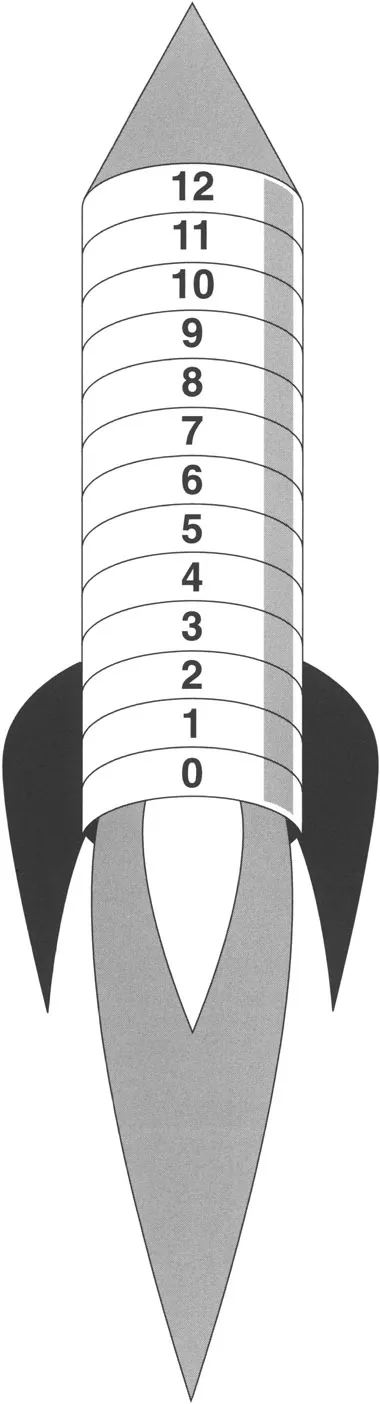
Two players need two 1-6 dice between them and one rocket sheet.
Each takes turns to roll the dice. The two numbers obtained are added together.
They then colour that number in on the rocket (or cover with a counter),
The winner is the one with the most numbers coloured in.
!! The rocket deliberately contains the numbers zero and one. This is to allow the children to discover for themselves that they cannot make these numbers.

Introducing the task to your class

Once the children have played the game a number of times ask them some questions.
  • Could they cover 0 or 1? If not, why not?
  • Did some numbers come up more often than others did? Were some numbers hard to get?
Build on this by changing the rules. When the dice are rolled this time, place counters on the numbers attained. When the game is finished ask the pupils to record how many counters are on each number. Collect their results altogether.
  • What do they notice?
  • Why is this happening?

Writing up the investigation

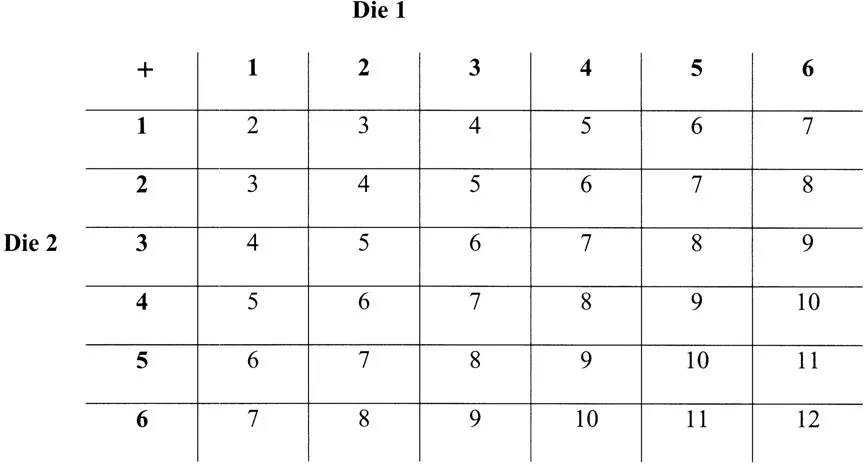
Ask each pupil to record all the possible throws. You will want to encourage systematic listing. Some of the pupils may need the dice in front of then to record the possible throws. This can be done in a variety of ways; below are two possible ways.
As the teacher you could choose to set up the recording system in this way or let the children experiment. They will find it hard to know if they have missed out any combinations unless they have a system.

Extension ideas

  • Use 0-5 dice
  • Use different shaped dice
  • Use a combination of 0-5 and 1-6 dice
Ask the pupils to predict what is going to happen before they play the game.

2
Making 10p

The task

A task to encourage systematic listing.

Introducing the task to your class

You need lots of 1p, 2p, 5p, and 10p coins.
Ask the pupils to list the ways to make 10p, either on paper or using coins.
Pupils may record by placing the coins under plain paper and rubbing over them with a crayon, or using money stamps, or by listing.
Ask them all to start with 10p.
The two possible routes are now to change this for 10 × 1p coins or 2 × 5p coins.
If they choose the 1p route then their next choice should progress from this and not leapfrog to, for example, 2 × 5p.
A better choice from 10 × 1p coins would be to swap 2 × 1p coins for 1 × 2p coin and build on this. Gradually increase the coin denominations. Then consider the 5p combinations, again being systematic.
!! Of course, for some of your pupils you will be pleased that they can do any combinations, but here we are considering able pupils and how to teach them the basic building blocks of problem solving of which systematic working is one.

Writing up the investigation

Systematic listing for making 10p:

Extension ideas

Making 20p, 50p, £1. You could also limit which coins pupils can use.

3
Tables and Chairs

The task

A task to help pupils to work systematically and to spot patterns. Encourage pupils to discuss their ideas.

Introducing the task to your class

Start the activity with the whole class. Use either real tables and chairs in the classroom or square tiles and small blocks on their classroom tables. Ensure that all children use the equipment to simulate the arrangements before they attempt to write anything down. Always refer back to the practical equipment to overcome diffic...

Table of contents

  1. Cover
  2. Title
  3. Copyright
  4. Contents
  5. Introduction
  6. 1. Rocket to the Moon
  7. 2. Making 10p
  8. 3. Tables and Chairs
  9. 4. Polygons and Polyhedra
  10. 5. Adding to 15
  11. 6. Hidden Faces
  12. 7. Dotty Investigation