- 216 pages
- English
- ePUB (mobile friendly)
- Available on iOS & Android
eBook - ePub
About this book
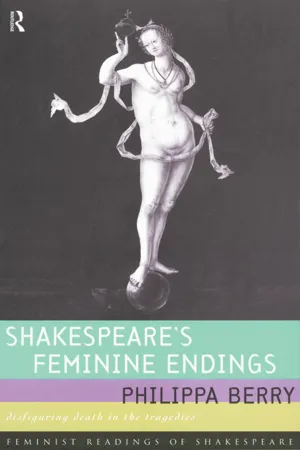
Philippa Berry draws on feminist theory, postmodern thought and queer theory, to challenge existing critical notions of what is fundamental to Shakespearean tragedy. She shows how, through a network of images clustered around feminine or feminized characters, these plays 'disfigure' conventional ideas of death as a bodily end, as their figures of women are interwoven with provocative meditations upon matter, time, the soul, and the body. The scope of these tragic speculations was radical in Shakespeare's day; yet they also have a surprising relevance to contemporary debates about time and matter in science and philosophy.
Information
1
DISFIGURED ENDINGS:
SEXUAL MATTERS AND SHAKESPEARE’S ARS MORIENDI
What is then woven does not play the game of tight succession. Rather, it plays on succession. Do not forget that to weave (tramer, trameare) is first to make holes, to traverse, to work one-side-and-the-other of the warp.
(Derrida, Margins of Philosophy)1
[Y]ou’ll be rotten ere you be half ripe, and that’s the right virtue of the medlar.
(As You Like It, 3.2.117–18)
In one of Shakespeare’s most evocative anticipations of tragedy in and through a female character, Richard II’s queen laments her husband’s recent departure for Ireland. And she tells one of Richard’s favourites, Bushy, that she has a vivid premonition of disaster:
I know no cause
Why I should welcome such a guest as grief,
Save bidding farewell to so sweet a guest
As my sweet Richard. Yet again methinks
Some unborn sorrow ripe in Fortune’s womb
Is coming towards me, and my inward soul
With nothing trembles; at some thing it grieves,
More than with parting from my lord the king.
Save bidding farewell to so sweet a guest
As my sweet Richard. Yet again methinks
Some unborn sorrow ripe in Fortune’s womb
Is coming towards me, and my inward soul
With nothing trembles; at some thing it grieves,
More than with parting from my lord the king.
(2.2.10–13)
The queen’s words—from a play described on the title page of its first Quarto as a tragedy—provide us with a proleptic insight into the topic which this book addresses: the ambiguous function, not simply of women, but of feminized figures of speech in a Shakespearean interrogation of the meanings of tragedy. For the tropes of her speech create a strikingly contradictory representation of the queen’s state of grief. The inexplicable amplification of her emotion is evidently allied to the impending tragedy; at the same time, however, conventional notions of tragic suffering are unsettled by the troping of grief’s arrival in terms not just of hospitality but of a quasi-sexual penetration and a highly physical ‘ripening’.
The future sorrow which Richard’s queen uncannily anticipates is a state she imagines receiving as ‘a guest’ that is both like and unlike the ‘sweet’ or sexually intimate guest who is her departed husband. Indeed, this other ‘guest’, who uncannily arrives just as Richard departs, is figured as a mysterious addition to her present grief, since ‘at some thing it grieves/More than with parting from my lord the king’ (my emphasis). What the queen so fearfully anticipates, it seems, is some future experience of nullification or ‘nothing’ —the image ultimately invoked by Richard himself to trope his tragic fate—that will paradoxically involve both a coming to fruition and a very different ‘parting’: a birth from ‘Fortune’s womb’. This half-buried layer of sexual imagery performs a suggestive doubling of ends, as anticipation of the climactic closure of Richard’s tragedy—with his death—becomes peculiarly conflated with an oxymoronic as well as interlingual conception of grief: as the bearing of a burden (in French, grevé) which compels the opening or ‘parting’ (and here a cognate French word is crevé) of a ‘ripe’ bodily end.2
This book argues that Shakespearean tragedy performs a comparable, albeit infinitely more extensive interrogation of tragic sensibility, as countless puns and other tropes that emphasize the open bodily ‘ends’ of women (and sometimes, those of men) enunciate a subtle differing —a disfiguring—both of tragic discourse and of concepts of death as bodily extinction. The Shakespearean ‘shapes of grief’ that are refracted through a feminine figural lens have an intricate cultural specificity. Moreover, they remind us of some of the complexity, indeed the inherent strangeness, of Renaissance thought, as quasi-philosophical as well as political speculations are perplexingly interwoven, not only with mythic or emblematic motifs, but also with a partially abjected vein of grossly material imagery, drawn from popular culture. Commenting on the often remarkable difficulty of Shakespeare’s tropes, Ann and John O. Thompson point out that this Shakespearean drive towards figurative difficulty is inseparable from ‘a sense of the groundedness of these elaborations in…everyday metaphor’.3 My contention here is that, if we examine these textual nodes from a critical perspective that aims to reassess the complex materiality of the Shakespearean text, we can hopefully decipher what might be described, pace Bakhtin, as an impacted lower stratum of this textual archaeology, and begin to examine its complex relationship to other strata of tragic signification.4 For while this multilayered, ‘earthy’, and primitive sediment of meaning unsettles some of the seeming gravitas of tragedy, it has an obscure, philosophical and political ‘weight’ of its own, as it challenges dominant cultural notions of what is ‘fundamental’ and ‘final’ both to tragedy and to human identity.
A major study of the ‘issues of death’ in English Renaissance tragedy, by Michael Neill, has recently restated some of the key assumptions which typically inform critical responses to tragedy, by describing tragedy as ‘a profoundly teleological form whose full meaning will be uncovered in the revelation of its end’ (my emphasis).5 Neill’s book is richly innovative in many respects, and he is certainly right in his observation that the formal structure, or the narrative design, of tragedy is ‘fiercely end-driven’ in its movement towards a seemingly unambiguous telos, or end, in and through which a heroic masculine identity will paradoxically be confirmed. But in a deliberate departure from this teleological and structural perspective, my reading of the tragedies uses a heightened attention to textual detail in order to question the presumed finality and fixity of these cultural versions of ending, along with the diachronic, linear versions of both identity and temporality that appear to inform them. The centrality to the Shakespearean literary corpus of what Patricia Parker describes as ‘preposterous’ or ‘arsy-versy’ figures and tropes that question the aesthetic, as well as political and sexual, drive to containment and the certainty of endings has been brilliantly demonstrated in her book, Shakespeare from the Margins.6 This seminal re-evaluation of Shakespeare’s wordplay signals a new climate in Shakespeare studies, in which critics can at last begin to interrogate in detail these previously neglected aspects of the most ‘canonical’ of texts, and consequently, to elucidate the multifaceted, fluid model of sexuality which Shakespeare’s puns delineate. In an attempt to draw out some of the wider philosophical implications of this complex figurative dimension within the tragedies, my book aims to show how a repetitive pattern of feminine or femininized tropes performs an allusive reweaving both of tragic teleology and of orthodox conceptions of death. Within this mobile textual process, as in the account of ‘Fortune’s womb’ given by Richard’s queen, endings are repeatedly unravelled, like those of Penelope’s forever unfinished tapestry in the Odyssey (in fact, in a suggestive textual detail that is often overlooked, this famous textile was actually a shroud). And as the ‘end’ of tragedy is refigured not as a closure, but rather as an opening of meaning, Judaeo-Christian notions of history as a singular and successive movement towards ‘a promised end’ or eschaton are similarly undermined. Gesturing beyond death as a fin or end to a grossly sensuous as well as numinous version of the infini or unfinished, this Shakespearean (dis-)figuration of tragic endings, not as a limit or boundary, but rather as a resonant surfeit of signification, may plausibly be compared to the ‘feminine endings’ found in much Shakespearean blank verse.
Feminine endings
The feminine endings of verse (which I distinguish here from the rather different device of ‘feminine rhyme’) are metrical supplements to an iambic pentameter in the form of an eleventh syllable, usually unstressed, that assists the transference of poetic sense from one line to the next. In Shakespeare’s Metrical Art, George T.Wright observes of this device:
Whether the choice of feminine as a term to describe this ending was accidental or fitted contemporary notions of gender, iambic verse that regularly ends with an unstressed syllable takes on a quality which, in different lines, may variously be described as soft, haunting, yearning, pliant, seductive. In verse that is enjambed, it helps to threaten our sense of the line as a line, as pentameter; in endstopped verse, it subtly undermines the line’s iambic (or masculine) character.7
In the queen’s speech quoted on p. 1, two words extend beyond the structural limit conventionally imposed by the ten-syllable line of the iambic pentameter: ‘soul’ at the end of line 11, and the last syllable of ‘grieves’ at the end of line 12. Both words imply a surplus of meaning, and also of affect, that issues beyond the expected poetic limit. Indeed, the selection of these particular words for metrical marginality hints at the connection of the feminine ending’s semiotic surplus both with the experience of grief as a process (in ‘grieves’), and with what, for the late Renaissance, was the increasingly problematic status of that ghostly supplement to visible human identity: soul, that ‘with nothing trembles’. The tragedies’ figurative insinuation of an abjected and feminized supplement to versions of death as an end is marked by a similar emphasis on the uncanny mobility, even vitality, which informs tragic experience.
In an elaboration and interrogation of Freud’s theory of the death drive, Julia Kristeva has commented on the ways in which ‘the unrepresentable nature of death [i]s linked with that other unrepresentable —original abode but also last resting place for dead souls in the beyond —which, for mythical thought, is constituted by the female body’.8 In her work on abjection, Kristeva has shown how this liminal condition of the female body evokes a cultural response in which not only fascination and horror, but also motifs of sacredness and pollution, are peculiarly combined.9 But what has been described as ‘the figure that crosses femininity with death’ can be interpreted in diverse ways. Elizabeth Bronfen’s elegant study of that distinctively modern aestheticization of death which is accomplished, as she convincingly demonstrates, by constant repetition of this figure, concludes that ‘over her dead body, cultural norms are reconfirmed or secured’.10 My contention here, however, is that Shakespearean tragedy uses a similar figure precisely to unsettle cultural norms, since it tropes not only female characters, but also tragic protagonists whose masculinity is figuratively unsettled by their encounter with tragedy, not as stable signifiers of any singularity of either gender or meaning, but rather as sites of maximum undecidability or uncanniness. By redefining dying as a state that is open rather than closed, these tragedies both problematize and amplify orthodox religious knowledge of and around death, disrupting the orderliness of such established significations in a complex layering of figurative detail that is often emblematically embodied, near the end of the play, by a dead or dying woman.
Whether literally enacted or presented solely in tropical guise, Shakespeare’s feminine dyings figure death repeatedly, not as an ending, but as a process: an interitus or passing between.11 The motif is common to most religions; but—drawing on pagan currents of thought as well as the obscene imagery of popular culture—the tragedies reinflect it as a highly material, bodily process that is mysteriously productive. So the body of the living Juliet (who by her marriage is no longer a Capulet) proves to be an uncannily disruptive force in her own family vault, while the ‘maimed rites’ of Ophelia’s corpse generate social and political disturbances on a comparable scale in the Elsinore graveyard. As they hover disturbingly upon the borders of death and life, Cordelia and Desdemona likewise have peculiarly equivocal ‘ends’.
Gisèle Mathieu-Castellani has observed that Renaissance culture had a pervasive sense of the ‘strange reversibility’ of death and life, or le jouir de mourir—the pleasure in dying.12 This interrelationship could be variously inflected, however. In the religious literature of the period, the motif of death-as-life typically produced the grotesque conception of men and women as walking cadavers: a perception that is echoed at key points in Shakespearean tragedy, and most notably by Hamlet. At first glance, the dead or dying women of the tragedies are represented as effecting what was culturally a quite familiar conjunction of sexuality or physical attraction with death (in the case of Cordelia, this imagery of desire is implicit rather than explicit, and focused in a single emblematic device, the mirror which is held to her dead lips—a familiar attribute of the medieval Venus luxuria). But whereas this well-worn trope was commonly used in the Middle Ages and the Renaissance to reinforce the traditional Christian equation of sin (here in the form of female sexuality) with death, the tragedies accord it a notably heterodox significance, by using these feminine endings to explore the strangely erotic vitality of death and putrefaction, as ‘kissing carrion’. So Cleopatra’s dying words, as she suckles the asp that kills her, perform an ironic unsettling of biblical chronology, in a figurative conjunction of the fall of man (through the temptation of Eve by the serpent) with images of the Virgin and Christ child—the newborn ‘Prince of Peace’: ‘Peace, peace! /Dost thou not see my baby at my breast/That sucks the nurse asleep?’ (5.2.307–9). The dying pagan queen is momentarily both the first and the second Eve, while Eve’s serpentine tempter is problematically fused with the saviour of mankind. Several lines later, in a reference whose palimpsest-like layering of allusions assimilates both Protestant and Catholic imagery into a highly erotic spectacle of death which exceeds the doctrines of each faith, we are told by Caesar that: ‘she looks like sleep, /As she would catch another Antony/ In her strong toil of grace’ (5.2.345–7). These words evoke another contradictory medley of Christian images: the ‘dormition’ of the Virgin Mary—a final falling asleep whose difference from normal death was doctrinally reasserted at the Counter-Reformation; the first Christian disciples fishing for men’s souls; and the Calvinist emphasis on the role of divine grace in the process of salvation. Yet elided with these different versions of Christian salvation is the image of a female body whose sexuality is seemingly active even after death: Shakespeare and his contemporaries frequently punned on the homophonic association of ‘grace’ with the ‘greasiness’ of carnival pleasures (as in Mardi Gras or Shrove Tuesday), and the ‘greasy’ end of the genitalia in particular. In this late Renaissance ‘gallimaufry’ —which involved a riddling juxtaposition of diverse images —contemporary religious concerns for the fate of the soul are differed and dilated by a bawdy emphasis upon the seeming...
Table of contents
- Cover
- Title
- Copyright
- Contents
- List of plates
- Series editor’s preface
- Acknowledgements
- 1 Disfigured endings: sexual matters and Shakespeare’s ars moriendi
- 2 Double dying and other tragic inversions (Romeo and Juliet)
- 3 Echoic language and tragic identity (Hamlet)
- 4 Disclosing the feminine eye of death: tragedy and seeing in the dark (Othello)
- 5 Fortune’s fools: revolutions of time, fate and sovereignty (Macbeth)
- 6 Cordelia’s bond and Britannia’s missing middle (King Lear)
- Notes
- Index
Trusted by 375,005 students
Access to over 1.5 million titles for a fair monthly price.
Study more efficiently using our study tools.
Frequently asked questions
Yes, you can cancel anytime from the Subscription tab in your account settings on the Perlego website. Your subscription will stay active until the end of your current billing period. Learn how to cancel your subscription
No, books cannot be downloaded as external files, such as PDFs, for use outside of Perlego. However, you can download books within the Perlego app for offline reading on mobile or tablet. Learn how to download books offline
Perlego offers two plans: Essential and Complete
- Essential is ideal for learners and professionals who enjoy exploring a wide range of subjects. Access the Essential Library with 800,000+ trusted titles and best-sellers across business, personal growth, and the humanities. Includes unlimited reading time and Standard Read Aloud voice.
- Complete: Perfect for advanced learners and researchers needing full, unrestricted access. Unlock 1.5M+ books across hundreds of subjects, including academic and specialized titles. The Complete Plan also includes advanced features like Premium Read Aloud and Research Assistant.
We are an online textbook subscription service, where you can get access to an entire online library for less than the price of a single book per month. With over 1.5 million books across 990+ topics, we’ve got you covered! Learn about our mission
Look out for the read-aloud symbol on your next book to see if you can listen to it. The read-aloud tool reads text aloud for you, highlighting the text as it is being read. You can pause it, speed it up and slow it down. Learn more about Read Aloud
Yes! You can use the Perlego app on both iOS and Android devices to read anytime, anywhere — even offline. Perfect for commutes or when you’re on the go.
Please note we cannot support devices running on iOS 13 and Android 7 or earlier. Learn more about using the app
Please note we cannot support devices running on iOS 13 and Android 7 or earlier. Learn more about using the app
Yes, you can access Shakespeare's Feminine Endings by Philippa Berry in PDF and/or ePUB format, as well as other popular books in Letteratura & Collezioni letterarie. We have over 1.5 million books available in our catalogue for you to explore.