- 251 pages
- English
- ePUB (mobile friendly)
- Available on iOS & Android
eBook - ePub
Emergencies and Disorder in the European Empires After 1945
About this book
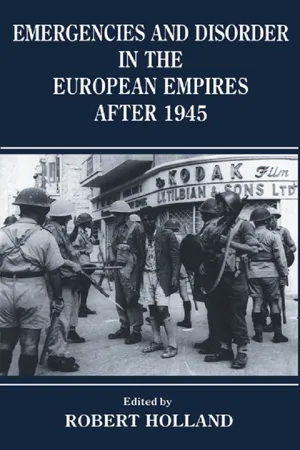
Bringing together for the first time leading historians of European decolonization, this book is a landmark in the comparative analysis of the fall of the European empires, viewed both as a problematic of European policy-making and as a formative experience in the development of new states.
Information
The Origins of the Algerian War: The Reaction of France and its Army to the two Emergencies of 8 May 1945 and 1 November 1954
Jean-Charles Jauffret
(Translated by Christina Watkins and Maria Sparling)
(Translated by Christina Watkins and Maria Sparling)
On 22 November 1944, General de Gaulle, head of the temporary government of the Republic, enjoined the members of the Consultative Assembly in the following terms: 'Let us rebuild our power, from now on let it be our country's great crusade'.1 At the heart of this ambition lay the colonial empire, whose new-found unity was to be a condition of French domination for a decade. The clearly nationalistic aspiration to retain the Empire, which even gained the support of the communists in 1944-45, was nevertheless accompanied by a desire for reform. In his Constantine speech on the 12 December 1943, General de Gaulle outlined the framework for greater assimilation of the three Algerian regions within the national community, while in January-February 1944 the Brazzaville Conference pointed to association as the way forward for the remainder of the colonial territories. However, these reforms were based first and foremost on the principle of loyalty, the 'Great Nation' alone having the power to determine to what extent its people were to be emancipated. The French State could not allow any form of armed conflict. Such an attitude set little store by the Second World War which accelerated the course of history, the hopes created by the Atlantic Charter and the inevitable movement towards decolonization, which reached the point of no return at Dien Bien Phu in May 1954.
On two occasions, 8 May 1945 and 1 November 1954, the Republic and its armed forces found themselves challenged by a Muslim Algeria impatient to throw off the shackles of colonization. How did the civil and military authorities react? The two events were very closely linked: the rebellion of 1954 was a direct result of the failed coup of spring 1945. This leads us to a new interpretation of the Algerian War derived from the publication of a series of army archive documents, the first volume of which was published in March 1990.2
I
Intelligence work is vitally important for any military action, and it took on different forms between 1945 and 1954. Its reliability and various applications explain why the public authorities' reaction differed in 1945 from that of 1954. Another consideration may be added to this. In May 1945 France was at war, and in Algeria the state of siege lasted until December of that year. This particular situation, which led to shortages, had to be endured since the best troops were in Germany, and gave rise to a key-word absent in 1954 — initiative, namely the ability to meet a new challenge with limited means.
On 14 August 1944 General Henri Martin, who had just been appointed to command the 19th Army Corps (Algeria) received the following order from General de Gaulle: 'We must ensure that while liberating France, we do not let North Africa slip through our fingers'.3 Having been warned about the size of the nationalist movement, which had been united within the 'Amis du Manifeste et de la Liberié' movement (AML) since 14 March 1945, General Martin was determined not to let a rebellion take him unawares. He therefore carried out the instruction of 20 February 1944 on maintaining order in Algeria. This essential document set out the army's three objectives: to obtain information on the development of the political situation and the mood of the people, to forestall any trouble by resorting to police inspections, manoeuvres and exercises as a show of strength, and to prepare for either conscription or direct military action in the event of the collapse of civil authority.
In order to achieve this, the commander of the 19th Corps had a particularly effective tool at his disposal: the Army Intelligence Service. Algeria was still officially a war zone. World events were observed by an active service which at that time used its own agents to gather information. Native agents and Muslim military affairs officers were 'immersed' in Muslim environments. They answered to code names like 'Denis' or 'Philinte' and never ceased to warn the military authorities about the danger of a general rebellion in Algeria. They took all sources of discontent into consideration: the black market, the wheat crisis, demands for greater justice, desire for autonomy or independence encouraged by the Allies and the after-effects of the Axis propaganda.4 The Service also drew attention to all kinds of incidents, which became increasingly frequent from March 1945 and which were a cause for great concern: the clash in Mostaganem, the attack on a convoy in the territory of the mixed commune of Belezma, the series of deliberately-started forest fires. The Japanese attack on 9 March 1945 which damaged the prestige of French power in Indo-China was also a source of comment in Moorish cafés. In short, according to Martin's secret report on the events of spring 1945, many incidents occurred from March until 1 May inclusive. They were indicative of a popular mood which no longer tolerated colonial power. Between 8 March and 2 May, 10 people died including some Muslims and some Europeans (such as the wife of a colonist and demonstrators killed by the forces of law and order). In Algeria on May Day 1945 there was a feeling of impending rebellion and demonstrations followed in Cherchell, Oran and Algiers. On that day in Sétif, 3,000 'natives' demonstrated bearing banners calling for the release of Messali Hadj, the charismatic leader of the PPA (Algerian People's Party), an event which foreshadowed the events of 8 May. At the same time, the nationalists were expecting a great deal from the San Francisco Conference which should have confirmed the isolation of colonial France, already refused participation at the Yalta Conference. The wave of protest seemed to threaten the basis of old colonialism and to enjoy the tacit agreement of France's allies, who were still waiting for the Republic to grant a 'Trusteeship', that is to say a small measure of autonomy, to its North African territories.
However, it was not yet time to close the chapter on Algeria, where the slogan 'The suitcase or coffin' already loomed large over the European contingent of less than 900,000 people. They were in a minority compared to the 7,000,000 Muslims. When the civil authorities continued to ignore the gravity of the situation, General Martin took a series of preventive measures. In October 1944 he had a potential army of 115,000 men mainly made up of recruits training in preparation for the war which continued to rage at home. The so-called sovereignty troops ('troupes de souveraineté'), permanently stationed in order to guarantee the safety of the Algerian state, represented 18 poorly trained battalions in 19 squadrons and six batteries. They were chronically under-equipped, as in the example of the 15th Regiment of Senegalese Infantry (RTS). Despite their exemplary conduct in the Italian and French campaigns, people were beginning to distrust the Algerian infantry, as a result of the strength of nationalist propaganda. It was therefore necessary to innovate and use imagination in order to deal with the shortage of troops and equipment. From the 30 August 1944 onwards, Martin was put in charge of combined inter-service operations should serious trouble flare up in Algeria. The commander of the 19th Corps took this appointment to direct military operations seriously, benefiting from the co-operation of the Navy and the Airforce (5th Air Region). On 30 October 1944, following a conference held between the Residents and the Governors General of North Africa, Martin received the support of a co-ordination plan involving the armies of the whole of the three French dependencies of the Maghreb. The plan put the Taza-Guerif mobile troop, made up of units of Moroccan irregulars ('goums') at the disposal of the 19th Corps, and provided for mutual support from the troops stationed in Tunisia. In the event of a rebellion, reinforcements would be sent from France and Black African states. All this goes to show that the entire transport infrastructure was in place to cope with any eventuality well before 8 May 1945. Finally, on the basis of information from the Intelligence Service, the plan defined 'sensitive zones', which were to be kept under close surveillance outside the three main regional capitals, namely Grande and Petite Kabylie, the Tlemcen Mountains and the Aurès, places where in 1871,1881 and 191617 respectively, large uprisings had taken place.
The old African army maxim, 'Show strength to avoid having to use it', taken together with the implementation of various orders following the instruction of 20 February 1944, explains the series of parades and operations over the spring of 1945. At the end of March, the 7th Legion of the Republican Guard were 'nomadizing' in the Saint-Arnaud-Mila region. In April, operations involving the Saharan unit of the Foreign Legion took place around the town of Biskra. The largest show of strength was in Grande Kabylie where manoeuvres using live rounds of ammunition took place on 4 and 5 May. These ended with a large military parade at Tizi-Ouzou. Should we attribute the relative calm enjoyed in Grande Kabylie in 1945 to these operations? The only events of note were minor acts of sabotage on 24 May. This 'approach' was doubtless due to another factor: the counter-command from the nationalist authorities, who were taken by surprise by the scale and then by the failure of the Constantine rebellion.
The lack of co-ordination between the most radical members of the Amis du Manifeste et de la Liberté and their local sections scattered throughout the Constantine urban areas originated from the transfer of Messali Hadj to A1 Golea on the 21 April 1945, prior to his forced exile in Brazzaville. The rebellion was therefore so badly organized that in the aftermath of the demonstrations of 1 May the administrative structure of the Nationalist Party was momentarily paralysed by the arrest of 30 of its members.
This explains why the Constantine rebellion, which had no leaders, lacked organization. A question should be asked at this point: did the military leaders do everything possible to prevent the rebellion in the eastern part of Algeria? Military documents provide an answer to this important historical question.5 Despite the concern of the general councillors of the Constantine department, the civil authorities took no specific measures. The campaign records of the 15th RTS note only that the 5th and 6th Companies of the 6th Battalion went on parade in Setif on the evening of 15 May 1945. This was symbolic but insufficient, because the public powers, from their position in the stronghold of Ferhat Abbas, author of the Algerian People's Manifesto, probably wanted to avoid any act that might be considered as a provocation. However, everything leads one to believe that the military command wished to show its strength. In a letter to General Juin dated 10 May 1945, Lieutenant-Colonel Frandon, head of the African Section of the State Command for National Security, accused the civil authorities of having refused to allow any 'show of strength' in the area where the rebellion took place.6 If the army had been able to carry out its plan, would there have been a rebellion on such a scale? 'Avoid provocation', said the administration, 'give warnings in order to dissuade', said the army, but history cannot be remade and the Europeans and Muslims who died in May 1945 were real enough.
None the less, on the evening of 7 May, in order to prevent incidents without setting foot outside the barracks, General Martin sent the leaders of the three Algerian ground divisions a coded telegram ordering troops to remain in their quarters with a view to avoiding any unrest likely to cause trouble during the victory celebrations in Europe. On that occasion, the military command could not have anticipated the extent of the demonstrations that were to take place.7 The spontaneous revolt which exploded in Sétif on 8 May before spreading to Kherrata, Guelma and the countryside of the Constantinois caused Martin to react immediately by sealing off the rebellion zone as quickly as possible. Faced with 40,000 badly armed and disorganized rebels, and with only 10,000 men immediately available in operational troops supported by 28 aircraft, the command chose to strike hard and fast to prevent the revolt from spreading to the whole of Algeria. Thanks to additional aid afforded by armoured cars and reinforcements, within a few days colonized centres such as Chevreul were liberated. Operations then got underway to root out rebel groups who were easy to eliminate by applying the colonial rules used in fighting 'small wars'. The conflict was over in six weeks, but the death toll was very high: 102 Europeans and close to 3,000 rebels were killed.8 The only image retained by the colonial authorities of this warning shot fired in May 1945 was the reassuring sight of the great symbolic act of the African army. On 22 May, on the beach known as the 'Falaises' to the East of Bougie, with their backs to the sea and in the presence of the massed ground, air and sea forces, 15,000 rebel members of the Babor and Oued Marsa tribes solemnly surrendered to Martin. All in all, if a further revolt were to be attempted, it would be sufficient to reapply the old recipes of repression and pardon.
II
Following the speech of Adrian Tixier, the Socialist Interior Minister, on 18 July 1945 before the Consultative Provisional Assembly, in which he confirmed that the French government would continue with its reformist policy, the spotlight moved from Algeria. Order reigned once again, the Levant and Indo-China became the new priorities. Officially, the myth of social peace in the Algerian departments lasted until November 1954. While the local press so skilfully mastered the art of doublespeak that the French press began to copy it, the public authorities refused to see anything except the official image of the Algerian departments. This gave rise to an historical error of judgement which continues to haunt many memories because it is based on a kind of conscious conspiracy on the part of the political leaders of Algeria's French and Muslim communities. In the eyes of the National Liberation Front (FLN), founded in October 1954, it was a question of making people believe that it was the first serious organization of its kind, and that in the 'Roll of Honour' of the National Revolution it should be given all the credit for the Algerian War of Independence. The French Algerians preferred to retain the illusion of a 'bolt from the blue'. As a result, 1 November 1954 heralded a 'betrayal' committed by the French Republic which would lead to its tragic withdrawal followed by the exodus of summer 1962.
The reality was quite different, and the opening up of both military and civil archives has served to invalidate a great many generally accepted ideas. Of course, there was no continual unrest between the first two events of the Algerian War, that is to say between the mass phenomenon of 8 May 1945 and the initiative of a small group of activists on 1 November 1954. However, the memories of the harsh repression of May-June 1945, the clandestine reforming of the PPA, the desire to take revenge on the part of hard-core fanatics like Ait Ahmed and Krim Belkacem who went underground in Kabylie very soon after 1945, the dreams shattered by the Algerian Statute adopted in 1947 but in reality never fully enacted, the rigged elections and ensuing violence of 1948 and, above all, the lasting influence of an unchanging relationship between master and servant, citizen and subject, maintained a climate of latent insecurity. Fuelled by circumstances of near rebellion in Morocco and Tunisia, the troubles reached a peak in the 13 months leading up to the 'Toussaint rouge' in November 1954. According to the archives of the military Intelligence Service for that period only, there were 53 anti-French attacks ranging from the killing of European soldiers, (the assassination attempt of the rue d'Isly in Algiers on 29 January 1954, in which three soldiers were killed and four civilians were injured), to attempts to derail trains and to desecrate graves.9 This was the work of young nationalist hotheads, who were then immediately incorporated in the ranks of the FLN, as soon a...
Table of contents
- Cover
- Title
- Copyright
- Contents
- Preface
- Acknowledgements
- Creating an Emergency: Metropolitan Constraints on French Colonial Policy and its Breakdown in Indo-China, 1945—47
- The Origins of the Algerian War: The Reaction of France and its Army to the Emergencies of 8 May 1945 and 1 November 1954
- Militant Response: The Dutch Use of Military Force and the Decolonization of the Dutch East Indies, 1945-50
- The Egyptian Base and the Defence of the Middle East, 1945-54
- 'A Widespread and long-concocted plot to overthrow government in Malaya'? The Origins of the Malayan Emergency
- Creating a Breathing Space: The Political Management of Colonial Emergencies
- Police Intelligence in Ghana in the Late 1940s and 1950s
- Emergency in Morocco, 1950-56
- Never, Never Land: British Colonial Policy and the Roots of Violence in Cyprus, 1950-54
- Policing and Communal Conflict: The Cyprus Emergency, 1954-60
- Algeria: The War Without a Name
- The Central African Emergency, 1959
- Emergencies and Nationalist Wars in Portuguese Africa
- Notes on Contributors
- Index
Trusted by 375,005 students
Access to over 1.5 million titles for a fair monthly price.
Study more efficiently using our study tools.
Frequently asked questions
Yes, you can cancel anytime from the Subscription tab in your account settings on the Perlego website. Your subscription will stay active until the end of your current billing period. Learn how to cancel your subscription
No, books cannot be downloaded as external files, such as PDFs, for use outside of Perlego. However, you can download books within the Perlego app for offline reading on mobile or tablet. Learn how to download books offline
Perlego offers two plans: Essential and Complete
- Essential is ideal for learners and professionals who enjoy exploring a wide range of subjects. Access the Essential Library with 800,000+ trusted titles and best-sellers across business, personal growth, and the humanities. Includes unlimited reading time and Standard Read Aloud voice.
- Complete: Perfect for advanced learners and researchers needing full, unrestricted access. Unlock 1.5M+ books across hundreds of subjects, including academic and specialized titles. The Complete Plan also includes advanced features like Premium Read Aloud and Research Assistant.
We are an online textbook subscription service, where you can get access to an entire online library for less than the price of a single book per month. With over 1.5 million books across 990+ topics, we’ve got you covered! Learn about our mission
Look out for the read-aloud symbol on your next book to see if you can listen to it. The read-aloud tool reads text aloud for you, highlighting the text as it is being read. You can pause it, speed it up and slow it down. Learn more about Read Aloud
Yes! You can use the Perlego app on both iOS and Android devices to read anytime, anywhere — even offline. Perfect for commutes or when you’re on the go.
Please note we cannot support devices running on iOS 13 and Android 7 or earlier. Learn more about using the app
Please note we cannot support devices running on iOS 13 and Android 7 or earlier. Learn more about using the app
Yes, you can access Emergencies and Disorder in the European Empires After 1945 by R. F Holland, Robert Holland in PDF and/or ePUB format, as well as other popular books in Politics & International Relations & Colonialism & Post-Colonialism. We have over 1.5 million books available in our catalogue for you to explore.