Brain Mystery Light and Dark examines scientific models of how the brain becomes conscious and argues that the spiritual dimension of life is compatible with the main scientific theories. Keyes shows us that the belief in the unity of mind and brain does not necessarily undermine aesthetic, religious, and ethical beliefs.
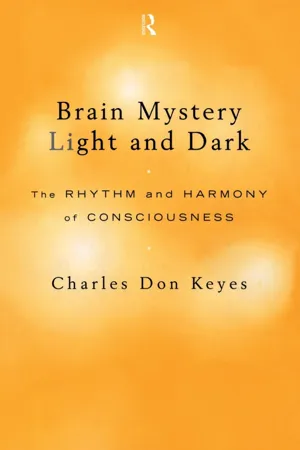
- 184 pages
- English
- ePUB (mobile friendly)
- Available on iOS & Android
eBook - ePub
About this book
Information
Part one
Shadow journey
Paul D.MacLean’s foremost critic, John Durant, claims that the triune brain concept is “probably the single, most-influential idea in brain science in the postwar period, at least in terms of public or popular perceptions as for what brain science has to say about the human condition” (Durant 1992:268). Chapter 2 introduces MacLean’s concept, examines Durant’s criticism of it, and reinterprets it as an inadvertent naturalistic restatement of Plato’s “triune” metaphor of the soul as a “many-headed, many colored beast” in Book 9 of the Republic. The same metaphor can also describe both the misery and grandeur of the human condition, respectively the strife of injustice and the harmony of justice.
I argue that mental states are brain events. This position opposes theories that claim that body (brain) and soul (mental states) are two different kinds of substance, including the Platonic split between the two and similar dualistic theories. At the same time, reduction of mind to brain does not eliminate mental states or suggest that they are unimportant, as some claim. On the contrary, aesthetic, religious, and ethical symbols are real partly because they are brain events. Chapter 1 journeys beyond the destruction of Platonic dualism to find the core of Plato’s philosophy which can be retrieved from its discarded dualistic container. Music is the most important part of the core.
Plato likens the human condition to that of prisoners in an underground dungeon chained so that they cannot see actual objects, but only shadows on the wall cast by the light of a fire burning behind them. One of the prisoners, freed of his chains, to his amazement sees the objects that cause the reflection. These underground objects and their shadows stand for actual sense perceptions.
He resists liberation from the dungeon, but someone above ground drags him out into the sunlight which initially overwhelms and temporarily blinds him until he begins to regain his sight by degrees. At first he cannot see things above ground directly, but only their reflections (“shadows,” “phantoms”) in water. Later he sees the “things themselves” that cause these reflections and finally can look directly at the sun (Plato 1968:516A–B). The sun stands for the good, source of the “things themselves,” namely the forms (or ideas, the “really real”) like the fair and the just. Mathematical entities reflect the forms, and the allegory represents them as the reflections in water.
Some current neurobiolgical models of consciousness attach importance to the theory Plato illustrates by the allegory of the cave. Chapter 6 refers to two such suggestions. Roger Penrose asks whether the Platonic forms might actually exist as the ground of mathematics. Bernard Barrs suggests that Plato’s image of “fire-cast shadows” refers to some biologically generated “spotlight of attention” that might be the source of consciousness (Baars 1997:5). Suggestions like these are evidence that late twentiethcentury natural science has become dissatisfied with positivistic restrictions.
Chapters 1 and 2 recast essential parts of Plato’s idealism in a naturalistic mode. They are a shadow journey in the positive sense that they focus on music as the privileged type of sense perception. Auditory shadows of musical rhythm and harmony might be the most direct route to mathematical entities and whatever they might reflect. It is interesting that Plato has Socrates ask: “Do you want to see ugly things, blind and crooked, when it’s possible to hear bright and fair ones from others?” (Plato 1968:506C– D).
Music is also the Platonic fortress that remains steadfast and untouched after the destruction of dualism. It is the guardhouse within the guardian part of us, the seat of courage. Music consists of three parts: words, rhythm, and harmony. The words of music, however, are subordinate to rhythm and harmony, which are sovereign. The poetic plots that words narrate arise from still more basic rhythms and harmonies of consciousness and can be resolved into them. We witness both the destruction of dualism and recovery of the fortress by a certain way of reading the Phaedo, Plato’s account of Socrates’ attempt the night before he was executed to prove that the soul survives death.
Chapter 1
The fortress
Death is one of two things, according to Socrates, and neither is to be feared. It is total annihilation, an eternal sleep without dreams, or else it is a journey to another place. That was Socrates’ answer to the death sentence in the Apology.
Plato’s Phaedo
At his execution, Socrates holds fast to the second of these possibilities: “Does not death mean that the body comes to exist by itself, separated from the soul, and the soul exists by herself, separated from the body?” (Plato 1951:64C). The soul’s eternal destiny and its present happiness now depend upon whether it lives justly or unjustly during its bodily existence. Justice is harmony and injustice is disharmony among the wisdom-loving, honor-loving, and gain-loving activities that make up the soul. These three vital functions are respectively the ruling, guardian, and producer psychological structures within individual human beings. Moderation must order and master the sensual gain-loving part that desires more food, sex, wine, and money. Courage must keep the honor-loving part that desires to score steadfast in the face of the pleasures, pains, fears, and desires that would otherwise distract it. Both of these vital functions that desire are mortal. Only the wisdom-loving “part” survives death.
The middle of the dialogue presents Socrates the philosopher struggling to prove that his wisdom-loving soul actually does survive death. Near the end, he narrates what his religious faith holds about how souls will be judged in Hades. Souls that survive the judgment pass through many reincarnations, until those that have “sufficiently purified themselves with philosophy” overcome the need for bodies and “proceed to dwellings still fairer” (Plato 1951:114C).
The Phaedo is a paradox. On the one hand, it epitomizes all the subsequent western theories of immortality that it inspires: “Then, it seems, when death attacks a man, his mortal part dies, but his immortal part retreats before death, and goes away safe and indestructible” (Plato 1951:106E). On the other hand, it is a battle-field of belief and doubt. This dialogue invites skepticism about what it affirms. Doubt plagues Socrates while the dialogue seems to invite us to get rid of the body/soul dualism that contains the belief. This skepticism expresses itself in at least three ways. The cogency of Simmias’ counter-argument is the first and most obvious way. The body produces the soul, according to Simmias, and when the body dies, the product ceases to exist. Simmias’ position stands between idealism and materialism. It points towards the former because he says that the soul is more divine than the body; but it is more like the latter in the sense that there are only material causes. The soul cannot go on existing when the body is dead because the soul emerges from the body in the way a musical harmony does from a lyre. Simmias says:
It might be said that the harmony in a tuned lyre is something unseen, and incorporeal, and perfectly beautiful, and divine, while the lyre and its strings are corporeal, and with the nature of bodies, and compounded, and earthly, and akin to the mortal…when the lyre is broken and the strings are cut or snapped…the harmony, which is of the same nature as the divine and the immortal, and akin to them, has perished, and perished before the mortal lyre…. And I think, Socrates, that you too must be aware that many of us believe the soul to be most probably a mixture and harmony of the elements by which our body is, as it were, strung and held together…the soul, though most divine, must perish at once, like other harmonies of sound and of all works of art…(Plato 1951:85E–86D)
Plato lets Socrates flounder when he tries to answer Simmias’ argument that the soul is a harmony. This is a second indication of the Phaedo’s skepticism. Socrates claims “it is quite wrong to say that the soul is a harmony” (Plato 1951:94E) because harmony or the lack of it is a quality in souls that already exist, not the cause of their existence. By reverting to his definition of justice as harmony and injustice as disharmony, he fails to get to the bottom of Simmias’ main point, which is that the soul depends upon the body for its existence. Does the fact that Plato lets Socrates equivocate about harmony and causality suggest that he is more critical of dualism than his teacher?
Socrates himself claims that at an earlier time he himself had believed that brains are the organ of consciousness. He admits this after he failed to answer Simmias’ objection:
When I was a young man, I had a passionate desire for the wisdom which is called Physical Science. I thought it a splendid thing to know the causes of everything; why a thing comes into being, and why it perishes, and why it exists. I was always worrying myself with questions such as…. Is it…the brain which gives the senses of hearing and sight and smell…?(Plato 1951:96B)
Clearly Socrates no longer holds this belief, but might some imprint of it be linked to his inability to deal with Simmias’ objection? He might be struggling with doubts that spring from challenges to body/soul dualism.
Immediately after narrating his religious creed about the soul’s survival, Socrates claims that it is worth while to stake everything on this belief:
A man of sense will not insist that these things are exactly as I have described them. But I think that he will believe that something of the kind is true of the soul and her habitations, seeing that she is shown to be immortal, and that it is worth his while to stake everything on this belief. The venture is a fair one, and he must charm his doubts with spells like these. That is why I have been prolonging the fable [mythos] all this time.(Plato 1951:114D)
Does Socrates admit that he “charms doubts” through religious myth because he is uncertain whether his arguments stand up to Simmias’ criticism? Does he wager that he will survive death because he doubts the validity of his own proofs of immortality? If so, his need to charm his doubts now might account for his statement in the Apology that annihilation might follow death.
The fastest gun in the west
The human brain, supreme product of evolution, is extraordinarily fragile. Its unimaginable complexity alongside its vulnerability might partly explain why we try to deny that it is the organ of consciousness. Do our brains engage in denial because not doing so would smash protective vestiges of the soul substance illusion? Dualism is an emotional prophylactic against the cosmic threat, but monism forbids us to wear any such protective covering. Overwhelming amounts of scientific evidence show us that it is not rational to split brain and mind into two different realms of reality. Brain and mind are identical in the sense that every mental state is a neurobiological process. Monism confronts us with the fragility of our existence, the inevitability of our death, and our tragic vulnerability.
Brain/mind is even more fragile than most people think. George Wolf visited a laboratory that monitored the impulses of individual neurons by translating them into “popping” sounds. He also heard “a soft moan” and asked the researcher what it was. He told Wolf that “it was the sound of dying cell—a high frequency discharge as the cell’s life ebbed away.” Wolf reflects that “the moan was an expression of a feeling that all sentient creatures share—it was a feeling of perishing” (Wolf 1984:119). How many of your own brain cells do you suppose might have “moaned” their death in the time it takes you to read this page?
An account by Vernon Mark and Frank Ervin of the damage a stroke did to the thalamus of a 43-year-old accountant shows how vulnerable the brain/mind is. What happened to him puts a fitting cap on much I share in the Epilogue:
He was awake and alert and able to see and follow objects, and could move both his hands and feet; but he retained only one item out of his cultural past. He kept repeating over and over again the phrase, The fastest gun in the West,’ which was all he remembered. He did not recognize his own wife and children when they came to visit him; and to their pathetic attempts to remind him who they were, he could only mumble, ‘The fastest gun in the West, the fastest gun in the West.’(Mark and Ervin 1970:142)
Could it be that he kept saying that because he thought someone had shot him?
Hope as meaning and purpose1
The fact that brain and mind are a unity clearly makes the human condition tragic, possibly absurd, since the organ of consciousness is both mortal and exceedingly vulnerable. All our thoughts, feelings, memories, and every mental state depend upon fragile neurons that are already dying. If we translate what brain/mind monism means into human terms, it turns into a crisis (Part four) resembling what Paul Tillich calls the despair of meaninglessness. Also following Tillich, I am going to conclude that “The act of accepting meaninglessness is in itself a meaningful act” (Tillich 1952:176). Accepting despair, however, is not giving in to it, but spiting it by getting on top of despair and wrestling with it. This activity is courage.
Resolving the crisis requires a kind of courage that is consistent with scientific evidence and also does not undermine the spiritual dimension of life. This dimension is not a substance but a process in which brain/ mind attributes ultimate importance to aesthetic, religious, and ethical symbols (Part five). Neuroscience rightly asks how the brain produces such processes, even though their meaning is beyond the limits of scientific judgment. The spiritual dimension of life gives hope in spite of the crisis of monism. Elsewhere I define hope within the limits of our bodily existence as the “simultaneous possession of meaning, which is the participa-tion in value bestowing symbols, and purpose, which is the projection of meaningful possibilities and goals into the future and thereby sensing time’s continuity between them and the present” (Keyes 1989:1). Hope is both mystical and practical. Its roots are aesthetic.
Science and aesthetics
Immanuel Kant distinguishes between scientific and aesthetic intuitions and establishes the legitimacy of both in their difference in the Critique of Judgement. This decisive work that he thinks completes his system goes entirely beyond the spiritual narrowness of much eighteenth-century thought. He shows that science and aesthetics use (present) categories (concepts) like causality and substance in two different ways.
Scientific knowledge presents categories directly, not figuratively. It uses language in a literal (demonstrative) way and is strictly limited to factual information (sensible intuitions). This would, of course, include empirically testable hypotheses. When we use categories scientifically in these ways according to our experience of nature, Kant calls them schemata: “The schema is, properly, only the phenomenon, or sensible concept, of an object in agreement with the category” (Kant 1965 [1787]: B 186).
Aesthetic knowledge, by contrast, uses categories indirectly as symbols namely by a “double function.” It takes an object of “sensible intuition” and “reflects” (bends back) on it analogically. Kant uses the mundane example of a hand mill as symbolizing a despotic state: “For between a despotic state and a hand mill there is, to be sure, no similarity; but there is a similarity in the rules according to which we reflect upon things and their causality.” Similarly, but more profoundly, aesthetic intuition and the feelings of the beautiful and the sublime that characterize it, as well as the language required to express it, are “symbolical.” Ethics is aesthetically significant since “the beautiful is the symbol of the morally good.” Religious faith depends upon a sublime aesthetic intuition, since “all our knowledge of God is merely symbolical” (Kant 1968 [1790]: Sec. 59). The meaning of symbols cannot be tested empirically, but this does not make them arbitrary as the many suppose, since (as Part five shows) ...
Table of contents
- Cover Page
- Title Page
- Copyright Page
- Preface
- Acknowledgments
- Prologue: Callixylon tree
- Part one: Shadow journey
- Part two: Beasts within
- Part three: At the threshold
- Part four: Vacuum in a bubble
- Part five: Light at midnight
- Epilogue: Make-a-man
- Notes
- Bibliography
Trusted by 375,005 students
Access to over 1.5 million titles for a fair monthly price.
Study more efficiently using our study tools.
Frequently asked questions
Yes, you can cancel anytime from the Subscription tab in your account settings on the Perlego website. Your subscription will stay active until the end of your current billing period. Learn how to cancel your subscription
No, books cannot be downloaded as external files, such as PDFs, for use outside of Perlego. However, you can download books within the Perlego app for offline reading on mobile or tablet. Learn how to download books offline
Perlego offers two plans: Essential and Complete
- Essential is ideal for learners and professionals who enjoy exploring a wide range of subjects. Access the Essential Library with 800,000+ trusted titles and best-sellers across business, personal growth, and the humanities. Includes unlimited reading time and Standard Read Aloud voice.
- Complete: Perfect for advanced learners and researchers needing full, unrestricted access. Unlock 1.5M+ books across hundreds of subjects, including academic and specialized titles. The Complete Plan also includes advanced features like Premium Read Aloud and Research Assistant.
We are an online textbook subscription service, where you can get access to an entire online library for less than the price of a single book per month. With over 1.5 million books across 990+ topics, we’ve got you covered! Learn about our mission
Look out for the read-aloud symbol on your next book to see if you can listen to it. The read-aloud tool reads text aloud for you, highlighting the text as it is being read. You can pause it, speed it up and slow it down. Learn more about Read Aloud
Yes! You can use the Perlego app on both iOS and Android devices to read anytime, anywhere — even offline. Perfect for commutes or when you’re on the go.
Please note we cannot support devices running on iOS 13 and Android 7 or earlier. Learn more about using the app
Please note we cannot support devices running on iOS 13 and Android 7 or earlier. Learn more about using the app
Yes, you can access Brain Mystery Light and Dark by Charles Don Keyes in PDF and/or ePUB format, as well as other popular books in Psychology & Mind & Body in Philosophy. We have over 1.5 million books available in our catalogue for you to explore.