- 112 pages
- English
- ePUB (mobile friendly)
- Available on iOS & Android
eBook - ePub
About this book
First published in 1999. This book addresses the principles behind individual education plans for pupils who exhibit speech, language and communication difficulties. The authors provide practical advice for compiling education plans and ideas for institutional self-development, and discuss the key areas of concern for teachers: how can there be agreement on the targets when the pupil functions differently in different contexts? Should the aim for pupils be on accessing the curriculum or social communication? How can speech and language targets be met across a range of subject areas? Given that language is dynamic, can the static IEP document provide a feasible blue-print for action? Can the challenge of monitoring IEPs for speech and language targets be realistically met? To what extent can teachers deliver specialist strategies to meet IEP targets in the absence of speech therapy support? How can new developments in IT support IEP delivery for students with speech, language and communication difficulties?
Information
Assessment for target setting: Principles
‘How can IEPs be integrated into the school's general arrangements for assessing and recording the progress of all pupils?’ (OFSTED 1996).
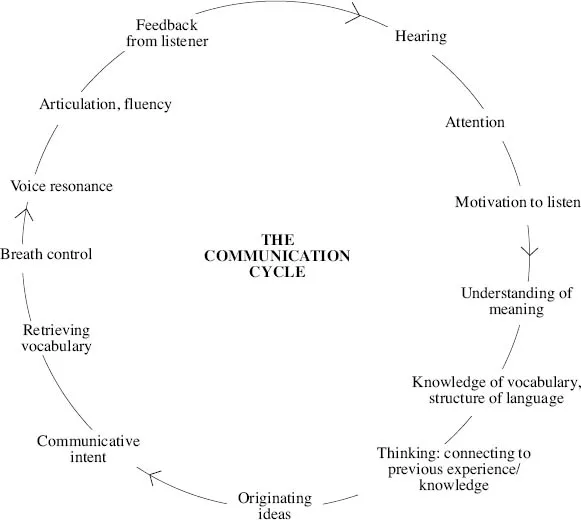
Assessment for IEP planning continues to remain challenging for schools owing mainly to both generic factors associated with whole-school assessment and specific factors which relate to the assessment of speech, language and communication – the complexities of which are illustrated by ‘the communication cycle’ (see diagram above).
As implied by OFSTED, there is a clear need to integrate IEP assessment arrangements into the school's ‘general’ arrangements for assessment and recording. Challenges for schools in this respect include the following.
• Agreeing a framework for the assessment of language and communication for all pupils so that individual pupil progress can be compared with that of their same-aged peers, with the result that an ‘expression of concern’ can be triggered and evidenced for assessment of pupil progress within the staged procedures described in the Code of Practice. It follows that any intervention including IEP provision should be delivered and assessed in the context of the medium- and long-term aims of the school's planning for language and communication. Figure 3 describes how assessment for IEP planning can be integrated into planning for curriculum delivery at whole-school level. The advantages inherent in inclusive IEP planning include a reduction in the paper-work and an increase in the effectiveness of monitoring.
• Communication of assessment information so that the recipient of the information receives more than a retrospective descriptive report. Collection and collation of assessment information needs to be purposeful to address the following questions.
1. What are the agreed areas of concern for this pupil?
2. Under what conditions does this pupil communicate/learn most effectively? This includes recording strengths and weaknesses.
3. What are the likely long-term aims for the pupil?
4. Which resources can be brought to bear to support pupil learning, (including human resources – parents, peers, etc.)?
If assessment information is interpreted, analysed (‘What does this tell me about the way the pupil is processing information and how does this information inform IEP provision?’) and reported in such a way as to inform planning, then time spent on assessing the pupil and collecting vast amounts of information which is then filed could be reduced. It may be that schools, as they move towards further development of their IEP provision, may consider examining the way they currently report assessment information to see if there might be changes that could be made so that assessment for ‘extra and different’ provision is made in relation to ‘need’ and not individual ‘deficit’. For pupils experiencing speech and language difficulties it is not uncommon to see ‘needs to increase vocabulary’ targeted on an IEP. Assessment for such a target needs to take account of the school's approach to teaching and monitoring the acquisition of the language needed for subject specific learning and social communication (see: Language: A Common Approach (SCAA 1997) and to analyse the pupil's response to that teaching across a range of settings such that appropriate ‘extra’ provision can be designed.
Figure 3 links COP planning for Stage 1 and Stage 2 and 3 IEPs by using the framework for curriculum planning described by SCAA.
In addition to integrating assessment for IEP planning into the school's general arrangements for assessment, the assessment of speech, language and communication difficulties poses a particular problem in schools because of the following.
1. Language performance depends on the circumstances in which the language is elicited. Wells (1985) found that children's language varied according to the different contexts in which they were interacting.
2. Teachers often feel insufficiently qualified to assess speech and language difficulties. At Stage 3 and beyond of the Code it is suggested that external specialists’ advice should be sought. In the case of pupils with speech and language difficulties the ‘specialists’ are usually speech and language therapists. In areas of the country where there is a shortage of speech therapy provision, teachers have been faced with the dilemma of deciding how best to meet the needs of pupils in their class who exhibit speech and language difficulties. This, coupled with increasing numbers of pupils with communication difficulties being placed in mainstream settings, and LSAs being given speech therapy programmes to ‘deliver’, has resulted in an increased demand by teachers for training in speech and language.
Assessment for planning:
developing a model to encompass the IEP (as suggested by SCAA)
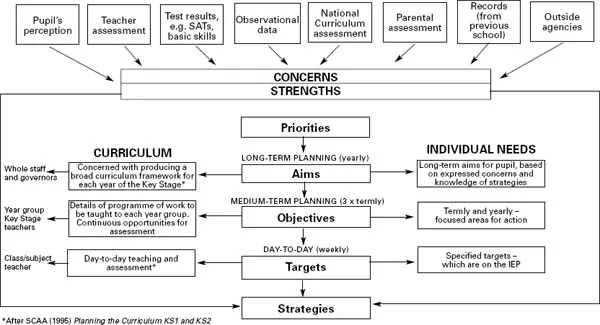
Figure 3
While there is no easy answer to the dilemmas faced by teachers in dealing with pupils with speech and language difficulties it is useful to note the following.
• Language and communication should underpin education. A study of normal language development describes how parents and/or carers facilitate language development in their offspring. Many of the strategies used in this context can be adopted by adults involved in teaching children with speech and language difficulties.
• Guidance written to support National Curriculum English ‘speaking and listening’ (Language: A Common Approach (SCAA 1997) contains ideas and approaches for teaching language).
Teachers frequently request information on how to ‘test’ children with speech and language difficulties and somehow feel that they need to acquire skills traditionally associated with speech therapists. It is useful to consider that teachers are skilled in the ‘content’, ‘form’ and ‘use’ model of curriculum delivery and assessment. This ‘model’ is used as a framework for assessment by speech and language therapists. For teachers it involves asking the following questions.
• What is the pupil saying (relevance, appropriateness, developmental level, etc.)? Is there a match between pupil ‘content’ and teacher ‘content’? If not, what adjustments need to be made? Do such adjustments require the ‘different or extra’ provision prescribed by an IEP?
• How is the pupil using language? Is it in an appropriate grammatical form? Are available role models able to extend and develop grammatical format by example rather than correction?
• Why is the pupil using language? For what purpose is he/she talking and is there a match between this pupil purpose and what is needed in the classroom? Does the pupil monitor the effectiveness of his/her performance? Do those involved with the pupil hinder or assist his/her use of la...
Table of contents
- Front Cover
- Title Page
- Copyright
- Contents
- Acknowledgements
- Preface
- How to use this book
- IEPs: Electronic communications
- What is an Individual Education Plan?
- Learning language is the solution – not the problem
- Assessment for target setting: Principles
- Writing targets: Principles
- Monitoring: Principles
- Strategies within IEPs: Principles
- Holistic language interventions: Principles
- Social stories: Principles
- Peer involvement: Principles
- Circle time: Principles
- Social skills: Principles
- Adult interventions: Principles
- Auditory discrimination: Principles
- Visual strategies: Principles
- Questioning strategies: Principles
- Using Information and Communications Technology: Principles
- Postscript
- Resources
- References
Trusted by 375,005 students
Access to over 1.5 million titles for a fair monthly price.
Study more efficiently using our study tools.
Frequently asked questions
Yes, you can cancel anytime from the Subscription tab in your account settings on the Perlego website. Your subscription will stay active until the end of your current billing period. Learn how to cancel your subscription
No, books cannot be downloaded as external files, such as PDFs, for use outside of Perlego. However, you can download books within the Perlego app for offline reading on mobile or tablet. Learn how to download books offline
Perlego offers two plans: Essential and Complete
- Essential is ideal for learners and professionals who enjoy exploring a wide range of subjects. Access the Essential Library with 800,000+ trusted titles and best-sellers across business, personal growth, and the humanities. Includes unlimited reading time and Standard Read Aloud voice.
- Complete: Perfect for advanced learners and researchers needing full, unrestricted access. Unlock 1.5M+ books across hundreds of subjects, including academic and specialized titles. The Complete Plan also includes advanced features like Premium Read Aloud and Research Assistant.
We are an online textbook subscription service, where you can get access to an entire online library for less than the price of a single book per month. With over 1.5 million books across 990+ topics, we’ve got you covered! Learn about our mission
Look out for the read-aloud symbol on your next book to see if you can listen to it. The read-aloud tool reads text aloud for you, highlighting the text as it is being read. You can pause it, speed it up and slow it down. Learn more about Read Aloud
Yes! You can use the Perlego app on both iOS and Android devices to read anytime, anywhere — even offline. Perfect for commutes or when you’re on the go.
Please note we cannot support devices running on iOS 13 and Android 7 or earlier. Learn more about using the app
Please note we cannot support devices running on iOS 13 and Android 7 or earlier. Learn more about using the app
Yes, you can access Individual Education Plans (IEPs) by Janet Tod,Mike Blamires in PDF and/or ePUB format, as well as other popular books in Education & Education General. We have over 1.5 million books available in our catalogue for you to explore.