eBook - ePub
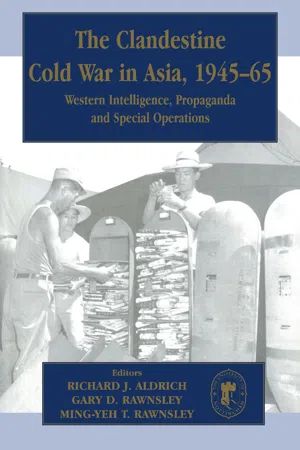
The Clandestine Cold War in Asia, 1945-65
Western Intelligence, Propaganda and Special Operations
- 316 pages
- English
- ePUB (mobile friendly)
- Available on iOS & Android
eBook - ePub
The Clandestine Cold War in Asia, 1945-65
Western Intelligence, Propaganda and Special Operations
About this book
A range of clandestine Cold War activities in Asia, from intelligence and propaganda to special operations and security support, is examined here. The contributions draw on newly-opened archives and a two-day conference on the subject.
Information
1
Introduction:
The Clandestine Cold War in Asia, 1945–65
RICHARD J. ALDRICH, GARY D. RAWNSLEY and MING-YEH T. RAWNSLEY
Asia represented the ‘hottest’ theatre in a global Cold War that lasted for half a century. Across this vast region there were usually several undeclared wars and numerous civil wars in progress, all with their clandestine elements. Among the five occasions when the US National Security Council seriously considered the use of nuclear weapons in this period, four of these instances were triggered by events in Asia.1 The volatility of this conflict owed something to its additional complexities, for intertwining with obvious Cold War frictions were the pressures of nationalism and anti-colonialism, the politics of neutralism and non-alignment, together with the deep tensions of Sino-Soviet rivalry.
The Cold War in Asia was undoubtedly ‘hotter’ than its European counterpart, but it can also be distinguished in other ways. Our current knowledge about the European Cold War is more complete. The collapse of authoritarian regimes in East Germany and the Soviet Union, with the consequent opening of archives, has not been replicated everywhere in Asia and this has implications for what we know now. Although there have been substantial releases of new documentation from Beijing and from other Asian centres, the scope and scale of these releases has been more constrained. This is particularly true of the clandestine aspects of the Cold War. In Germany, individuals may consult their own former Stasi files, while in Russia, former KGB officers publish their memoirs with impunity. Remarkably, the former head of Soviet signals intelligence has recently offered detailed commentary on the role of his service and its achievements during the Cold War. By contrast our knowledge of the role and place of Communist Chinese and other Asian Communist secret services in the Cold War remains in its infancy.2
William Colby, Director of the CIA during the 1970s and a veteran of the clandestine Cold War in Asia, observed in his memoirs that: ‘The great challenges to secret intelligence gathering were … in Berlin, Vienna and Hong Kong.’ Again the contrast between Europe and Asia is instructive. In Europe, we have witnessed the appearance of studies such as Battleground Berlin, in which senior CIA and KGB officers have come together to write a collaborative history of their mutually antithetical activities in that city, employing not only memory and interview, but reams of American and Russian declassified documents. We are unlikely to see the appearance of a similar volume dealing with Hong Kong or any other Asian city.
Equally, the history of the U-2 aerial reconnaissance programme over the Soviet Union, including the shoot-down of the Gary Powers aircraft in 1960, is now familiar to many. Yet the sight of photographs of the wreckage of four U-2 aircraft downed by the Chinese and eventually laid out in a neat row in a public park in Beijing in 1966 rarely fails to evoke surprise.3 In short, the diet of material for the Cold War in Asia has been comparatively thin and many of its clandestine aspects are likely to remain poorly understood for some time to come.4
Notwithstanding the persistent problems relating to information in Asia, the moment for the reconsideration of some of these areas seems fortuitous. ‘Glasnost’ is increasingly a global phenomenon, triggering accelerated programmes of document release in Europe, the United States and Asia. Within this broader process of global declassification we might consider the decision of the authorities in United States to process rapidly documentation that were more than 25 years old, and even to move the declassification of some types of material out of the hands of the agencies that generated the documents. The latter was surely a landmark decision. Equally we might consider the sudden appearance of hitherto elusive Communist figures, such as Chin Peng, leader of the Malayan Communist Party, and their generous collaboration with scholars.5
These accelerated ‘releases’ have offered a fleeting opportunity to researchers and historians. The possibility of consulting intelligence materials, and other types of sensitive records, that are less than 50 years old has allowed a greater combination of archival work and interview work. Some of the documentation in areas such as intelligence, propaganda and special operations is often particularly arcane and therefore commentary and explanation by participants can be of special value. Sometimes the declassification of documents has prompted security-minded witnesses to speak on subjects which they would otherwise have been reluctant to address. Sadly, these witnesses will not be with us forever. The essays that constitute this volume represent a limited attempt to seize this opportunity. They arise from a conference organised to review work arising out of recent documentary releases on Asia and which was deliberately designed to draw together academics and former practitioners in fruitful discussion.
A prominent theme in this volume is that of intelligence. It is clear that Western intelligence services in Asia certainly shared a common state of dilapidation during the early Cold War. Damaged by the pressures of demobilisation, disrupted by decolonisation and further buffeted by summary ejection from one of its principal established areas of activity — mainland China — it was in a poor state by 1949. This was further exacerbated by the low status of Asian intelligence targets generally. Both London and Washington were primarily focused on Moscow and rated the likelihood of a Soviet incursion into Asia to be very low. Europe and the Middle East were considered to be the ‘flashpoints’ in the late 1940s.
Even the limited intelligence apparatus that was available in Asia showed a marked reluctance to examine Asian targets and the resources available were often focused on the Soviets in Asia. The examples are legion. At the end of the war, British signals intercept staff at Hong Kong found themselves shifting over to collecting Soviet traffic. When George Blake was sent to Seoul to open the first SIS station in Korea, he was told that his priority was to gather material on Soviet Asia, rather than China or North Korea, and his American opposite numbers were similarly Soviet-focused. Accordingly, both the Malayan Emergency in 1948 and the Korean War in 1950 took policy-makers by surprise.6
The rush to improve intelligence in Asia after 1950 did not produce immediate results and the construction of agent networks in particular is a matter for those with patient disposition. Human intelligence operations, whether launched into China, Soviet Asia or North Korea were especially dangerous. Local populations were sufficiently terrified to denounce any suspicious persons entering their area, even they happened to be from that particular locality, and the result in Korea and mainland China was a suicidal rate of failure. Poor survival rates were themselves a contributory factor and gradually prompted the authorities to surrender only indifferent human material for agent training. One officer engaged in running airdropped agent penetrations of North Korea recalled the moment when he began his work. One morning the ‘fifteen specially selected Koreans’ he had been promised arrived at his facility for training. He could scarcely believe his eyes. Pathetic and malnourished, they were mostly shy rustic youths in their teens, some as young as 15. A week was enough for them to master the use of basic firearms, but they ‘had only the haziest idea of the parachute drill’. Accompanying his ‘agents’ as far as their dropping zones over North Korea, this officer was overcome with a sense of black depression:
Never before had I taken unprepared men into battle and now I was about to do something far worse. I was sending untrained men into the most frightening and lonely of battles … the cold night air rushed in through the open jump door. The tense queue of men waited to jump. Red light, green light, and the first man stumbled out into the night, then the next, then the next. The fourth hesitated and was pushed by those behind, and so the procession of fear went on until the fuselage was empty but for myself.7
Agent operations launched from Japan and Taiwan were equally unsuccessful. Eventually, in the early 1960s the head of the CIA station in Taipei, Ray Cline, pressed for the re-deployment of U-2 aircraft, which had ceased their increasingly hazardous flight over the Soviet Union, to Taiwan. His argument was that the rate of human agent attrition required a radical change in tactics. American U-2 pilots had already over-flown the Chinese coast from Japan during the Taiwan Straits Crisis of 1958, but now the CIA helped to launch a U-2 programme run by the ROC Air Force with pilots from Taiwan. The result was a comprehensive picture of Chinese missile development.
At the same time signals interception capability was continually expanded. Yet these new sources were not immune to countermeasures. Much Chinese communications traffic still went by landline and could not be intercepted, while the U-2s launched from Taiwan were becoming vulnerable by the mid-1960s. Satellites were the way ahead and in 1964 it was satellite photography that allowed the prediction of the first Chinese nuclear test.8
As with the Soviet Union, Western intelligence co-operation in Asia was encouraged by the nature of Communist China as a hard target. The close nature of Western co-operation in intelligence collection is often attributed to familiar patterns of co-operation established during World War II and indeed, in some cases, World War I. The legacy of close wartime personal associations — for example British and American intelligence officers working shoulder to shoulder in Eisenhower's SHAEF Command — was clearly important. But in Asia World War II, with its strongly imperial complexion, had left a legacy of tensions as well as friendships for many secret services and propaganda agencies employed by the British, Americans, French and Dutch.9 Cold War pressures, particularly after 1949 helped to overcome these problems. The key factor driving co-operation was the extreme difficulty of collecting any intelligence from inside areas such as Soviet Asia, Communist China and North Korea where agents enjoyed a short life. In these conditions of famine, any allied contribution to the overall picture was considered valuable.
Although co-operation in the area of collection and sharing of raw data was considerable, the more complex area of intelligence analysis and interpretation was marked by distrust. While great volumes of agent reports, decrypts and finished analyses were exchanged, nevertheless the whole process of interpretation was characterised by justified suspicions that intelligence might be used to manipulate policy. Attempts to produce agreed ‘Allied’ reports often failed or resulted in compromise papers. These suspicions were exacerbated by deep disagreements over policy towards mainland China. On the one hand Washington suspected Britain and its Commonwealth allies as purveyors of material that would always suggest that Beijing's mentality was relatively defensive, while on the other hand Taiwan's secret services were anxious to impart a view of Beijing as extremely aggressive.
In Washington suspicions were heightened by clear examples of efforts to ‘plant’ material on the CIA by Taipei. One experienced CIA officer, who had served in many Asian locations, recalls how a Chinese agent recruited in Vietnam, with a supposed network of sub-agents working in southern China, eventually proved to be a officer in the Taiwanese intelligence service who was merely feeding him material that emanated from Taipei.10 Within the vast United States national intelligence system there were also divisions and rivalries. National Intelligence Estimates were often ignored by policy-makers in favour of their own departmental studies that imbued the outlook of that particular section of the administration.11
Despite these uncertainties, intelligence in Asia was no less critical than it had been during World War II. Limited, but large-scale, military conflicts such as Korea, and later Vietnam, re-introduced many operational issues confronted during 1937–45. These ranged from the role of theatre commanders to the urgent demands for real-time intelligence on the battlefield.
As Matthew Aid makes clear in his extraordinary exposition on American human and signals intelligence and Korea, the extent to which the lessons of the previous conflict would, or would not, be successfully applied was crucially determined at the theatre level. Calamitous failures in the area of signals intelligence during the Korean War were central to Truman's decision to create the National Security Agency in 1952.
In a different context, Philip Davies explores the parallel complexities involved in the relationship between centre and region for the British SIS. Again, the problems of centre and region had impressed themselves between 1941 and 1945, but still remained live issues a decade later.12
What was the broader significance of the strategic intelligence effort in Asia? For the United States, faced with a continual state of war, near war, or proxy war, with mainland China until 1972, the premium was always upon military intelligence against the background of conflicts which often seemed to threaten to develop into a wider Asian war. For her allies, these conflicts provided both opportunities and dangers.
As Gary Rawnsley and Johannes R. Lombardo demonstrate, areas around the perimeter of China, especially Taiwan and Hong Kong, served as crucially...
Table of contents
- Cover
- Half Title
- Also in this series
- Full Title
- Copyright
- Contents
- List of Illustrations
- Foreword
- Acknowledgements
- Abbreviations
- 1 Introduction: The Clandestine Cold War in Asia, 1945–65
- PART I: CHINA AND THE CHINESE PERIMETER
- PART II: SOUTHEAST ASIA
- PART III: THE MALAYAN EMERGENCY
- Abstract
- About the Contributors
- Index
Trusted by 375,005 students
Access to over 1.5 million titles for a fair monthly price.
Study more efficiently using our study tools.
Frequently asked questions
Yes, you can cancel anytime from the Subscription tab in your account settings on the Perlego website. Your subscription will stay active until the end of your current billing period. Learn how to cancel your subscription
No, books cannot be downloaded as external files, such as PDFs, for use outside of Perlego. However, you can download books within the Perlego app for offline reading on mobile or tablet. Learn how to download books offline
Perlego offers two plans: Essential and Complete
- Essential is ideal for learners and professionals who enjoy exploring a wide range of subjects. Access the Essential Library with 800,000+ trusted titles and best-sellers across business, personal growth, and the humanities. Includes unlimited reading time and Standard Read Aloud voice.
- Complete: Perfect for advanced learners and researchers needing full, unrestricted access. Unlock 1.5M+ books across hundreds of subjects, including academic and specialized titles. The Complete Plan also includes advanced features like Premium Read Aloud and Research Assistant.
We are an online textbook subscription service, where you can get access to an entire online library for less than the price of a single book per month. With over 1.5 million books across 990+ topics, we’ve got you covered! Learn about our mission
Look out for the read-aloud symbol on your next book to see if you can listen to it. The read-aloud tool reads text aloud for you, highlighting the text as it is being read. You can pause it, speed it up and slow it down. Learn more about Read Aloud
Yes! You can use the Perlego app on both iOS and Android devices to read anytime, anywhere — even offline. Perfect for commutes or when you’re on the go.
Please note we cannot support devices running on iOS 13 and Android 7 or earlier. Learn more about using the app
Please note we cannot support devices running on iOS 13 and Android 7 or earlier. Learn more about using the app
Yes, you can access The Clandestine Cold War in Asia, 1945-65 by Richard J. Aldrich, Ming-Yeh Rawnsley, Richard J. Aldrich,Ming-Yeh Rawnsley,Ming-Yeh Rawnsley, Richard J. Aldrich, Ming-Yeh Rawnsley, Ming-Yeh Rawnsley in PDF and/or ePUB format, as well as other popular books in Psychology & Asian History. We have over 1.5 million books available in our catalogue for you to explore.