- 208 pages
- English
- ePUB (mobile friendly)
- Available on iOS & Android
eBook - ePub
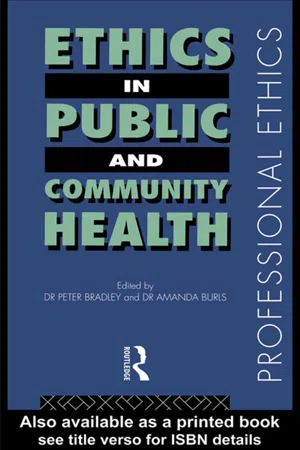
Ethics in Public and Community Health
About this book
The purpose of public and community health is to improve the health of populations or groups rather than concentrating on individuals. This book examines the ethical issues associated with public and community health.
The contributors analyse the major ethical issues in public health - prioritisation, public participation, health promotion and screening - all of which reflect current practice in the UK. They examine what health services should be available, who should have access to which health services, what are the best strategies for preventing disease, how can professional and public views be reconciled and when can an individual's health needs override the choice of a community.
The contributors apply up-to-date ethical theory to practical examples in public health practice to provide a comprehensive and accessible introduction to the key issues in public health ethics.
Information
Part I
RATIONING AND PRIORITISATION
In this section of the book the ethical issues of rationing and prioritisation are discussed. Prioritisation resulting from limited resources inevitably leads to ethical dilemmas; for example, if one group receives health care then another may be denied it. As public health practice concerns itself with maintaining health in the whole population, the issue is particularly pressing.
Traditionally priorities have been decided implicitly, at the point of making a clinical decision or by governmental resource allocation. In some countries this process is becoming more explicit as a result of the reforms of the health care system. For example in the UK health authorities now have a direct input into decisions about whether a treatment is available or what groups of people receive certain kinds of health care. This process might take into account national priorities, the views of local professionals, the views of the public and evidence of clinical effectiveness of treatments. The level of public participation in deciding priorities is extremely varied.
In the first chapter by Bradley, the case for a move to a more explicit process is considered. Some of the ethical frameworks which could support decision-making are presented. However, he concludes that although useful, the theories only offer a partial solution to the practicalities of decision-making. The theme of the importance of the process of decision-making is considered in other sections of the book, especially Part III, where the relevance of public participation is considered.
The second chapter, by Ewart, describes an implicit decision-making process for the funding by a health authority of extra-contractual referrals. The emphasis in this case was on developing an ethical framework by local consensus. Griffiths’s chapter, in contrast, shows the need for explicitness in decision-making as made possible in a Priorties Forum. Even so, this process has very limited public participation. In the chapter by Needham, a process for full participation by the public is described. The logistic, practical and ethical problems of getting decisions made by the public accepted by health authorities are discussed. Another way of sharing decision-making is discussed by Locock in her chapter comparing international attempts at priority-setting. The ethical bases for these processes are discussed. All these processes achieve only partial solutions to the dilemmas of prioritisation in health care. Prescriptive rationing criteria, as used in Oregon, for example, are seen to be too inflexible. Loose criteria, as used in New Zealand, are not seen to carry enough force to influence decisions. However, cultural, ethical and other factors do influence the choices made in each health care system.
In conclusion, there are no easy solutions to deciding which ethical frameworks or which processes will help to resolve prioritisation dilemmas. The different chapters illustrate a variety of approaches.
1
APPLICATION OF ETHICAL THEORY TO RATIONING IN HEALTH CARE IN THE UK: A MOVE TO MORE EXPLICIT PRINCIPLES?
Introduction
At present, rationing policy in the UK National Health Service (NHS) is mostly implicit in that decisions about which treatments should be funded are decided without national or local debate. Many believe that a more explicit and open debate on rationing policy is inevitable. Presently, decisions about health care rationing are often inconsistent and judgements unclear. Consideration of the ethical principles that lie behind health care decision-making can help decision-makers realise which values underpin their decisions and where their judgements are inconsistent. This chapter summarises the arguments used in ethical theory and the implications of having certain philosophical frameworks in health care rationing.
A definition of rationing
The term ‘rationing’ is often replaced by phrases relating to resource allocation or priority-setting. Although the terms are used in slightly different ways, they all arise from a similar assumption, that is, it is impossible to meet all the health care demands from the population within the NHS on current levels of public expenditure.1
Rationing of health care services can be defined as: ‘an explicit or implicit policy to withhold specific measures of treatment or care on the grounds that their economic costs are prohibitive’.2 In other words, rationing of health care may mean that a specific treatment or type of care is denied to a group of people or to an individual, even if that treatment would confer health benefit to them.
Is rationing a necessity?
The rationing debate has intensified in the last few years because of a perceived funding crisis in the NHS. This is attributed to several factors. For example, the population of the UK is ageing, and traditionally elderly people have used the resources of the NHS more heavily than other age groups. There has been an increase in the use of high technology in the NHS, making many more treatments available than before and, more often than not making treatment more expensive. Public expectations of and demands upon the health service have grown in the last few decades.3 Total NHS funding increased by 105 per cent between 1980/1 and 1989/90.4 Even allowing for inflation, this is an enormous increase.
Some have argued that rationing would be an unnecessary policy if the NHS were ‘more appropriately’ funded,5 for example, by diverting resources to health from other government ministries. However, in this chapter, we will assume that the budget for health is unlikely to meet all health demands. The NHS is, at present, largely funded through public rather than private means, and the source of this public funding is mainly taxation.6 At the present level of funding, the NHS cannot satisfy the current demand for health care services.7 Several authors believe that some sort of health care rationing is inevitable.8
Types of rationing in the NHS
Rationing takes many forms in the NHS. It is done by restricting the budget for health at the level of governmental ministries,9 or by geographical areas using resource allocation formulae,10 or for certain types of health care services, for example community health services. Other types of rationing include restricting the number of people who might receive a particular treatment, for example denying expensive heart operations to smokers or the elderly.11 Access to treatments can be limited by waiting lists, by the health authority’s or the doctor’s ability to pay, by age limits, or by the number of treatments available (such as assisted fertility services).12
Where rationing occurs in the NHS, decisions are usually made without public knowledge or involvement,13 either by individual clinicians (when a doctor denies a patient treatment);14 or centrally, through the amount of funds given to each health authority or purchaser.15 So rationing decisions are usually implicit. There is a continuing misconception that the NHS is always able to deliver services according to health care need, so if a patient ‘needs’ treatment, economic reasons will not preclude it.16
Occasionally, decisions have been more explicit. There have been a number of high profile cases about the rationing of resources by purchasers, such as the case of child B, diagnosed with leukaemia and denied specialist treatment on the NHS17 and the debate over the use of ß interferon in the treatment of multiple sclerosis.18 Some health authorities have produced lists of specific treatments that they are not prepared to fund.19
Despite this, the general consensus seems to be that rationing in the NHS continues to be mainly unadmitted.20 But it seems inevitable health care costs will rise and demands from the population will continue to increase. Health inequality between social groups is also increasing.21 As public concern grows about the limitations of the health service, implicit decision-making by a minority may become unacceptable. The decision-making process behind health care rationing decisions will need to become more open to view and the public more informed.
How might rationing decisions be made in the UK?
Many groups could be involved in future rationing decisions,22 for instance the medical profession, health authorities, primary care groups, certain sections of the public, central government, expert committees and the courts.23 More open debate is now being encouraged in the NHS.24 However, this approach will only be useful if all parties are appropriately informed in the issues related to health care rationing.25 Previous explicit approaches have shown that public and professional views are likely to be at variance.26 Such a situation was encountered in the state of Oregon, USA, which used public opinion to inform health policy. Apart from recognised difficulties in the consultation process, some of the conclusions reached by public consultation were unacceptable to politicians and professionals. For example, the treatment of crooked teeth had higher priority than the management of non-Hodgkin’s lymphoma, a type of leukaemia.27
Bearing in mind the near-inevitable disagreement between the public, professionals and politicians, a better understanding of ethical issues is needed. It will allow decision-makers to realise what values underpin their decisions, where their judgements are inconsistent and where they are being unfair.
Rationing alternatives: theoretical concerns
The following sections will consider how ethical theory might inform the rationing debate. Firstly, cost-effectiveness and utilitarian views will be discussed. Secondly, concerns of equity, rights theory and Rawlsian interpretations of distributive justice will be outlined.
Cost-effectiveness and the utilitarian view
It is often said the NHS needs to be a cost-effective service. There are many examples of initiatives in promoting cost-effectiveness in the NHS at present, for example the use of Quality Adjusted Life Years and Marginal Analysis techniques.28 The basic notion behind using cost-effectiveness criteria in rationing decisions is the concept of ‘opportunity cost’; if health resources are used for one person they will not be available to others.29 This implies that resources should be used in such a way that they achieve maximal overall benefit,30 in terms of the population’s health.31
Adequate decisions can be made using only cost-effectiveness criteria when two treatments, although leading to a similar outcome, vary greatly in cost.32 An example is of two differently priced drugs, which have similar side effect profiles, but produce similar effects. It makes obvious sense to use the cheaper drug. Adequate decisions can also be made where the outcomes differ, but can be measured on a similar scale, as reduction in blood pressure can be, for example.
The cost and effectiveness of treatments are always relevant when health care must be prioritised. However, comparisons between treatments and costs are not easy. Firstly, it is not always clear how health benefits can be measured and compared.33 Secondly, there are many treatments used regularly, which have yet to be fully evaluated for their cost-effectiveness.34 Thirdly, some beneficial treatments may never demonstrate effectiveness.35 For example, studies of treatments for the homeless are difficult to conduct, because of the high drop-out rates of these people from the studies.
As well as the practical difficulties i...
Table of contents
- Cover
- Title
- Copyright
- Contents
- Contributors
- Preface
- Series Editors’ Preface
- PART 1. Rationing and Prioritisation
- PART 2. Screening
- PART 3. Health Promotion, Research and Public Participation in Health Care
- Index
Trusted by 375,005 students
Access to over 1.5 million titles for a fair monthly price.
Study more efficiently using our study tools.
Frequently asked questions
Yes, you can cancel anytime from the Subscription tab in your account settings on the Perlego website. Your subscription will stay active until the end of your current billing period. Learn how to cancel your subscription
No, books cannot be downloaded as external files, such as PDFs, for use outside of Perlego. However, you can download books within the Perlego app for offline reading on mobile or tablet. Learn how to download books offline
Perlego offers two plans: Essential and Complete
- Essential is ideal for learners and professionals who enjoy exploring a wide range of subjects. Access the Essential Library with 800,000+ trusted titles and best-sellers across business, personal growth, and the humanities. Includes unlimited reading time and Standard Read Aloud voice.
- Complete: Perfect for advanced learners and researchers needing full, unrestricted access. Unlock 1.5M+ books across hundreds of subjects, including academic and specialized titles. The Complete Plan also includes advanced features like Premium Read Aloud and Research Assistant.
We are an online textbook subscription service, where you can get access to an entire online library for less than the price of a single book per month. With over 1.5 million books across 990+ topics, we’ve got you covered! Learn about our mission
Look out for the read-aloud symbol on your next book to see if you can listen to it. The read-aloud tool reads text aloud for you, highlighting the text as it is being read. You can pause it, speed it up and slow it down. Learn more about Read Aloud
Yes! You can use the Perlego app on both iOS and Android devices to read anytime, anywhere — even offline. Perfect for commutes or when you’re on the go.
Please note we cannot support devices running on iOS 13 and Android 7 or earlier. Learn more about using the app
Please note we cannot support devices running on iOS 13 and Android 7 or earlier. Learn more about using the app
Yes, you can access Ethics in Public and Community Health by Peter Bradley,Peter M Bradley,Amanda Burls in PDF and/or ePUB format, as well as other popular books in Medicine & Ethics in Medicine. We have over 1.5 million books available in our catalogue for you to explore.