- 512 pages
- English
- ePUB (mobile friendly)
- Available on iOS & Android
eBook - ePub
Newnes Electrical Pocket Book
About this book
Newnes Electrical Pocket Book is the ideal daily reference source for electrical engineers, electricians and students. First published in 1932 this classic has been fully updated in line with the latest technical developments, regulations and industry best practice. Providing both in-depth knowledge and a broad overview of the field this pocket book is an invaluable tool of the trade.
A handy source of essential information and data on the practice and principles of electrical engineering and installation.
The 23rd edition has been updated by engineering author and consultant electrical engineer, Martin Heathcote. Major revisions have been made to the sections on semiconductors, power generation, transformers, building automation systems, electric vehicles, electrical equipment for use in hazardous areas, and electrical installation (reflecting the changes introduced to the IEE Wiring Regulations BS7671: 2001).
Information
1 Fundamentals and theory
Fundamentals
Current. The term ‘current’ is used to denote the rate at which electricity flows. In the case of a steady flow the current is given by the quantity of electricity which passes a given point in one second. (Although since 1948 the unit of current has been officially defined in terms of the electromagnetic force that it produces, see below – since this force can be most conveniently measured.) The magnitude of the current depends not only upon the electromotive force but also upon the nature and dimensions of the path through which it circulates.
Ohm's law. Ohm's law states that the current in a direct current (d.c.) circuit varies in direct proportion to the voltage and is inversely proportional to the resistance of the circuit. By choosing suitable units this law may be written

The commercial units for these quantities are
| Current – the ampere | (A) |
| Electromotive force – the volt | (V) |
| Resistance – the ohm | (Ω) |
Using the symbols I, V and R to represent the above quantities in the order given, Ohm's law can be written

The law not only holds for a complete circuit, but can be applied to any part of a circuit provided care is taken to use the correct values for that part of the circuit.
Resistivity. The resistivity of any material is the resistance of a piece of the material having unit length and unit sectional area. The symbol is ρ and the unit is the ohm metre. The resistivity of a material is not usually constant but depends on its temperature. Table 1.1 shows the resistivity (with its reciprocal, conductivity) of the more usual metals and alloys.
Resistance of a conductor. The resistance of a uniform conductor with sectional area A and length l is given by

The units used must be millimetres and square millimetres if ρ is in ohm millimetre units.
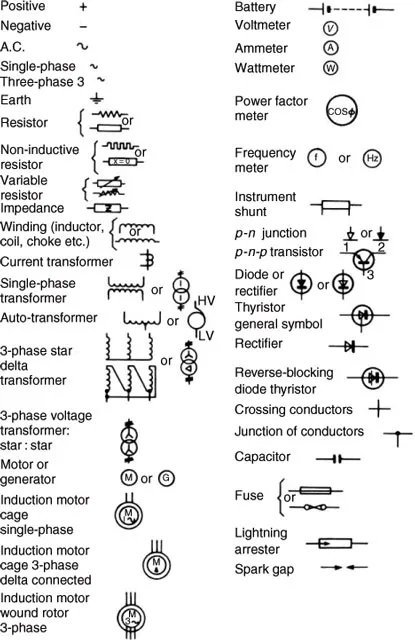
Figure 1.1 Graphical symbols – BS 3939
Temperature coefficient. The resistance of a conductor at any temperature can be found as follows:
Rt = R0(1 + αt)
Rt = resistance at temperature t °C
R0 = resistance at temperature 0°C
The coefficient α is called the temperature coefficient and it can be described as the ratio of the increase in resistance per degree C rise in temperature compared with the actual resistance at 0°C. The coefficient for copper may be taken as 0.004. The increase in resistance for rise of temperature is important, and for many calculations this factor must be taken into account.
Table 1.1 Resistivities at 20° C
| Material | Resistivty Ohm metres | Conductivity Siemens per metre | ||
| Silver | 1.64 | × 10−8 | 6.10 | × 107 |
| Copper (annealed) | 1.72 | × 10−8 | 5.8 | × 107 |
| Gold | 2.4 | × 10−8 | 4.17 | × 107 |
| Aluminium (hard) | 2.82 | × 10−8 | 3.55 | × 107 |
| Tungsten | 5.0 | × 10−8 | 2.00 | × 107 |
| Zinc | 5.95 | × 10−8 | 1.68 | × 107 |
| Brass | 6.6 | × 10−8 | 1.52 | × 107 |
| Nickel | 6.9 | × 10−8 | 1.45 | × 107 |
| Platinum | 11.0 | × 10−8 | 9.09 | × 106 |
| Tin | 11.5 | × 10−8 | 8.70 | × 106 |
| Iron | 10.15 | × 10−8 | 9.85 | × 106 |
| Steel | 19.9 | × 10−8 | 5.03 | × 106 |
| German Silver | 16–40 | × 10−8 | 6.3–2.5 | × 106 |
| Platinoid | 34.4 | × 10−8 | 2.91 | × 106 |
| Manganin | 44.0 | × 10−8 | 2.27 | × 106 |
| Gas carbon | 0.005 | 200 | ||
| Silicon | 0.06 | 16.7 | ||
| Gutta-percha | 2 | × 107 | 5 | × 10−8 |
| Glass (soda-lime) | 5 | × 109 | 2 | × 10−10 |
| Ebonite | 2 | × 1013 | 5 | × 10−14 |
| Porcelain | 2 | × 1013 | 5 | × 10−14 |
| Sulphur | 4 | × 1013 | 2.5 | × 10−14 |
| Mica | 9 | × 1013 | 1.1 | × 10−14 |
| Paraffin-wax | 3 | × 1016 | 3.3 | × 10−17 |
Power. Power is defined as the rate of doing work. The electrical unit of power (P) is the watt (abbreviation W), and taking a steady current as w...
Table of contents
- Front Cover
- Half Title
- Title Page
- Copyright
- Contents
- Preface
- Acknowledgements
- Introduction
- 1 Fundamentals And Theory
- 2 Properties Of Materialsm
- 3 Plastics And Rubber In Electrical Engineering
- 4 Semiconductors And Semiconductor Devices
- 5 Rectifiers And Converters
- 6 Computers And Programmable Controllers
- 7 Electricity Generation
- 8 Transmission And Distribution
- 9 Cables
- 10 Transformers And Tapchangers
- 11 Tariffs And Power Factor
- 12 Requirements For Electrical Installations (BS 7671)
- 13 Lighting
- 14 Motors And Control Gear
- 15 Switchgear And Protection
- 16 Heating And Refrigeration
- 17 Building Automation Systems
- 18 Instruments And Meters
- 19 Electric Welding
- 20 Battery Electric Vehicles
- 21 Battery Systems
- 22 Cable Management Systems
- 23 Hazardous Area Electrical Work
- Index
Trusted by 375,005 students
Access to over 1.5 million titles for a fair monthly price.
Study more efficiently using our study tools.
Frequently asked questions
Yes, you can cancel anytime from the Subscription tab in your account settings on the Perlego website. Your subscription will stay active until the end of your current billing period. Learn how to cancel your subscription
No, books cannot be downloaded as external files, such as PDFs, for use outside of Perlego. However, you can download books within the Perlego app for offline reading on mobile or tablet. Learn how to download books offline
Perlego offers two plans: Essential and Complete
- Essential is ideal for learners and professionals who enjoy exploring a wide range of subjects. Access the Essential Library with 800,000+ trusted titles and best-sellers across business, personal growth, and the humanities. Includes unlimited reading time and Standard Read Aloud voice.
- Complete: Perfect for advanced learners and researchers needing full, unrestricted access. Unlock 1.5M+ books across hundreds of subjects, including academic and specialized titles. The Complete Plan also includes advanced features like Premium Read Aloud and Research Assistant.
We are an online textbook subscription service, where you can get access to an entire online library for less than the price of a single book per month. With over 1.5 million books across 990+ topics, we’ve got you covered! Learn about our mission
Look out for the read-aloud symbol on your next book to see if you can listen to it. The read-aloud tool reads text aloud for you, highlighting the text as it is being read. You can pause it, speed it up and slow it down. Learn more about Read Aloud
Yes! You can use the Perlego app on both iOS and Android devices to read anytime, anywhere — even offline. Perfect for commutes or when you’re on the go.
Please note we cannot support devices running on iOS 13 and Android 7 or earlier. Learn more about using the app
Please note we cannot support devices running on iOS 13 and Android 7 or earlier. Learn more about using the app
Yes, you can access Newnes Electrical Pocket Book by E A Reeves,Martin Heathcote in PDF and/or ePUB format, as well as other popular books in Technology & Engineering & Construction & Architectural Engineering. We have over 1.5 million books available in our catalogue for you to explore.