- 424 pages
- English
- ePUB (mobile friendly)
- Available on iOS & Android
eBook - ePub
Newnes Building Services Pocket Book
About this book
Newnes Building Services Pocket Book is a unique compendium of essential data, techniques and procedures, best practice, and underpinning knowledge. This makes it an essential tool for engineers involved in the design and day-to-day running of mechanical services in buildings, and a valuable reference for managers, students and engineers in related fields.
This pocket reference gives the reader access to the knowledge and knowhow of the team of professional engineers who wrote the sixteen chapters that cover all aspects of mechanical building services. Topic coverage includes heating systems, ventilation, air conditioning, refrigeration, fans, ductwork, pipework and plumbing, drainage, and fire protection. The result is a comprehensive guide covering the selection of HVAC systems, and the design process from initial drafts through to implementation.
The second edition builds on the success of this popular guide with references to UK and EU legislation fully updated throughout, and coverage fully in line with the latest CIBSE guides.
Information
1 Energy and Environmental Considerations
DOI: 10.4324/9780080548777-1
1.1 Introduction
Up to now the building industry in this country has been influenced by short-term economic strategies and high interest rates in such a way that design decisions have been dominated by the need to reduce capital cost and space requirement to a minimum.
However, public opinion, long-term commercial viability and higher standards must eventually influence design to give greater consideration to such factors as.
- low energy use;
- low maintenance requirement;
- more flexibility of building use;
- better system hygiene;
- low operating cost.
This chapter is devoted to design techniques which address these factors.
1.2 Typical Building Energy Use Pie Chart
Since lower energy use is likely to be the subject of increasing public attention it is useful to have an awareness of how various components of building services use energy, and where significant savings can be made. The pie charts in Figure 1.1 give a broad indication of the energy intake proportions of various elements of building services. This is based on a typical UK commercial office building air conditioned with a four-pipe dry fan coil system without heat recovery or free cooling features and 55 hour/week occupied period. The top chart is based upon the annual energy intake metered at the building. The proportions of energy usage by various components would vary for different types of building, usage and air conditioning system.
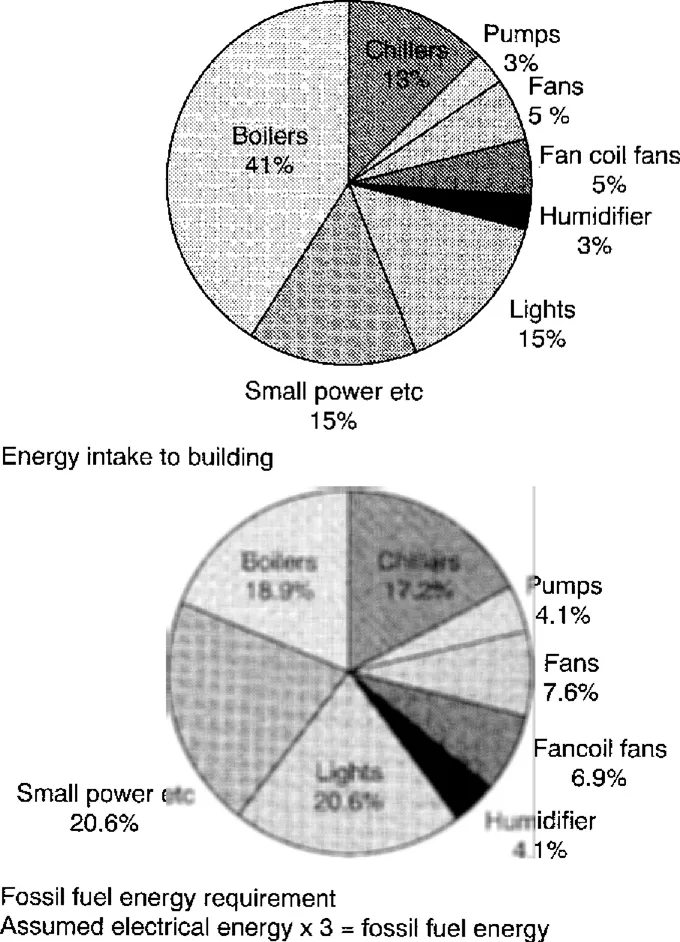
The lower chart is for the same building, but in this case the electrical power usage is based on the fossil fuel energy consumed at the power stations to produce the electrical energy required. The chart assumes that electrical energy delivered to the building requires three times as much fossil fuel energy per useful kWh as natural gas. This multiplier is affected by the average efficiency of electricity generating stations which is changing due to the increasing proportion of gas-fired dual cycle stations. These must be considered as a rough guide and the multiplier should be based upon the latest information from UK energy statistics. From an environmental point of view the CO2 emission (kg per kWh delivered) for electricity is also approximately three times that of natural gas based on the Building Research Establishment Environmental Assessment Method Report 1993 [1].
1.3 The Effect of Duct Space on the Energy Used for Air Distribution
From the pie chart it can be seen that fan energy is a significant proportion of the building energy intake and a major part of this is expended in overcoming the resistance of ducts and duct fittings. For a given air flow this can be reduced in a number of ways, but unfortunately most of these have an effect on the planning and space allocation for services. Consideration should be given to the following factors when planning.
- Increasing duct diameter by 5 per cent reduces the energy in overcoming duct resistance by approximately 18 per cent.
- Feeding air into the middle of a duct instead of from one end, reduces the resistance of that duct (and consequently the energy required to overcome that resistance) to 12.5 per cent (result of half the run and half the velocity).
- In ceiling voids where space is restricted, splitting the distribution into several ducts instead of using one main duct, enables the air velocity and consequently the resistance to be reduced. (Two ducts of a given size have 25 per cent of the resistance of one duct of the same size, when conveying the same airflow.)
- Locating the air handling unit in the centre of the area to be served instead of at one end of the area reduces the horizontal duct resistance by up to 87 per cent for similar sized ducts. (The effect of half the travel and half the velocity.)
- The major part of duct resistance is usually in the fittings. Duct work should have a high priority when coordinating multiple services, to enable duct runs to be straight with the minimum number of directional changes. Sets in electrical cables incur no energy loss. Air duct sets incur a high energy loss.
1.4 Fan and Pump Efficiencies
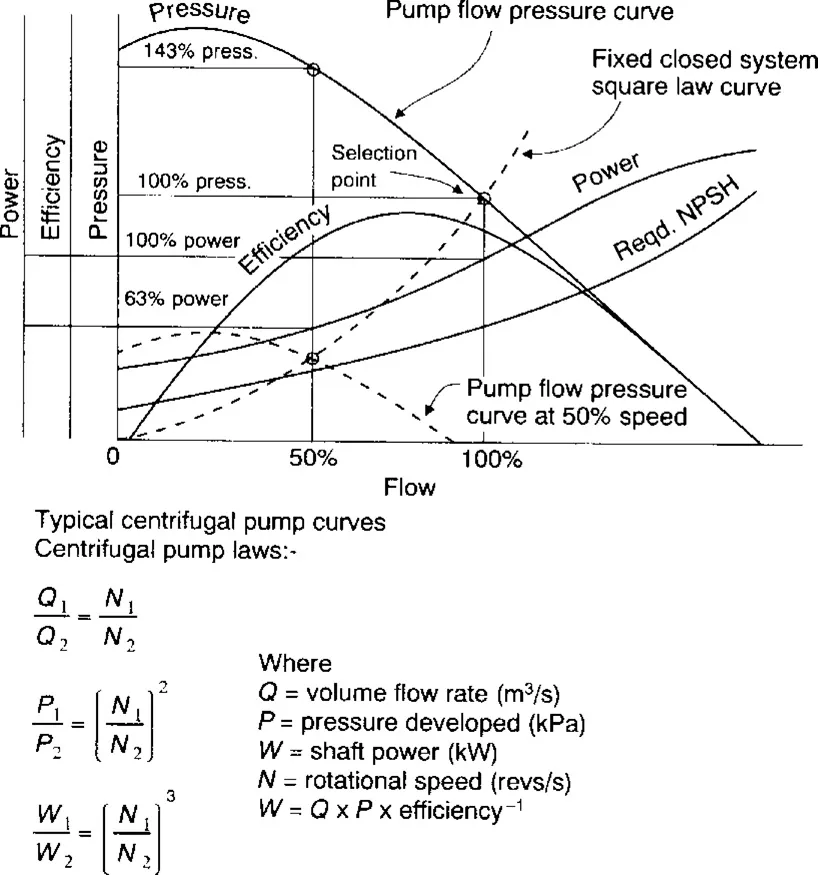
Pump efficiencies can vary considerably, dependent on the pump design and more importantly, where the operating point falls on the characteristic curve of the pump.
When selecting a pump, part of the system curve should be plotted to intersect the pump characteristic curve and so establish the probable operating point.
When selecting the duty of a pump it is normal to add margins to the design flow rate and system pressure drop to allow for balancing inaccuracies and system changes. These margins usually result in a shift in the operating point which, to some extent can be anticipated. It is worth checking the operating point for a number of different pumps to see which one gives the lowest power consumption. Figure 10.21 shows a typical pump characteristic curve, with design system curve and probable operating point.
Similar selection procedures apply to fans and these are dealt with in Chapter 6. There are, however, some important differences between selecting fans and pumps.
With pumps the outlet velocity has little significance on the power requirement or the flow generated noise. With fans the outlet velocity will have a considerable effect on both, requiring careful consideration when selecting a fan and designing the fan outlet connection. This is dealt with in Chapters 6 and 7 but is mentioned here as it can have a marked effect on fan power and energy.
High efficiency electric motors are now readily available as an alternative to standard motors and will give a significant reduction in electrical consumption, as will avoiding oversized motors.
1.5 The Effect of Variable Flow Air and Water Distribution Systems on Energy Consumption
Secondary chilled and heating water distribution systems are mostly designed with a constant flow rate and a constant pumphead. Local terminal unit control under this system is achieved by changing the flow rate through the terminal and by passing the balance of the flow directly back to the return main. This means that the pumping energy remains constant at any thermal load on the system and the pump flow rate must be the sum of all the terminal peak flow rates including calculation and selection margins plus a further margin for inaccurate balancing. In contrast, if the secondary distribution is designed as a variable flow system, where the whole system flow rate is the minimum required by the terminals (none being bypassed to the return main), then the pump duty is less and the power requirements reduces with the thermal load.
If a variable speed pump is used with this system the distribution pump energy is likely to be less than 15 per cent of the pump energy associated with the equivalent constant flow system. The hydraulic design of variable flow systems is a little more complex because the pressures vary with the load. This is dealt with in Chapter 10. The mains losses on heating systems are much lower at part load.
The distribution energy savings associated with variable air volume (VAV) systems, although significant, are not as dramatic as those associated with variable flow water systems. This is mainly due to the need to maintain high minimum air flows. VAV system design is dealt with in Chapter 3.
1.6 Free Cooling and the Energy Used for Refrigeration
Free cooling is a term used for the reduction or elimination of mechanical refrigeration load by using outside air instead of recirculated air, or by the operation of the refrigeration plant as a thermosiphon, the compressor then being off. When used in an all-air system of air conditioning, such as most VAV plants, it means that if the outside air enthalpy is lower than the enthalpy of the return air there is a reduction of refrigeration load by using all outside air. When the outside air temperature is at or below that required off the cooling coil, the refrigeration load is zero and the refrigeration plant can be shut down. This temperature is typically about 10°C and by using the BSRIA data [2] on the occurrence of wet and dry bulb temperatures it can be seen that the dry-bulb temperature is at or below 10°C for about 59 per cent of the year.
With a dry fan coil system it is possible to use the primary air cooling coil to cool the secondary water to the fan coils (without using the refrigeration plant) when the outside air temperature is below about 5°C (approximately 23 per cent of the year). This technique also saves boiler energy since the cooling coil is then preheating the air. The arrangement and control of dry fan coil systems are described in Figures 1.3 and 3.37.
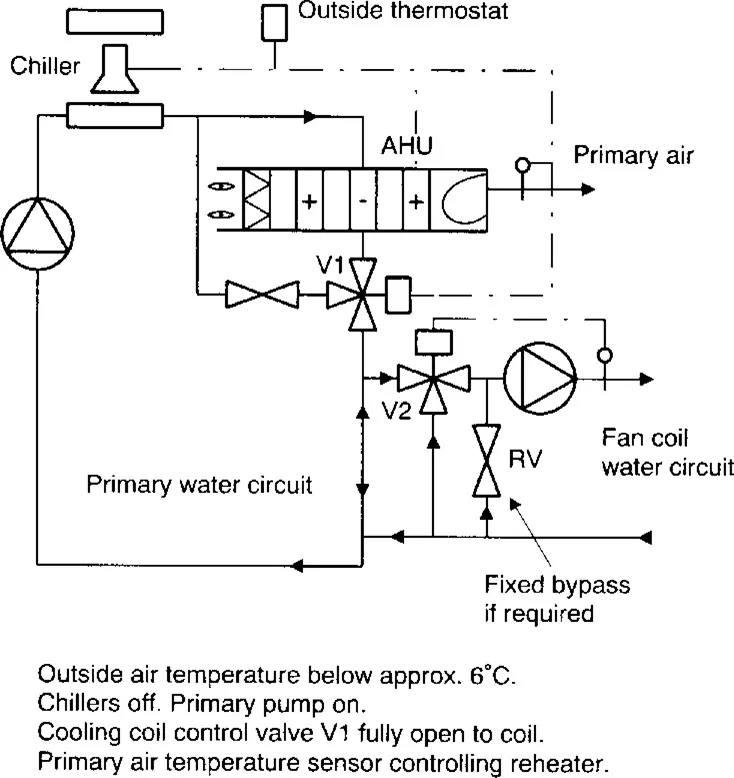
Table of contents
- Cover Page
- Half Title Page
- Title Page
- Copyright Page
- Contents
- Introduction
- List of Contributors
- 1 Energy and Environmental Considerations
- 2 Heating System Design
- 3 Air Conditioning and Ventilation
- 4 Automatic Controls
- 5 Control Applications
- 6 Fans and their Characteristics
- 7 Ductwork Design
- 8 Refrigeration
- 9 Heat rejection
- 10 Pipework Design for Closed Water Circuits
- 11 Fire protection
- 12 Coldwater Services
- 13 Hotwater Services
- 14 Building Drainage
- 15 Sanitary Plumbing
- 16 Roof Drainage
- Index
Trusted by 375,005 students
Access to over 1.5 million titles for a fair monthly price.
Study more efficiently using our study tools.
Frequently asked questions
Yes, you can cancel anytime from the Subscription tab in your account settings on the Perlego website. Your subscription will stay active until the end of your current billing period. Learn how to cancel your subscription
No, books cannot be downloaded as external files, such as PDFs, for use outside of Perlego. However, you can download books within the Perlego app for offline reading on mobile or tablet. Learn how to download books offline
Perlego offers two plans: Essential and Complete
- Essential is ideal for learners and professionals who enjoy exploring a wide range of subjects. Access the Essential Library with 800,000+ trusted titles and best-sellers across business, personal growth, and the humanities. Includes unlimited reading time and Standard Read Aloud voice.
- Complete: Perfect for advanced learners and researchers needing full, unrestricted access. Unlock 1.5M+ books across hundreds of subjects, including academic and specialized titles. The Complete Plan also includes advanced features like Premium Read Aloud and Research Assistant.
We are an online textbook subscription service, where you can get access to an entire online library for less than the price of a single book per month. With over 1.5 million books across 990+ topics, we’ve got you covered! Learn about our mission
Look out for the read-aloud symbol on your next book to see if you can listen to it. The read-aloud tool reads text aloud for you, highlighting the text as it is being read. You can pause it, speed it up and slow it down. Learn more about Read Aloud
Yes! You can use the Perlego app on both iOS and Android devices to read anytime, anywhere — even offline. Perfect for commutes or when you’re on the go.
Please note we cannot support devices running on iOS 13 and Android 7 or earlier. Learn more about using the app
Please note we cannot support devices running on iOS 13 and Android 7 or earlier. Learn more about using the app
Yes, you can access Newnes Building Services Pocket Book by Andrew Prentice,John Knight,W.P. Jones in PDF and/or ePUB format, as well as other popular books in Technology & Engineering & Civil Engineering. We have over 1.5 million books available in our catalogue for you to explore.