- 368 pages
- English
- ePUB (mobile friendly)
- Available on iOS & Android
eBook - ePub
Diversity Success Strategies
About this book
Powerful self-awareness activities and real-life case studies make this new information fascinating, practical, and easy to apply to the workplace.
Seeing the world through the eyes of a person from another group is a potent process for shifting perspective and gaining multicultural people skills.
" . . . an informative, comprehensive, and practical book. It is easy to read and is a must for everyone who is seriously interested in learning about and working more effectively with diverse people. I highly recommend it."
James P. Grey, Centre for Organization Effectiveness, Inc.
Norma Carr-Ruffino is Professor of Management at San Francisco State University. Author of the bestselling book, The Promotable Woman, and a well-known lecturer, she has made presentations throughout the U.S., Europe, and Asia. She has facilitated seminars and courses in managing cultural and gender diversity since the 1970s. As an entrepreneur, she helped to found and expand a chain of food stores. Her research has focused on helping organizations successfully compete in local and global markets by utilizing the talents of a diverse range of people.
1
How to Succeed in a Diverse Workplace
American workplace diversity can be a major source of innovation, global savvy, and profitability--or a source of conflict and chaos. It all depends on us: on how we respond to workplace changes, and on our ability to build produc tive relationships with people from many cultures and lifestyles. The increasing diversity you encounter in your workplace may pose challenges to your ability to do your job, but that diversity can also be the source of amazing career success. You're about to learn the diversity success strategies that make all the difference.
HOW THE AMERICAN WORKPLACE IS CHANGING
The workplace is changing in most every way. The kinds of people we see in high-powered jobs are more diverse. The way people work together and what they do are changing. And the way business is done throughout the world is changing almost month by month. The terms we use for various groups are changing, too, as we'll discuss a little later.
New Faces in New Jobs
People with university degrees and technical expertise come from all types of backgrounds these days. Since the 1960s, more and more African Americans, Latino Americans, Asian Americans, and women have been entering college pro grams and technical areas that were formerly dominated by Euro-American ("White" or European American) men. As a result, these "minorities" have been moving into managerial, executive, technical, and professional careers formerly closed to them.
The workplace is becoming more diverse in other ways, too. A survey of the disability research literature reveals that persons with disabilities have been find ing ways to use the many abilities they do have as productive employees. Many gay persons no longer try to hide their sexual orientation and want to be dealt with as employees who have rights equal to those of straight employees. Older employees now have the right to refuse mandatory retirement and can work as long as they are still productive. Obese persons are beginning to expect and gain some rights to be treated fairly and equally in the workplace. And people are be coming aware of the unfairness of "appearance bias" in general, especially when it is not essentially related to job productivity.
These dramatic changes in the workplace are producing some interesting challenges for everyone, from entry-level employees to top management. All must face the misunderstanding, communication breakdown, conflict, and even failure that can result when people from widely diverse backgrounds must pull together as a team or at least complete some sort of business transaction to gether. But these changes also offer bountiful opportunities for new levels of growth, innovation, expansion, and productivity. This book is about success fully meeting the challenges and prospering from the opportunities.
More Women and Immigrants
Since the 1960s, more and more women have worked outside the home for most of their adult lives. Some are there because they want careers, even though they may be wives and mothers as well; some because their family needs their income; and most for both reasons. More and more ethnic minorities are in the workforce because immigration quotas were expanded in the 1960s, allowing more Latinos and Asians to become citizens. In 1940 more than 85 percent of people who had come to the United States as immigrants were European, while in 1995, 75 percent were from non-European countries. Most are from Latin American (47 percent) and Asian countries (22 percent). These immigrants tended to be younger on average and to have more children than the Euro American population, further expanding their numbers.
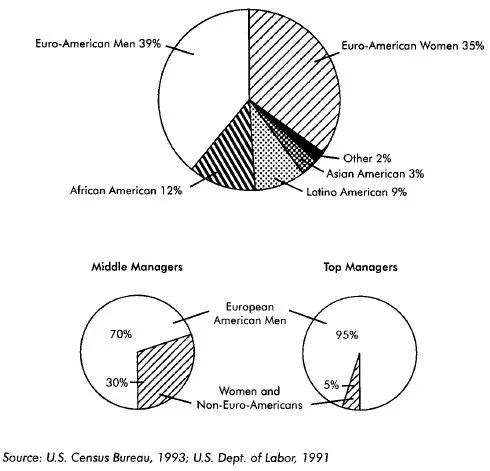
Figures 1.1(a) and 1.1(b) show the ethnic makeup of the population and the workforce in 1990, as well as the proportions of major American ethnic groups in the better-paying middle- and top-level management jobs. Although Euro American women and minorities made up 65 percent of the workforce, they held only 30 percent of middle management jobs and 5 percent of top management positions.
Income for these groups reflects the glass ceiling that is still in place and blocking access to higher-level jobs in corporate America. In 1990, according to the U.S. Census Bureau, median incomes for full-time workers were:
| Men | Women | |
| Median income, all workers | $20,409 | $10,371 |
| Euro-American | 22,065 | 10,747 |
| African American | 12,950 | 8,825 |
| Latino American | 13,501 | 8,354 |
| Asian American | 19,396 | 11,986 |
| American Indian | 12,180 | 7,310 |
| Other Americans | 12,493 | 7,876 |
Figures 1.1 (a) and 1. 1 ( b ) Ethnic and Gender Segments of the Workforce and of Management, 7 990.
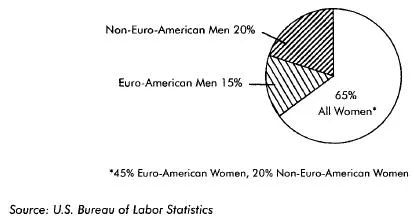
The trend toward a more diverse population and workforce is expected to continue. Of the 26 million new workers coming into the workforce between 1990 and 2005, about 85 percent are expected to be women and non-EuroAmericans. A handy way to remember the proportions is to think in terms of sixths: women will account for about four-sixths, minority men more than one sixth, and Euro-American men one-sixth, as depicted in Figure 1.2.
Historically, men of European ancestry have run virtually all the major American organizations. They have set the rules of the game in the American culture as well as in corporate cultures. Other types of employees were tradition ally excluded from mainstream leadership roles. They worked on the periphery of our organizations as the workers who were told what to do and how to do it, and as temporary employees and part-timers. Some were kept out completely the unemployed and unemployable.
In the past, most American businesses functioned primarily within U.S. borders. Now even very small businesses may do much of their business in globalmarkets. Corporate success now depends on building positive, productive rela tionships with people from many cultures around the planet. Corporate cultures that are open, flexible, appreciative, and savvy about cultural and lifestyle differ ences have a competitive edge. Having diverse employees at all levels in all func tional areas of a corporation enhances that edge-and is becoming ever more crucial for success and profitability as reliance on global transactions increases.
Figure 1.2 New Workers Entering the Workforce, 1990-2005.
New Terms that We Use for People
Not only is workplace diversity growing and changing, but the terms we use for various groups has been changing. People who resist such change say the new names are a demand for "political correctness." Others say they're a sign of common courtesy. People are very sensitive about the labels that others attach to them. Most prefer no labels at all. Yet how do we discuss the issues of cultures and subcultures, of diverse groups in a pluralistic society, of prejudice and dis crimination based on group stereotypes? Obviously, verbal communication re quires the use of descriptive terms. Such terms tend to change over time in re sponse to social and cultural changes and interactions.
African Americans were properly called "Negroes" during the 1800s, po litely called "Colored" during the first half of this century, then took the term "Black" for themselves. Women were politely called "ladies" before the women's movement of the 1960s. When group labels are continually used in a limiting, demeaning, scornful, or hostile way, they eventually are resented by some of the people of that group. Therefore, if you want to show respect and ap preciation for others, you'll naturally want to use the terms they prefer. This can be difficult, since members of a particular group rarely have unanimous opinions about preferred terms.
The terms used here are those adopted by The President's Task Force on Multiculturalism in the Curriculum at San Francisco State University, one of the most diverse campuses on earth. This campus claims the only College of Ethnic
Studies in the world, one with separate departments for African American, American Indian, Asian American, and Latino American studies. The task force met weekly for many months to work out terminology and basic policy concern ing diverse groups. The terms for the largest ethnic groups are listed below and reflect the preferences of activists and leaders from those groups.
- • African Americans
- • Asian Americans (such as Chinese Americans, Asian Indian Americans)
- • Euro-Americans (or European Americans) referring to "White" persons
- • Jewish Americans
- • Latino Americans (such as Mexican Americans, Puerto Rican Americans)
- • American Indians (such as Navajo, Hopi)
If you got a sense of equality as you looked at these terms, you're on the right track. The major rationale for these particular terms, rather than some oth ers, is that we're all Americans, and most of us are native Americans. If we go back far enough, all of us have ancestors who came from somewhere else. And how long we or our ancestors have been here is not a valid measure of our worth or our right to be here.
If your ancestors were immigrants from Europe, you're a Euro-American and you're a member of the dominant majority in American culture. The terms Asian American and Latino American are used for convenience in discussing certain cul tural and statistical commonalties. Most Asian Americans don't think of them selves as Asian Americans so much as Chinese Americans or Filipino Americans or one of the many Asian subcultural groups. The same is true for Latino Americans, many of whom don't appreciate the term "Hispanic," because it brings up painful visions of Spanish conquest and colonialism.
The terms used for other major groups are based on discussions with various leaders of those groups and on a review of current literature. These groups are:
- • Persons with disabilities
- • Gay, lesbian, and bisexual persons
- • Older persons
- • Obese persons
Because Euro-American men have traditionally been in charge in the Ameri can workplace, others are often called minorities. Some feel the term "minori ties" trivializes the fact that, taken together, ethnic subcultures are the majority in most metropolitan areas and in many workplaces. The Task Force did notre solve this terminology issue.
"Minorities" is the term I will use for all groups that are not Euro-American men, that is, all those groups that are generally considered disadvantaged in the workplace, even though we know that taken together they are a large majority. The alternate terms are persons from various cultures and lifestyles, persons of diverse backgrounds, and non-Euro-American employees or persons.
When you relate one-to-one with people from any of these groups, you rarely need to use group names. You're dealing with the individual. When you need to discuss group issues with others, consider asking them questions about what terms they prefer to use for their own group. Reach some agreement about appropriate labels. Become sensitive to language that some consider racist and sexist, and weed it out of your vocabulary. Every time you use such terms, you may reinforce the prejudicial patterns, even though you don't intend to.
Diverse Backgrounds = Diverse Issues
Whether you're an entry-level trainee, a team leader, or a top manager, your ca reer success and enjoyment increasingly depend on how well you understand and relate to a diverse range of people. If you can mentally slip inside their skin for a time and see the world through their eyes, you'll gain great power in under standing the way others think and feel and the issues most important to them. Here's a brief preview of some of the issues you'll soon learn about. These issues have been extensively explored by a wide variety of researchers from many fields, such as business, sociology, and anthropology. For example, Geert Hofstede has done major comparative studies of corporate employees across many countries and cultures; M. L. Hecht has done extensive research on Afri can American cultural and communication patterns; and Paul Longmore is a leading activist on disability issues and has done much well-respected research in that field.
Career women often find themselves in catch-22 situations. For example, many people assume that women are more emotional, indecisive, and vulnerable than men. But business leaders are expected to be in controJ of their emotions, decisive, and able to roll with the punches. If women project the traditional femi nine image, they're not seen as potential leaders. But if they project the business leader image, they're often seen as too hard and masculine, even abnormal.
Men are expected to be aggressive, ambitious, and proud. But many corporate cultures are changing in ways that call for leaders who are cooperative and who focus more on inspiring and supporting others than on personal achieve ment. Many men are confused about what companies expect of them, just as they're confused about what the women in their lives expect. The dramatic changes in women's roles have had a major impact on men's lives.
African Americans who have a problem with a "brother or sister" typically take the bull by the horns and confr...
Table of contents
- Front Cover
- Diversity Success Strategies
- Copyright
- Content
- 1 How to Succeed in a Diverse Workplace
- 2 How Cultural Differences Affect Job Success
- 3 Understanding the Dominant Culture: Euro-Americans
- 4 Beyond Stereotypes to Profitable Collaboration
- 5 Male-Female Bonding
- 6 African American Alliances
- 7 Asian American Associates
- 8 Latino American Liaisons
- 9 Gay and Lesbian Connections
- 10 Persons with Disability: Bridging Comfort Gaps
- 11 Older-Younger Persons : Bridging Generation Gaps
- 12 Beyond Appearances: Appreciating All Sizes and Shapes
- Chapter Notes
Trusted by 375,005 students
Access to over 1.5 million titles for a fair monthly price.
Study more efficiently using our study tools.
Frequently asked questions
Yes, you can cancel anytime from the Subscription tab in your account settings on the Perlego website. Your subscription will stay active until the end of your current billing period. Learn how to cancel your subscription
No, books cannot be downloaded as external files, such as PDFs, for use outside of Perlego. However, you can download books within the Perlego app for offline reading on mobile or tablet. Learn how to download books offline
Perlego offers two plans: Essential and Complete
- Essential is ideal for learners and professionals who enjoy exploring a wide range of subjects. Access the Essential Library with 800,000+ trusted titles and best-sellers across business, personal growth, and the humanities. Includes unlimited reading time and Standard Read Aloud voice.
- Complete: Perfect for advanced learners and researchers needing full, unrestricted access. Unlock 1.5M+ books across hundreds of subjects, including academic and specialized titles. The Complete Plan also includes advanced features like Premium Read Aloud and Research Assistant.
We are an online textbook subscription service, where you can get access to an entire online library for less than the price of a single book per month. With over 1.5 million books across 990+ topics, we’ve got you covered! Learn about our mission
Look out for the read-aloud symbol on your next book to see if you can listen to it. The read-aloud tool reads text aloud for you, highlighting the text as it is being read. You can pause it, speed it up and slow it down. Learn more about Read Aloud
Yes! You can use the Perlego app on both iOS and Android devices to read anytime, anywhere — even offline. Perfect for commutes or when you’re on the go.
Please note we cannot support devices running on iOS 13 and Android 7 or earlier. Learn more about using the app
Please note we cannot support devices running on iOS 13 and Android 7 or earlier. Learn more about using the app
Yes, you can access Diversity Success Strategies by Norma Carr-Ruffino in PDF and/or ePUB format, as well as other popular books in Business & Business General. We have over 1.5 million books available in our catalogue for you to explore.