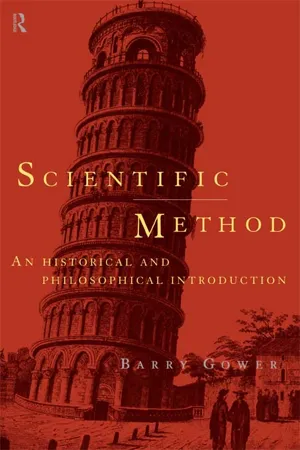
The central theme running throughout this outstanding new survey is the nature of the philosophical debate created by modern science's foundation in experimental and mathematical method. More recently, recognition that reasoning in science is probabilistic generated intense debate about whether and how it should be constrained so as to ensure the practical certainty of the conclusions drawn. These debates brought to light issues of a philosophical nature which form the core of many scientific controversies today. Scientific Method: A Historical and Philosophical Introduction presents these debates through clear and comparative discussion of key figures in the history of science. Key chapters critically discuss
* Galileo's demonstrative method, Bacon's inductive method, and Newton's rules of reasoning
* the rise of probabilistic `Bayesian' methods in the eighteenth century
* the method of hypotheses through the work of Herschel, Mill and Whewell
* the conventionalist views of Poincaré and Duhem
* the inductivism of Peirce, Russell and Keynes
* Popper's falsification compared with Reichenbach's enumerative induction
* Carnap's scientific method as Bayesian reasoning
The debates are brought up to date in the final chapters by considering the ways in which ideas about method in the physical and biological sciences have affected thinking about method in the social sciences. This debate is analyzed through the ideas of key theorists such as Kuhn, Lakatos, and Feyerabend.
- 288 pages
- English
- ePUB (mobile friendly)
- Available on iOS & Android
eBook - ePub
About this book
Information
1 Introduction
We have increasingly powerful reasons for acquiring some understanding of the natural sciences. Their influence on the technologies that shape our lives has already been immense, and undoubtedly will continue to grow. In peace and in war, in work and in leisure, in health and in sickness, in each of the different stages of life, we cannot escape that influence. This book is being written with the aid of an electronic computer of a type which, as little as twenty years ago, was unavailable and unimagined by most people. You could well be reading it in circumstances equally unanticipated. On the surface at least, the most prominent differences between our lives and those of earlier generations are differences which have come about as a result of discoveries, investigations, explorations and inventions in the natural sciences. If we compare our modes of transport or communication with those available to previous generations, or compare our education with theirs, we cannot help but be struck with the consequences, for good or for ill, of scientific knowledge. On the credit side, that knowledge, but not that knowledge alone, has resulted in such benefits as the elimination of drudgery and repetitive work for some people, the eradication and control of some life-threatening diseases, and increases in crop productivity. For the sake of these and other benefits we have welcomed science. But we also fear science because, on the debit side, scientific knowledge, though not scientific knowledge alone, is responsible for such harms as the damage suffered by our environment, and has led to questionable experimental practices which need the control of so-called ‘ethics committees’. Without the scientist's knowledge of theories, of laws, of techniques and, in general, of what is possible and what is not, the circumstances in which we live our lives would undoubtedly be different.
At a deeper level, too, we feel the effects of the growth of natural science and its technological consequences. Many people feel uneasy about, and some are alienated by, the impersonality of science, and even more so by what they perceive as its inhumanity; the future societies imagined by science-fiction writers tend to be uncomfortably alien rather than reassuringly familiar. This sense of science being something apart from us becomes more apparent if we take a longer view and compare the role that the science of Shakespeare's England played in understanding the place and significance of people in the world with its present role. Four hundred years ago the natural sciences and the picture they presented were inconsequential. They engaged the attention of otherwise idle gentlemen of means and leisure, but there was no sense that they were initiating enquiries which could or would have significant practical effect on people's lives. Even Francis Bacon, who was more sensitive than most to the practical consequences of scientific knowledge, would be astonished today to find that Her Majesty's Government is spending ever larger sums of money on laboratories to create what he called ‘experimental histories’. Until the beginning of the twentieth century, scientific knowledge was limited in its scope and therefore limited in its practical significance. Industrialisation had affected some parts of western Europe, but it was the management of that process rather than the technology and science it used which raised moral and social issues. The discoveries of scientists were, it is true, interesting and sometimes entertaining, but for the most part neither they nor their effects presented a challenge which was more than intellectual. Now, though, at the end of that century, scientists know, or we think they know, so much about the natural world, including the species of animals we call human beings, that nothing important can be missing from the scientific picture of the world they present. The picture presented today by the scientific enterprise is so large and so comprehensive that we sometimes wonder whether there is room for anything else. Accordingly we raise questions about the role of creativity, sensitivity, feeling and reflection. We wonder, therefore, how and why the arts and music, literature, religion and philosophy can have a place in our lives. Sometimes these questions take a striking form in the work of artists, musicians, and writers themselves. The growth of science and technology makes many of us feel uneasy, not just because of its effect on the details of our lives but on account of its implications for the way we think about ourselves, our responsibilities and our place as individuals in an impersonal world where everything is weighed, counted, measured and, we think, understood. Our image of the scientist as philosopher, in some sense of that elastic term, is being replaced by the image of the scientist as accountant. Both images have the capacity to disturb us.
The tension which underlies this uneasiness arises from the need we all feel to control and predict our environment. We want to improve the circumstances in which we live our lives; we want to secure our future. To achieve these ends we must understand our environment; we must be able to explain why our circumstances are as they are. The kind of explanation which has proved most helpful is that provided by science, particularly natural science. There is, then, a close connection between our desire to enhance and make secure the circumstances in which we live, and the quest for the knowledge which will enable us to explain our world scientifically. Yet we are social beings; we live with other people who form an essential part of our environment. In so far as we think of them as having an inner life which is as important to them as ours is to us, we do not seek to control and predict their behaviour. Often what we look for in others is autonomy rather than conformity, spontaneity rather than predictability. We wish to understand the people who share our environment, but a scientific explanation will, we feel, miss what is essential. No doubt much of what matters to us is illuminated by natural science. After all, natural science has been a subject of interest for many people for many hundreds of years. It is not an insignificant object of knowledge. But still there is much more which is not, and cannot be, illuminated in an appropriate way by natural science or by any other kind of science. The projects which have tried to enlighten us – religion, philosophy, art, music, literature – have engaged our attention for thousands of years. They contribute something other than knowledge which is nevertheless important to us. They have served needs which are not met by science, despite its pervasiveness and power.
We should not, though, think that science is some all-devouring monster growing by force of its own inner logic. We can control and shape the way in which scientific knowledge changes; we do so control and shape it, though we are seldom aware of what we are doing. We, or more usually politicians, bureaucrats, financiers and industrialists, influence the development of the natural sciences and thus that of the technologies with which they are coupled. There is, in short, influence the other way. To be sure, the personal circumstances of a scientist and the interests she or he is able to develop have an effect upon what the scientist achieves, but more importantly there are powerful social, economic and political circumstances which will shape that effect as well. If we know more about some aspects of our natural environment than we do about others, that is not so much because some things are easier to investigate than others, though that is no doubt true, but rather because some sorts of enquiries are deemed more important by those who pay for science.
What we know is, in this sense, influenced by and perhaps determined by socio-economic forces. There are a great number of things which could become the object of scientific knowledge; a proportion of them have become the object of scientific knowledge, and socio-economic considerations have affected the selection of that proportion. Scientific knowledge is, in this sense, ‘socially contructed’. But what we know is what is true and, on the face of it, this is a matter of how the facts are, rather than of what social forces are operating. Scientific knowledge is, Introductionin this sense, not constructed, either socially or in any other way; what we or others might want to know or need to know in order to further a political agenda, or promote a social policy, or secure a financial advantage, is beside the point, for knowledge can only be of what is true. Similarly, when I buy a lottery ticket and choose a number, my choice is determined by many factors, some perhaps social, but the number chosen is not, or at least not for that reason, a social construct. What I choose, in the sense that it is my choice, is indeed ‘constructed’ by me rather than given to me. But what I choose, in the sense that it is a number, is given rather than ‘constructed’.
There are, no doubt, complex issues about how in practice socioeconomic forces work, and we need to assess them carefully. But we also need to exercise care in describing their effects. Our interest in these forces and our conviction that they play a crucial role can easily blind us to dimensions of the scientific enterprise that have been important in characterising it. Until relatively recently, social factors played a negligible role in that characterisation, and there is perhaps a temptation to suppose that, in order to give them proper prominence, we must urge the neglect of all other factors. We suppose, or argue, that natural science is entirely a creature of our own making and the responsibility for its effects on our lives and our thinking lies with the vested interests of multi-national corporations, neo-colonial powers and the so-called free market; science neither has, nor has need of, a ‘logic’. We infer that the supposed intellectual content of natural science is spurious and is no more than a means of deceiving people into maintaining and enhancing the current role of science in a society which respects those intellectual values science is supposed to represent. But there is little merit in this supposition, or in what we infer from it. Science does sometimes succeed in stating the truth, or at least a good approximation to it, and that truth is independent of the wishes of anybody, however powerful. The facts that keep aircraft aloft are, fortunately for passengers, not socially determined but ascertained on the basis of evidence by logical reasoning. The truth that cigarette smoking increases susceptibility to lung cancer is, unfortunately for smokers, not socially determined but established on the basis of evidence by logical reasoning. We could, no doubt, use our reasoning powers to establish other conclusions about other matters, such as the prevalence of schizophrenia in Eskimos, or the facts about the forces driving weather systems in the North Atlantic. If we have not done so, then the responsibility may well lie with social, economic and political considerations. But even if the selection of a subject matter for scientific enquiry is determined by powers, sinister or benign, outside of science and its methods, the nature of the logical reasoning we use in that enquiry has a part to play in understanding science.
So, although the understanding of natural science that we need does depend upon the powerful political, economic and social forces which drive the activities producing it, we should not glibly set aside the methods enabling it to have a fact-stating capacity. In this respect, as in some others, the work of a scientist is analogous to that of a detective. A detective attempting to solve a crime is no doubt subject to many kinds of forces and influences, if only because he or she will be part of an organisation which acts upon, and reacts to, the society in which it exists. But when the detective successfully solves a crime, in the sense that he or she correctly identifies the person or persons responsible, an important part of the explanation for the success will be the extent to which the reasoning used to justify the identification is persuasive. If it were just a matter of identifying a person or persons then, no doubt, we could provide an adequate explanation for the choice made by reference to forces and influences of various kinds. However, correct identification would elude such an explanation. Similarly in the case of scientists. The sociologist or anthropologist can study the work of a scientist in the same kind of way that they study other human activity, such as playing football or participating in a religious ceremony. Some of that work will have a successful outcome in the sense that it will result in new knowledge; some will not. This difference will not matter to the sociologist or anthropologist. Their explanations will not discriminate between successful and unsuccessful science. If we wish to explain the success of the work of scientists we will have to refer to the methods they use; we will have to refer to the reasoning they use to justify their new knowledge.
So we need to know something about scientific method in order to understand the production of new knowledge. But it is also important when we turn to the distribution of that new knowledge. For it is a further important feature of the late twentieth century that an ever-increasing amount of information, including scientific information, is available to people. Information technology gives us access to much of what we might want to know and to even more of what we do not want to know. Even if we do not have a professional involvement with science we should, as responsible and effective citizens, have some knowledge of some science. But in order to transform scientific information into knowledge we have to understand and assess it, and this in turn requires a grasp of the kind of reasoning relevant in science. Often this knowledge is of practical value: knowledge of current research findings on causes of heart disease might have a practical effect on a person's diet and life style; knowledge of trials undertaken by a pharmaceutical company might have a practical effect on investment decisions; knowledge of successful biochemical techniques might affect a person's career development, etc. So understanding scientific reasoning – the methods of science – is not only an interesting and challenging task in itself; by undertaking it we will be better equipped to make the practical evaluative judgements that are required of us.
There is, then, a reason for paying some attention to scientific method. It is of course connected with the fact that many people have confidence in claims described as scientific. This is not to say that people think scientists are always right, even about scientific matters; they know perfectly well that scientists have made mistakes and that they will continue to make mistakes. Rather, it is to say that people think scientific claims are reliable. It is to say that, when faced with a choice between the predictions of an astrologer and an astronomer, many of us would place greater trust in the latter, even though we might think the former more interesting, more challenging, and indeed more relevant to our lives. It is to say that many of us find the geologist's account of the origin of the Earth more credible than the creationist's alternative account, even though we might recognise and respect the mythical, imaginative and emotional power of the latter. What, though, is the basis for this confidence? Setting aside the question whether we can justify confidence in scientific knowledge, we can take that confidence as a psychological fact and ask for its explanation. No doubt the authority of science is part of the answer: we trust scientific claims simply because they are scientific and therefore authoritative. But this is hardly helpful, for it simply invites a question about the basis of the supposed authority of science. A better answer to questions about the reliability of scientific claims, and hence their authority, directs our attention to the way in which they are established. Claims which count as scientific and therefore as reliable do so because they are established by means of a scientific method.
Associated with these ideas we sometimes find the view that the natural sciences are characterised not so much by their subject matter as by their methods. Thus we can, it is said, define physics as ‘all that could be profitably studied by using a certain method’. This method of physics, we are told, was invented by Galileo and is experimental; an adequate understanding of physics depends on a grasp of this experimental Galilean method. That is why, in introducing novices to this science, and indeed to any science, it is thought important to refer to method. But there is a further implication that we should note. If scientists do need to know something about method in order to understand science, then it is also true that ‘a scientific method cannot adequately be discussed if it is divided from the science to which it applies’ (Toraldo di Francia 1981: 6–7).
So the study of scientific method should shed some light on the character customarily attributed, rightly or wrongly, to beliefs expressed in scientific statements. Individually considered, scientific beliefs are of course very various. Some are general in their scope, others are specific and particular; some are well established, others are more tentative; some are fundamental and central, others are less important. But despite these differences they have something in common which explains why we count them as scientific, namely the method by which they are established. The evidence which makes physicists believe Newton's law of gravity is quite different from the evidence which makes chemists believe that acids are electron acceptors, and yet in both cases the same kind of method is used to justify the beliefs on the basis of the relevant evidence. This means that, despite their difference, the beliefs share an important characteristic, and by describing them as scientific beliefs we show that we recognise that characteristic. To study this characteristic, and thereby to study what makes beliefs scientific, we have to turn our attention to the method used to justify them.
In the light of this background it is perhaps surprising that scientific method is currently neglected by philosophers of science. Many think the neglect justified. The interesting philosophical issues raised by examining scientific reasoning have been explored sufficiently thoroughly, and in any case a naturalistic approach to a subject which involves social co-operation rather than solitary ratiocination, calling on the insights of social scientists, is more appropriate. Part of the reason for resisting this facile response is that, until comparatively recently, scientific method occupied an important place in the study of both logic and the philosophy of science. For besides the connections often, and naturally, made between scientific method and science itself, there is a complex history which deserves our attention and interest. For a long time, analysing the logic of scientific reasoning has seemed important not only to those concerned with the scope of logic but also to those concerned with the scope of science. If we are to take seriously those who would have us believe that science has no logic, but is steered by rhetoric and ideology, we need to take this history into account. It is possible that all those analysing the logic of science were suffering from an illusion created by the psychological, social and ideological circumstances in which they found themselves. It is possible that there is no logic of science even though there is a long, sustained and coherent history of people who thought that there is such a logic. But possibilities are not always reasonable; we can and should ignore them unless they are shown to be reasonable. Moreover, there is a kind of arrogance involved in the claim that we are able, at last, to correct the mistake they made. Presumably we are as much influenced by our circumstances as they were by theirs; we are as liable as they to suffer from illusions. Of course, plausible tales can be told of the effects people's lives have on what they think. But this will not show that the possibilities envisaged are reasonable. For we can accept these tales without having to set aside other reasons why people think as they do, and some of them might be reasons of logic. To grasp the history of thinking about scientific method, and thereby illuminate current thinking, we cripple ourselves if we set aside the idea that the existence of real, objective, logical issues about the nature of scientific reasoning could have been an important reason why so much attention has been paid to scientific method.
Given its complexity, it is inevitable that the history traced in the chapters of this book is selective. My aim has not been comprehensiveness, even if that were possible. Rather, I have tried to tell a story which is coherent in the sense that certain ideas grew out of preceding suggestions and formed the basis for succeeding developments. Especial emphasis is placed on the role of ideas about probability in scientific method. One reason for this is that a great deal of interesting work has been done recently in recovering those ideas and relating them to the intellectual aspects of the historical contexts in which they emerged. A second reason is that current discussions of scientific method, even if they do not endorse the view that it is fundamentally probabilistic, cannot afford to ignore that view. This does, indeed, involve a certain distortion of history because, in describing and evaluating the contributions made by participants in that history, implicit use is made of information not available to them, namely, information about the fate of what they accomplished. Some distortion is, though, unavoidable if history is to connect with the present and help us understand it. One particular kind of distortion is readily apparent. It results from the omission of certain important thinkers and their ideas from this history. Thus, Aristotle's views about method are ignored, despite the influence that they exerted prior to the scientific revolution in the seventeenth century. In many respects we cannot properly appreciate the achievements of that century without information about those views, and about the very many ways in which they were received and modified. Nevertheless, the link with thinking about probability, which began to take shape in the seventeenth century, has meant that this history begins with Galileo and Bacon. There are other omissions. Descartes is a more important figure in the history of scientific method than is here acknowledged. In the nineteenth century there are several whose contributions are neglected, including Auguste Comte, Stanley Jevons, George Boole, John Dewey and Leslie Ellis. As for the twentieth century, the list of those neglected is embarrassingly long. To itemis...
Table of contents
- Front Cover
- Scientific Method
- Title Page
- Copyright
- Contents
- Preface
- 1 Introduction
- 2 Galileo Galilei: New methods for a new science
- 3 Francis Bacon: Why experiments matter
- 4 Isaac Newton: Rules for reasoning scientifically
- 5 The Bernoullis and Thomas Bayes: Probability and scientific method
- 6 John Herschel, John Stuart Mill and William Whewell: The uses of hypotheses
- 7 Henri Poincaré and Pierre Duhem: Conventions and scientific reasoning
- 8 John Venn and Charles Peirce: Probabilities as frequencies
- 9 John Maynard Keynes and Frank Ramsey: Probability logic
- 10 Hans Reichenbach and Karl Popper: The (in)dispensability of induction
- 11 Rudolf Carnap: Scientific method as Bayesian reasoning
- 12 Conclusion: Experimental interventions and social constructions
- Bibliography
- Index
Trusted by 375,005 students
Access to over 1.5 million titles for a fair monthly price.
Study more efficiently using our study tools.
Frequently asked questions
Yes, you can cancel anytime from the Subscription tab in your account settings on the Perlego website. Your subscription will stay active until the end of your current billing period. Learn how to cancel your subscription
No, books cannot be downloaded as external files, such as PDFs, for use outside of Perlego. However, you can download books within the Perlego app for offline reading on mobile or tablet. Learn how to download books offline
Perlego offers two plans: Essential and Complete
- Essential is ideal for learners and professionals who enjoy exploring a wide range of subjects. Access the Essential Library with 800,000+ trusted titles and best-sellers across business, personal growth, and the humanities. Includes unlimited reading time and Standard Read Aloud voice.
- Complete: Perfect for advanced learners and researchers needing full, unrestricted access. Unlock 1.5M+ books across hundreds of subjects, including academic and specialized titles. The Complete Plan also includes advanced features like Premium Read Aloud and Research Assistant.
We are an online textbook subscription service, where you can get access to an entire online library for less than the price of a single book per month. With over 1.5 million books across 990+ topics, we’ve got you covered! Learn about our mission
Look out for the read-aloud symbol on your next book to see if you can listen to it. The read-aloud tool reads text aloud for you, highlighting the text as it is being read. You can pause it, speed it up and slow it down. Learn more about Read Aloud
Yes! You can use the Perlego app on both iOS and Android devices to read anytime, anywhere — even offline. Perfect for commutes or when you’re on the go.
Please note we cannot support devices running on iOS 13 and Android 7 or earlier. Learn more about using the app
Please note we cannot support devices running on iOS 13 and Android 7 or earlier. Learn more about using the app
Yes, you can access Scientific Method by Barry Gower in PDF and/or ePUB format, as well as other popular books in Filosofía & Historia y teoría filosóficas. We have over 1.5 million books available in our catalogue for you to explore.