Understanding and Managing Children's Behaviour through Group Work Ages 7 - 11
eBook - ePub

Understanding and Managing Children's Behaviour through Group Work Ages 7 - 11

A child-centred programme

  1. 162 pages
  2. English
  3. ePUB (mobile friendly)
  4. Available on iOS & Android
eBook - ePub

Understanding and Managing Children's Behaviour through Group Work Ages 7 - 11

A child-centred programme

About this book

'I would highly recommend the skills, expertise and delivery that Cath can bring to a school and can guarantee that any school following her advice will not regret it.'

Carl McIver, Head of School, St. Willibrord's R.C. Primary, Manchester

'I have worked with Cath Hunter now in two schools and find that the work she does with children, parents and staff is amazing.'

Sam Foord, Headteacher, Ravensbury Community School, Manchester

Understanding and Managing Children's Behaviour provides the reader with an insight into children's emotional wellbeing and helps them to understand what and how children communicate and how to respond in a way that provides positive messages, increases their emotional vocabulary and encourages them to change their behaviour. It provides an alternative and effective child centred way of managing children's behaviour through introducing the concept of reflective language and other tools, equipping staff with new skills that are transferable across the school in any role.

The book is divided into two sections, enabling the reader to link theory with practice. The first section takes the reader on a journey to help them understand the different factors that influence children's behaviour. The second section of the book focuses on the group work programmes, how they can be used, their value and the impact they can have on children and the school as a whole. The activities in the group work programme explore the concept of using reflective language as a behaviour management tool and are designed to motivate, build confidence, self-esteem and resilience. Useful pedagogical features throughout the book include:-

  • Practitioner and classroom management tips and reflective tasks;
  • Strategies and practical ideas for staff to use to help them engage more deeply with the contents of the book;
  • Flexible, tried and tested group work programmes designed to promote inclusion rather than exclusion;
  • Clear step by step instructions for delivering the work programmes;
  • Case studies showing behaviour examples with detailed explanations for the behaviour and strategies to respond to it.

The book is aimed at all primary school staff, especially teaching assistants, learning mentors and family workers who can deliver the group work programmes. It is also recommended reading for SENCOs and trainee teachers and will also be useful for therapists who work with children and are looking at delivering other approaches in their work.
Frequently asked questions

Yes, you can cancel anytime from the Subscription tab in your account settings on the Perlego website. Your subscription will stay active until the end of your current billing period. Learn how to cancel your subscription.
No, books cannot be downloaded as external files, such as PDFs, for use outside of Perlego. However, you can download books within the Perlego app for offline reading on mobile or tablet. Learn more here.
Perlego offers two plans: Essential and Complete
  • Essential is ideal for learners and professionals who enjoy exploring a wide range of subjects. Access the Essential Library with 800,000+ trusted titles and best-sellers across business, personal growth, and the humanities. Includes unlimited reading time and Standard Read Aloud voice.
  • Complete: Perfect for advanced learners and researchers needing full, unrestricted access. Unlock 1.4M+ books across hundreds of subjects, including academic and specialized titles. The Complete Plan also includes advanced features like Premium Read Aloud and Research Assistant.
Both plans are available with monthly, semester, or annual billing cycles.
We are an online textbook subscription service, where you can get access to an entire online library for less than the price of a single book per month. With over 1 million books across 1000+ topics, we’ve got you covered! Learn more here.
Look out for the read-aloud symbol on your next book to see if you can listen to it. The read-aloud tool reads text aloud for you, highlighting the text as it is being read. You can pause it, speed it up and slow it down. Learn more here.
Yes! You can use the Perlego app on both iOS or Android devices to read anytime, anywhere — even offline. Perfect for commutes or when you’re on the go.
Please note we cannot support devices running on iOS 13 and Android 7 or earlier. Learn more about using the app.
Yes, you can access Understanding and Managing Children's Behaviour through Group Work Ages 7 - 11 by Cath Hunter in PDF and/or ePUB format, as well as other popular books in Education & Classroom Management. We have over one million books available in our catalogue for you to explore.

Information

Publisher
Routledge
Year
2013
eBook ISBN
9781135135546
Edition
1

Part One:
Theory

A child-centred approach to emotional health and well-being and understanding children’s behaviour

1
What does a child need to be emotionally healthy?

In order for children to achieve success at school they need a degree of healthy emotional and social development so that they are emotionally ready and able to learn. This involves being able to cope with success and failure and having the resilience to manage this, along with being able to ask for help when they need it. It includes having a sense of confidence and self-esteem, having self-reliance and independence appropriate to their age, having a positive self-image and a strong sense of self, along with being able to understand their own feelings and express them. They need the stability and security to be able to manage change and unpredictability without it eroding their feelings of safety. They also need to have the social skills to develop, build and sustain relationships with both adults and children. How many children are equipped with all these skills to be able to do this?
The experience of being emotionally healthy is achieved by a combination of all the above skills together and not in isolation, in the same way as a child’s ability to hold a pencil is dependent on their hand–eye coordination and manipulative skills. It is the cumulative effect of the child’s experiences, learned behaviours and reactions to events that help define their sense of self and their ability to deal with situations both in and out of school. Children need information and explanations about what is happening in order for them to be able to make sense of their experiences.

Self-regulation

In order for children to be able to regulate their own stress levels, they need to have had this experience from an adult. Babies are unable to regulate their own stress and they depend on their caregivers to regulate it for them. For example, when a baby cries because they are hungry, tired or upset and the adult responds with love and concern, this helps to reduce the baby’s stress. If a crying baby is ignored or met with anxiety or hostility, it can increase their stress. The way the adult responds to this stress can either help the child to develop their own stress regulatory system, or create even more stress and prevent this development taking place. If the child gets what they need from an adult then a pattern develops that allows the child to begin to manage stress for themselves.
In order for children to develop healthily, adults need to respond to children’s stress in a way that calms and soothes them rather than exacerbates their stress. For example, Tom, aged 3, is happily playing with a train when another child snatches it from him. Tom screams with rage and hits the child. If he is soothed, comforted, listened to and supported then this validates his feelings and enables stress regulatory systems to be developed. If he is offered a calm and clear explanation about not hitting other children then he is gradually able to understand that this behaviour is not acceptable. Tom is totally dependent on the stress regulating systems of a caring adult to help him to develop his own. If a caring adult is able to help him with his feelings and acknowledge and soothe his distress, he gradually develops the ability to do this for himself. As stressful situations occur in his life, he has the ability to manage them due to his initial experiences of stress being held and helped by a caring adult.
However, if the adult responds to the situation by shouting at him, dragging him away or smacking him for hitting the other child, Tom will feel even more stressed and anxious and will be unable to develop self-regulation. He does not learn how to manage stress and anxiety for himself; instead he learns to be wary and fearful of other people and finds it extremely difficult to share. He is overwhelmed by his feelings and unable to self-regulate.
Case study
Nyall, aged 8, had regular tantrums at school where he would hurl himself across the room, throw things and on occasion bite the other children. He couldn’t accept that he had to share and would snatch to get what he wanted.
Possible reasons for Nyall’s behaviour:
  • His dad regularly hit his mum if he wasn’t happy with the meal she had provided.
  • His younger sister took his toys from him and he was told he was a ‘cry baby’ and shouted at if he got upset.
When children have not had the experience of self-regulation being provided by a parent, school staff can contribute to fulfilling this role.

Strategies to help children to self-regulate

  • Respond to the intensity of what the child is feeling and reinforce this with the appropriate tone of voice and facial expression; for example, ‘It made you furious that you couldn’t be at the front of the line today.’
  • Validate the child’s experience – it is very real for them so ensure they feel you are taking it seriously; for example, ‘When Sam called you stupid it must have really hurt.’
  • Support the child by helping them to find alternative ways to express their feelings if appropriate; for example, ‘It’s never ok to hit people, Michael, we need to find other ways that you can have your feelings and not hurt anyone when you have them.’
  • Offer a calm and reassuring approach so the child feels you are affirming them and accepting rather than dismissing their feelings; for example, ‘It can be really difficult when you want to have the red pen and someone else is already using it.’
The above responses enable the child to feel connected to, understood and recognised for who they are and what they are feeling. It gives the message ‘All feelings are ok and I can help you with them.’ It helps them to make the link between feelings and words. It affirms the pain the child is feeling and helps them to understand it. This helps them to feel less overwhelmed and alone with the feelings and therefore less scared. This will support the child with developing self-regulation. When an adult intervenes and offers support, it can reduce the anxiety levels for children along with validating rather than invalidating their experiences and feelings.
Staff strategy – angry arrow
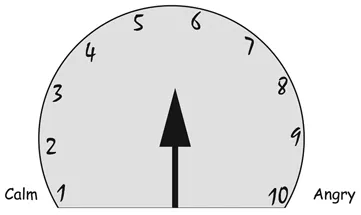
Figure 1.1 Angry arrow
Create a calm/angry board by attaching an arrow with a paper fastener to a numbered background so that the arrow can be rotated (see Figure 1.1).
The child uses an arrow to assess how angry they are and are then supported to use calming techniques such as take a deep breath and count from 10 backwards or take a deep breath in count 1 then breath out in count 2, etc. up to 10 or more. Check with the child where they are now on their angry arrow and explore what they think has helped them.
The role of the facilitator in the group work programmes enables the children in the group to practise self-regulation and provides an opportunity for the facilitator to transfer these new skills to their role across the school. This alternative way of responding to children’s feelings and behaviour can be modelled across the school and empowers all staff to use a different approach.
Staff strategy – releasing feelings
If a child needs help to manage their feelings of anger and frustration, offer them a large scribble pad and pens or crayons for them to use when they need to. Ensure they are able to access this easily and offer support and demonstrations if needed.
This activity provides a powerful message that all feelings are acceptable and an alternative and constructive way of helping a child to release them. It can be a useful tool to assist them in the process of self-regulation.

Self-reliance

Case study
Hussein, aged 8, was getting changed for PE with the rest of his class. One of his trainers had a big knot in the lace which he kept tugging at and trying to undo. His class teacher approached him and offered to help him. He shook his head, not looking up and began to bite at the knot with his teeth. She explained that if he didn’t hurry up the class would start the lesson without him and offered him help again. He shook his head again and started trying to shove his foot in the back of the trainer, causing him to wobble and fall over.
Possible reasons for Hussein’s behaviour:
  • As a baby if he cried no one came.
  • When he fell and hurt himself no one comforted him.
  • If he was hungry then he got himself some food even if this meant stealing it.
It was impossible for Hussein to ask for or allow himself to receive help as he’d learned to rely on the only person that had always been there for him, himself. He had learned to adopt self-reliance as a way of coping and feared neediness or asking for help as it had not been available for him. At school he presented as someone who was self-contained and could manage on his own. This resulted in him finding relationships with both children and adults challenging, as he was controlling and manipulative as a way of feeling safe in his world.
In order for children to develop a sense of independence and ability to depend on themselves it helps if they have had an experience of being able to depend on an adult who has responded appropriately to their needs. For a child who has not had this experience or it has been inconsistent, it can feel terrifying to both ask for help and be able to receive it. These children have learned to be overly reliant on themselves as a way of feeling safe and will need plenty of support to change this behaviour. They may think ‘I can only rely on myself.’ The challenge for these children is to trust that an adult will consistently support them and to understand that it is acceptable to ask for help from others.

Strategies for children who are overly reliant on themselves

  • Understand that they have learned to do this as a way of feeling safe and ensure you do not take over or invade their space; for example, provide opportunities for them to work near you so they can access you easily and you can monitor whether they need help.
  • Identify their need to do things for themselves and reflect on what it may feel like to change this; for example, ‘I can see you are struggling to get that jigsaw piece in, I wonder what it would feel like if I helped you with it?’
  • Let them lead their relationship with you and gradually access help in their own time and at their own pace by gentle reminders that you are available and willing to help them; for example, ‘You are working very hard building that model; remember I can help you at any time if you need it.’
  • Provide strong messages that validate it’s ok to ask for help; for example, ‘Even adults need help with things sometimes and it’s ok to ask for what we need.’
The experience of developing self-reliance and becoming more independent is a gradual process that develops throughout childhood. In order for a child to achieve this in a healthy way it is necessary to provide them with opportunities to experience this. A child’s ability to do things independently depends on several factors and is affected by their confidence and self-esteem along with the opportunity to develop these skills. In school there may be an expectation that children have a level of self-reliance that enables them to cope with the school day. For example, being able to change for PE with minimum or no help from adults, depending on their age. For a child who has no experience of this at home, perhaps because they are treated like a baby to meet their parent’s needs, the very experience of this can be daunting.

Strategies to help children develop self-reliance

  • Provide regular opportunities during the day for children to carry out tasks for themselves; for example, filling their own water bottle at the start of each day.
  • Identify opportunities to help other children with small tasks; for example, ‘Please could you help Nathan find his coat.’
  • Ensure that children are rewarded for their efforts as well as their achievements; for example, ‘You tried very hard to tie your shoe lace, well done.’
  • Talk to the child’s parents and identify something they have done well or achieved that day; encourage them to see the importance of the child having opportunities to do things for themselves at home.

Self-confidence and self-esteem

A child’s sense of self-worth is deeply affected by their confidence and self-esteem. For children who have a poor sense of self, the school day can be made up of regular experiences that can erode this even further. However, there are also frequent opportunities to enhance this a...

Table of contents

  1. Cover Page
  2. Half Title page
  3. Title Page
  4. Copyright Page
  5. Dedication
  6. Contents
  7. Figures
  8. Foreword
  9. Acknowledgements
  10. Introduction
  11. Part One Theory A child-centred approach to emotional health and well-being and understanding children's behaviour
  12. Part Two Practice Using group work to promote emotional health and well-being and manage children's behaviour
  13. Conclusion
  14. Resources
  15. Index