- 248 pages
- English
- ePUB (mobile friendly)
- Available on iOS & Android
eBook - ePub
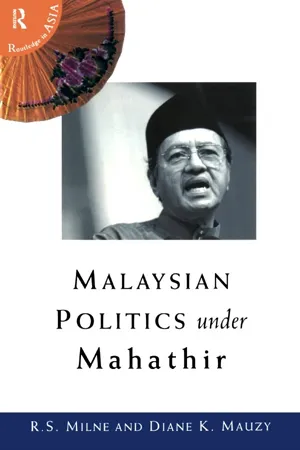
Malaysian Politics Under Mahathir
About this book
A hard-hitting and readable book which examines Mahathir's character, his ideas and policies and relates them to the social, economic and political setting inside Malaysia. Up until recently, high rates of economic growth and a striking reduction in poverty have been the hallmarks of this vibrant Tiger economy. Mahathir's success has now been placed in jeopardy by the recent economic crisis, and his rule is coming under hostile scrutiny.
As one of the most controversial political figures in South-east Asia, Mahathir's success at managing ethnic tensions, policies of industrialization, modernization and foreign policy are explored, as are his grandiose projects, his human rights record and approach to corruption. Milne and Mauzy, leading authors in this field, assess Mahathir's rule within this context as well as the abrupt dismissal from office, arrest and trial of Anwar Ibrahim, Mahathir's deputy, in late 1998.
Information
1 Malaysia
How Mahathir came to power
When Datuk Seri Dr. Mahathir Mohamad became Prime Minister in 1981, Malaysia was still quite a new country. As Malaya, it had attained independence in 1957, becoming Malaysia when in 1963 it combined with two former British colonies on the nearby island of Borneo (and with Singapore, temporarily). Malaya, situated at the southern tip of the mainland of Southeast Asia, is only about two-thirds of the size of Malaysia, but contains about 80 percent of the population. It was here that the government structure was established, and was later extended with the addition of the Borneo territories. It was also here that, with independence approaching, the party system developed, including the chief party of the Malays, the dominant ethnic group, UMNO. In that party Mahathir began, and has continued, with only one brief interruption, his political career.
What follows is a brief political history of the country that Mahathir inherited. Malaya was small compared with its neighbors, Indonesia and Thailand, as regards area and population. However, it had resources conducive to economic growth—timber, tin deposits, and land suitable for rubber plantations. It was situated on several trade routes, which facilitated the exchange of goods. Under British rule, an effective civil service was created—a necessary condition for economic expansion.
However, Malaya had one great potential disadvantage. It was ethnically diverse, almost half the population being Malay, a third Chinese, and about 10 percent Indian. World-wide, there are many examples of ethnic differences leading to violence, which sometimes becomes endemic. Currently, the former Yugoslavia and several parts of central Africa come to mind. With two exceptions, Malaya/Malaysia has been free from major ethnic conflicts. One took place after the end of the Second World War and the departure of the Japanese, when there was a (mainly Chinese) Communist rebellion, which caused numerous casualties and disruptions and lasted, effectively, for about six years. The other occurred in the capital, Kuala Lumpur, in May 1969, when hundreds were killed or injured during a few days. Although the casualties were small compared with those incurred during the rebellion, the incidents made a deep impression on the government and the public. Since then, no general election has been held in a year ending with the number nine, and for several years afterwardsrumors circulated about a recurrence of ethnic violence as the date, May 13, approached. As a direct response to the violence, the government not only took measures to tighten provisions to preserve order and curtail free speech, but it also acted so as to assuage Malay economic dissatisfaction, by launching a pro-Malay New Economic Policy.
Today, Malaysia’s economic success seems truly remarkable. It has gone from depending on its natural resources to moving into manufacturing. Its annual economic growth until 1997 averaged about 8 percent for the previous decade or so. It has newly industrializing economy (NIE) status. Its smallness has become less of a handicap—from the economic or security point of view—through its membership of ASEAN (the Association of Southeast Asian Nations), which in 1998 contains nine states and about 500,000,000 people. It is also a member of the Asia-Pacific Economic Cooperation (APEC) forum and the World Trade Organization (WTO). Much of its prominence on the world stage and its reputation as a champion of the “South” (less industrialized countries, as opposed to the more industrialized “North”) has been due to the energy and persistence of its Prime Minister, Mahathir.
From the sixteenth century onwards, the territories that later constituted Malaya, and the surrounding areas—especially the present Indonesia— produced spices, notably pepper, cinnamon, cloves, etc., which were greatly in demand by west European countries. These countries sought agreements and concessions from Southeast Asian rulers in order to secure their sources of supply. Portuguese expeditions were followed by Dutch and then by British ones. In Malaya, the British connection took the form mainly of “indirect rule.” As the term suggests, the British exercised their power through local, Islamic, rulers, mostly known as “sultans,” with whom the British concluded agreements, ensuring peaceful conditions for trade in and near the main ports. The rulers’ powers were not removed; the British appointed “residents” to their courts who conveyed appropriate “advice.” In some ways, the rulers’ powers were actually strengthened. The British regarded the influence of Islam as a force for promoting stability, and the sultans were reinforced by recognition of their religious status and by the introduction of more elaborate ceremonials.
It would be tedious to provide a blow-by-blow account of constitutional and administrative developments. A distinction was made between “federated” and “unfederated” states. British control was tighter in the former, while the latter were less affected by the impact of colonialism, for example they were more likely to conduct some of their business in Malay rather than in English. Four more (northern) states, which had previously been under Siamese (Thai) rule, were added to the structure in the early 1900s. The closest British control was exercised over the three “Straits Settlements” —Singapore, Penang, and Malacca—ports that were the most vital for British trade. The whole complex was tied together through the Governor of the Straits Settlements in Singapore, who was responsible to the British Colonial Office in London.
By the early 1900s, major economic and social changes were occurring. Tin mines were being developed and rubber plantations were in production. Indeed, rubber was the leading export, and its role in the economy was now so dominant that its price had become the accepted measure of the condition of Malaya’s economy. Social changes were also taking place. There was an increase in immigration to provide labor for the tin mines (mostly Chinese) and for rubber plantations (mostly Indian—although there were many Malay laborers). The expanding economy also provided other jobs for immigrants. Although these immigrants were needed, their rapid arrival altered the ethnic composition of Malaya, and ethnic competition led to occasional ethnic “incidents.”
This broad ethnic picture needs amplification. For instance, Chinese immigrants were made up of several dialect groups, some not easily comprehensible by others, although geography dictated that nearly all the immigrants came from southern China. The majority of the Indians were from South India and Sri Lanka, and they were mostly Tamil-speaking. The Malays were more homogeneous, though not completely so. In fact, for administration purposes, government tended to lump groups together as “Chinese,” “Indian,” etc. The British accorded a special status to the Malays. They were regarded as the original inhabitants, although, as their name suggests, the fifty thousand or so orang asli (“aborigines”) had been there longer. The British believed that they should offer “protection” to the Malays, thus supplementing the protective role of the rulers. This was thought to be necessary because the Chinese and the Indians were exceptionally competitive. They were compelled to be so, for them to have undertaken the journey to Malaya, survived and made the necessary adjustment to local conditions. Protection took the form of protecting the Malays’ occupation of land and according them preference for some government employment and for acquiring various permits and licenses. The consequence was that the Malays, for the most part, continued to live in rural areas, while Chinese and Indians tended to concentrate in urban settlements, the main exception being the Indian plantation workers.
The Japanese occupation: the “Emergency”
After the Japanese occupation (1942–5), it was clear that the old days of white supremacy could never be restored. Apart from British “loss of face,” the wind of change that prompted Britain to grant independence to many of its colonies also reached Malaya. An unintended consequence of the Japanese occupation was that it exacerbated ethnic divisions. The Japanese wooed some Malays to support them, a similar policy to the one that they pursued in Indonesia. On the other hand, Japanese-Chinese relations had been strained by the Japanese occupation of, and atrocities in, parts of China. Some Indians were attracted by Japanese support for the Indian National Army (INA), which was pro-Indian independence and anti-British, and they provided recruits for that army.
The most determined resistance offered to the Japanese in Malaya came from the Malayan People’s Anti-Japanese Army (MPAJA), supported largely by the Malayan Communist Party (MCP). In 1948, the party had attempted unsuccessfully to infiltrate the trade unions, and, after that failed, resorted to “direct action,” which took the form of armed attacks. The vast majority of the rebels were Chinese; very few were Malays or Indians. At its peak, the number of armed rebels, as opposed to sympathizers or those who helped by hiding arms, providing food, etc., was more than 10,000. There were several reasons that the rebellion (which the British, with characteristic understatement, officially termed the “Emergency”)1 lost its force in the mid-1950s and was declared to have ended in 1960. The rebels suffered from two main handicaps, which caused them to be less successful than their counterparts in Vietnam in the 1970s. There was no country bordering on Malaya that was sufficiently friendly to the rebels to facilitate the passage of men or arms. Also, for the very reason that the insurgents were mostly Chinese, the Malays and Indians were unsympathetic to the rebellion.
British schemes for restructuring government
Soon after end of the war, the British, who had been considering what to do about Malaya’s future, produced a scheme called the “Malayan Union,” which excluded Singapore. The aim was to streamline the complex pattern of rule, and to make it more “democratic.” However, the scheme was strongly challenged by the Malays and by many of the British “old Malaya hands,” who had been administrators there, and now wrote irate letters to The Times of London. In Malaya itself, for the first time ever, Malay women joined public UMNO demonstrations in the streets. The Malays and their supporters objected that the position of the rulers, of great symbolic value to the Malays, would be downgraded, and attacked political concessions to the non-Malays, in particular claiming that too many of them would be given the right to vote too soon. They also protested that some jobs that had hitherto been reserved for Malays by the British would now be opened to others. Also, the scheme was introduced in a coercive, rather than a consultative, manner. The Union was withdrawn and replaced by a “Federation of Malaya Agreement,” again without Singapore. Most of the objections were met. Citizenship would not be as easy to acquire as was contemplated in the Malayan Union scheme, and the rulers’ roles and the preference for Malays in certain positions would be less affected.
The Agreement differed from its unfortunate predecessor in two important respects: there was no direct attack on the position of the rulers, and provisions were made for discussion and consultation about implementation. The British acknowledged that they had tried to alter too abruptly the pattern that they had evolved for governing Malaya over the previous three-quarters of a century. The Agreement became law in 1948.
Discussions about, and criticisms of, the proposals tended to be phrased in ethnic terms, because they contained items that seemed to benefit or disadvantage either Malays or non-Malays. Ironically, although the British plans were devised to secure concurrence on the form that government should take, in a multi-ethnic society, the immediate effect was to strengthen ethnic sentiments and to stimulate political activity along ethnic lines.
Ethnicity
The disputes about what ought to be the future shape of government reflected the significance of ethnicity. There were fears that, after the changes culminated in independence, not only might some ethnic groups be worse off, but that also ethnic violence might break out.
Ethnicity, of course, is of interest not only to political scientists but also to social scientists in general. In broad terms, an ethnic group has a common ancestry and shared memories of history (real or imagined). From past experience it has derived certain symbols, such as geographical continuity, language, religion, etc., to which it has become attached and which contribute to its sense of “group worth.”2 Additionally, ethnicity entails that not only the groups themselves have a subjective feeling about their ethnicity, but they also seek recognition that other groups accept this feeling. The symbolic elements referred to may coincide, a situation sometimes described as “coinciding cleavages.” In Malaya, for example, all Malays, by definition, are Muslims. The reverse is not true, although the authors’ Malay cook, in Penang in 1974, impressed by the publicity given to Mohammed Ali, when he came to box in Malaysia, identified him as the second most famous Malay in the country, behind only Tunku Abdul Rahman, the country’s first Prime Minister.
Of course, groups can be further refined into sub-groups; for instance, “Chinese” could be split into the main dialect groups. However, sub-groups, such as Cantonese or Hokkien, might be too small for a party to direct its appeal to just one, or two or three, of them. This might not appeal to a sufficiently large number of electors. When dealing with ethnic politics in Malaysia, it is usual to speak of the broader groups, conventionally Malays, Chinese, and Indians. Another category, although the definition of ethnicity given here does not quite apply, is “non-Malay,” which is often used to apply to Chinese, Indians, and others. Who you are is defined by who you are not.3 Use of the term has been encouraged by government policies which designate special benefits for Malays only.
Ethnicity is also related to occupation and location. At the time of independence (1957) most Malays were rural, working on the land or as fishers. Malays were also well represented in government service. Apart from mining and farming, Chinese tended to be urban, mostly employed in small family businesses or working for European firms. Rural Indians were often employed on rubber, or other, plantations. Those in professional occupations were likely to be non-Malays. A degree of separation actually contributed to ethnic harmony. One of the dangers of “modernization” is that it may bring different ethnic groups closer to each other under competitive conditions. The substantial movement of Malays to the towns stimulated by the New Economic Policy (NEP) (1970–90) may have had such a tendency. Much depends on the speed with which intermingling occurs and the extent to which the newcomers are seen as competitive rather than complementary. The early and gradual influx of, mostly male, Chinese into the Straits Settlements was followed by a high degree of peaceful assimilation. Most Chinese who arrived there were quick to pick up the Malay language, as well as Malay culture and a taste for Malay food. The later arrivals were not so easily assimilated.
A class approach
A supplemental approach in investigating causes of tension is through differences and conflicts between social classes. Indeed, in Kelantan, a state where practically everyone is Malay, it may be the only approach. However, it would be too simple to think that class explains everything.4 Nor would it be correct to assume that only elites derive advantages from the status quo. Government parties, which confer benefits mainly on elites, may still provide limited but tangible benefits for non-elites even if they may occur only in the future.5 These include patronage in the form of providing jobs, permits, licenses, expenses-paid trips, and loans, etc.6 Sometimes the choice of an ethnic or a class approach may depend on the interpretation of a given situation by the beholder. A conflict between Malays and Chinese may be seen either in terms of ethnicity or of economic interest. An example might be the reactions of Malay rice producers to what they perceive as inadequate payment offered by Chinese intermediaries.
In his classic account of social class in Malaya/Malaysia, K.S.Jomo begins with the colonial period, but remarks that government efforts to create a really capitalist class had made little progress by 1969.7 Consequently, if one is discussing an internal capitalist class, the choice of an ethnic or a class approach (or the appropriate “mix” between them) would seem to depend on the period under study. Failure to use an ethnic approach in considering, say, the mid-1960s, would be as unproductive as treating class divisions too lightly in studying the 1990s. In the former case, the ethnic approach is not just “conventional,”8 it is also entirely appropriate. Even as recently as 1994, a voting study on Malaysia found that, although class differences were emerging as a potential force in differentiating attitudes, they were not as strong as political ethnic differences.9
Ethnicity and political parties
Given the salience of ethnicity in the early 1950s, it was only to be expected that most of the effective parties formed to contest the first federal elections in 1955 would be ethnically based. Even those that claimed not to be ethnically based found that their support came mainly from one ethnic group. Which parties were formed around this time, and to what extent were they “ethnic?” UMNO was an ethnic party par excellence, having been formed (1946) principally to resist the Malayan Union proposals aimed, it seemed, at the heart of Malay power and status, hitherto strongly backed by the British. Underpinning this specific reason for establishing the political organization, UMNO, were Malay nationalist sentiments. Some of these came from abroad—for example, from those who had studied in Britain, or in Egypt, or had been influenced by Indonesian nationalist feelings—or from inside Malaya, for example, from religious schools or Islamic literature. By the end of the 1930s, nationalism was starting to assume a political form.10 Whatever the sources of nationalism which led to the creation of UMNO, there was little doubt about where it would have to look for leadership. In the virtual absence of a Malay middle class, or of a religious leader with extraordinary charismatic powers, leadership could come only from “aristocrats,” in a broad sense. The founder of UMNO, Dato Onn Jaafar, and his successor, the Tunku, both came from this source.
A religious party, founded in 1951, later changed its name to PAS (Partai Islam Se-Malaysia). As the name suggests, it laid more emphasis on Islam than did UMNO, and also, having gained most of its following in the mainly rural northeast of the country, it campaigned hard for more development for the peasants. It came to power in the state of Kelantan in 1959.
T...
Table of contents
- Cover Page
- Title Page
- Copyright Page
- Foreword
- Acknowledgments
- Acronyms
- Malaysian proper names and titles
- Key dates
- Introduction
- 1 Malaysia
- 2 Mahathir’s assertion of executive power
- 3 The economy and development
- 4 Containing ethnic discontent
- 5 Human rights
- 6 Foreign policy
- 7 The succession to Mahathir
- 8 Mahathir as Prime Minister
- Postscript
- Notes
- Further reading
Trusted by 375,005 students
Access to over 1.5 million titles for a fair monthly price.
Study more efficiently using our study tools.
Frequently asked questions
Yes, you can cancel anytime from the Subscription tab in your account settings on the Perlego website. Your subscription will stay active until the end of your current billing period. Learn how to cancel your subscription
No, books cannot be downloaded as external files, such as PDFs, for use outside of Perlego. However, you can download books within the Perlego app for offline reading on mobile or tablet. Learn how to download books offline
Perlego offers two plans: Essential and Complete
- Essential is ideal for learners and professionals who enjoy exploring a wide range of subjects. Access the Essential Library with 800,000+ trusted titles and best-sellers across business, personal growth, and the humanities. Includes unlimited reading time and Standard Read Aloud voice.
- Complete: Perfect for advanced learners and researchers needing full, unrestricted access. Unlock 1.5M+ books across hundreds of subjects, including academic and specialized titles. The Complete Plan also includes advanced features like Premium Read Aloud and Research Assistant.
We are an online textbook subscription service, where you can get access to an entire online library for less than the price of a single book per month. With over 1.5 million books across 990+ topics, we’ve got you covered! Learn about our mission
Look out for the read-aloud symbol on your next book to see if you can listen to it. The read-aloud tool reads text aloud for you, highlighting the text as it is being read. You can pause it, speed it up and slow it down. Learn more about Read Aloud
Yes! You can use the Perlego app on both iOS and Android devices to read anytime, anywhere — even offline. Perfect for commutes or when you’re on the go.
Please note we cannot support devices running on iOS 13 and Android 7 or earlier. Learn more about using the app
Please note we cannot support devices running on iOS 13 and Android 7 or earlier. Learn more about using the app
Yes, you can access Malaysian Politics Under Mahathir by Diane K. Mauzy,R. S. Milne in PDF and/or ePUB format, as well as other popular books in Politics & International Relations & Economic Policy. We have over 1.5 million books available in our catalogue for you to explore.