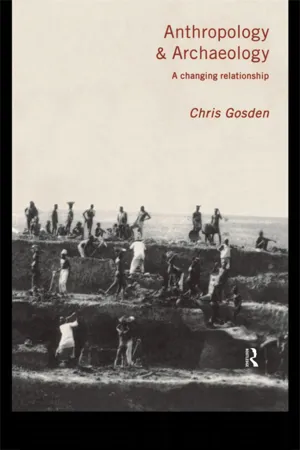
Anthropolgy and Archaeology provides a valuable and much-needed introduction to the theories and methods of these two inter-related subjects.
This volume covers the historical relationship and contemporary interests of archaeology and anthropology. It takes a broad historical approach, setting the early history of the disciplines with the colonial period during which the Europeans encountered and attempted to make sense of many other peoples. It shows how the subjects are linked through their interest in kinship, economics and symbolism, and discusses what each contribute to debates about gender, material culture and globalism in the post-colonial world.
- 248 pages
- English
- ePUB (mobile friendly)
- Available on iOS & Android
eBook - ePub
About this book
Information
1 Anthropological archaeology and archaeological anthropology
‘Stone Age tribe flees bushfires in Brazil’ was a headline carried by a number of British newspapers in March 1998. During this month bushfires raged through the savannah and rainforest of Roriama Province of northwest Brazil, due to a drought said to be caused by El Niño. What does the newspapers’ use of the term ‘Stone Age’ mean? Stone Age evokes echoes of the land that time forgot; portions of the globe and groups of people by-passed by the major currents of history; the survival of the past in the present. In a different age, the journalists might have used the word ‘primitive’ more freely, as this is partly what they meant: Stone Age tribes represent a prior stage of human history, superseded elsewhere, but still preserved by the isolating wilderness of the Amazonian rainforest.
The reports, in fact, referred to a number of rainforest groups, the best known to the western world being the Yanomami, documented through the writing and films of Napoleon Chagnon (1997). This area of Brazil has a long and complex history, both of colonialism and pre-colonial times (Rivière 1995). It is ironic that one of the most famous scenes from Chagnon’s films, shows an axe fight, in which metal axes are used. Metal tools were introduced centuries ago and complex interactions have taken place between all sorts of different groups leading to the exchange of material culture and ways of life. The Yanomami and their neighbours are not Stone Age in a literal sense: they do not use stone tools. But neither are they Stone Age in a metaphorical sense, being as fully a part of the modern world as the inhabitants of New York or Tokyo. They have been propelled into the modern world through creating a history as complex, dynamic and varied as anywhere else. Theirs is not an isolated culture, but one with multiple links to rainforest and savannah groups.
However, the inaccuracy of the statement is not its interesting aspect, but rather that it was made at all. How is the phrase ‘Stone Age tribe’ immediately understood by people reading the news at their breakfast tables in Britain? All these readers would know that they do not live in the Stone Age. The same newspapers tell them that they live in the age of the Internet and the jumbo jet. They are not modern, but post-modern. On the other hand, they know Stonehenge originated in the Stone Age, a phase of life long past in Britain and many other places. Stone Age tribes in Brazil are made doubly distant,inhabiting a remote part of South America and a period of prehistory simultaneously.
The term ‘Stone Age’ succeeds in evoking such images because of several centuries of writing about the distant past and the distant present. Much of this writing is now carried out by archaeologists and anthropologists, although this academic work builds on a longer tradition of accounts by explorers and antiquarians (Pratt 1992). The immediacy of the phrase is partly a success story for archaeology and anthropology: our concepts are in general use. It is obviously also part of our failure, if such a progressivist view of world history still has common currency. But concepts such as the Stone Age are elements of the joint histories of archaeology and anthropology. An important route to understanding the distant past and the distant present by those of European descent has been to make constant metaphorical links from one to the other. Prehistory was constructed through extended analogies with people living in the present. For instance, tribal people who made and used stone tools in the Americas were models for understanding the phases of European prehistory before the use of metal. As we have seen, intellectual recycling can now take the analogy back to its American point of origin, but with overtones of European prehistory attached.
There has been a complicated trade of concepts and discoveries between archaeology and anthropology over the last five centuries, such that the history of one would have been totally different without the other. Archaeology and anthropology can be seen as a double helix with their histories linked, but distinct. In this book I hope to explore the reasons for this joint heritage and separate identities, and the implications this heritage has for pursuing both subjects in the present.
Anthropological archaeology
‘Archaeology is anthropology or it is nothing’, is a statement with which many archaeologists would strongly agree. As a statement of disciplinary identity, it is odd, contradictory and not at all straightforward. It seems somewhat unusual to define one discipline in terms of another. As far as I know, no one has ever said anthropology is archaeology or it is nothing. Not to define archaeology in its own terms appears intellectually lazy, bad academic politics and lacking in disciplinary self-confidence. However, people who take this view are not giving up their disciplinary identity. Instead we are indicating that archaeology is part of a broad field of study, composed of archaeology, social/cultural anthropology, physical anthropology and linguistics. This larger field is often known as anthropology, which is taken to be the study of all aspects of human life, past and present. Within anthropology, conceived broadly, social/cultural anthropology studies the people of the present, originally concentrating on so-called small-scale societies but increasingly focusing on the structures of life in the west as well. Social/cultural anthropology uses the method of participant observation, which involves immersing oneself inthe life of the group being studied, learning their language (if necessary) and producing some sort of synthetic account of the experience. This is something very different to the excavation and analysis of archaeological evidence, or the study of language as such, or the bodily aspects of human existence and evolution. This book is about the relationship between archaeology and social/cultural anthropology, within the broader field of anthropology.
When I started this book, I thought it was a hopeless task, but now I know I was being optimistic. Part of my optimism was wanting to include an account of physical anthropology, although I was realistic enough to know that I could only mention linguistics in passing. My sin of omission in leaving out physical anthropology came about when I realised the magnitude of the task and it would take another book to explore the three-way relations between archaeology, social and cultural anthropology and physical anthropology. I have taken the dishonourable route of leaving out any systematic discussion of physical anthropology at all.
It also needs mentioning that social/cultural anthropology is very varied, as already implied by my joint designation. For reasons I hope will become clear as the book proceeds, there have been shifting definitions of anthropology over time. Some people have stressed the social structure provided by kinship as being the key element of life to be studied: these were self-proclaimed social anthropologists. For others, the crucial factor is culture, which ranges between the material objects that people make and use, to their sets of beliefs and views of the world. Today it is probably true to say that culture is in the ascendant, although there is much overlap and many sensibly decline to waste too much effort defining any dividing line too closely, as it is impossible to decide where society stops and culture starts or to give relative weight to each. Nevertheless both terms are in common use to designate slightly different forms of anthropology and this needs acknowledging. Other terms of importance are ‘ethnography’ and ‘ethnology’, which tend to refer to the observable aspects of a society encountered by the anthropologist in the field, the basic data observed (to use a scientific metaphor). Ethnographic data are synthesised back home and combined with theory to produce a rounded anthropology. Ethnography was often seen as the equivalent of excavation and therefore somewhat looked down on as basic toil, whereas the really worthwhile activity was the synthetic and comparative work of anthropology carried out on the data. Today, with a greater emphasis on material culture and practical action in general, ethnography is less of a second-class activity and there is some overlap between cultural anthropology and ethnography.
In a some ways it makes no sense to attempt to look at the relationship between archaeology and anthropology, as neither are single entities. There is much internal variety, with archaeologists defining themselves as scientific, ecological, historical as well as anthropological. Also, there are differences in the meaning of anthropological archaeology in different times and varying places. In order to give a sketch of this variety I shall look at the divergent meanings given to the term ‘anthropological archaeology’ on the two sides ofthe Atlantic and how usages in north America and Britain have changed over time. This will be a limited history covering the last forty years, the period in which current positions and debates have been defined; the longer-term history of the last 150 years is considered later in chapters 2 to 5.
Anthropological archaeology in North America
It was Willey and Phillips (1958: 2) who wrote that ‘American archaeology is anthropology or it is nothing.’ It is worth noting that they limited the statement to America and it would not have been true in any sense to say the same of British archaeology at the time. This statement had been true since the time of Boas at the end of previous century, who emphasised the combination of social anthropology and archaeology needed to uncover the culture history of local areas (see chap. 5). However, Willey and Phillips wrote when a contrasting to view to that of Boas was emerging within a new evolutionary synthesis. ‘Anthropology is fundamentally a generalizing and comparative discipline’ (Willey and Sabloff 1980: 1), whose ultimate aim was to understand and explain the processes underlying culture change. It is no coincidence that the article seen as the starting point for the New Archaeology was entitled ‘Archaeology as anthropology’ (Binford 1962).
This article, written in Binford’s impenetrable style, said that archaeology could and should participate in the study of the evolution of human culture. Given that anthropologists have only a small range of variability to study in the shape of extant cultural systems, archaeology would, in fact, have the major part to play and was the only discipline that could look at really long-term change and come out with broadly based generalisations about human behaviour. His view of archaeology was as an holistic discipline, which could look at the whole of human culture. Such a view was in contradiction to the oft-expressed criticism that ‘you cannot dig up a kinship system’. While Binford agreed that this was true and thus archaeologists were never going to be the same as anthropologists, he did feel they could identify all aspects of past change as well as the fact that changes happened for different reasons and at varying rates in specific elements of the cultural system. Artefacts and features have a systematic relationship to the total extinct cultural system and this relationship can, potentially, be understood. Following Leslie White he divided these elements of the cultural system into three types: the technomic, sociotechnic and idiotechnic. The first of these was technology, the extensions of the human body by which people extracted energy from the environment and processed it. The sociotechnic was to do with people’s social identity within the group and the manner in which groups were given cohesion in such a manner as to use their technology efficiently. Ideotechnic artefacts created a symbolic milieu in which people were acculturated. It is necessary for archaeologists to establish relations between these different sets of artefacts, which should be expressed in statistical terms. The relationships could be expressed ultimately against the background of exceptionless generalisations or laws.
Binford felt that the ultimate aim of archaeology is to generate and apply laws of human behaviour through combining the evolutionary theory of White with the systematic study of archaeological materials. Thus although the theory came from anthropology the major contribution in data would come from the archaeologist, the only discipline with the evidence from which to generalise about long-term change and long-distance relationships. These optimistic hopes left unprobed the tricky question of the relationship between past and present forms of life and of understanding the past through analogy with the present. Binford (1972: 18) acknowledged that most ideas about the organisation of culture in the past have come from the study of human variability in the present. This obviously was not good enough if that past was truly different from the present, as interpretation based on observation in the present could only render the past in the shape of the contemporary world. The way out of this which was consistent with the philosophy of science employed at the time was to use analogies from the present as hypotheses to be tested against remains from the past (Binford 1967: 1), presumably with the possibility that quite a number of such hypotheses would be proved wrong. The more limited and specific the analogies were, the less chance they had of being pertinent. To build strong and rounded analogies ‘Archaeologists must be trained comparative ethnographers’ (Binford 1972: 18). This was a sentiment echoed by Richard Lee, a social anthropologist, one of a number brought in to comment on the work of the archaeologists: ‘if every African prehistorian spent a field season working with the Kalahari Bushmen (or the Australian Aborigines), this experience would immeasurably enrich his understanding of all levels of African prehistory’
Binford took his own advice to heart and carried out intensive studies with the Nunamiut, an Alaskan Inuit group (Binford 1978, 1980) and less intensive studies elsewhere. He hoped to use specific observations on butchery of carcasses or behaviour around a hearth to interpret Palaeolithic remains, making the assumption that in all cases people would behave in a functionally efficient manner and not be influenced, for instance, by culturally specific attitudes to dirt in depositing their rubbish round a hearth. By positing an emphasis on efficient function Binford hoped to come up with a series of cross-cultural generalisations which could allow an understanding of the specifics of the past. But in making these observations, he became rather more bound up in testing and verification of his hypotheses than he did in building theory (Shennan 1989). On a larger scale, Binford developed the global hunter-gatherer model, which looked at how such things as technology, storage and sedentism amongst hunter-gatherers today varied with latitude, finding that those at highest latitudes in cold environments had to be most efficient in their technology and storage (Binford 1980, Lee 1968b). He used such observations to understand Palaeolithic evidence and this is a line of work that has been extended by others (Kelly 1995).
Anthropological archaeology of this type is still current in North America. Writing the first editorial to the journal Anthropological Archaeology in 1982Whallon emphasised the generalising theoretical purpose of anthropological archaeology. He defined ‘Anthropological archaeology as the study of organizational and evolutionary process in human cultural systems’ (Whallon 1982: 2) and hoped that ‘we ultimately may see the development of a systematic and rigorous understanding, on both short-term and long-term timescales, of human cultural organization and evolution’ (Whallon 1982: 1). Many of the articles that have appeared in the journal subsequently have followed these lines, essentially those laid down by Binford twenty-five years ago. It seems fair to say that the majority of prehistoric archaeologists in North America would still see themselves as anthropological archaeologists within a functionalist and generally evolutionary framework (although the same would not be true for historical archaeologists). However, social/cultural anthropology has moved a long way from Leslie White, as we shall see in the course of the book. This means that there is little in common between prehistoric archaeology and anthropology so that there is a wider gap between the two disciplines now than at any time over the last 150 years.
Anthropological archaeology in Britain
Rather the opposite is the case in Britain. Since the demise of the evolutionary synthesis in the late nineteenth century (chaps 2 and 3) there has been little contact between prehistoric archaeology and anthropology. In the recent period David Clarke in Analytical Archaeology asserted that ‘archaeology, is archaeology, is archaeology’ (Clarke 1968: 13). Shennan (1989: 833) sees this work as an attempt to combine the end of the Childean culture tradition and a new cultural archaeology, which was looking at the birth, growth and death of archaeological entities, such as artefact assemblages. Such an archaeology comes out of work on seriation, battleship curves and the like and was contained within the framework of the Three Age system, rather than the evolutionary framework of White, which could immediately link it into the anthropological concerns of the time.
An anthropological archaeology was something of a novelty in Britain and, unsurprisingly, owed a lot to influences from across the Atlantic. These came either in the form of the New Archaeology itself or through the influence of evolutionary anthropologists, such as Sahlins (1958, 1963) and Service (1962, 1971). The social archaeology of Renfrew (1973a, 1973b, 1975, 1984) was an attempt to chart the movement from band, to tribe, to chiefdom to state in the archaeological evidence using the evidence of trade, or the distribution of monuments. Even though anthropological models were used, for looking at social hierarchy or forms of trade and exchange, there was never a sense that archaeology and anthropology were part of the same general study of humanity. Renfrew made efforts to distinguish social archaeology and social anthropology: anthropologists are reliant upon learning language and from there go on to kinship and the general structure of society. For social anthropologists many things were obvious, such as the size of the social unit, its politicalorganisation, roles and statuses, which were at the top of the social archaeologist’s list of things to find out (Renfrew 1984: 9–10). Archaeologists also stressed material culture, which social anthropologists had become less interested in since the decline of ethnography (Renfrew 1984: 10). This was an accurate depiction of British social anthropology at the time, which was going through a structuralist and symbolic phase.
It is interesting to contrast the reactions of anthropologists on either side of the Atlantic to new moves within archaeology. The anthropological commentators on the Binfords’ New Perspective in Archaeology (who included Lee, Devore, Fried and Harris) were generally very positive towards the aims of the New Archaeology, which accorded with their own evolutionary anthropology. Leach, who was one of the main importers of French structuralism into British anthropology, made notorious comments on a collection of New Archaeology papers put together by Renfrew (Leach 1973), which set back relations between the disciplines considerably. Leach stressed the fragmentary nature of the archaeological evidence on the one hand, and the infinite variety of human cultures on the other. He concluded that ethnographic analogies and parallels were very hard to use with any confidence in archaeology. When Renfrew talked about Neolithic chiefdoms in southern Britain on the basis of the distribution of monuments ‘social anthropologists in this audience were quite unimpressed . . . ethnographic parallels suggest at least half a dozen alternative possibilities and none of them need be right’ (Leach 1973: 767). He concluded that: ‘It seems to be that the wise archaeologist should steer away from trying to do the kind of social anthropology which the professional social anthropologist knows to be quite impossible’ (Leach 1973: 768). So much for anthropological archaeology!
In Britain in the 1960s and 1970s the position of anthropological archaeology was complicated. There were many who wanted nothing to do with anthropology, either for Clarke’s well-argued reasons or because many practitioners of archaeology had always felt more allegiance to history and had local, rather than generalising concerns. Anthropological archaeologists had common aims with anthropologists in North America, but found few at home sympathetic to an evolutionary view of human culture. Also, the stress on theory within anthropological archaeology cut it off from some areas of the discipline, so that Classical archaeologists, for instance, were sceptical of the jargon and abstractness of those who espoused a generalising, anthropologically oriented approach (Morris 1994, Renfrew 1980). This situation has changed considerably over the last twenty years, when moves in both archaeology and anthropology have brought convergence. Post-processual archaeology has embraced a social theory essentially the same as that of any anthropologists. Anthropology (or parts of it) has moved away from the abstract structuralist analyses carried out by Leach and others towards material culture, the body, art, technology and landscape. Pretty well all anthropologists acknowledge the decline in the belief in the ‘ethnographic present’ and the need to integrate history into their analyses. In many parts of the worldwithout long written records, rounded and long-term histories can only be created through the use of archaeology. The result of these moves within archaeology and anthropology is an unprecedented unity in some parts of the two disciplines, in terms of teaching and research, as alluded to in the Preface.
For instance, Chris Tilley’s (1996) An Ethnography of the Neolithic, which interestingly makes many of the same points Leach did (cross-cultural generalisations are impossible, life is about signification), is a sophisticated account of the uses that archaeologists can make of anthrop...
Table of contents
- Cover Page
- Title Page
- Copyright Page
- Illustrations
- Preface
- Acknowledgements
- 1 Anthropological archaeology and archaeological anthropology
- Part I Histories
- Part II The contemporary scene
- References
Trusted by 375,005 students
Access to over 1.5 million titles for a fair monthly price.
Study more efficiently using our study tools.
Frequently asked questions
Yes, you can cancel anytime from the Subscription tab in your account settings on the Perlego website. Your subscription will stay active until the end of your current billing period. Learn how to cancel your subscription
No, books cannot be downloaded as external files, such as PDFs, for use outside of Perlego. However, you can download books within the Perlego app for offline reading on mobile or tablet. Learn how to download books offline
Perlego offers two plans: Essential and Complete
- Essential is ideal for learners and professionals who enjoy exploring a wide range of subjects. Access the Essential Library with 800,000+ trusted titles and best-sellers across business, personal growth, and the humanities. Includes unlimited reading time and Standard Read Aloud voice.
- Complete: Perfect for advanced learners and researchers needing full, unrestricted access. Unlock 1.5M+ books across hundreds of subjects, including academic and specialized titles. The Complete Plan also includes advanced features like Premium Read Aloud and Research Assistant.
We are an online textbook subscription service, where you can get access to an entire online library for less than the price of a single book per month. With over 1.5 million books across 990+ topics, we’ve got you covered! Learn about our mission
Look out for the read-aloud symbol on your next book to see if you can listen to it. The read-aloud tool reads text aloud for you, highlighting the text as it is being read. You can pause it, speed it up and slow it down. Learn more about Read Aloud
Yes! You can use the Perlego app on both iOS and Android devices to read anytime, anywhere — even offline. Perfect for commutes or when you’re on the go.
Please note we cannot support devices running on iOS 13 and Android 7 or earlier. Learn more about using the app
Please note we cannot support devices running on iOS 13 and Android 7 or earlier. Learn more about using the app
Yes, you can access Anthropology and Archaeology by Chris Gosden in PDF and/or ePUB format, as well as other popular books in Social Sciences & Anthropology. We have over 1.5 million books available in our catalogue for you to explore.