- 304 pages
- English
- ePUB (mobile friendly)
- Available on iOS & Android
eBook - ePub
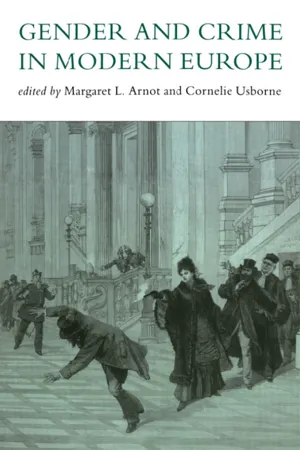
Gender And Crime In Modern Europe
About this book
This work explores the construction of gender norms and examines how they were reflected and reinforced by legal institutional practices in Europe in this period. taking a gendered approach, criminal prosecution and punishment are discussed in relation to the victims and perpretrators. This volume investigates various representations of femininity by assessing female experiences including wife-beating, divorce, abortion, prostitution, property crime and embezzlement at the work place. In addition, issues such as neglect, sexual abuse and the "invention" of the juvenile offender are analyzed.
Chapter 1

Why gender and crime? Aspects of an international debate1
Margaret L. Arnot and Cornelie Usborne
As recently as 1985 one historian of crime bemoaned the fact that women’s roles in connection with crime in past societies had received very little scholarly attention and he offered two tentative explanations for this: first, because women have traditionally been perceived as “exceptionally law-abiding”; and secondly, citing the criminologist Doris Klein, because of “the preponderance of male theorists in the field”.2 This dearth of interest was despite the publication at the turn of the century of a number of prominent studies of female criminality by male authors. But these were, to use Klein’s words, “classist, racist and sexist”, based, as they were, on prejudiced notions of female physiological and psychological peculiarities; they hardly qualifed as role models.3 Certainly, many major studies of the 1970s investigating patterns of crime and punishment in modern Europe paid scant attention to women4 although there were some important exceptions: for England, John Beattie published his germinal article on the criminality of women in eighteenth-century England in 1975 and certain specific “crimes” of central interest to women’s and gender history attracted attention from scholars from a wide range of sub-disciplines within history.5 Yet it was even possible as late as 1985 for a general crime history book to omit a clear entry for “women” from the index,6 although by this time most historians of crime gave women at least this level of recognition.7
One major reason for the relative neglect of women was that the major questions being posed by this work were not the right ones to “find” much material significant to women’s lives and gender relations more broadly. In Britain, major growth in the history of crime at this time comprised one element in the development of social history. Historians usually came from the left, and an examination of “social crime” was central to their agenda of writing “History from Below”. Criminals such as rioters, smugglers, poachers and rebels in industry could be seen in political terms as dissidents in a social system where law was the cement that held the hierarchy together.8 By the 1980s the major trend was towards quantitative approaches.9 While British historians utilized the detailed records of that nation’s criminal justice records first, European scholars soon followed. Most of the records referred to related only to the activities of the highest courts in any nation, where the most serious, indictable felonies were tried. The vastly greater number of petty offences – where women probably featured significantly – were very often lost to the historian.10 Furthermore, in interrogating court records, historians very often followed the logic of the surviving sources. As Australian historian Judith Allen has explained, crime history monographs tended to mirror the patterns of crime prosecuted and indicted: the priorities that police and magistrates employed in the past in selecting offenders for prosecution and trial tended to give shape to the crime histories.11 Two historians of Italy have eloquently explained a fundamental challenge for crime historians that such a critique presents:
Although historians so often masquerade as participants in the judicial process, they cannot passively accept the schema of roles and results assigned by the dominating ideology of the criminal justice system. Instead they must seek to discover opportunities in a disturbing moment of the past to identify other ideologies, values, and lives often masked or obliterated by the hegemonic vision of criminal records. Thus, even as he [sic] snitches on the dead, the historian’s fundamental obligation is to respect them in their own terms rather than in those of the judicial record that brings their experiences to view.12
Though crime historians clearly set out to develop critical perspectives on crime and criminal justice systems,13 following the logic of the sources sometimes suggested the underlying and continuing influence of positivist definitions of crime. B. L. Ingraham, a historian of political crime, has usefully explained the implications: “Implicit in this approach is the confinement of one’s analysis of ‘crime’ and legal behaviour with respect to ‘crimes’ to those categories of behaviour officially defined as ‘criminal0’.”14 Even while so carefully discussing definitional problems, Ingraham was himself caught out by androcentric myopia. He included in his list of acts deemed either “treason” or “political offenses” in western Europe from ancient times until the beginning of the nineteenth century certain “sexual crimes, including rape of, or adultery committed with or by, the monarch’s wife or close female relatives and intermarriage between persons of the political in-group and the political out-group.”15 These fitted into a broader category he defined as “challenges to political authority and legitimacy: those which concern the safety and security of rulers and the legitimizing principles on which their right to rule and their authority depends.”16 This carried enormous potential for an analysis of political crime that integrated an understanding of the central place of sex and gender in the broad social contract of modern western societies,17 but after constructing these definitions the book was written assuming more conventional definitions of the “political” that wrote sex and gender out of consideration.
We would agree with Allen’s assessment that such approaches resulted in the neglect of crimes and associated activities which may have been extremely insignificant in the overall criminal statistics gleaned from macro-studies of whole criminal justice systems – or indeed, absent from the record because the practices were “secret”18 – but which were of great significance in the construction of gender relations, and indeed, of wider European culture and politics. This is not, however, to say that quantitative history is of no use to women’s history.19 Indeed, the deconstruction and critical interrogation of the “terms . . . of the judicial record” is a crucial part of the project of understanding the historical relationships between gender norms and institutional processes.20
Leaving women out, and focusing studies on questions that do not reveal essential elements of the operation of gender in society is one level of criticism that can be made of some work in criminal justice history. But feminist historians have also pleaded that if female criminality is studied, it should be done with careful reference to the social, economic and political contexts of women’s lives, and with feminist perspectives.21 Nevertheless, by the mid-1980s, a valuable and interesting historiography in the social history of crime and criminal justice was developing. These developments benefited greatly from feminist theory22 and the new research in women’s history. Both stimulated new theoretical and methodological approaches, the latter by questioning some of the basic concerns of historical thought like “periodization, the categories of social analysis, and theories of social change”.23 It was the cross-fertilization between the new social history of crime and women’s history that proved so beneficial to both subjects. Women’s historians began with questions that had not been addressed head-on by criminal justice historians. They wanted to understand the nature of gender relations and gendered power structures in the past and used the study of particular aspects of crime to provide powerful insights into these broad questions. The resulting feminist history of crime has focused most frequently on questions about sexuality, reproduction, marriage and family relations, and historians have sought out records associated very often with illicit practices that have been erratically and unevenly policed, even sometimes tacitly condoned.24 These were the sorts of offences that might not appear particularly “significant” to earlier criminal justice historians (although some sexual offences in particular were discussed by crime historians: prostitution could not be ignored because of its ubiquity, nor rape, because of the severity with which it was met in the past).25
Whatever the main focus of studies by women’s historians – women’s role as perpetrators, their place on the receiving end of crime, the legal procedures and punishments that faced them, the discourse about particular crimes or gendered criminality itself – these histories always recognized the importance of social history contexts, sometimes to the point that the very concepts of “crime” and “criminality” began to dissolve. From her Australian perspective, Judith Allen has argued for the complete rejection of these categories.26 In Regina Schulte’s work on infanticide in rural Bavaria in the nineteenth century, infanticide as a “crime” disappeared almost completely, as she unravelled the complex social explanations for why some infanticidal women were exposed to the authorities, while others were not.27 Judith Walkowitz clarified that before the Contagious Diseases Acts were passed in England in the 1860s, working-class women could pass in and out of prostitution as economic circumstances demanded, while still being accepted as part of their working-class communities: “criminality” is of little use as a concept in such contexts.28 Yet such radical deconstruction can add immeasurably to our understandings of European criminal justice systems and has done a great deal to fill the void in the crime historiography. Work in women’s history has also inspired some criminal justice historians to begin to address issues about women from a more nuanced perspective, and whole monographs have begun to appear from such historians about issues of central concern to women’s history.29
Many who have contributed to the pioneering, compensatory stage of women’s history have more recently invested their energy to open up a wider field of study and reinterpret all social relations of the past from a feminist perspective. After women’s history laid the groundwork for a new methodology and theory and offered new insights into the role of women as historical actors, some scholars broadened their attention from the role of women to include gender as a whole. Their interest has been to investigate how societies were shaped by the relations of power between women and men, and the historical construction of masculinity has become as important as femininity for understanding the past.30 But it remains the case that while criminal justice history has developed strongly as a distinctive sub-discipline of social history and while there is a proliferation of specific studies on aspects of gender relations, there is considerably less work that brings these areas together. And what integrative work there is tends to focus on “women” and crime rather than on the conceptual category “gender”. Feminist crime historians who centred their account on women only were aware of the advantages of the conceptual category of gender but often felt they had to provide access to criminal women or female crime victims first before gendered structures could be examined.31 Garthine Walker and Jenny Kermode, for example, argued for gender history on the gounds that this would limit the “extent to which ‘women’s’ history can be considered in isolation from women’s relation to men” and would discourage “the treatment of women as an homogeneous group with a common interest, viewpoint and experience. But it also . . . forces the historian’s attention to focus more critically upon the relative power of women and men.”32 Nevertheless, they decided to concentrate on women rather than gender to explore the common constraints and processes women shared and to emphasize “female agency in the face of a legal system institutionally biased towards men”.33 The importance of gender was also recognized by one of the foremost scholars in the field of the history of crime, Clive Emsley, the author of the foreword to this book. His most recent edition of Crime and society in England 1750–1900 (1996) now has a chapter on “Crime and Gender”, a welcome corrective, although a gender analysis integrated more thoroughly throughout the book would have been even more satisfactory. But within this special chapter, too, references to masculinity are only fleeting, and Emsley’s focus remains “women” rather than “gender”. Most work in other European countries on an integrated gender analysis of the history of crime is at a similarly rudimentary stage. What work there is that more successfully integrates a gender perspective is scattered:34 we hope this book provides the field with added focus.
We opted for a book on “gender” and crime rather than on “women” and crime because we believe that the concept of femininity cannot be understood without also addressing the concept of masculinity and that women’s experience cannot be reconstructed except in the context of a complex set of relations and processes which includes both women and men. Yet while choosing “gender” for our title, we do not want to suggest that “women” should be forgotten or elided: the project of gender history must continue to include the search for the hidden experiences of women, but the historicity of masculinity is fundamental too. The new and significant insights that can be achieved through focusing on both men and women rather than on women alone can be found throughout this book. But the sorts of insights stressed by Walker and Kermode remain as important for “gender” history as they are for “women’s” history. “Gender” is a vital analytical tool for understanding masculinity and the historical construction of traditional male institutions and male experiences. Historians have until recently rather neglected this aspect simply because men traditionally had less reason to question their “gendered status”, a privilege of those in a dominant position to take that position for granted and to think of the social hierarchy as natural.35 In addressing men and masculinity as well as women and femininity, this book hopes to illuminate the ways that societies have been shaped by the relations of power between women and men. By examining in depth crimes alleged to have been committed by – or perpetrated against – women or men, or both sexes, and by refusing to use gender as a synonym for women, but rather as a category of analysis, our edited collection moves in the direction anticipated by but not accomplished by studies that focus primarily on women. We have also aimed to contribute to the social history of crime, that is, to situate criminal deeds and their perceptions into relevant contemporary economic, political and social contexts.
This book arises from an international conference we organized at Roehampton Institute London in 1995, which was much wider in scope than this book as far as both period and topics were concerned. In producing an edited collection of some of the papers, we wanted to explore the relationship of gender and crime within a comparative European framework and faced the difficult task of deciding how to limit the book in order to give it some coherence. We decided to examine different ways in which criminality was gendered, together with aspects of the gendered judicial process – and, where possible, the wider historical significance of these phenomena: a great many papers delivered at the conference fitted into this focus. But as a consequence we do not address in any detail a number of relevant topics, the most obvious being the histories of punishment and policing.36 For reasons of coherence we also decided to include in this volume papers about the modern period only (late eighteenth- to mid-twentieth-century Europe) in order to facilitate comparison if that became possible.
While this book offers an international approach to the study of gender and crime in as much as our contributions range across some six European countries, only a minority of papers contain a genuinely comparative angle, concentrating instead on an in-depth national or local study of their given problem. At the same time, the authors of this volume address the broad theme of “gender and crime” from many different perspectives; many different questions are asked and different theoretical approaches pursued. One of the themes is the construction of gender norms as they are reflected and reinforced by legal institutional practices: prosecution pa...
Table of contents
- Cover Page
- Title Page
- Copyright Page
- Foreword
- Acknowledgements
- Notes on Contributors
- Chapter 1
- Chapter 2
- Chapter 3
- Chapter 4
- Chapter 5
- Chapter 6
- Chapter 7
- Chapter 8
- Chapter 9
- Chapter 10
- Chapter 11
- Chapter 12
- Chapter 13
Trusted by 375,005 students
Access to over 1.5 million titles for a fair monthly price.
Study more efficiently using our study tools.
Frequently asked questions
Yes, you can cancel anytime from the Subscription tab in your account settings on the Perlego website. Your subscription will stay active until the end of your current billing period. Learn how to cancel your subscription
No, books cannot be downloaded as external files, such as PDFs, for use outside of Perlego. However, you can download books within the Perlego app for offline reading on mobile or tablet. Learn how to download books offline
Perlego offers two plans: Essential and Complete
- Essential is ideal for learners and professionals who enjoy exploring a wide range of subjects. Access the Essential Library with 800,000+ trusted titles and best-sellers across business, personal growth, and the humanities. Includes unlimited reading time and Standard Read Aloud voice.
- Complete: Perfect for advanced learners and researchers needing full, unrestricted access. Unlock 1.5M+ books across hundreds of subjects, including academic and specialized titles. The Complete Plan also includes advanced features like Premium Read Aloud and Research Assistant.
We are an online textbook subscription service, where you can get access to an entire online library for less than the price of a single book per month. With over 1.5 million books across 990+ topics, we’ve got you covered! Learn about our mission
Look out for the read-aloud symbol on your next book to see if you can listen to it. The read-aloud tool reads text aloud for you, highlighting the text as it is being read. You can pause it, speed it up and slow it down. Learn more about Read Aloud
Yes! You can use the Perlego app on both iOS and Android devices to read anytime, anywhere — even offline. Perfect for commutes or when you’re on the go.
Please note we cannot support devices running on iOS 13 and Android 7 or earlier. Learn more about using the app
Please note we cannot support devices running on iOS 13 and Android 7 or earlier. Learn more about using the app
Yes, you can access Gender And Crime In Modern Europe by Meg Arnot,Cornelie Usborne in PDF and/or ePUB format, as well as other popular books in History & European History. We have over 1.5 million books available in our catalogue for you to explore.