Winning the Knowledge Game focuses on the thinking and attitudes required to remain knowledgeable, competitive and high performing.
Topics include: having a winning strategy, improving collaboration and teamwork, creating a smarter business, competitive intelligence, protecting intellectual property, keeping talent, leveraging the latest digital technology, increasing customer loyalty and measuring the impact of your people on performance, market value and society.
Winning the Knowledge Game provides practical advice on the strategies, tactics and systems you need to remain capable and agile in this rapidly changing business world.
To help you meet this challenge, Winning the Knowledge Game explores three questions:
* How do you open the hearts and minds of people to
smarter learning?
* How do you grow competitive advantage?
* How do you sustain and ensure lasting success?
All managers need to learn the skill of acquiring and putting knowledge to work if they are to successful. Most of all they need to learn how to play the knowledge game every day of their life.
Do not leave things to chance discover the ideas and tips that will deliver a measurable improvement to your business leadership, performance and career.
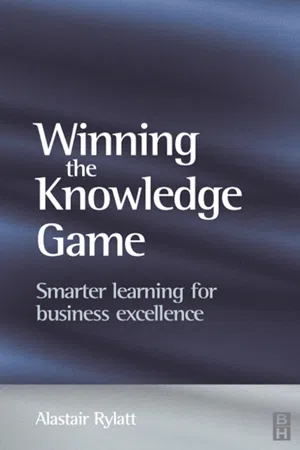
- 224 pages
- English
- ePUB (mobile friendly)
- Available on iOS & Android
eBook - ePub
Winning the Knowledge Game
About this book
PART ONE
Opening Hearts and Minds
Inspiring higher levels of curiosity and imagination is the major foundation for winning the knowledge game. Managers must spend their time and effort winning over the hearts and minds of people to the shared importance of building a smarter and more agile business.
There are a number of capabilities that help this pursuit. They include building a culture of discovery and innovation, sponsoring higher levels of trust and support, exploring new ways of expanding your thinking, combining faster and deeper levels of learning and, finally, being prepared to freshen up your collaboration, teamwork and relationships.
These principles are common to all forms of human interaction whether you are managing a large organization, a small business professional, or working for a not-for-profit organization. These are the life skills for twenty-first century business and personal growth.
1 Having a Winning Strategy
You cannot schedule creativity . . . We don’t know what is going to be a good idea, but we do know that to have good ideas, we have to have ideas – the good, bad and the ugly. We must empower individuals to pursue his or her dream to help the good ideas survive.
(Dr Geoffrey Nicholson)
Having a winning strategy requires:
• knowing your business and positioning your knowledge
• creating safe space for people to toss around ideas
• stomping out bullying, the hoarding of information and back-stabbing
• encouraging people to be intelligent together
• making it very clear why sharing is important.
Getting the Basics Right
Let us begin by asking two simple questions: what makes a truly outstanding business? What capabilities does a business generate that makes it extra-ordinary and very hard to copy?
These two questions are at the core of winning the knowledge game. Outstanding business performance begins and ends with the enduring ability to know your marketplace, position your knowledge and build your capability. No industry or business can ignore the fact that it must tailor its products and services to an increasingly sophisticated and aware audience, community and/or customer base. The better businesses are very clearly aware of their purpose and have built a compelling vision for the future and created a practical plan to get there.
As one reads literature, hears stories and observes practices you can quickly get a real sense that know-how is the critical difference. When done correctly, learning and knowledge is transformational and ground-breaking.
Whatever your trade, profession or passion, putting knowledge to work is central to everything you do. There is no job or business that can ignore the fact that wisdom and higher levels of insight will set you apart from the rest. As Thomas Stewart said in his book the Wealth of Knowledge: ‘Knowledge is a rock.’ Uniqueness particularly unique knowledge is where business wins or loses.
Here are seven examples that will give you a feel of better practices in knowledge and innovation in a variety of industries:
• BMO Financial Group increased their capacity to attract and keep customers while also improving profitability by developing a data warehouse of customer information and preferences. The pilot implementation saved the bank an estimated US$22.8 million through reorganizing product lines and creating more targeted marketing campaigns.
• Celera-Genomics estimated it would take two years to determine the structure and sequence of the 3 billion chemical base pairs that make up human DNA. Using 300 specially developed DNA sequencing robots at a cost of US$300,000 each and the most powerful supercomputer in the private sector, Celera Genomics began sequencing the human genome and were able to publish the results well ahead of the two-year expected time frame.
• Ford Motors introduced a knowledge exchange between thirty-seven plants around the globe to reduce the time it took from the concept of a car to it being in the marketplace. On the latest count 2800 proven practices were shared and the production cycle has been reduced from thirty-six months to twenty-four and the value of improvements are estimated at US$1.25 billion.
• John Paul College, with the assistance of notebook computers, wireless networks and on-line learning technology, has become one of the largest schools in Queensland, Australia. Its vision of pioneering ‘anywhere anytime’ education has led to the establishment of a connected learning community involving collaboration with student teachers, parents and the wider community in learning and education.
• The Lgov NSW learning team began using web cams to mentor, coach and give supplement skills training to managers in remote country and city locations. The result is a higher level of learning and skill development for managers.
• Parramatta City Council, as a result of a management initiative, established five cross-functional teams to explore better ways to improve organizational capability in 2003. As a result, new policies, systems and protocols were established and action plans agreed.
• In 1996 the new president of the World Bank declared that the bank would strive to become the ‘knowledge bank’. Each staff member now devotes two weeks per year to knowledge creation, sharing and learning. Staff now participate in over 100 different discussion forums to create and share knowledge in key areas such as early childhood development, school health and disaster relief.
As you read these citations of varying complexity and size, it is easy to see that the potential and terrain for improving knowledge work and innovation is immense. As you would expect, there are many factors that help create business value, such as new enhancements in technology, better customer service, patenting a new product or the ability to cut transaction or production costs. These capabilities cut across the fabric of what drives outstanding business in most modern industries and occupations. With the right attitude and thinking, solid progress can be made.
So what generates a successful strategy? Generally, there needs to be a business leadership that nurtures trial and error as well as a never-ending commitment to ingenuity and discovery. There is a clear realization that winning the knowledge game has no miracle solutions and quick-fix answers. You need to be in the game for the long haul. Such intention and spirit is essential before you can expect to reap the rewards. You need to accept that often there will be a slowdown in productivity and service before the benefits of learning can begin to sink in. This can be seen in training courses where people need time to develop their expertise and practice before you can see positive change.
Assuming you have the basic attitudes right, you will need to work hard to stay in the knowledge zone. In this regard businesses must, first, lead from the top to engender a corporate culture of never-ending improvement. All the techniques, tools and technologies in the world will not make a scrap of difference if the heart of the business fails to champion daily innovation and continuous improvement. Being quietly comfortable and thinking that things can cruise along is a proven recipe for decline or stagnation. We must be prepared to look for new and better ways to improve. Second, you need to be receptive to unlearn what you know, while also being open to discovering what we do not know. It is vitally important that we test our assumptions, myths and taboos. In this fast-paced world it is very easy to miss the blatantly obvious, so we must work hard to keep our antennae and radar up. Business must be prepared to move beyond just doing tasks and completing projects, and be prepared to note the learning that comes from experience. Life is a great teacher if only we take the trouble to learn the lessons that it provides us. At times managing such dynamics can be disturbing, unsettling and uncomfortable. Each business needs to feed off chaos, uncertainty and expediency to uncover what is most necessary and important.
To sum up, better practices in knowledge and innovation display a clear understanding of five guiding principles:
• To be successful one must create a clear and inspiring vision for change, thereby assisting people to clearly understand why better knowledge is vital and why it is deeply important to everyone involved.
• Leaders need to stimulate a spirit of collaboration and mutual advantage by sharing what they know, while learning what they do not. They realize that knowledge cannot be conscripted or forced; it must be volunteered and encouraged.
• Knowledge work is essentially a social experience. It needs exchange and interaction. Digital technology, tools and systems are a great help, but you need people for it to work.
• Knowledge is not about which talent you hire or intellectual property you own, it is about how well you stimulate the flow of ideas. Without open and frank exchange you will fail to get the depth of insight you need.
• Knowledge work is not about flooding people with information, but is about creating greater value for your business, its people, your customers and society.
Watching Our Blind Spots
No week can pass without us sighting an example of a business that has closed or is obviously struggling. Whether it is a government organization like a local council or an insurance giant who has negated its obligations to its shareholders and customers, the examples are endless. The fact is, businesses do not have a great track record of adapting to change.
Of course, it is not just the medium to large organizations that struggle in winning the knowledge game; small businesses struggle as well. Just think about your local shops, restaurant or industrial precinct and count how many businesses have changed in the last twelve months. Each business no doubt would have a story to tell. In most cases, although they may not wish to admit it, absence of know-how or being blind to impending change may be the root cause.
A close family friend is a very successful artist who runs an art gallery in an inner city area. He recently told me this story of his attempt to build on the business but devote more time to painting. To do this he appointed a full-time gallery manager to manage the retail side of the business. In time he became curious that given the high turnover of artwork the profitability of the business did not seem to be improving. He asked his accountant to have a closer look at the daily transactions. To his horror he discovered that over $40 000 went missing in a classic white-collar crime. Needless to say, when confronted the gallery manager left without a trace. My friend immediately recruited a new gallery manager but this time better checks and procedures, including daily reporting of transactions and regular conversations on building the potential of the business, were employed. Together the working relationship has much more potential for success. Blind spots such as these are notoriously common in businesses.
But blind spots may not always result in direct financial losses. The outcome could be lost or unfulfilled potential because the talent and capabilities of people are lying dormant or hidden. Organizations such as Honeywell, Microsoft, Body Shop, Lend Lease Corporation, Ernst and Young and Buckman Laboratories are companies that have a track record of investing in their people by building systems that nurture and develop a winning strategy. The result is a much quicker response rate, higher agility and adaptability to the customer.
The key to overcoming blind spots is first to recognize the danger of overconfidence and arrogance by encouraging greater honesty, disclosure and transparency. As Bill Catucci from AT & T in Canada says, ‘In the past, the person reporting an unfavourable number was lonely and isolated. Now, I want people to admit to shortfalls and have everyone else respond, “How can we help?” This is an entirely new management model for the company.’
In this new model of leadership managers must support a different code of behaviours. First, they must set up safe spaces in the business for people to have deep conversations on issues that they feel passionate about. This must be done without them being constrained by hierarchy, ego and status. People must feel safe to be able to share their frustration, explore unresolved issues and dig for the truth. These exchanges must be undertaken in an environment of humility and humbleness. Trying to look smart or fine is not a formula for winning the knowledge game.
Second, people must be prepared to coach and facilitate rather than trying to be the star. From experience, managers can be both a friend and a foe when it comes to finding smarter solutions. For example, a government client of mine had a serious backlog of requests for a new home loan initiative. When I was called in to help it became obvious very quickly that much of the initiative of the team was being stomped on by a highly motivated manager. At the initial meeting when another member of the team raised a possible solution the manager quickly discredited it, thereby killing off any flow of ideas. It was obvious that the current dynamics could not continue. On this occasion we took the pressure off this person, a subject matter expert, by asking the person to be a coach rather than a judge. The good news was that the manager played their new role beautifully and all of a sudden new natural leaders and problem-solvers emerged. Within a short time the backlog problem was solved.
Finally, business must be prepared to broaden its view of the world and marketplace, and be more receptive to explore the unknown or, even, the unspeakable. One of my most vivid memories of a blind spot was a consulting project I undertook at the Australian Navy Supply Centre in Sydney. In the early 1990s I was asked to conduct a series of managing change training programmes. At the time there was strong rumour that the head office would soon be closed down, privatized or relocated. When I raised this scenario at the site many of the managers and team leaders saw i...
Table of contents
- Cover
- Half Title
- Title Page
- Copyright
- Dedication
- Contents
- Preface
- Acknowledgements
- About the author
- Introduction
- Part One: Opening Hearts and Minds
- Part Two: Growing Competitive Advantage
- Part Three: Ensuring Lasting Success
- Select bibliography
- Index
Trusted by 375,005 students
Access to over 1.5 million titles for a fair monthly price.
Study more efficiently using our study tools.
Frequently asked questions
Yes, you can cancel anytime from the Subscription tab in your account settings on the Perlego website. Your subscription will stay active until the end of your current billing period. Learn how to cancel your subscription
No, books cannot be downloaded as external files, such as PDFs, for use outside of Perlego. However, you can download books within the Perlego app for offline reading on mobile or tablet. Learn how to download books offline
Perlego offers two plans: Essential and Complete
- Essential is ideal for learners and professionals who enjoy exploring a wide range of subjects. Access the Essential Library with 800,000+ trusted titles and best-sellers across business, personal growth, and the humanities. Includes unlimited reading time and Standard Read Aloud voice.
- Complete: Perfect for advanced learners and researchers needing full, unrestricted access. Unlock 1.5M+ books across hundreds of subjects, including academic and specialized titles. The Complete Plan also includes advanced features like Premium Read Aloud and Research Assistant.
We are an online textbook subscription service, where you can get access to an entire online library for less than the price of a single book per month. With over 1.5 million books across 990+ topics, we’ve got you covered! Learn about our mission
Look out for the read-aloud symbol on your next book to see if you can listen to it. The read-aloud tool reads text aloud for you, highlighting the text as it is being read. You can pause it, speed it up and slow it down. Learn more about Read Aloud
Yes! You can use the Perlego app on both iOS and Android devices to read anytime, anywhere — even offline. Perfect for commutes or when you’re on the go.
Please note we cannot support devices running on iOS 13 and Android 7 or earlier. Learn more about using the app
Please note we cannot support devices running on iOS 13 and Android 7 or earlier. Learn more about using the app
Yes, you can access Winning the Knowledge Game by Alastair Rylatt in PDF and/or ePUB format, as well as other popular books in Business & Business General. We have over 1.5 million books available in our catalogue for you to explore.