- 256 pages
- English
- ePUB (mobile friendly)
- Available on iOS & Android
eBook - ePub
Coaching to Solutions
About this book
The book provides a tool kit for managers tasked with raising performance and sustaining motivation. Organisations are being judged by the way in which they accommodate the needs of the individual in work and life-style terms. In this context, the 'smart' employer will not only be looking to develop policies that retain talent through recognising their work-life issues, they will be equipping their managers to manage that talent in ways which maximise the contribution that individual can make.
The text introduces managers to techniques largely drawn from Brief Therapy (De Shazer & Berg). Brief Therapy is used in the UK, but primarily by social workers, psychologists and counsellors. It's application to work settings is now growing. The attraction of a Solution Focussed approach to coaching is that it offers pragmatic tools that help managers structure helping conversations.
The book presents the principles of solution focussed thinking in a language that is readily understandable by managers, and shows how those principles can be applied to a range of issues which managers may find themselves facing as willing or enforced coaches. The book places coaching as an activity which can be done as part of the daily process of management.
1 Coaching — why all the attention now?
DOI: 10.4324/9780080454634-1
In most cases people do not leave businesses. People leave managers.Sir Clive Woodward
Twenty years ago, few people would have talked about coaching unless it related to sports performance. There it would have been recognized as a signal that the person had abilities that could be best developed through having focused attention on reducing technical weaknesses. Successful sportsmen would pay tribute to their coaches as key to achieving their goals. At the same time, to say to a manager, who would happily pay for tennis or golf coaching, that they needed a coach at work would have been seen as an insult. It would imply that they were underperforming, when career success rests on signalling to an employer that you are always performing to your full potential.
Move on to the 21st century and, for many business people to have an external coach has become a signal of success. It offers a safe space to talk about the loneliness of being near the top, lack of confidence, knowledge and skills gaps, the challenges of living the life of a senior manager, relationship difficulties with senior colleagues and even ‘is it worth it?’. For an elite within organizations, external coaching is available as a source of support; a confidential relationship like no other within their working day. The sceptical have dismissed it as corporately sponsored therapy. The people who work as executive coaches come from a wide range of backgrounds, but they have often had extensive training to enable them to deal with the psychology of the individual interacting with the tough reality of a business environment.
For this very reason, many line managers resist the idea of being coaches to their staff. They believe that they do not have the skills to fulfil this remit, and they may have very little inclination. Their desire is to deliver on the objectives they have been set, applying the skills and motivation of their direct reports to support that delivery. Those who have an interest in coaching staff may hold back because they fear it will become a major part of their role, when in reality they have little spare capacity. They express concern that they will be dragged into areas that are beyond their competence, or that they will shift the focus of their relationship with staff to the ‘touchy feely’ when they need it to be focused on the ‘doing quickly’.
All of this suggests that coaching is something that sits outside the ‘real business’ of getting the work done, and risks deflecting attention from delivery. I believe neither assertion is true, and that coaching is the most powerful enabler you have as a manager to gain what you need of an individual, and what they desire for themselves.
Regardless, however, of your own feelings about coaching, there is plentiful evidence that it has now become a necessary and required aspect of the manager’s role.
The tipping point
In 2002 Malcolm Gladwell published The Tipping Point,1 a hugely influential book that highlighted the ways in which ideas, products, music and fashions spread like viruses, to the point where they become embedded as part of a culture. What begins as an idea or fashion statement with appeal to a few can spread like an epidemic until it develops a ‘stickiness’ that glues it to its target audience. The universality of mobile phone use, the speed of iPod penetration, the focus on the eating habits of children, the rising acceptability of plastic surgery are all indicators of this viral spread. Coaching has been another. From an activity that would have been suppressed as a sign of deficit, it has come to be seen as a badge of success for those who have been identified as ‘talent’. From an organizational perspective, it has also come to be seen as part of the management skill set that should be available to all direct reports.
In the Chartered Institute of Personnel and Development’s (CIPD) survey of training and development activity in the UK,2 95 per cent reported that coaching had increased in their organizations in the last year. Even more significantly, 97 per cent agreed with the statement that coaching skills are a necessary part of a manager’s skill set. The tipping point has been reached. Whether coaching is a good thing is now not even a subject for debate — it is a fact of life.
What is also true is that the person most likely to be delivering the coaching is someone like you: a busy overworked individual, who may well have received little or no training for this role. According to the CIPD study, only 5 per cent of organizations do not expect line managers to coach, but fewer than 20 per cent of organizations have trained all or most of their managers to deliver coaching. Regardless of your training, or lack of it, there is a ready audience within your direct reports. According to the CIPD, coaching is an organizational offer to two-thirds of junior and middle managers, and since 40 per cent of organizations report that they use no external coaches, the organization will assume you have the will and skill to deliver it. Most centrally, so too will your staff. What makes this expectation even more challenging is that they have grown up in an era when coaching in all its diverse manifestations is readily available to them as consumers. They may have used life-coaches, relationship coaches, prosperity coaches, fitness coaches or even parenting coaches in other areas of their lives, and they have absorbed from them a sense of the difference that focused attention can make.
The Millennials: are they really different?
If all this is becoming worrying, then there is a whole literature to increase your anxiety. A best-selling French book extols the virtues of workers shirking work as a rational response to its meaningless.3 In this argument, since most of what office workers do is pointless and very few experience real success, workers should protect themselves by doing the minimum possible. This view of work is endorsed in the burgeoning world of blogging. The internet hums with accounts of disaffected employees. ‘My life lost all meaning the day I joined’, wrote one blogger, ‘I create absolutely no value to society. I just help move data from one place to another’. Perhaps even more worrying from a corporate perspective, another blogger writes, ‘I think one reason I stay here is because it is easy to be mediocre’.4 While this view of work appeals to the cynic in us all, it denies the reality that if you have ever worked in a job that you perceive as pointless, it has a profound effect on self-esteem. Most people, while recognizing that ultimately there are more important things in life than work, still want to feel a sense of connection with what they do, and to believe that it matters. Their manager has a key role in creating that sense of connection and meaning, or in its absence.
Back in the 1980s Douglas Coupland wrote Generation X5 which highlighted that the generation coming after the baby-boomers of the post-World War 2 era, posed a challenge to organizations. They did not buy into the idea of organizational careers in terms of identifying with an institution, but did want success in terms of acquiring skills and experiences that would ensure their marketability. They have been labelled by Bruce Tulgan6 as ‘self-builders’. That does not mean that they want to do it all themselves, but that they value people they work with for the degree to which they can help them build their desired future. A manager is valued who can teach them, push them, believe in their abilities and provide opportunities. They seek evidence of the value of their own contribution and look for recognition, in order to confirm whether it is worth staying. So far, you may have been agreeing, because this describes you. You may well be a Generation Xer, born between 1963 and 1977, and have noticed that your own feelings about your working life have rested on such measures. You have worked well for a manager who offered support in your self-building and have even left a job because of a manager who did not.
All this is fine whilst you are the recipient of this attention, it looks different when you are in the provider role. If you are a Generation Xer you may well be managing those who have been labelled either Generation Y or Millennials. Generation Y’s — those born after 1977 — have been described as ‘Generation X on fast forward’.7
Add to expectations of challenge and responsibility that the challenge should have personal meaning; that the delegated responsibility should allow them to define how and where the work is delivered; and that their manager should create a fun environment, and it becomes frightening. Michel Syrett and Jean Lammiman, writing about Millennials from a UK perspective,8 warn that they want to be inspired, but approach office life with a negative mindset that has to be won over; that Millennials believe their commitment has to be earned and sustained, that it does not come as part of their automatic offering and that they will walk away from an organization if there are no opportunities to show their individualism. Written in these bald terms it reads like a mantra for spoilt children. It may well evoke those feelings in you, as a Millennial requests a discussion about their career future or their personal development, just months after their arrival. The skill of the manager is to stand back and consider what might be the benefit in working with this perspective, and to determine what you need to offer in order to obtain those benefits.
Coaching as part of the psychological contract
To view coaching as an enabler to achieving what you need of a staff member, as well as an expectation they may have as an attention-hungry Millennial, it is helpful to recognize coaching’s value within the psychological contract you have with staff. The psychological contract is a term first coined in the 1960s to describe the expectations that an organization and an employee have of each other, and that, if such expectations are met, provide a glue between the two. It came into focus in the 1990s9 when the impact of global competition, the influence of Information Technology on how business could be done, economic conditions in the UK and changing patterns of employment made it apparent that the assumptions that individuals had of their employer in areas such as job security and career progression, and the assumptions that organizations had about staff, such as that they would trust the motives of the employer, value security and offer unconditional loyalty, were no longer accepted. The old ‘deal’ was being broken by both parties and a new one had to be constructed which worked with changes that were occurring both within businesses and within individuals.
The psychological contract that now operates for many staff, regardless of the economic cycle, is likely to include some of the features shown in Figure 1.1.
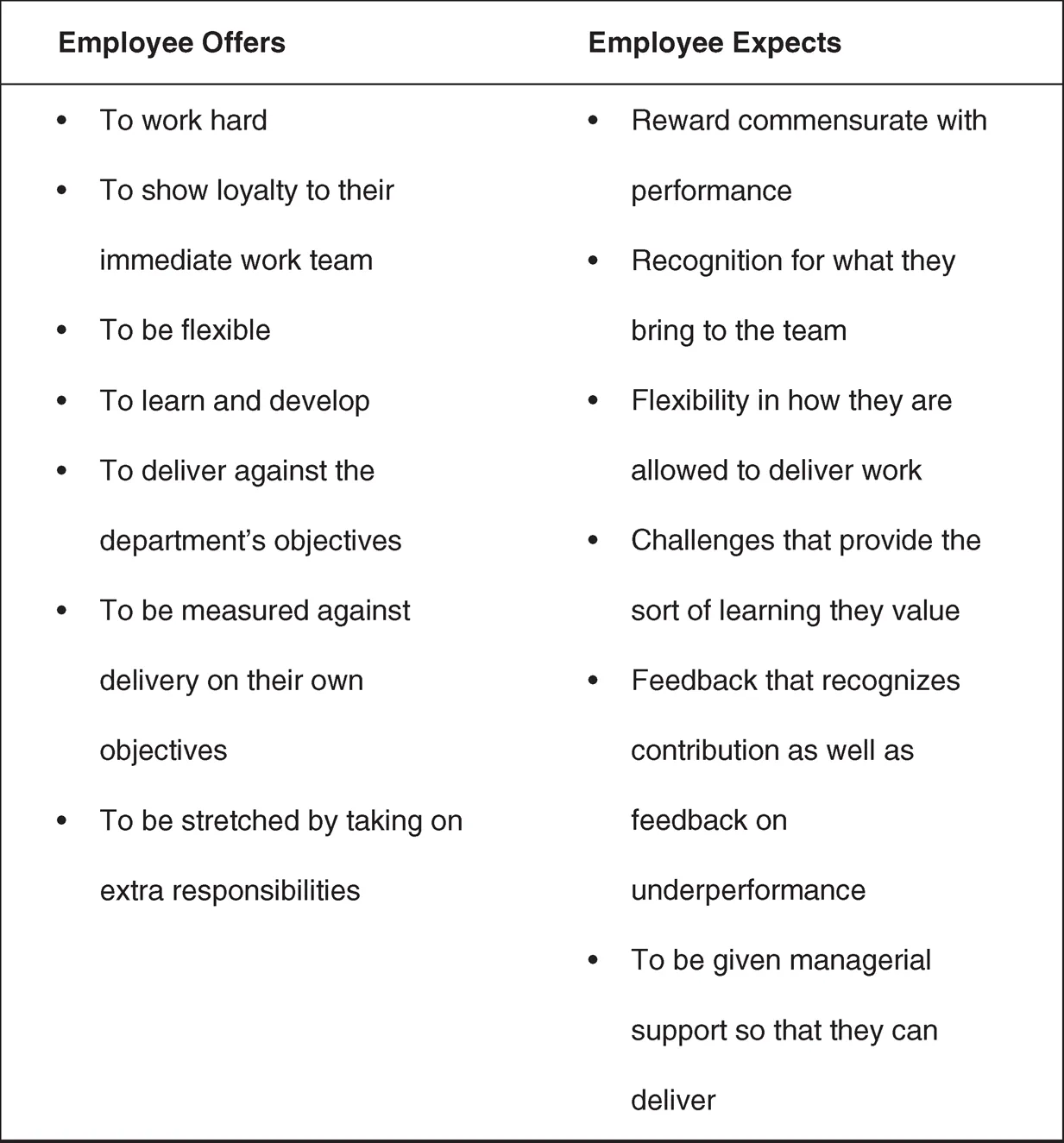
What is apparent in this ‘deal’ is that there is no expectation of a long-term relationship or long-term job security. The deal is conditional, but this does not mean that every employee constantly has their eye on the exit door. Rather, they will stay for as long as the ‘deal’ is delivering from their perspective. From their side this means that central to their retention is attention from the person who is the most significant shaper of their perception of their ‘deal’ — their line manager. An organization has an identity or ‘brand’ that shapes why individuals are attracted to it but, once employed within it, the quality of their psychological contract is directly influenced by the degree to which their expectations are met by their manager.
What is new in this?
Everything I have written so far suggests that the case for coaching by managers is based on responding to the ‘uppity demands’ of an increasingly egocentric workforce. That is not my case. Rather, I believe that what the writers on newly identified populations such as the Millennials have done is to re-package and re-label universal truths through allying them to visible changes in how work is done, or societal shifts. In doing so they suggest that it is the impact of technology that has brought about the increasing need for attention or an increase in time spent at work, and the growth of solo living that means people expect more of their relationship with their boss. In reality, people have always responded to attention as a means of enhancing their motivation and performance.
Rather than seeing coaching within work as a growth industry, born of a current fascination with having someone available to help deal with any aspect of your life, and legitimated by increased pressures within work, the real case for coaching staff is its centrality to employee motivation.
Early in their management development every manager is introduced to theories on human motivation. The work of Abraham Maslow10 in defining a hierarchy of need, proposed that once a need has been met, an individual will seek to satisfy a need at the next level. In his hierarchy, once basic physiological needs are met, e.g. pay, warmth and shelter, an individual’s attention will shift to their desire for security and order in their lives. Once an individual is certain that the environment provides those certainties then attention will focus on higher-order needs of affiliation, respect, status and the opportunity to act out their view of themselves within work. For talented marketable employees, the needs that they bring to work are of the higher order. They seek to be respected, and see managerial attention as a signal that they are valued. They feel respected when their views are listened to. They feel respected when mistakes they make are used to help them do it differently next time, rather than as an excuse for attacking their identity. If their identity with work is strong, then they will value being supported in becoming the person that they want to be, through seeing that their manager has an investm...
Table of contents
- Cover Page
- Half Title Page
- Dedication
- Title Page
- Copyright Page
- Contents
- Foreword
- Acknowledgements
- Introduction
- 1 Coaching — why all the attention now?
- 2 The coach in you
- 3 Before you assess others, assess yourself
- 4 Getting STARTED
- 5 Set Up
- 6 Tangibles
- 7 Assumptions
- 8 Reality bites
- 9 Targeting
- 10 Emerging solutions
- 11 Delivery
- 12 Leadership and coaching
- Index
Trusted by 375,005 students
Access to over 1.5 million titles for a fair monthly price.
Study more efficiently using our study tools.
Frequently asked questions
Yes, you can cancel anytime from the Subscription tab in your account settings on the Perlego website. Your subscription will stay active until the end of your current billing period. Learn how to cancel your subscription
No, books cannot be downloaded as external files, such as PDFs, for use outside of Perlego. However, you can download books within the Perlego app for offline reading on mobile or tablet. Learn how to download books offline
Perlego offers two plans: Essential and Complete
- Essential is ideal for learners and professionals who enjoy exploring a wide range of subjects. Access the Essential Library with 800,000+ trusted titles and best-sellers across business, personal growth, and the humanities. Includes unlimited reading time and Standard Read Aloud voice.
- Complete: Perfect for advanced learners and researchers needing full, unrestricted access. Unlock 1.5M+ books across hundreds of subjects, including academic and specialized titles. The Complete Plan also includes advanced features like Premium Read Aloud and Research Assistant.
We are an online textbook subscription service, where you can get access to an entire online library for less than the price of a single book per month. With over 1.5 million books across 990+ topics, we’ve got you covered! Learn about our mission
Look out for the read-aloud symbol on your next book to see if you can listen to it. The read-aloud tool reads text aloud for you, highlighting the text as it is being read. You can pause it, speed it up and slow it down. Learn more about Read Aloud
Yes! You can use the Perlego app on both iOS and Android devices to read anytime, anywhere — even offline. Perfect for commutes or when you’re on the go.
Please note we cannot support devices running on iOS 13 and Android 7 or earlier. Learn more about using the app
Please note we cannot support devices running on iOS 13 and Android 7 or earlier. Learn more about using the app
Yes, you can access Coaching to Solutions by Carole Pemberton in PDF and/or ePUB format, as well as other popular books in Business & Business General. We have over 1.5 million books available in our catalogue for you to explore.