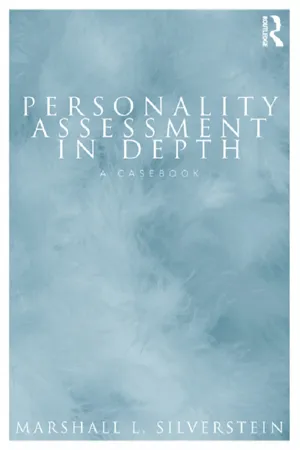
Comprised of five unique and extended case studies, Personality Assessment in Depth examines contemporary clinical problems that are familiar to clinicians, but have not been explored extensively in the personality assessment field. Each case study demonstrates the test protocols of the Rorschach test, Thematic Apperception Test, MMPI or MCMI, and Human Figure Drawings. Important clinical questions and areas of theoretical concern are examined, including differential diagnosis of disorders of affect and personality in light of contemporary viewpoints about these disturbances, personality and adaptation accompanying neuropsychological deficit, and stages of development, including differentiating these from personality characteristics viewed longitudinally, the latter demonstrated by a noteworthy comparison of two evaluations of the same patient, first as a 15-year-old adolescent and then as a 25-year-old adult.
A battery of performance and self report personality instruments are applied to the cases, allowing the author to integrate findings across multiple tests and thereby expose clinical psychology students to personality assessment in a broad perspective. Cases are discussed comprehensively, relying on a thorough consideration of thematic content examined alongside formal test scores. Further, the Rorschach findings are examined using both the Exner Comprehensive System and the recently-introduced Rorschach Performance Assessment System approaches. The cases are considered using a broad psychodynamic framework for interpretation, employing classical ego psychology, object relations, and self psychological theoretical perspectives. This is an essential casebook for professionals and students, demonstrating the depth and richness of personality considered alongside the empirical foundations of personality assessment.
- 344 pages
- English
- ePUB (mobile friendly)
- Available on iOS & Android
eBook - ePub
About this book
Information
1 Empirically Based and Content-Based Clinical Interpretation
The interpretation of psychological tests of personality has long been a thorny problem, it largely being a matter of whether to favor an idiographic (clinical-impressionistic) approach, a nomothetic (empirically guided) approach, or more typically one representing a combination of both. There are no easy answers to the question of which method is preferable, in part because it may depend on the purpose of an assessment evaluation, for example, to provide a rich, characterological in-depth understanding of an individual or to provide an answer to a relatively specific clinical question such as suicide potential or disordered thinking. Frequently, the decision depends on the clinical temperament of particular examiners. Probably many test instruments, regardless of their nature, will work well in the hands of particular clinicians because of their experience or way of apprehending the material various methods yield. One objective of this book is to revisit the still unsettled issue of achieving a scientifically and clinically sound balance using empirically based and content-based methods of clinical interpretation.
For some of us, it is not really an issue at all, there being a great many clinicians and investigators who subscribe nearly exclusively to one or another approach. Thus, some clinicians rely substantially on reliable and valid approaches to test interpretation, exemplifying what would be referred to as an evidence-based approach, to use today’s parlance. Others may favor its polar opposite—an exclusive or predominant content analysis approach—although there probably are few adherents to such an approach in contemporary times. Most examiners rely on some combination of the two. It is not my intention to advocate for one or another method of interpreting personality tests. I simply demonstrate my own clinical temperament, using a combination of empirically derived and clinical-impressionistic approaches, regardless of the terms used to describe different approaches or the method at one time or another for obtaining clinical data (such as projective vs. performance-based or empirically derived vs. self report). It also will become clear that I personally delve quite far into thematic content and in many respects I probably rely more on this source of data than many others do, speculative though that may be. It is partially because I believe that analysis of content is fast becoming a lost art that I undertook writing this book, which is one of a small number of volumes of comprehensive, response-by-response clinical case studies in the field. This book, however, makes use of empirical scores and codes and self report methods far more integratively than the case studies I reported in previous works (Silverstein, 1999; Silverstein, 2007a; Silverstein, 2007b).
Varying degrees of uncertainty surround the clinical work of personality assessment examiners who practice different ways of combining empirical and clinical data. Certainly, there is little consensus about balancing the two; when and how to draw a line between empirically grounded formulations and clinical hunches; how to construct theoretically informed clinical speculations from scores, ratios, and thematic content; and when and how to modify how examiners use clinical-theoretical approaches typically applied to other forms of practice—usually psychotherapy—with the data of personality evaluations. We take comfort in the research support afforded by the major self report instruments and reliable and valid Rorschach coding scores, which undoubtedly is an important reason underlying the confidence many have about using the Rorschach. It is of course an important reason why most clinicians rely on Exner’s (2003) Comprehensive System (CS) or Meyer, Viglione, Mihura, Erard, and Erdberg’s (2011) Rorschach Performance Assessment System (R-PAS) for grounding clinical interpretation. Nevertheless, even with this foundation examiners often augment interpretations by incorporating impressions derived from thematic content of Rorschach responses and tests such as Figure Drawings (Handler, 1996) or the Thematic Apperception Test (TAT; Murray, 1943) that do not usually yield formal scores. Clinicians undoubtedly are of different minds concerning the kinds of clinical situations impacting a decision to use or not to use thematic content material. Nor does the field have a consistent approach to this issue; indeed, this may be an issue that by its nature defies formulating consistent, reliable guidelines.
The matter of empirically based scores or codes and thematic content analysis in clinical interpretation is undoubtedly best considered using the Rorschach as an example. Unlike self report instruments—which are typically interpreted almost exclusively using a nomothetic approach—the Rorschach exemplifies an instrument that may be interpreted idiographically, nomothetically, or in both ways. There do not exist empirical scoring methods for Figure Drawings or the TAT that are in widespread use, despite there being a number of scoring procedures for some tests such as the TAT (Jenkins, 2008). Thus, instruments such as these resemble self report scales in that their interpretation is carried out mainly in one way—idiographically in the case of the TAT and Figure Drawings and nomothetically in the case of self report instruments like the Minnesota Multiphasic Personality Inventory (MMPI-2; Butcher, Graham, et al., 2001) and Millon Clinical Multiaxial Inventory (MCMI-III; Millon, 1997). Consequently, a tension between idiographic and nomothetic interpretation never existed for most of these instruments, certainly not to the extent that it has characterized nearly the entire history of the Rorschach since its introduction almost one hundred years ago. I thus focus on the Rorschach test to trace the history of its interpretive use and the conceptual viewpoints about clinical interpretation that derived from the tension in the field over many years.
Although we usually think of Rorschach’s so-called “thought experiment” and the inkblots he created as the beginning of the inkblot method, Zubin, Eron, and Schumer (1965), in their classic review of the Rorschach and related projective instruments prior to 1965, delineated precursors antedating Rorschach’s work with the method. For example, based on amorphous inkblot and cloud imagery as a stimulus for artistic creation, Leonardo da Vinci and Botticelli as early as the fifteenth century drew artistic inspiration from imagery formed when a sponge containing various colors of paint was thrown against a wall. Zubin et al. also noted that Shakespeare wrote a dialogue in Hamlet concerning the meanings of shapes that could be discerned in cloud formations.
In relatively recent times, but still preceding Rorschach’s introduction of his inkblot method in 1921 (Rorschach, 1981), Binet applied a psychometric approach to the use of inkblot tests of imagination (Binet and Simon, 1908)—quite possibly an early forerunner of current concepts of emotional intelligence and creativity—with a view toward considering such tests among those Binet developed as measures of intelligence. Other contemporaries of Binet and Rorschach during the years between 1900 and 1917 also studied inkblot perception in relation to thinking and imagination. But it fell to Hermann Rorschach to devise the inkblots and the basic method for using the instrument from the standpoint of its intriguing opportunity for examining perception. He conceived of the method as an experimental approach and he was particularly interested in questions concerning individual differences for inferring personality structure.
Rorschach identified key characteristics to measure how individuals perceived structure from the amorphous inkblots, and he regarded characteristics such as location and determinants to be the primary measures of perceptual-cognitive processes (Rorschach, 1981). He derived measures such as the Experience Balance (EB), comprised of the relative proportion of human movement and color determinants, as a dimension of personality along which people differed in nature and degree. Rorschach also classified the contents of responses; however his interest in content was confined only to categories of experience (for example, human, animal, anatomy, etc.). He apparently did not regard verbalizations per se as a subject of interest for interpreting inkblot responses, at least not during the brief time he worked with the method before his premature death. He recognized that content of associations was one property of verbalized responses, but he treated it as something to be considered last. However, in a posthumous publication with his colleague Emil Oberholzer, Rorschach had begun to consider certain aspects of response content in relation to personality. For example, commenting on the protocol of a politician, Rorschach observed that the only response with kinesthetic movement involved gigantic gods clinging to something and that this patient reported several responses with percepts such as the inside or core of the earth, or the center of a volcano, about which Rorschach wrote the following:
on the one hand we have gigantic gods and on the other the inside of the earth and the germ from which all grows. These interpretations arouse the “suspicion” that there are present ideas of re-making the world and show how he became a politician, particularly how he became a constructive organizer. Such experiences have taught me that the content of interpretations can have a meaning of its own …
(1981, p. 207)
Influenced by the growth of psychoanalysis, as the above example begins to show, Rorschach compared his technique to the analysis of dreams, likening percepts to the manifest content of dreams. Weiner (2003) also pointed out that Rorschach seemed to vacillate between disparaging the method as a means of discerning unconscious material and recognizing its potential value for exactly this purpose.
Following Rorschach’s lead, developments following his death remained predominantly focused on codifying details of the perceptual and cognitive properties of the technique, both in Europe and North America. Exner (1969) described how Beck, Klopfer, Piotrowski, and Hertz all developed scoring systems that frequently overlapped, although these systematizers also introduced unique scores or variables that interested them. Content analysis did not figure prominently in any of these approaches, with the possible exception of that of Klopfer and Kelley (1942), nor was thematic content a major focus of Exner’s CS. It was largely through the work of David Rapaport at the Menninger Clinic that substantive work on thematic content originated.
Rapaport was a noted theoretician writing about topics in psychoanalysis at a time when drive theory was evolving into the structural theory as an integrated psychology of the ego and its functions and development. Psychoanalytic ego psychology, beginning with Freud’s shift in emphasis during the mid 1920s, over the next decade had become the established theoretical focus of mainstream psychoanalysis. Rapaport wrote extensively about thinking, affect, motivation, and memory predominantly in the ego psychological tradition. Rapaport was instrumental in explicating how drives and defenses impacted cognitive and perceptual functioning. He and his colleagues Roy Schafer and Merton Gill extended the influence of ego psychology to psychodiagnostic test instruments, which included intelligence tests, story recall, word association, and sorting tasks as well as the Rorschach and other projective techniques. Consequently, one important focus of Rapaport’s work integrated personality with general psychology.
Their work (Rapaport et al., 1968) described four major dimensions of the Rorschach: the quantitative and qualitative wealth of the record, form level, and verbalizations. They considered content and its analysis as the qualitative wealth of the Rorschach, taking account of response content in relation to formal or structural aspects of the response process—such as form, shading, and color. Rapaport et al. also emphasized that the processes of perceptual organization and association were interwoven in Rorschach responses.
In Rapaport et al.’s (1968) description of the Rorschach dimension related to verbalizations, they described disharmonies between perceptual and associative processes. Here, Rapaport and colleagues incorporated three distinct but over-lapping areas: (1) the analysis of traditionally defined content categories—such as human, animal, anatomy, etc.—and their implications concerning patients’ preoccupations or concerns, (2) patients’ verbal communication of responses in relation to determinants and location, which represented the scorable products of patients’ thought processes, and (3) symbolic references, which is the aspect of content analysis, primarily thinking distortions, that Rapaport et al. regarded as lacking a psychological rationale for explaining the relationship between phenomena such as loss of distance or autistic thinking and the ego functions subserving reality testing and adaptation.
Holt, in his edition of Rapaport et al. (1968), commented that the analysis of verbalizations represented a hallmark of Rapaport’s contribution to interpreting Rorschach responses, despite Rapaport’s own acknowledgment that a method for analyzing verbalizations was not fully developed. Interestingly, however, Rapaport’s ideas about the TAT actually seemed to better reflect his thinking about content than did his writings about the Rorschach. He was interested in the flow of material in TAT stories mainly to examine control of drives by the ego, and he regarded rigid or inhibited as well as labile or impulsive stories as markers of poorly controlled drives. Rapaport et al. viewed interpreting TAT stories as a person’s way of experiencing one’s personal world. By designating the TAT for this purpose, they attempted to take advantage of this instrument’s capacity to elicit “free-swinging fantasy” to discern conscious and unconscious thought content (Rapaport et al., 1968, p. 468).
Schafer (1954, 1967), who extended Rapaport’s work on content analysis, attempted to understand content material by applying a disciplined and controlled application of psychoanalytic ideas, carefully eschewing what he called idiosyncratic improvisation as a form of unsubstantiated interpretation. Schafer also advocated a rigorous clinical sensibility concerning rules of evidence and clinical relevance that should be crucial to clinicians’ attitude toward interpretation; however he also recognized without apology that the way it operated and the data it considered were not subject to formal empirical testing. He stressed the importance of finding an optimal balance when analyzing the unique material constituting personality assessment data and that of reality. He thus attempted to take account of the tension inherent in describing one’s way of managing the world of everyday life, with its emphasis on problem solving and relationships with other people, while simultaneously attempting to apprehend the world of inner life with its emphasis on the depths of internal psychological experience. Schafer regarded psychological tests of personality as occupying a space intersecting both worlds, going back and forth between these realms of experience.
That being said, what then would it mean to apply the clinical sensibility that Schafer spoke about to thematic content analysis? This is where his familiar inferential thinking criteria for judging the adequacy of clinical interpretation comes into play, developed by Schafer (1967) to distinguish between thoroughness and recklessness, to use his own characterization of the problem. A large part of the difficulty concerns determining an appropriate degree of depth that is logically and clinically supportable.
Primary among the criteria Schafer advised as a guide to clinical interpretation is that of sufficient evidence, by which he meant considering converging lines of evidence, frequently based on several recurrences of a particular theme. However, Schafer also considered associations to particular test responses as a form of evidence for confirming or modifying interpretive leads. He compared the interpretive strategy to navigating an airplane, in which a pilot steers a plane by consulting instrument panels, his co-pilot, and his navigator, who in turn rely on data and feedback from a control tower or other devices. Though this was a useful metaphor, Schafer thought that the interpretive process using analysis of Rorschach content was similar to the corresponding approach to reconstruction in psychotherapy, in which patients respond to interpretations by recalling memories, dreams, or associations that further amplify or modify interpretations by steering them in a more accurate direction.
On the Rorschach, a particular response may strike an examiner as unusual or atypical because it is a rare response or because it suggests something more than what the scores themselves contain, particularly if it initiates or furthers a hypothesis-generating line of thinking in the examiner. Moreover, it may facilitate links with other tests, such as Figure Drawings or the TAT, analogous to Schafer’s metaphor of a pilot consulting with a plane’s co-pilot. Sometimes, content analysis may reveal more about intensity of affect states than that which formal scores indicate. For example, a coding for aggressive movement may not necessarily differentiate among nuances such as hostile vs. contemptuous vs. menacing; similarly, a coding for cooperative movement generally does not permit finer gradations or shades of cooperativeness, such as eagerly vs. grudgingly vs. passive-aggressively vs. compliantly. Schafer, while making use of subtleties such as these, also advised caution about how far to interpret meanings of particular responses, although he considered the sequence of responses within and between cards as providing potentially important information about shifts in intensity of affects or defense operations and adaptability of defense operations.
Probably his main emphasis in considering interpretive possibilities of content material was that both listening openly to potential meanings while simultaneously exercising caution about finalizing interpretations called for delicately balancing the two, but what was most important was keeping the range of options for clinical inferences broad rather than narrow. It is in this spirit that one could say that Schafer’s position represented a disciplined openness to experience, letting the examiner’s imagination roam over possible meanings, but filtering such meanings through a coherent theoretical framework rather than “flying blind,” to use his airplane pilot metaphor. Lerner (1991) and Fischer (1994b) discussed a similar process in their approaches to generating theoretically sound, higher-level inferences from Rorschach scores and verbalizations.
Schafer also took into account the depth of interpretation and manifest content of Rorschach responses as another consideration in using content analysis, for example, equating a response of a mouth with oral longings or a contest with Oedipal rivalry. Schafer was particularly cautious about such one-to-one equivalences, but he did not ignore this line of thinking either. What he emphasized, however, was the crucial step of anchoring how he used links such as these in a context that considered their regulatory functions. That is, interpreting orality, dependency, or competitiveness would depend on how drives or wishes such as these were expressed or modulated. Thus, merely mentioning a mouth in a Rorschach response would mean less about oral longings per se than, for example, whether the mouth was opened in anticipation of being fed, closed either in stubborn refusal or as an expression of autonomy, drooping in disappointment, spitting in disgust, pursed to inhibit affect, and so forth.
Schafer also privileged interpretations emphasizing defense operations over interpretations based on specific conflicts, such as oral longings or conflicts in the above examples, because defenses were more directly discernible as a rule whereas conflicts were usually less evident. He applied the general principle of psychodynamic psychotherapy to psychodiagnostic material in which a conflict is usually not interpreted until the defenses against that conflict’s conscious emergence are interpreted. Thus, Schafer argued that psychodiagnostic examiners should reserve inferences about underlying conflicts or their intensity until the defenses that operate become clear in a Rorschach or assessment protocol. As such, “the interpretation should not push below the level of defense” (Schafer, 1954, p. 150). For a similar reason, interpretations based on fixed, symbolic meanings—such as so-called “father” or “mother” Rorschach cards—were almost always gratuitous, unless sufficient evidence was strongly compelling—a very difficult criterion to achieve. Schafer called this use of content “arbitrary, presumptuous efforts to deepen interpretation in spite of the patient” (1954, p. 150).
However, the frequency with which a particular content emerges adds incremental certainty that the dynamic giving rise to it is salient. Less compelling, however, are more oblique indications of drives, for example contents about Santa Claus, angels, or hands reaching heavenward as indications of oral longings or dependency. Nonspecific thematic content such as these examples indicate possibly may strengthen interpretations if more substantive evidence exists; rarely if at all, however, should inferences be based on the absence of mentioning thematic content references. Despite such caveats, Schafer clearly attempted interpretations of drives or conflicts when he beli...
Table of contents
- Cover
- Title
- Copyright
- Contents
- Preface
- 1. Empirically Based and Content-Based Clinical Interpretation
- 2. Personality Problems Associated with Affect Dysregulation
- 3. Personality Problems in Adolescence
- 4. Personality Problems in Later Life
- 5. Personality Problems Associated with Cerebral Dysfunction
- 6. Continuity and Change from Adolescence to Young Adulthood
- Notes
- References
Trusted by 375,005 students
Access to over 1.5 million titles for a fair monthly price.
Study more efficiently using our study tools.
Frequently asked questions
Yes, you can cancel anytime from the Subscription tab in your account settings on the Perlego website. Your subscription will stay active until the end of your current billing period. Learn how to cancel your subscription
No, books cannot be downloaded as external files, such as PDFs, for use outside of Perlego. However, you can download books within the Perlego app for offline reading on mobile or tablet. Learn how to download books offline
Perlego offers two plans: Essential and Complete
- Essential is ideal for learners and professionals who enjoy exploring a wide range of subjects. Access the Essential Library with 800,000+ trusted titles and best-sellers across business, personal growth, and the humanities. Includes unlimited reading time and Standard Read Aloud voice.
- Complete: Perfect for advanced learners and researchers needing full, unrestricted access. Unlock 1.5M+ books across hundreds of subjects, including academic and specialized titles. The Complete Plan also includes advanced features like Premium Read Aloud and Research Assistant.
We are an online textbook subscription service, where you can get access to an entire online library for less than the price of a single book per month. With over 1.5 million books across 990+ topics, we’ve got you covered! Learn about our mission
Look out for the read-aloud symbol on your next book to see if you can listen to it. The read-aloud tool reads text aloud for you, highlighting the text as it is being read. You can pause it, speed it up and slow it down. Learn more about Read Aloud
Yes! You can use the Perlego app on both iOS and Android devices to read anytime, anywhere — even offline. Perfect for commutes or when you’re on the go.
Please note we cannot support devices running on iOS 13 and Android 7 or earlier. Learn more about using the app
Please note we cannot support devices running on iOS 13 and Android 7 or earlier. Learn more about using the app
Yes, you can access Personality Assessment in Depth by Marshall L. Silverstein in PDF and/or ePUB format, as well as other popular books in Psychology & Clinical Psychology. We have over 1.5 million books available in our catalogue for you to explore.