
- 266 pages
- English
- ePUB (mobile friendly)
- Available on iOS & Android
eBook - ePub
About this book
Written by two educational psychologists, this essential aid shows how change can be managed to increase job satisfaction and avoid unnecessary stress and conflict.
* offers practical advice for schools with action plans
* outlines the mechanics and processes in self-appraisal
* analyses the key methods for promoting effective change
* shows ways to monitor, review and evaluate change
* examines a number of strategies including consultation, negotiation, project development and in-service training
Information
Chapter 1
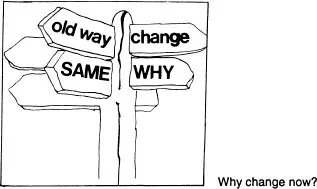
Why change now?
‘Mustn't grumble’ was the most English of expressions. English patience was mingled inertia and despair. What was the use?… In America you were admired for getting ahead, elbowing forward, rising, pushing in. In England this behaviour was hated.
(Theroux, 1983: 15)
In this chapter we look at reasons for change and attitudes towards change which will help to sustain the change process.
While positive attitudes are commonly promoted as helpful or necessary to innovation, we attempt to look at attitudes towards change in a number of ways, from several angles, in depth and at a number of levels. As a result, the chapter is one that can be returned to a number of times and reflected upon, or it can be sampled parallel to later chapters which relate even more directly to action.
As individuals or groups may like or find it advantageous to depict themselves as conservative or radical, so we find that a school's attitude to change says something important about that school. In exploring the change processes and how a school might address them, deep issues about the essence of the school, what it is and what it does, can be addressed in a purposeful rather than a theoretical way.
Living in the UK, we find this especially revealing and personally valuable. The novelist and travel writer, Paul Theroux, picked on a particularly English phrase: ‘Mustn't grumble', used in answer to any enquiry like ‘How are you?’ Theroux found this irritating: a confusion between the need to speak and think positively and the need to acknowledge and face up to problems, producing a fatalistic, inactive view that, while things could be better, we have to comment on what the world does to us, not to make things happen. This is the opposite of being realistic about problems and positive in trying to work out ways forward; Theroux's grouse was that the English avoided acknowledging or specifying problems so that they did not have to try to devise solutions.
While you go through this book, and at the end, consider how this applies to your school. You may wish to find a phrase that expresses your school's reply to a ‘How are you?’ that is not a ‘Mustn't grumble'.
RADICAL, CONSERVATIVE OR DON'T KNOW?
Change of some kind is a fundamental part of human existence. People grow and develop; they age and they die. Some aspects of human existence seem to have extraordinary stability. Religions can be identified as continuous over thousands of years, and cultural continuity is impressive. Humans take pride in aspects of their heritage that are ancient, reflected in family trees, traditions, and music. They also forget and/or reject these things. In Britain, some people like to call themselves conservative which can either mean a political view or a way of defining one's overall approach to life or both. Others like to feel they are radical, although the specific capture of that title by a political group is something now lost in the past. Both words have the effect of expressing something basic and important about people, and many people like to define themselves by these and similar phrases. For conservatives, this may mean that they like to feel that they are solid, competent, reliable, realistic, humble in the recollection of the great achievements of previous generations. For radicals this may mean liking to feel that they are breaking new ground, exposing the weakness of the status quo, challenging, a little daring, unafraid.
There are other positions relating to people's feelings about change, society and themselves. These can be interesting and complex. Some people can swing between two positions, indeed from extreme to extreme. Some people like to talk radical but act conservative, others talk conservative but act radical. There are many historical examples of radical change pushed through by essentially conservative figures: Charles de Gaulle, for example. In Britain we have over the last ten years been exposed to an extremely radical but supremely conservative government and our education system is still reeling from a number of imposed ‘reforms'.
BREAKING THE HABIT …
Humans also settle into habits which can be limiting and store up long-term problems and contradictions. We like our routines but if we stick to them closely over a period of time we can become dissatisfied and bored. For some of our clients, anxieties have limited their lives to very set routines for themselves and their families; moving forward requires specific changes in behaviour to be made, usually in small steps, but steps which really will be taken and lead somewhere, together with a high level of reassurance to manage the anxiety.
Organisations and people need to address the issue of change to avoid settling into patterns of behaviour which may be comfortable and effective short-term, but may prove to be limiting and unhelpful over a longer time scale. A common belief in educational circles is that what is needed is more – usually more resources – if change is to occur successfully. However it is patently clear that more of the same can have the reverse effect leading to a maintenance of the problem or of the status quo. For instance, a child who is demanding a lot of attention may not be helped by being provided with ever longer counselling sessions after every incident or misdemeanour. When children receive more and more attention they may get worse because they actually enjoy this outcome. More, in this case, has the reverse effect. More of the same is thus not always the most effective approach to change. We may like to feel that we are dealing effectively with the real world but are we?
Our view is that in any change situation we need systematic, formal methods to ensure that we really are changing, developing or growing, and can show real progress which can be backed by resource changes.
At a group level, attitudes to change can reflect individual positions and contradictions. Our own profession of educational psychology has been depicted as talking radical but acting conservative (Quicke, 1982). A team one of us worked in once decided to dress conservatively in order to act more effectively as radicals. For individuals and groups, many positions and permutations are possible. Because of the variety in possible positions, addressing the change process effectively is a matter of concentrating on behavioural change. Changes in expressed attitudes will be interesting in their own right, but most valuable when behavioural change has been initiated. Development can be sustained as new and creative ways of thinking emerge and are applied.
Thus it can be counter-productive to give people your marvellous scenarios for their future. They need to be involved in the thinking through and planning of the changes so that they have the opportunity to react, then understand the need for change and then adapt to the future necessities. It is very easy to think that because you have worked through the issues and come up with a good solution, other people need only to accept the lightness of the solution and do not need to go through the thinking process.
(Hawkins and Shohet, 1989: 145)
Examining the process of change and reasons for and against changes is an activity that is fascinating and never to be completed. For the purposes of this book, some grasp of the practical processes of change for educational organisations, principally schools, is provided, together with some reference to broader perspectives. We start by looking at how the process of change is perceived, how it is construed.
SURVIVING THE DAY OR MOVING FORWARD?
It is naturally hard to consider innovation when the effort to keep things as they are is immense. Running hard in order to stand still is a valuable metaphor for how many of us feel and have to act. Pressures of this kind can be a feature of our own work and there are specific additional sources of stress which can affect the helping professions (see chapters 10 and 11). It is important not to undervalue past achievements or procedures that have been inherited, and not to sweep them away without having effective, well-thought-out and properly piloted replacements ready. Working to produce such alternatives at the same time as running hard to stand still is a daunting prospect.
The first stage in thinking about this is critical for the stages that follow. Adopting the philosophy that any system that involves immense stress to maintain the status quo is probably in decline or has serious malfunctions is liberating. Another liberating perception is that there are likely to be diminishing returns on high pressure work that is not regularly reappraised. Hard work and stress are quite distinct, but the harder an organisation makes people work, and the more stress they are experiencing, the more important it becomes to allocate time to consideration of the change process. Chapter 4 gives advice about the basic mechanism of change, but it is best to start with a consideration in some detail of why changes might be made.
We find it valuable to look at the reasons why people or organisations decide they want to adopt changes and at the reasons they give for wanting to change at a particular time.
The most basic decision of all is to decide whether to react or to proact, whether to devote most or all resources to surviving the day, or to planning to create better days. Will we allow events to change us? Will we be the initiators of change? Or what balance between the two will we seek?
PROACTING AND REACTING: WORTHWHILE ACHIEVEMENT OR GETTING BY?
The publications of Peters and his co-authors (1988; and Waterman, 1982; and Austin, 1985) and Peters (1982, 1985, 1988) are valuable sources for asserting that change is a natural and important part of an organisation. Peters argues a case for change in general and types of changes in particular to originate from within organisations in preference to reacting to external pressures.
Reacting quickly and effectively is something we all have to do. However, organisations which have effective innovation as a core activity will approach a situation in which reactive work is managed well, crises are infrequent, much of the activity is positive, planned and successful and quality of work is defended and maintained. The employees find their work leads to greater achievement and becomes more rewarding. People are on top of their jobs because the demands made on them are reasonable and part of a well designed, well run system.
At first sight, some of these points about proacting may seem obvious but we feel they are well worth looking at in detail. Peters (1988):
gives a high priority to a change strategy which empowers employees at a basic level in the organisation;
sees learning to love change, empowering workers, fast-paced innovation, and responsiveness as essential for survival in a fast moving world; focuses on quality.
sees learning to love change, empowering workers, fast-paced innovation, and responsiveness as essential for survival in a fast moving world; focuses on quality.
We find Peters to be an excellent guide to certain aspects of the change process. He cites and describes organisations which pursue quality objectives yet also have great capacity for responsiveness. This approach is largely but not wholly rooted in the business sector, although Peters does cite some public sector examples. We feel that exploring in detail the reasons for adopting change as central to organisational planning and practice is essential for educationalists. Educational progress must be towards the highest possible quality, yet the need for effective evaluation, appraisal, optimal use of resources, may lead to the widespread and insensitive use of quantitative measures. This would be ironic at a time when attention to quality has seldom if ever been so salient in the business management literature with developments such as the quality circle in Western businesses based on successful Japanese experience (Hutchins, 1985). Since the rise of Japan as a leading industrial power, organisation theorists and managers have looked much closer at not only the issue of quality but also the links between management and culture.
Gradually, but with increasing force, through the 1970s the performance of Japanese automobile, electronics, and other manufacturing industries … began to take command of international markets, establishing a solid reputation for quality, reliability, value, and service.
(Morgan, 1986: 111)
Devotion to quality and responsibility to the public are at the core of accepting and promoting change strategies in education. High quality relationships and experiences are essential conditions for a successful school. Because schooling involves such a high number of interactions daily, keeping the quality of those contacts rewarding has to be addressed; quality is thus even more important in education.
We emphasise that change for its own sake or for the sake of appearing to be ‘doing something’ is not useful and is inefficient. It can also be, and be seen to be, critical of and punitive to the teachers and other workers. Peters firmly asserts the disadvantages of change in these circumstances. In contrast, giving all teachers and others in schools the security, encouragement, guidance and resource priority to pilot innovation successfully is the starting point for developing the unrealised potential of schools. Allied to this should be the real commitment to quality which teachers bring to the profession and which can be squeezed out of them by poor quality management or conditions.
Reactive modes of operating will fail to use much or most of the human potential of the school, and staff will feel and be undervalued. We now see how a school can start to look at the processes of change.
Which of these arguments for seeking change best applies to your school?
The world is a chaotic place; change now or your survival is unlikely. YES/NO
Changes in technology dictate changes for humans (the computer says we have to … ). YES/NO
Others are changing, change is essential to compete effectively (the school down the road has just produced a glossy brochure … ) YES/NO
Parents, politicians and central administrators can be fickle; we have to have something for them to retain their loyalty. YES/NO
Our examination results are going to be published by law, so we have to make them as good as possible, certainly better than our competitors. YES/NO
If your YES score is zero for your school, read on cheerfully. If you scored even one YES for your school, also read on cheerfully, but make sure that you really take on board the positive reasons for change which follow to replace the negative ones above. We will see later in more detail how important the examination of the reasons for change in an individual school can be. Effective proacting is dependent on positive ideas from which specific goals can be derived.
The reasons listed above may be valid, but they are of limited value in promoting innovation and are inadequate as motivators. In addition, they can be construed negatively by others. Such reasons can foster defeatism and a sense of helplessness, which are obstacles to effective change strategies.
We believe that you will be able to look at the positive reasons for change that we list...
Table of contents
- Front Cover
- Managing change in schools
- Educational management series Edited by Cyril poster
- Title Page
- Copyright
- Dedication
- Contents
- Foreword
- Acknowledgements
- Introduction
- 1 Why change now?
- 2 Evaluating your organisation
- 3 Children learn - so can schools
- 4 Visions and objectives
- 5 Consultation and negotiation
- 6 Policy development, objectives and INSET
- 7 Successful in-service training
- 8 Research and development
- 9 Evaluating and monitoring change
- 10 The human factor of change
- 11 Surviving imposed change
- Conclusion: Speculating about future change
- Bibliography
- Index
Trusted by 375,005 students
Access to over 1.5 million titles for a fair monthly price.
Study more efficiently using our study tools.
Frequently asked questions
Yes, you can cancel anytime from the Subscription tab in your account settings on the Perlego website. Your subscription will stay active until the end of your current billing period. Learn how to cancel your subscription
No, books cannot be downloaded as external files, such as PDFs, for use outside of Perlego. However, you can download books within the Perlego app for offline reading on mobile or tablet. Learn how to download books offline
Perlego offers two plans: Essential and Complete
- Essential is ideal for learners and professionals who enjoy exploring a wide range of subjects. Access the Essential Library with 800,000+ trusted titles and best-sellers across business, personal growth, and the humanities. Includes unlimited reading time and Standard Read Aloud voice.
- Complete: Perfect for advanced learners and researchers needing full, unrestricted access. Unlock 1.5M+ books across hundreds of subjects, including academic and specialized titles. The Complete Plan also includes advanced features like Premium Read Aloud and Research Assistant.
We are an online textbook subscription service, where you can get access to an entire online library for less than the price of a single book per month. With over 1.5 million books across 990+ topics, we’ve got you covered! Learn about our mission
Look out for the read-aloud symbol on your next book to see if you can listen to it. The read-aloud tool reads text aloud for you, highlighting the text as it is being read. You can pause it, speed it up and slow it down. Learn more about Read Aloud
Yes! You can use the Perlego app on both iOS and Android devices to read anytime, anywhere — even offline. Perfect for commutes or when you’re on the go.
Please note we cannot support devices running on iOS 13 and Android 7 or earlier. Learn more about using the app
Please note we cannot support devices running on iOS 13 and Android 7 or earlier. Learn more about using the app
Yes, you can access Managing Change in Schools by Colin Newton,Tony Tarrant in PDF and/or ePUB format, as well as other popular books in Didattica & Didattica generale. We have over 1.5 million books available in our catalogue for you to explore.