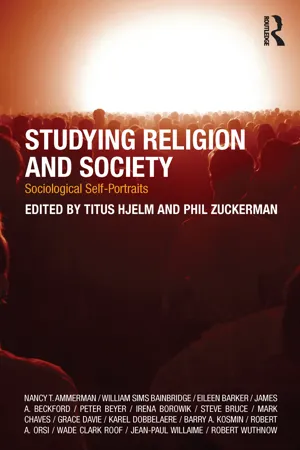
How do you study religion and society? In this fascinating book, some of the most famous names in the field explain how they go about their everyday work of studying religions in the field. They explain how the ideas for their projects and books have come together, how their understanding of religion has changed over the years, and how their own beliefs have affected their work. They also comment on the changing nature of the field, the ideas which they regard as most important, and those which have not stood the test of time. Lastly they offer advice to young scholars, and suggest what needs to be done to enable the field to grow and develop further.
- 212 pages
- English
- ePUB (mobile friendly)
- Available on iOS & Android
eBook - ePub
About this book
Information
1
INTRODUCTION
On sociological self-reflection
This is a book we have always wanted to read. We are both sociologists hovering somewhere in the grey area between early and mid-career, and our main area of interest for the past several years has been religion. We have read the theories, we have grappled with the methodologies, and we have learned from numerous case studies. But we have never had a chance to read about how the most famous and influential names in the field went about their everyday work of studying religion and society. True, we have been lucky enough to have met and worked with many of them personally – and have gained unique insights from such associations – but there is so much more we wanted to know. In addition, we feel – no, we know – that there are many others like us who would like to know more about the craft of sociology of religion.
Sociology is very much a human endeavor. We engage our subjects not as passive observers, but as thinking and feeling human beings. While most sociologists nowadays would acknowledge the reflexive nature of our work, very little has been written about the issue – except in abstract, normative terms. It is with this in mind that we set out to edit this book. What we had in mind was an “informal methodology textbook,”1 a collection of narratives that are not normative, like usual methods literature, but illustrative of how the craft of sociology of religion is actually practiced. We have taken the words of one sociological giant, Robert K. Merton, seriously. Speaking of scientific methods literature, he commented that “this literature is concerned with [ … ] ways in which scientists ought to think, feel, and act. It does not necessarily describe, in needed detail, the ways in which scientists actually do think, feel, and act.”2
Why, for example, do scholars undertake particular research projects or identify with a particular theoretical perspective?3 This is something we only rarely get to read from the published monographs or articles. We agree with Richard Jenkins, who notes that:
[T]he role of individual history and experience – which includes political and ethical conviction – in shaping our curiosity, in deciding which research gets done and by whom, shouldn't be underestimated. If there is a cumulative logic to scientific discovery – and I'm not wholly convinced that this notion applies to science, let alone sociology – then it's probably no more important than the biographies and idiosyncrasies of the human beings who plan and execute it.4
In a scholarly self-portrait of his own, prominent American sociologist Seymour Martin Lipset questions whether “an author or scholar is the best person to properly evaluate or explain the logic contained in the work which he [sic] has done.”5 Certainly, posthumous biographies of sociology's classic figures – even when written by sociologists or other academics – make connections between the classics' personal lives and their work that few autobiographers like to admit to. No wonder that Joachim Radkau's psychoanalytically tinged biography of Max Weber, for example, caused such a stir in the field.6
Nevertheless, looking at the history of sociology, the intersections of personal biography and scholarship are everywhere to be found: Marx and especially Engels (although firmly bourgeois themselves) found inspiration from their observations of the injustices suffered by the working classes in 19th-century Manchester and London. Weber grappled with the simultaneous urge to analyze the world scientifically and change it by being active in politics. Perhaps most acutely, Georg Simmel observed the micro interactions of people in order to understand the forms of sociability. His essay on the “outsider,” for example, gets much of its power in the context of Simmel's ancestry as a Jew barred from employment in German academia for most of his life.7
The classic sociologists were not always explicit about the connection between biography and scholarly interests – indeed none wrote autobiography as such – and post-WWII sociology, especially in the USA, tended to downplay the role of the individual in the pursuit of social scientific knowledge. It was C. Wright Mills, the “deviant academic,”8 who “rehistoricized” sociology as an academic endeavor. For Mills the (now ubiquitous) “sociological imagination” meant bringing together and recognizing “history and biography and the relations between the two within society.”9 Although sociologists were somewhat slow to turn this sociological gaze reflexively towards their own profession, several publications in the past 40 or so years have taken the challenge of sociological autobiography seriously. At the one end of the autobiographical spectrum is Phillip Hammond's Sociologists at Work, a collection of research project “chronicles” which discuss the social context of sociological research – but less so the biography of the individual researcher.10 At the other end is Arthur Shostak's Private Sociology, which aims to go beyond the autobiographical, to be “the study of what we hesitate to tell,”11 and the impact of these experiences – interracial relationships, abortion, and being religious, for example – on sociological work. In between are collections that take the middle road between the personal and the contextual, most notably Horowitz's Sociological Self-Images: A Collective Portrait,12 Riley's Sociological Lives,13 Berger's Authors of their Own Lives: Intellectual Autobiographies of Twenty American Sociologists,14 Glassner and Hertz's Our Studies, Ourselves: Sociologists' Lives and Work,15 and Deflem's Sociologists in a Global Age: Biographical Perspectives.16 These books concur on the point that where people come from, who they interact with, and the institutional contexts of their work all influence sociological research. Even Pierre Bourdieu, who begins his book Sketch for Self-Analysis17 with the words “this is not an autobiography,” spends a significant amount of space describing the intellectual framework (the “field” of academia) that shaped his career.
What is lacking in almost all of the above examples, however, is the sociology of religion. With the exception of Robert Bellah, Andrew Greeley, Philip Hammond, and Edward Tiryakian, none of the sociologists in the above works can be characterized as sociologists of religion. True, Bourdieu has written about religion, but he is hardly known as a sociologist of religion. This lacuna is most likely an effect of the marginal status of the sociology of religion in the broader field, bemoaned by many of its proponents – some of them featured in this book.18 Thus, although Peter Berger, one of the most influential sociologists of religion ever, recently published an autobiography,19 there is a gap in the literature that this book seeks to address.
With the above idea about an “informal methodology textbook” in mind, we sent out an invitation with the following guidelines.
The form/style of the essay is free and open, but would hopefully include discussion of the “nuts and bolts” of your way of doing sociology of religion and thoughts on some of the following questions:
- How has your identity as a sociologist of religion developed?
- How have the ideas for your research projects and books come together? (Perhaps focus on one project in particular.)
- Are there particular events in your personal and/or professional life that have shaped your scholarship?
- How has your understanding of religion changed over the years? Do you still think about religion in the same way as when you started your career?
- Looking back on your work, are there any regrets? Things you could have done better or differently?
- Are there any ideas or theories that you no longer espouse or hold to be true?
- In the past 40 years, what do you think have been the greatest/most important insights, theories, answers, etc. generated by sociologists of religion?
- What do you think are the greatest strengths and weaknesses of the sociological perspective when applied to religion?
- In what ways have your own personal religious beliefs (or lack thereof) been an advantage or disadvantage in your work? How have they affected what you study and how you study it?
- What advice would you give to young scholars? If the sociology of religion is to remain relevant and strong in the decades ahead, what should we be mindful of? What might we do differently than previous generations?
Although we wanted to give broad guidelines, the authors in this volume address the above questions in different ways, of course. In terms of coverage, while we acknowledge serious gaps in gender, ethnic, and geographical representation, we believe we have succeeded in capturing a wonderful variety of important insights from people whose work we have always admired – even when we have disagreed with them.
Thus, while (auto)biography may indeed be the “illusion” Bourdieu claims it to be,20 it can – when reflexively engaged – give us insights into influences, patterns, and styles that might otherwise remain unacknowledged or implicit. True to form, we will give you a glimpse of our own sociological trajectories before summarizing some insights from the contributions.
Phil: Studying the religious and the secular
When it comes to knowing about a sociologist's personal background, I am quite conflicted. On the one hand, I think such information should be deemed irrelevant. On the other hand, I find it downright fascinating.
Let me explain.
I strongly believe that scholarship should be assessed, critiqued, or appreciated by its contents alone: the parsimoniousness of its theoretical assertions, the empirical strength of its data, and the clarity of its articulation. The author's background shouldn't be taken into account. In fact, I once became rather worked up about this very issue, arguing with a graduate student during a class discussion. We were having a back-and-forth about the week's assigned reading (a book on rational choice theory and religion), when the student wanted to know the personal details about the author: What was his race? His age? His religious background? His political persuasion? I replied that such information was irrelevant, and that to refer to or draw upon such matters was inappropriately ad hominem. “Imagine if we didn't even know who the author was,” I vehemently exhorted. “Suppose we found the book with its cover torn off No name attached. We would still be faced with the content of the book: the arguments and the data. What do you think of them?” The student wasn't convinced, demanding that one cannot separate scholarly arguments from their author. But I remained firm. And I know that many share the point of view I was holding to: a scholar's background, upbringing, religious beliefs, demographics, or educational experiences should remain immaterial. Indeed, one very prominent sociologist of religion whom we invited to contribute to this volume declined, stating succinctly: “I prefer to let my work speak for itself.” I am sympathetic to that position.
However, in flagrant contradiction to what I have just expressed above, I must admit that I find learning about the personal backgrounds, worldviews, and formative experiences of various sociologists to be intrinsically compelling. Undeniably illuminating. To know, for instance, about Max Weber's personal history – the relationship he had with his mother and father, the social milieu within which he gre...
Table of contents
- Cover
- Hafl Title
- Full Title
- Copyright
- CONTENTS
- List of contributors
- 1 Introduction: on sociological self-reflection
- 2 A life in religious communities
- 3 Stranger in a strange land
- 4 Doing sociology: confessions of a professional stranger
- 5 Constructing religion: serendipity and skepticism
- 6 Straddling boundaries: disciplines, theories, methods, and continents
- 7 Work and adventure: from poetry to the sociology of religion
- 8 Unintended consequences biographical and sociological
- 9 Serendipity in the study of religion and society
- 10 Thinking sociologically about religion: discerning and explaining pattern
- 11 Hurdling over borders: reflections on my intellectual trajectory
- 12 The empiricist';s tale: academic wanderlust and the comparative imperative
- 13 My specific form of disorientation
- 14 Engaged faith: my own and that of others
- 15 Studying Protestantism in a Catholic and secular context: lessons for a comparative sociology of religion
- 16 Side roads and detours: a narrative reconstruction about studying religion
- Index
Trusted by 375,005 students
Access to over 1.5 million titles for a fair monthly price.
Study more efficiently using our study tools.
Frequently asked questions
Yes, you can cancel anytime from the Subscription tab in your account settings on the Perlego website. Your subscription will stay active until the end of your current billing period. Learn how to cancel your subscription
No, books cannot be downloaded as external files, such as PDFs, for use outside of Perlego. However, you can download books within the Perlego app for offline reading on mobile or tablet. Learn how to download books offline
Perlego offers two plans: Essential and Complete
- Essential is ideal for learners and professionals who enjoy exploring a wide range of subjects. Access the Essential Library with 800,000+ trusted titles and best-sellers across business, personal growth, and the humanities. Includes unlimited reading time and Standard Read Aloud voice.
- Complete: Perfect for advanced learners and researchers needing full, unrestricted access. Unlock 1.5M+ books across hundreds of subjects, including academic and specialized titles. The Complete Plan also includes advanced features like Premium Read Aloud and Research Assistant.
We are an online textbook subscription service, where you can get access to an entire online library for less than the price of a single book per month. With over 1.5 million books across 990+ topics, we’ve got you covered! Learn about our mission
Look out for the read-aloud symbol on your next book to see if you can listen to it. The read-aloud tool reads text aloud for you, highlighting the text as it is being read. You can pause it, speed it up and slow it down. Learn more about Read Aloud
Yes! You can use the Perlego app on both iOS and Android devices to read anytime, anywhere — even offline. Perfect for commutes or when you’re on the go.
Please note we cannot support devices running on iOS 13 and Android 7 or earlier. Learn more about using the app
Please note we cannot support devices running on iOS 13 and Android 7 or earlier. Learn more about using the app
Yes, you can access Studying Religion and Society by Titus Hjelm,Phil Zuckerman in PDF and/or ePUB format, as well as other popular books in Social Sciences & Religion. We have over 1.5 million books available in our catalogue for you to explore.