eBook - ePub
Group Techniques for Aging Adults
Putting Geriatric Skills Enhancement into Practice
- 176 pages
- English
- ePUB (mobile friendly)
- Available on iOS & Android
eBook - ePub
About this book
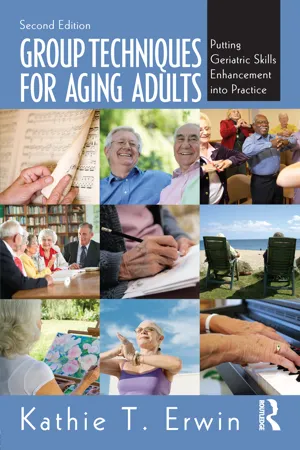
Elders can struggle with issues of social isolation and self-esteem, and benefit from having positive coping skills at their disposal. The practical ideas Kathie Erwin imparts in this second edition help mental health professionals working with elderly populations to create an interactive, multi-modal program that addresses the issues and needs elders have. The group modalities are defined in holistic contexts of mind, body, society, and spirituality. Among the group modalities are reminiscence, bibliotherapy, remotivation, humor, expressive art, and therapeutic writing and sacred spaces, which are new to this edition. Mental health professionals appreciate the practical and detailed guidelines for how to design, implement, and monitor progress for various types of group modalities that allow them to put theory into practice easily. Their elder clients will benefit from the methods they develop in group to deal with problems such as isolation and reduced social networks.
Information
1
Stages of Elder Groups
Therapists and leaders who are trained in group work for adolescents, young adults, middle adults, or families may have excellent backgrounds yet a totally incorrect mind-set for working with older adult groups. While many of the techniques are transferable, the overall group process, pace, and measures of effectiveness are dramatically different. The French may say “vive la difference” (long live the difference), yet for the newcomer to elder group work, these differences may initially seem odd. As the leader gains experience and witnesses the positive difference these groups can be to older adults by incorporating their long lives to make a difference for each other, this becomes worthy of celebration.
For decades, Gerald and Marianne Schneider Corey have been in the forefront of developing principles for therapeutic group process. Their classic Groups: Process and Practice has been the boot camp of basic group leader training for nurses, social workers, and mental health counselors from the first edition in 1977 to its eighth edition in 2010. The successive editions build on the core group progression as a four-stage model: initial, transition, working, and termination. These stages are similar in some ways to Tuckman’s (1965) still popular business and coaching model for team or group development: “forming, storming, norming, and performing.” In both models, the objective is to move these stages into a flow within a reasonable period of time, leading toward a planned termination date. If all works well within the group, members recognize how each other has experienced change, learning, socialization, or personal growth. These stages and outcomes play a role in geriatric groups, but with less predictability than with other adult groups. The Geriatric Skills Enhancement (GSE) program adapted existing group models for geriatric groups to these four stages: relational, transition, working, and adaptation.
Relational
In geriatric groups, more time is spent in the first stage to build rapport with new members to overcome resistance to participation in the group. Older adults, particularly those over 70, tend to be suspicious and mistrustful of anything that looks like counseling. They vividly recall the Depression, Dust Bowl, wars, and other hardships from which they were raised with a strong belief in the work ethic and self-sufficiency. The many philosophical adages like “don’t cry over spilt milk” gave them a stoic approach to life problems that may now be a stumbling block that keeps them from sharing their authentic selves with the group.
The initial stage in typical groups is for introduction and ground rules, which are often done in one session. With geriatric groups, this first stage is relational because nothing beneficial will happen in the group until the leader builds relationships with members and begins to encourage them to relate to each other. For that reason, the relational stage may take two or three sessions to accomplish.
For groups within a residential long term care facility, members will be referred by staff. Residents can become suspicious of the reason they are brought to the group. When the word got out that GSE group leaders were psychotherapists and social workers, some members became anxious until one brave soul voiced the elephant-in-the-room question, “Does that mean someone thinks I’m crazy?” In the life experience of most older to oldest-old adults, elective psychotherapy was never an option. Having anything to do with psychology or counseling implied serious personal flaws and images of padded cells. Review the history of how mental patients were warehoused, abused, tormented, and disrespected as late as the early 20th century, and their fears are grounded in a wretched historical reality. It’s no wonder that elders view counseling as punishment, abandonment, or spiritual compromise (Erwin, 1993). What group leaders consider commonplace about sharing feelings and gaining strength from the group dynamic, many elders see as being dragged to the principal’s office and compelled under duress to answer.
Some elders will offer polite acknowledgment of other group members but keep it on a surface level. They are hesitant to form attachments within the group as a way of shielding themselves from future losses by rejecting any efforts to bond with others. At times, their feelings on this matter sound much like the disgruntled adolescent who decides to sever connections with peers rather than face abandonment or disapproval again. Elders nearing their final years of life are also wrestling with how to balance their worldviews with their present realities and resolve questions of their spirituality in an affirming rather than a guilt-laden manner.
For the group leader, the overarching goal of the relational stage is establishing trust. This requires more than explaining the purpose of the group, ways to participate, and rules for confidentiality. Older adults were also raised with the belief that “actions speak louder than words,” so expect them to look to the leader as a model of trust, open communication, and positive regard. A simple, yet highly effective way for a leader to show trust is to avoid speaking in the hall or doorway to staff about group members. Even cognitively impaired older adults deserve more respect. If a discussion about a group member is needed, take it into a separate room, not a public space. Too often, insensitive staff or even physicians speak around elders as if they are not present. Such behavior is even worse when the older adult is in a wheelchair, and caregivers are literally talking over his or her head. An early incident like one of these examples is a quick way to erode trust.
Unlike Baby Boomers, the newest older adult cohorts, the older adults from their parents’ and grandparents’ generations have minimal experience with therapy groups or support groups. Their concept of group is family and friends or an activity-based group such as the bridge club or the bowling team. The leader must take ample time in the relational stage to create the atmosphere of friendliness and acceptance. Staying on schedule with a group plan is not as important as making the most of the initial relational stage. When done well, the stages to follow are more effective, and older adults gain a positive view of the group experience.
Transition
With cognitively aware elders, the transition stage marks a point in which group members determine whether to connect with others or remain on the sidelines. As the topics and level of discussion become less superficial, some group members blossom when given the opportunity to be heard and respected. As some blossom, others seem to fade in the background. Some older adults already have established a lifelong pattern of isolation in the crowd, a response that continues even in the small group. Some elders feel more vulnerable and lonely at this point in life and are unsure about making new connections. This dichotomy is typical at the beginning of the transition stage for elder groups.
The group leader may feel like a dance teacher attempting to persuade reluctant students to stop hugging the ballet bar and join the dance while not allowing the flamboyant students to overtake the spotlight. In other types of groups, this stage might be identified as resistance in a negative context. With geriatric groups, the leader has more to gain by promoting safe, slow steps toward participation than by challenging resistance or focusing on defenses. Although these elements may be present, a confrontational approach builds the walls higher with both the persons being challenged and those observing. As the walls go up, trust goes down. Conflicts will occur between group members and member to leader, but with geriatric groups, these conflicts tend to be more passive-aggressive.
The transition stage is a major test for the group leader who is being graded by the group on pass-fail with a minimal margin for redemption. Group members want to see how the leader handles conflict, motivates without shaming, establishes an atmosphere of trust, and models acceptance in dealing with group conflicts. Many geriatric groups spend longer in the transition stage than will other types of groups. The leader must avoid showing disappointment or pressing an agenda too rapidly. This is one of those issues in which a traditionally trained group therapist is most at risk by placing priority on a timetable. When working in a long term care facility or community agency, the leader may work with the same group for several cycles. Investing time in the relational and transition stages for the first group sets a positive tone for the following group cycle with these members.
Even experienced geriatric group leaders may find the members retreat to transition from working on occasion. The addition of new members, death of a member, changes in the physical surroundings, change of leaders, or diminishing levels of functioning of members are all factors that can impede rapid or uninterrupted movement through the transition stage.
Working
When a geriatric group enters the working stage, there is a noticeable level of cohesion, trust, and sense of personal safety. Members appropriately assume some leadership roles as they freely, without prompting, interact with others. Confrontation can occur with a positive outcome and less management by the leader than was needed in the transition stage.
A few group members are willing to attempt new behaviors, which encourages others to join. The leader may have the luxury of releasing some control and responsibility to the members in cognitively aware groups. More attention can be given to listening to the common concerns of group members and exploring how they apply what they experience in group in the environments outside of group.
In the latter years of life, elders rarely seek major changes in behavior or beliefs. The changes that emerge from the group are more often a refinement or return to expressing the authentic self. They are given freedom to be themselves, not what they think others expect an “older person” to be or do. In the working stage, group members can learn new ways to cope with physical deficits, increase self-esteem, and practice socialization in an accepting atmosphere. While fostering these skills constitutes a level of change, the focus is on practicing the skills rather than leading to a cathartic or confrontational reaction as prelude to change. The latter might work well in other types of groups, but not geriatric ones.
Corey, Corey, and Corey (2010) identify as “problem behaviors” within a group such reactions as storytelling, advice giving, silence, and dependency. These behaviors in the working stage have a different meaning for geriatric groups. An observant leader finds ways to use these behaviors positively. Storytelling is the essence of reminiscence. As long as the group leader manages situations in which storytelling by certain individuals becomes trite, repetitious, or obsessive, storytelling plays an important role in several modalities.
Advice given in “you should” or “you should not have” phrasing has no therapeutic value and needs to be redirected. However, there may be times when the oldest-old group members can be asked to share with younger-old members how they handle a situation, for example, dealing with lack of respect from staff in an institutional setting. What occurs is a soft line between advice giving (judgmental, superiority) and wisdom (how to solve a problem or manage one’s own responses to difficulty).
Silence among older adults is more often thoughtful reflection and processing than resistance. Rather than rushing to fill the void, the leader needs to become comfortable with silence. The silence can also be useful as a transition point to move the group in another direction.
Dependency is not encouraged in a therapeutic context. With cognitively impaired and some oldest-old groups, however, there will be more dependency on the group leader to guide and direct the modality even in working stage than is the ideal for other types of groups. As in any therapeutic context, the leader must constantly make attempts to empower the group and not use the tendency toward dependency for his or her gratification.
In elder groups, the change in coping is accomplished by restoration of skills that existed in younger years of the members’ lives. Thus, the working geriatric group is a reclamation group, aimed at identifying positive coping skills from the past with reminiscence and bringing the skills, attitudes, and successes of the past to cope with present realities. Keep in mind that not all geriatric groups reach this level of activity in the working stage. Cognitively impaired elders may be active within the group yet not fulfill the customary expectations of the working stage. Here is another situation in which the leader makes the adjustment to accept and affirm whatever degree of working is demonstrated by the cognitively impaired group.
Cohesion in the working geriatric groups may range from high to moderate for cognitively aware elders and moderate for cognitively impaired elders. An easy way to prompt cooperation in the working stage is to refer to being “good neighbors.” The old school concept of the good neighbor is familiar to older adults and relates to their past experiences in helping others, friendliness, and building relationships with persons outside the family. Keep in mind that the older generation was also raised on the adage, “if you can’t say something nice about someone, then don’t say anything.” With that in mind, attempts to draw out a quiet member by rallying the group to confront is not a suitable option. Being openly disrespectful of a peer is not comfortable for many elders. If there is a group member who challenges another person’s behavior or responses, the challenger may be excluded by some or all of the group members.
The intensity of the working stage can be difficult to sustain and too arduous for the oldest-old as well as the cognitively impaired elders. When that becomes evident, the leader needs to make adaptations of modalities or levels of intensity within a modality that can flow between transition and working stages. The greater good is to find the level where all members are included rather than pressing to maintain expectations of the working stage.
Adaptation
In most group theories, the final stage is termination or closure. A task-specific group may have a predetermined length and end date. All members know the final meeting date and begin to anticipate or dread that final session. The leader does not wait until the final session to prepare the group for the closure. Rather, the leader builds up that final meeting as a symbolic graduation in which each member’s progress is celebrated, and time is given for positive disengagement from the group. As part of the closure, the members may be asked to share what was most meaningful from the group, identify how they will use what was learned in the group, and provide suggestions that the leader may use in the next group.
Geriatric groups may be time specific, as in an intensive outpatient program, or more open ended and not time specific as part of an institutional program, community outreach, or adult day care. With open, non-time specific groups, there is no stated end date. However, there may be a change in modalities that results in a mini-closure of one modality with a group and the opening of a new modality with the same group. In a sense the group has not ended yet the focus or activity has changed.
With older adult groups, the leader can expect to manage a series of unexpected mini-closures occurring at random as the result of the death of a member, illness, or moving away from the area. These changes tend to occur with little warning. The leader must be prepared to manage these loss experiences, which supersede the current agenda and may require one or two group sessions to complete. Some long term care facilities make the mistake of ignoring the death or disappearance of a senior adult who moves away. Residents are not fooled or cajoled into ignoring a mysterious loss.
The loss of anyone who is important to the group, particularly another group member, needs to be processed at the next session. At this point, the leader switches to a grief and loss resolution focus that may also incorporate existing activities such as life review, reminiscence, or our postcards from eternity. Allowing the older adults to use the group as a safe place to grieve and talk about how this loss affects feelings of their own mortality is a way that the leader demonstrates respect and genuine regard for each member. Wrapping up this mini-closure time with verbal tributes about the missing member can be some of the most cohesive and profound moments that the group will share. In grief, their guard is down and their emotions can surface. From these closure points, the leader shows honor for the departed member and by that openness, which may not be present from staff, the leader further earns trust. From this closure, members begin the adaptation of becoming a smaller group or bringing a new member into the group.
Dealing with the adaptation stage differs slightly for community dwelling elders. From living within the larger community, they have more contact with people of various ages than do those who live in long term care facilities. The young-old (60–70) living in the community may still drive, live independently, and are less adversely impacted by age-related physical conditions (Toseland & Rizzo, 2004). Community dwelling elders in a community program are generally more mobile whether they drive or use other transportation. Because of their sustaining connection to their community, these elders are more likely to bring external issues into the group discussion such as changes in Medicare, scams preying on the elderly, or the price of groceries. This gives the leader an additional source of material to use in discussions by choosing current events within the immediate area where members live.
Community dwelling elders may be more vocal because they are only in group for a short time and return to their homes later. The aspect of distance between living space and group location allows community dwelling elders to be controversial or opinionated without concern for offending those on whom they depend, as is the case with elders in long term care.
The leader cannot let the appearance of independence shown by some community dwelling elders obscure that they deal with the same loss of roles, family, friends, health, and connections that are faced by those who live in long term care facilities. Aging and cohort effects are the great levelers in geriatric group work.
2
Designing Groups for Diverse Elder Populations
The first step in group design is to reject the ageist assumption that older adult groups are simple to design. There is no one-size-fits-all geriatric group modality. Some modalities may cross cohorts, working well with the young-old as well as the old-old, but only to the extent that group tasks have been adapted for each group. Geriatric groups are as much art as science. Perhaps surprisingly, it was the words of an 18th-century poet, not a social scientist, who captured the essence of what older adults need in group work:
One ought, every day at least, to hear a little song, read a good poem, see a fine picture and, if it were possible, to speak a few reasonable words.
Johann Wolfgang von Goethe
From the poetic to the practical, Goethe’s recommendation served as the foundation for the elder groups that combined music, reading, fine arts, and discussion. What older adults often lack in their daily schedule is a variety of engaging activities that stimulate differing social, verbal, and physical skills. These groups provide a structured process for older adults, who may have outlived close friends or family members, to begin new connections and discover the group as a new opportunity for socialization and possibly for some new friendships (Park, 2009; Rook, 2009; Street & Burge, 2012). Whether living in the community or assisted care, Shaw, Krause, Liang, & Bennett (2007) found that there is a “dynamic nature of social relationships in late life” that underscores the value of providing interactive, purposeful groups.
From the therapeutic side, geriatric group therapy is multimodal in the tradition of Arnold Lazarus. The geriatric group therapist is cont...
Table of contents
- Cover
- Half Title
- Title Page
- Copyright
- Dedication
- Contents
- Group Modalities List
- Introduction
- Acknowledgments
- 1. Stages of Elder Groups
- 2. Designing Groups for Diverse Elder Populations
- 3. Group Leadership
- 4. Group Location
- 5. Funding for Geriatric Groups
- 6. Group Modalities for the Mind
- 7. Group Modalities for the Body
- 8. Group Modalities for Social Skills
- 9. Group Modalities for the Spirit
- 10. The Future of Geriatric Groups with New Elder Generation
- References
- Resources
- Index
Trusted by 375,005 students
Access to over 1.5 million titles for a fair monthly price.
Study more efficiently using our study tools.
Frequently asked questions
Yes, you can cancel anytime from the Subscription tab in your account settings on the Perlego website. Your subscription will stay active until the end of your current billing period. Learn how to cancel your subscription
No, books cannot be downloaded as external files, such as PDFs, for use outside of Perlego. However, you can download books within the Perlego app for offline reading on mobile or tablet. Learn how to download books offline
Perlego offers two plans: Essential and Complete
- Essential is ideal for learners and professionals who enjoy exploring a wide range of subjects. Access the Essential Library with 800,000+ trusted titles and best-sellers across business, personal growth, and the humanities. Includes unlimited reading time and Standard Read Aloud voice.
- Complete: Perfect for advanced learners and researchers needing full, unrestricted access. Unlock 1.5M+ books across hundreds of subjects, including academic and specialized titles. The Complete Plan also includes advanced features like Premium Read Aloud and Research Assistant.
We are an online textbook subscription service, where you can get access to an entire online library for less than the price of a single book per month. With over 1.5 million books across 990+ topics, we’ve got you covered! Learn about our mission
Look out for the read-aloud symbol on your next book to see if you can listen to it. The read-aloud tool reads text aloud for you, highlighting the text as it is being read. You can pause it, speed it up and slow it down. Learn more about Read Aloud
Yes! You can use the Perlego app on both iOS and Android devices to read anytime, anywhere — even offline. Perfect for commutes or when you’re on the go.
Please note we cannot support devices running on iOS 13 and Android 7 or earlier. Learn more about using the app
Please note we cannot support devices running on iOS 13 and Android 7 or earlier. Learn more about using the app
Yes, you can access Group Techniques for Aging Adults by Kathie T. Erwin in PDF and/or ePUB format, as well as other popular books in Psychology & Developmental Psychology. We have over 1.5 million books available in our catalogue for you to explore.