Do you know what makes boys tick? In recent years suicide has drastically escalated among young males and academic underachievement is common, so it is of vital importance that our understanding of the young male psyche is well informed and not merely 'received wisdom'. John Head gets to the heart - and mind - of the matter, by tackling difficult, pertinent questions. Has male behaviour in school worsened, or has media hype inflated the proportions of a 'good story'? What is at the root of male violence? Are biological or social explanations telling the whole story? Head shows that it is only by engaging boys in new arenas of thought and feeling that we can hope to understand and help overcome the difficulties faced by boys today.
Essential reading for teachers, headteachers, researchers in education, gender, youth, community and social workers.
For centuries, and in various cultures, young men have been seen as a focus for social concern. References to the rebelliousness and unconcern of youth can be found from the times of Classical Greece through to the descriptions of Teddy Boys, Rockers, Mods, Punks and such in the second half of the twentieth century. This youthful turbulence cut across class barriers, so that in 1517 a riot among apprentices in London led to 300 arrests and one death, while there were also riots in prestigious schools, such as Rugby in 1797 and at Winchester in 1793 and 1818. In the latter year it had to be put down by the military.
There was, however, the underlying belief that this phase in life, in which ‘boys will be boys’, will be followed by a time of maturation, in which the young men assume responsibilities of adult life. Adolescence was seen to provide a carefree interlude before entering these adult responsibilities. For example, Shakespeare in his Henry IV plays shows the evolution of Prince Hal, the future Henry V, from a drunken companion of Falstaff to a wise, mature monarch. Upon becoming king he forsakes the company of Falstaff. The defining moment is when the new king meets the Lord Justice, who had previously punished him for his misdemeanours. Initially Henry is hostile, but then demonstrates his new maturity, saying:
You did commit me For which, I do commit into your hand The unstained sword that you have used to bear; With this remembrance, that you use the same With the like bold, just and impartial spirit As you have done ‘gainst me. There is my hand. You shall be as a father to my youth.
(Henry IV, Part 2: Act 5, scene 2, ll. 112–18)
What is new is that some contemporary youth seems unable to shake off this time of adolescent rebellion and instability. We have long had evidence that the boys lagged behind girls in some respects, for example in the former 11 plus examinations, but it was assumed that the later maturing boys would eventually catch up and even overtake the girls, and the greater participation of males in higher education seemed to confirm this belief. More recently there has been less evidence of boys catching up in this way.
For several decades up until the early 1990s considerable attention was given to this gender inequality in education, manifested by the lack of women in higher education. This educational deficit was seen to be a major causal factor for the finding that on average women’s wages were less than 80 per cent than those of men. Like many educationists at that time, I was involved in a number of research and curriculum development initiatives aimed at increasing the participation of girls, particularly in mathematics, science and technology, where traditionally boys had predominated. Although in these subjects males still seem advantaged at the post-16 level, the evidence is that some real progress was made in working towards greater equity.
It was in the mid-1990s that a new element was introduced into the debates about gender: that across a range of educational indices boys were emerging as the underachievers. This argument was found both in the academic research literature and the public media. Typical headlines have included: ‘Girls trounce the boys in examination league tables’ (The Times, 3 Sept. 1994) and have continued since then with: ‘Perils of ignoring our lost boys’ (The Times Educational Supplement, 28 June 1996), ‘Time we had jobs for the boys’ (Daily Telegraph, 5 Jan. 1998) and ‘Grim reading for males’ (Guardian, 6 Jan. 1998). In a major speech in January 1998 the then schools minister, Stephen Byers. drew attention to some salient evidence, such as that boys make up 83 per cent of school pupils who are permanently excluded from schools, and went on to make an attack on what he described as the prevailing ‘laddish anti-learning culture’. Summing up the evidence in an article in The Times Educational Supplement (16 May 1997) Professor Ted Wragg warned ‘unless we improve significantly the achievement of boys in our society now, we are storing up immense problems for the whole of the 21st century’. Clearly something significant has entered the public consciousness.
In 1996 the Equal Opportunities Commission and the Office for Standards in Education produced a joint report on performance differences between boys and girls in school (EOC/OFSTED, 1996). Their findings include ‘Girls are more successful than boys … or broadly as successful in almost all major subjects … the only major subject in which girls perform significantly less well than boys was GCSE physics’ (p. 6). They report that girls tend to be more reflective than boys and also better at planning and organising their work (p. 17).
Reactions to these findings that boys are doing less well in school and are also suffering in other respects, such as a disproportionate degree of unemployment, have varied. Some have identified what they see to be a crucial social problem of our time. Others see it as solely a symptom of a male backlash, creating a sense of moral panic, aimed at clawing back the gains made by women in recent years. In the light of such diverse views we need to maintain a sense of balance, scrutinize the evidence with care and seek practical ways to alleviate any problems which can be identified.
Looking at the Evidence
Looking at academic achievement first, we find that the most commonly quoted data relates to the GCSE results of 16-year-old school students. Over the years both boys and girls have raised their performance, but the girls have increased their advantage. In 1991 40.3 per cent of the girls and 33.3 per cent of the boys gained five or more passes with A to C grades. By 1996 50.2 per cent of the girls and 41.2 per cent of the boys attained such a result. It can be seen that both genders have raised their levels of achievement in this period but the gap between the them has increased. Prior to the introduction of the GCSE examination the gap was smaller, being only 4 per cent for the equivalent examination grades in 1988. This finding led to the government intervening in 1994 to force the examination boards to reduce the weighting given to course work in the overall examination grades on the basis that boys were less successful with the routines of course work. As the figures show, this intervention did nothing to close the gap.
Throughout this period girls have done better in the humanities and language-based subjects, but the figures for the two genders have diverged, so that in 1996 40.1 per cent of the boys and 57.7 per cent of the girls gained an A to C grade in English. With the traditional male subjects, such as science and mathematics, the figures have converged, with the girls catching up and, in most cases, overtaking the boys. The figures for 1996 show 40.9 per cent of the girls gaining A to C grades in mathematics compared with 39.7 per cent for the boys, while 42.7 per cent of the girls and 41.4 per cent of the boys gain such a grade in at least one science subject.
All the percentages quoted in the previous two paragraphs come from the DfEE (1997) publication of statistics and quote passes as a percentage of the total year cohort in schools. Sometimes other measures are quoted, for example the pass rates for those entering the examination in a particular subject. In most cases the differences between the two ways of presenting the information are trivial, but in some instances might cause confusion. In 1996 the participation rates for chemistry were 7.0 per cent for boys and 4.7 per cent for girls while 6.2 per cent of the boys and 4.2 per cent of the girls in the year gained A to C grades. In other words girls had a better pass rate but lower participation rate, and the final outcome came from the interaction of these two variables and, in this instance, the latter had the greater effect.
With post-16 education we find a similar pattern of girls doing relatively better but here they start from a historically poorer base. In 1995 girls made up 52 per cent of the entries for the GCE A level examinations at the age of 18 and they achieved a slightly better pass rate, for example 53.9 per cent gaining A to C grades compared to 53.0 per cent for the boys. At about the same time women became a majority among university undergraduates, although the difference as yet amounts to less than 2 per cent. Among undergraduates there are immense differences between subjects so that women are in a clear majority in the humanities, language areas, law and education but comprise considerably less than 40 per cent in the physical sciences, computer science and engineering areas.
It is difficult to predict precisely what the long-term effects of this increased success of girls will be. Currently there is the paradox that, despite this story of success, the average earnings for women still lag at about 20 per cent behind those of men. A number of factors may contribute to this situation. There will be a time-lag. Many of our current wage-earners left school two or three decades ago, at a time when girls did not compete so well. In this event we can predict a steady reduction of this earnings gap as more well qualified women enter the labour market. There are other variables. Often the family dynamics are such that the career interests of the husband are given greater priority than those of the wife so the family may move to allow the man to take on a better job but will not do so for the woman. If this latter effect prevails then women will continue to earn less than men.
In the light of such complexities we might not worry too much if these records of academic achievement were the only concern we have about boys. It might be argued that academic success is not essential to a happy life or gainful employment. However, there is further evidence of a male malaise. In 1997 the overall unemployment rates for males were 8.1 per cent for men and 5.8 per cent for women (Office for National Statistics, 1998). With men aged 16–19 the rate was 18.2 per cent and for those aged 20 to 24 it was 14.0 per cent. These two cohorts suffered from the two highest unemployment rates among the total population. Other indices tell a similar story. Overall suicide rates have dropped in the last two or three decades, but between 1971 and 1992 they more than doubled for males aged 16–24 and also increased by about two-thirds for males aged 25–44. One further piece of evidence is that of the crime figures, which show that to a large extent crime is an activity of young men with about 9 per cent of the 18–20 year olds being cautioned or found guilty of an indictable offence. For men aged over 30 years the figure is under 2 per cent.
Taking all this evidence into consideration, that of academic underachievement, school exclusion, unemployment, suicides and crime, there can be no doubt that there is some contemporary problem with young men which needs to be addressed. In saying this, I have no wish to deny that in a number of respects women are still disadvantaged in our society and we should rejoice at the academic success of girls in recent years. The task is not to deny the successes of women but to see what is needed to improve the lot of the young men.
Issues in Context
One factor which has inhibited us understanding what is happening to contemporary youth is that we tend to see each symptom as a discrete matter, without exploring the context and causes. In undertaking in-service work with teachers I find many Heads of Department asking for tips for improving the GCSE performances in their own subject without asking about the overall story. We find a range of professional people, such as teachers, educational psychologists, probation officers and youth workers, all concerned about the behaviour of young men, but not commonly sharing their professional insights.
Too often simplistic analysis is made from one specific perspective. Sometimes it is that of biological determinism, such as someone recently commenting on television that all men were rapists as their behaviour was dictated by the effects of the hormone testosterone. Is this statement meant to be taken literally? It is difficult to sustain a biological argument for the finding that rape is much more common in certain American urban areas than in the South East Asian cities. Probably a combination of effective policing and social mores contribute to this variance. Examples of youth engaging in gang rape indicate that participation does not damage the individual in the sight of his male peers, it may enhance his status in making him seem macho. In other societies being guilty of rape would bring shame to the family and condemnation from peers.
It is equally easy to find examples of simplistic social determinism, such as in the statement that poverty produces crime. There is an association, with about half our criminal families coming from the lowest fifth of the social economic spectrum. But it is also true that the majority of the families within this social stratum are not criminal. Social factors do matter, for example unemployment rates among young men vary with location, social class and ethnicity, but the relationship is subtle and complex.
The third background factor likely to affect behaviour lies in the personal history of the individual. Sometimes too much significance is attributed to early personal history, with people taking from psychoanalysis the mistaken belief that their life is solely determined by their past so that they are doomed to a certain lifestyle. They do not recognize their capacity to think, make decisions and shape their own life. Nevertheless, personal experience will be one of the factors shaping behaviour and needs to be considered alongside the biological and social contributions.
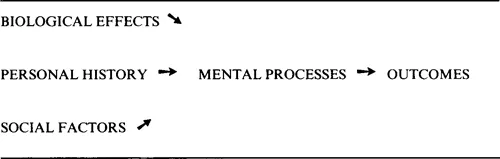
Any comprehensive understanding must incorporate all the elements shown in Figure 1. Biological, social and personal history all affect individuals, but they still have the capacity to be reflexive and to make decisions about matters such as their career and lifestyle.
Figure1.1 Underlying causes of behaviour
The importance of mental process is that it represents the one place in which we can make an intervention. We cannot rewrite history and alter the social background and personal experience of the individual. What can be done is to help people recognize that there are options open to them so that they can take more control of their life. By making young people aware of options and causing them to consider possibilities we can most effectively address the current male malaise. The structure of this book is intended to reflect this causal model. In Part I the underlying causes of any male malaise are explored and in Part II the emphasis is on the outcomes and what practical steps can be taken to address the issues.
Generalizations and Diversity
Already in this text warnings have been given about the validity of generalizations and the need to scrutinize evidence with care. In writing this book I have the problem that almost on every page I ought to repeat this warning. Unfortunately, this practice would make dull reading. At various places the problems of some specific groups, are discussed, such as white working-class boys, Afro-Caribbean boys and those suffering from dyslexia. Much of the time generalizations are made without qualification and it is hoped that we do not lose sight of the diversity which exists among young men and boys. Some display academic underachievement and behavioural difficulties, but many do not. In focusing on the former we should not lose sight of the latter.
2 Biological Effects
A model which sees biology as the underlying cause of human behaviour has appeal for its clarity and simplicity. With very rare exceptions children can be identified by their biological sex at birth and all subsequent development can then be attributed to the unfolding of a plan contained in the genes. Unfortunately, the reality proves to be much more complicated and confusing.
Clearly some of the characteristics which distinguish men from women, such as the style of dress and length of hair, are simply matters of social custom. Young men in the 1960s and 1970s commonly wore their hair in a style which would have appeared effete twenty years earlier or later. In order to clarify the issues it has become a convention to distinguish between sex differences and gender differences, with the former referring to the biological and the latter to the social. The ability to give birth to children and breast-feed them is solely biological, a characteristic of one sex, while other differences are attributed to the social. Even this distinction is not clear cut. Child bearing can only be undertaken by females while child rearing could be undertaken by either sex. Consequently the fact that women usually take the major role in child rearing is a gender difference, yet it has some biological basis, in that the mother may have to be with the child in order to feed it. Similarly, there is some biological sense in asking men to undertake work which involves physical endeavour, as they tend to enjoy greater muscular development, even though at times of war, when men are away from home, the female population have coped very effectively in factories and on farms with traditional male work.
It is easy to see why Freud opted for a biological basis for his notions of psychology. When he started his original work at the beginning of the twentieth century, psychology was subject to a confusing mix of influences. Ideas were rooted in such diverse sources as neurology, moral philosophy and theology so, for example, human behaviou...
Table of contents
Cover Page
Title Page
Copyright Page
Acknowledgments
Part I: Identifying the Issues
Part II: Addressing the Issues
Recommended Reading
Bibliography
Trusted by 375,005 students
Access to over 1.5 million titles for a fair monthly price.
Study more efficiently using our study tools.
Frequently asked questions
Yes, you can cancel anytime from the Subscription tab in your account settings on the Perlego website. Your subscription will stay active until the end of your current billing period. Learn how to cancel your subscription
No, books cannot be downloaded as external files, such as PDFs, for use outside of Perlego. However, you can download books within the Perlego app for offline reading on mobile or tablet. Learn how to download books offline
Perlego offers two plans: Essential and Complete
Essential is ideal for learners and professionals who enjoy exploring a wide range of subjects. Access the Essential Library with 800,000+ trusted titles and best-sellers across business, personal growth, and the humanities. Includes unlimited reading time and Standard Read Aloud voice.
Complete: Perfect for advanced learners and researchers needing full, unrestricted access. Unlock 1.5M+ books across hundreds of subjects, including academic and specialized titles. The Complete Plan also includes advanced features like Premium Read Aloud and Research Assistant.
Both plans are available with monthly, semester, or annual billing cycles.
We are an online textbook subscription service, where you can get access to an entire online library for less than the price of a single book per month. With over 1.5 million books across 990+ topics, we’ve got you covered! Learn about our mission
Look out for the read-aloud symbol on your next book to see if you can listen to it. The read-aloud tool reads text aloud for you, highlighting the text as it is being read. You can pause it, speed it up and slow it down. Learn more about Read Aloud
Yes! You can use the Perlego app on both iOS and Android devices to read anytime, anywhere — even offline. Perfect for commutes or when you’re on the go. Please note we cannot support devices running on iOS 13 and Android 7 or earlier. Learn more about using the app
Yes, you can access Understanding the Boys by Dr John Head,John Head in PDF and/or ePUB format, as well as other popular books in Education & Education General. We have over 1.5 million books available in our catalogue for you to explore.