The Routledge Companion to Modern European History since 1763
eBook - ePub

The Routledge Companion to Modern European History since 1763

  1. 504 pages
  2. English
  3. ePUB (mobile friendly)
  4. Available on iOS & Android
eBook - ePub

The Routledge Companion to Modern European History since 1763

About this book

The Routledge Companion to Modern European History since 1763 is a compact and highly accessible work of reference covering the broad sweep of events from the last days of the ancient regime to the ending of the Cold War, and from the reshaping of Eastern Europe to the radical expansion of the European Union in 2004.

Within the broad coverage of this outstanding volume, particular attention is given to subjects such as:

  • the era of the Enlightened Despots
  • the Revolutionary and Napoleonic era in France, and the revolutions of 1848
  • nationalism and imperialism, and the retreat from Empire
  • the First World War, the rise of the European dictators, the coming of the Second World War, the Holocaust, and the post-war development of Europe
  • the Cold War, the Soviet Union and its break up
  • the protest and upheavals of the 1960s, as well as social issues such as the rise of the welfare state, and the changing place of women in society throughout the period.

With a fully comprehensive glossary, a biographical section, a thorough bibliography and informative maps, this volume is the indispensable companion for all those who study modern European history.

Frequently asked questions

Yes, you can cancel anytime from the Subscription tab in your account settings on the Perlego website. Your subscription will stay active until the end of your current billing period. Learn how to cancel your subscription.
No, books cannot be downloaded as external files, such as PDFs, for use outside of Perlego. However, you can download books within the Perlego app for offline reading on mobile or tablet. Learn more here.
Perlego offers two plans: Essential and Complete
  • Essential is ideal for learners and professionals who enjoy exploring a wide range of subjects. Access the Essential Library with 800,000+ trusted titles and best-sellers across business, personal growth, and the humanities. Includes unlimited reading time and Standard Read Aloud voice.
  • Complete: Perfect for advanced learners and researchers needing full, unrestricted access. Unlock 1.4M+ books across hundreds of subjects, including academic and specialized titles. The Complete Plan also includes advanced features like Premium Read Aloud and Research Assistant.
Both plans are available with monthly, semester, or annual billing cycles.
We are an online textbook subscription service, where you can get access to an entire online library for less than the price of a single book per month. With over 1 million books across 1000+ topics, we’ve got you covered! Learn more here.
Look out for the read-aloud symbol on your next book to see if you can listen to it. The read-aloud tool reads text aloud for you, highlighting the text as it is being read. You can pause it, speed it up and slow it down. Learn more here.
Yes! You can use the Perlego app on both iOS or Android devices to read anytime, anywhere — even offline. Perfect for commutes or when you’re on the go.
Please note we cannot support devices running on iOS 13 and Android 7 or earlier. Learn more about using the app.
Yes, you can access The Routledge Companion to Modern European History since 1763 by Chris Cook,John Stevenson in PDF and/or ePUB format, as well as other popular books in History & European History. We have over one million books available in our catalogue for you to explore.

Information

Publisher
Routledge
Year
2004
Print ISBN
9780415345828
eBook ISBN
9781134281855

II
POLITICAL CHRONOLOGIES

EUROPE AT THE END OF THE RƉGIME ANCIEN

1762

Catherine the Great becomes Tsarina of Russia. Publication of Rousseau’s Social Contract and Emile.

1763

Peace of Paris ends Seven Years War; Britain makes extensive colonial gains in North America and India from France. Peace of Hubertusburg between Prussia and Austria; Prussia retains Silesia but evacuates Saxony.

1764

Stanislaw Poniatowski, protƩgƩ of Catherine the Great and Frederick the Great, becomes King of Poland.

1765

Beginning of Stamp Act crisis between Britain and her American colonies. Joseph II becomes Emperor of Austria and joint-ruler with Maria Theresa, his mother, of the Austrian states.

1766

Russian influence in Poland forces Polish Diet to agree to equal rights for non-Catholics and administrative reform.

1767

Catherine appoints reforming Great Commission. Alliance of Russia and Prussia to protect Polish non-Catholics.

1768

Polish Confederation of Bar wages war against King Stanislaw who is supported by Russia.

1771

Conflict between French Chancellor Maupeou and Parlement of Paris; it is abolished and replaced by the Conseil du Roi.

1772

First Partition of Poland between Russia, Prussia and Austria. Gustavus III of Sweden, by a bloodless coup d’état, becomes absolute ruler and introduces enlightened reforms.

1773

Pugachev Revolt begins in Russia.

1774

Treaty of Kutchuk-Kainardji between Turkey and Russia. Accession of Louis XVI; Parlement of Paris restored. Turgot becomes Comptroller General.

1775

First armed conflict between American colonists and British at Lexington. Conciliation attempts fail and open warfare develops.

1776

American Declaration of Independence. Adam Smith’s Wealth of Nations published. Turgot begins overhaul of French finances, but is dismissed. Necker becomes Comptroller.

1778

France allies with the American colonists; war declared between Britain and France.

1779

Spain declares war on Britain, Franco-Spanish fleet besieges Gibraltar. Congress of Teschen terminates war of Bavarian Succession.

THE FRENCH REVOLUTION

1783


(Dec.) The Queen’s favourite, Calonne, appointed as Minister of Finance.

1786


(Aug.) Calonne proposes a land tax and a stamp tax. These would be assessed by Provincial Estates. He persuades the King to summon an Assembly of Notables as he knows parliament will resist his proposals.

1787

(22 Feb.) The Assembly of Notables meets and declares against Calonne.
(17 Apr.) Calonne driven from office.
(May) Lorriene de Brienne, Archbishop of Toulouse, becomes Chief of the Council of Finance. The Assembly of Notables grants his request for a new loan of 60,000,000 livres.
(25 May) Dissolution of the Assembly of Notables which has refused to agree to new taxes. There is conflict with the Parlement of Paris which refuses to accept the proposed land and stamp taxes. It asserts the States-General has the sole right to levy taxes.
(6 Aug.) The decrees on taxation are passed by a ā€˜lit de justice’.
(7 Aug.) The Parlement gains great popularity by challenging the validity of a ā€˜lit de justice’.
(14 Aug.) Parlement exiled to Troyes by the King.
(24 Sept.) The King and Brienne agree to drop their demand for new taxes and the Parlement returns to Paris.

1788

(8 May) The May Edicts. Louis persuaded to hold a ā€˜lit de justice’ suppressing the Parlements and establishing new Courts of Appeal.
(June/July) The Revolt of the Nobility.
(21 July) At a meeting of the Estates of DauphinƩ the nobility condemn the May Edicts and demand a convocation of the States-General and Provincial Estates. They also speak in support of the Third Estate.
(16 Aug.) Brienne announces a national bankruptcy.
(25 Aug.) Brienne dismissed by the King. The States-General summoned to meet on 1 May 1789.
(27 Aug.) Necker recalled as Minister of Finance.
(Sept.) Recall of the Paris Parlement which recommends the States-General be held as in 1614.
(6 Nov.) Meeting of the second Assembly of Notables.
(27 Dec.) Decision by the Royal Council on the doubling of the Third Estate.

1789

(Feb.–Apr.) Election of States-General. Cahiers drafted. (27–28 Apr.) The Reveillon Riots in Paris.
(5 May) Meeting of the States-General opened by the King at Versailles.
(17 June) The Third Estate assumes the title of National Assembly, ignoring the existence of the other Estates and securing the leadership of the nation.
(19 June) By a majority of one the clergy vote to join the Third Estate.
(20 June) The Tennis Court Oath taken by the Third Estate. They swear not to disband until a constitution is established and confirmed on solid foundations.
(23 June) At a Royal SƩance the King makes important concessions, but declares the edicts of 17 June illegal, insisting that the Estates should meet separately and that the Assembly should be dissolved.
(27 June) The clergy and nobility join the Third Estate for fear that opposition could endanger the King’s life.
(6 July) A Committee is appointed to frame a new constitution.
(11 July) The electors of the Third Estate of Paris form a Civic Guard to maintain order in Paris. Under the influence of Court extremists Louis dismisses Necker.
(12 July) The Parisian mob seizes arms, fearing the dismissal of Necker was the signal for a royal coup d’état. The electors refuse to sanction the mob’s action.
(14 July) The fall of the Bastille. Louis is told by a close adviser ā€˜it is not a revolt, it is a revolution’. Troops withdrawn from Paris.
(15 July) The adoption of the Tricoleur; Bailly appointed Mayor of Paris; Lafayette appointed Commander of the Civic Guard which becomes the National Guard. The King recalls Necker.
(16 July) Necker returns; flight of Artois, CondƩ and Broglie, first of the ƩmigrƩs.
(17 July) Louis visits Paris where he accepts the Tricoleur and confirms Bailly and Lafayette in their posts.
(20 July) The beginning of the worst stage of the ā€˜Grand Peur’ (Great Fear) in the countryside.
(22 July) The murder of Fouillon and Berthier in Paris.
(4 Aug.) The abolition of tithes worth 120,000,000 francs. (4–11 Aug.) Decrees of the National Assembly abolishing feudal rights and many privileges in French society. Representatives of the Nobles make a voluntary surrender of all feudal rights and privileges.
(26 Aug.) Declaration of the Rights of Man and Citizens: makes all equal before the law.
(10 Sept.) The Assembly rejects the proposal of a second chamber nominated by the King as contrary to democratic sentiment.
(11 Sept.) The Assembly ac...
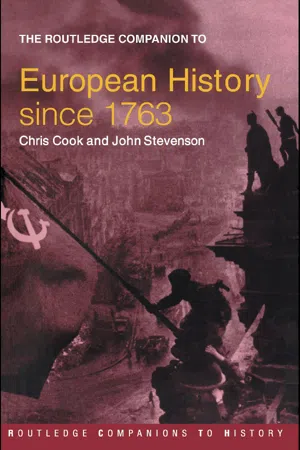
Table of contents

  1. COVER PAGE
  2. TITLE PAGE
  3. COPYRIGHT PAGE
  4. LIST OF MAPS
  5. PREFACE AND ACKNOWLEDGEMENTS
  6. I. PRINCIPAL RULERS AND MINISTERS
  7. II. POLITICAL CHRONOLOGIES
  8. III. WAR, DIPLOMACY AND IMPERIALISM
  9. IV. SOCIAL AND ECONOMIC HISTORY
  10. V. BIOGRAPHIES
  11. VI. GLOSSARY OF TERMS
  12. VII. TOPIC BIBLIOGRAPHY