Wrongful Conviction and Criminal Justice Reform is an important addition to the literature and teaching on innocence reform. This book delves into wrongful convictions studies but expands upon them by offering potential reforms that would alleviate the problem of wrongful convictions in the criminal justice system. Written to be accessible to students, Wrongful Conviction and Criminal Justice Reform is a main text for wrongful convictions courses or a secondary text for more general courses in criminal justice, political science, and law school innocence clinics.
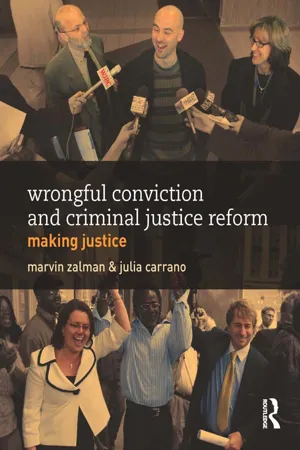
eBook - ePub
Wrongful Conviction and Criminal Justice Reform
Making Justice
- 334 pages
- English
- ePUB (mobile friendly)
- Available on iOS & Android
eBook - ePub
PART I
Prelude: Approaches to
Innocence Reform
CHAPTER 1
An Introduction to Innocence Reform
In his introduction to this volume, Professor Jon Gould, a leading expert on wrongful convictions, skillfully outlines what is known about miscarriages of justice and the innocence challenge. The existence of wrongful convictions is no longer in doubt, and studies show alarmingly high rates of error that translate into thousands of innocent people convicted of felonies annually. Despite this knowledge, little has been done by the criminal justice system to rectify such injustices, although reform efforts are beginning to occur. Mostly, it has been left to independent researchers and a few innocence projects to call attention to this serious problem. Hopeful signs of change in American criminal justice agencies, like the growing adoption of more accurate identification procedures, videotaping interrogations, or rationalizing post-conviction inquiry procedures, can be counterbalanced by examples of resistance to change. Other countries like Canada and the United Kingdom have been more proactive than American jurisdictions in implementing criminal justice reforms, and in this country the concern surrounding wrongful convictions pales in comparison with the attention paid to identify and reduce the risk of harm in other fields, such as air travel or medicine.
In assessing the reasons for lack of concern, Professor Gould sounds a theme often overlooked by wrongful conviction insiders, who may be too close to the problem. Public policy in the United States almost always depends on favorable public opinion, and the broad majority of Americans, especially those in the middle class and among the politically influential, are remote from crime and criminal justice issues generally and wrongful convictions in particular. They simply cannot see themselves falsely confessing (knowing little or nothing of psychologically coercive interrogation techniques) or ever being wrongfully convicted. In fact, the minority of Americans who have had contact with the criminal justice system are indeed more likely to be falsely convicted, offering support for the fact that ignorance of the realities of criminal justice impedes reform. If that is the case, what is the best source of adopting those criminal justice system reforms that are most likely to reduce error? Somewhat counter-intuitively, Professor Gould argues that it is the criminal justice system itself. Although the innocence movement has been characterized as the product of “liberal activists,” innocence projects are formally non-partisan and the issue of convicting the innocent is genuinely one of concern to citizens of all political persuasions, as demonstrated by Professor Gould's interaction with former Attorney General Edwin Meese, a staunch conservative. As fewer DNA wrongful convictions come to the fore, exonerating the innocent will comes to depend more on evidence that is less scientifically reliable. In such case the continuation of exoneration work and justice system reforms designed to lessen error will fall to genuinely professional justice agencies, and the hallmark of professionalism includes the willingness, the resources, and the structure to correct and prevent errors. The lesson of Professor Gould's introduction, then, is that the challenge of innocence reform is ultimately to the justice agencies themselves, and to the professionals who operate and oversee them.
* * *
As we note in the Preface, the chapters of Wrongful Conviction and Criminal Justice Reform focus on reforming criminal justice processes to prevent wrongful convictions, or to identify them if they occur and compensate the wrongfully convicted. To assist readers unfamiliar with the core issues regarding how these reform efforts have succeeded in reshaping the justice system, in this chapter we briefly review basic information to help readers better understand how justice is being made and re-made through the innocence movement.
DEFINITIONS OF WRONGFUL CONVICTION
Scholars recognize three types of wrongful conviction: (a) factual innocence, meaning someone else committed the crime or there was no crime; (b) lack of legal culpability (such as insanity or self-defense) that was not recognized at the time of conviction; and (c) convicted despite serious procedural errors that should have resulted in a dismissal or acquittal (Risinger, 2007). The innocence movement is primarily concerned with individuals who fall under the first, most conservative, definition, although some scholars and public officials might want to include the second group (Zalman, 2012, p. 247). The benefits of focusing on factual innocence as the measure of a wrongful conviction for generating reform are manifold. This definition is likely to garner the most public support because it includes the fewest number of defendants and carries the greatest moral weight. Moreover, it signals a particularly great public safety concern—the real perpetrator has gone free and is capable of committing additional crimes.
Limiting wrongful convictions to this narrow category of factually innocent defendants, however, has its problems. It may influence jury expectations, causing jurors to look for defendants to prove conclusive factual innocence rather than deciding cases on the traditional reasonable doubt standard embodied in the adversary trial—essentially lessening the government's burden of proof (Raymond, 2001). Focusing on the factually innocent, as opposed to the legally innocent, may also make it harder for reformers to enact changes in the justice system based on procedural rights or constitutional violations. In fact, some argue that certain reforms that are designed to benefit innocent defendants can actually harm those defendants who are either not innocent or can never conclusively prove that they did not commit the crime (Skitka & Houston, 2001; Steiker & Steiker, 2005).
While these thoughtful arguments deserve more consideration, in this book wrongful conviction is generally defined as the conviction of a factually innocent defendant—actual innocence. This is the common understanding of the innocence movement. A further distinction must be made between those who have been wrongfully convicted and those who have been exonerated. Unlike wrongful conviction, which is an unofficial conclusion, exoneration is a legal concept or status; it signifies that “a defendant who was convicted of a crime was later relieved of all legal consequences of that conviction through a decision by a prosecutor, a governor or a court, after new evidence of his or her innocence was discovered” (Gross & Shaffer, 2012). Clearly, not every wrongfully convicted person has been exonerated (unfortunately many are still in prison), while official bodies may exonerate a defendant even where proof of his or her innocence is debatable. Thus the terms, though often used in conjunction, are not synonymous.
This book is concerned with both the wrongfully convicted and the exonerated—indeed, the innocence movement is predicated on the desire to exonerate innocent defendants in courtrooms and governors' offices, not simply determine who has been wrongfully convicted. Because of limited resources, however, many innocence projects practice a form of triage and decline to investigate cases where the defendant is already out of prison or has only a few years left on a sentence, in order to concentrate their efforts on exonerating those who have substantial prison time left. In this sense, many wrongfully convicted defendants (particularly those convicted of misdemeanors) are unlikely to be exonerated because of institutional and monetary constraints.
SIZE OF THE PROBLEM
The number of false convictions occurring each year is important; if minuscule when compared to total criminal convictions, it will be a minor justice system problem in comparison to other concerns that should take precedence. If, however, miscarriages of justice are occurring at epidemic rather than episodic rates (cf. Marquis, 2005), wrongful conviction emerges as a major policy concern.
Calculating the number of wrongful convictions is exceedingly difficult for two reasons. First, there is a collection or documentation problem—with no official national database of wrongful convictions and an extremely fragmented criminal justice system, discovering, documenting, and counting these convictions across America is a daunting task. Researchers are simply unaware of exonerations that occur but go “uncounted” because of a lack of media attention or innocence project involvement. New efforts at documenting wrongful convictions on a systematic and nationwide level show that progress is being made in this realm (Gross & Shaffer, 2012). The second problem, of “seeing” wrongful convictions, is more intractable, because a wrongful conviction is invisible when a defendant is convicted (Gross, 2008). Without investigating every conviction (an impossibility), a scientifically verifiable estimate of wrongful convictions generally remains a “dark figure” (Schehr, 2005).
Scholars have nonetheless attempted estimates of wrongful conviction incidence using a variety of methods. Given the impossibility of “counting” wrongful convictions (analogous to estimating crime rates from counts of crimes known to police and national victimization surveys) some have made subjective estimates based in part on estimates provided by justice system personnel, suggesting a wrongful conviction incidence of between 0.5% and 1.0%, with further subjective estimation as high as 2.0% (Huff, Rattner, & Sagarin, 1986; Ramsey & Frank, 2007; Zalman, 2012; Zalman, Smith, & Kiger, 2008). If true, the national estimates would result in 2,000 to 8,000 innocent people imprisoned every year.
Other researchers have made quantitative estimates of wrongful conviction rates for smaller subsets of known cases—such as those receiving a death sentence or murder cases—and then extrapolated system-wide rates from these. Using this method, Poveda (2001) calculated a wrongful conviction rate for murder sentences in New York of 1.4%. Risinger (2007) estimated a rate of between 2% and 3.3% to 5.0% using different estimates of two known samples of rape-murder death sentences and exonerees across different states. Gross and O'Brien (2008) calculated death penalty exoneration rates of 2.3%, meaning that, if every defendant sentenced to death in America had been executed, two or three innocent persons of every hundred sentenced would have been killed by states retaining capital punishment. A recent study based not on exoneration sample but on an unbiased random sample of convictions, drawn from a forensic examiner's files from 1973 to 1987, found that DNA analysis eliminated the convicted defendant in 7.8% of all of the sexual assault cases, and in 5.3% the elimination was accompanied with probative evidence that appeared to support exoneration (Roman, Walsh, Lachman, & Jahner, 2012). This is the strongest evidence to date that wrongful convictions are widespread and numerous—more epidemic than episodic.
Therefore, while scholars' estimates vary considerably, most innocence researchers agree that the incidence of wrongful convictions is high enough to merit serious concern. Wrongful conviction is indicative of substantial, although not necessarily rampant, flaws in the criminal justice system. The question then becomes, what are these flaws and what can be done to fix them?
LIKELY SOURCES OF WRONGFUL CONVICTION
The majority of relevant literature, both scholarly and popular, has highlighted one or more of the following seven causes of wrongful convictions: mistaken eyewitness identification, false confessions, tunnel vision, forensic errors, prosecutorial or police misconduct, perjured snitch or informant testimony, and inadequate defense counsel (Gould & Leo, 2010). Gross and Shaffer's (2012) recent groundbreaking systematic report on more than 800 wrongful convictions provides further empirical proof of the centrality of these factors, at the same time noting that the prevalence of each error is different depending on the crime at issue in the wrongful conviction. The bulk of wrongful conviction scholarship has been devoted to understanding these factors.
Of these factors, eyewitness misidentification is certainly one of the leading sources of wrongful convictions. Eyewitness identifications are central to many criminal cases, particularly those involving stranger rapes, but we know from extensive psychological research that errors occur in identifications as a result of weaknesses in human memory and judgment. Some of these weaknesses are inherent in human psychological processes (such as the time it takes the brain to process the contours of a face), while others are created or exacerbated by conditions such as the stress surrounding a crime or suggestive identification techniques. Compounding the weaknesses of human memory, traditional lineup and show-up techniques are suggestive and increase error even though the police honestly conduct scientifically flawed identification procedures. Unfortunately, in some wrongful convictions the misidentification is not an honest mistake but rather a deliberate act of perjury—these types of cases have a different set of causes and concerns.
While not as prevalent as eyewitness misidentifications, false confessions also occur in many wrongful convictions, playing a key role in 25% of the known wrongful convictions proven by DNA (Innocence Project, n.d.). Social science research indicates that individuals confess to crimes that they did not commit for a variety of reasons (Costanzo & Leo, 2007). Probably the most common type of false confessions leading to wrongful convictions occurs when innocent suspects are induced by psychological coercion simply to end a stressful interrogation or receive more lenient treatment. Most such coercion, which is intended to convince suspects they have no choice but to confess, is a legal and accepted technique in police departments. Research also reveals that such individuals as youths and the developmentally disabled are more sensitive to psychological coercion and more likely to comply with pressure to confess (Drizin & Leo, 2004; Grisso & Schwartz, 2000; Redlich, 2007).
Forensic errors also contribute to wrongful convictions. Garrett and Neufeld (2009) reviewed 137 trials of exonerees with forensic evidence; 60% of the cases involved improper forensic testimony. Much less common but particularly shocking are instances of forensic fraud b...
Table of contents
- Cover
- Half Title
- Criminology and Justice Studies Series
- Title Page
- Copyright Page
- Table of Contents
- Preface and Acknowledgements
- Introduction
- Part I: Prelude: Approaches to Innocence Reform
- Part II: Institutions of Innocence Reform
- Part III: Changing the Criminal Justice System
- Part IV: Summation
- Contributor Biographies
- Index
Trusted by 375,005 students
Access to over 1.5 million titles for a fair monthly price.
Study more efficiently using our study tools.
Frequently asked questions
Yes, you can cancel anytime from the Subscription tab in your account settings on the Perlego website. Your subscription will stay active until the end of your current billing period. Learn how to cancel your subscription
No, books cannot be downloaded as external files, such as PDFs, for use outside of Perlego. However, you can download books within the Perlego app for offline reading on mobile or tablet. Learn how to download books offline
Perlego offers two plans: Essential and Complete
- Essential is ideal for learners and professionals who enjoy exploring a wide range of subjects. Access the Essential Library with 800,000+ trusted titles and best-sellers across business, personal growth, and the humanities. Includes unlimited reading time and Standard Read Aloud voice.
- Complete: Perfect for advanced learners and researchers needing full, unrestricted access. Unlock 1.5M+ books across hundreds of subjects, including academic and specialized titles. The Complete Plan also includes advanced features like Premium Read Aloud and Research Assistant.
We are an online textbook subscription service, where you can get access to an entire online library for less than the price of a single book per month. With over 1.5 million books across 990+ topics, we’ve got you covered! Learn about our mission
Look out for the read-aloud symbol on your next book to see if you can listen to it. The read-aloud tool reads text aloud for you, highlighting the text as it is being read. You can pause it, speed it up and slow it down. Learn more about Read Aloud
Yes! You can use the Perlego app on both iOS and Android devices to read anytime, anywhere — even offline. Perfect for commutes or when you’re on the go.
Please note we cannot support devices running on iOS 13 and Android 7 or earlier. Learn more about using the app
Please note we cannot support devices running on iOS 13 and Android 7 or earlier. Learn more about using the app
Yes, you can access Wrongful Conviction and Criminal Justice Reform by Marvin Zalman,Julia Carrano in PDF and/or ePUB format, as well as other popular books in Law & Criminal Procedure. We have over 1.5 million books available in our catalogue for you to explore.