With the advent of affordable equipment, there are more opportunities than ever in the field of corporate media production. This book examines all aspects of this creative field, from concept development to the final stages of postproduction. The book also clarifies the roles of the writer, producer, director and client while focusing on the dynamics among these key players. This in-depth book captures all the technical and creative elements used in the creation of media in the corporate world. The new edition has been updated to reflect the most current media production, editing, delivery formats and processes, with an emphasis on DV. There is material on the new digital video cameras and non-linear editing systems, as well as an expanded discussion of audio sweetening. A new chapter on evaluation demystifies this critical process, and there is a new discussion of multimedia.
- 263 pages
- English
- ePUB (mobile friendly)
- Available on iOS & Android
eBook - ePub
Corporate Media Production
About this book
Information
Part 5
The Director

The Director’s Role
We have now followed the production process from a detailed perspective focusing on the involvement and responsibilities of the client, producer, director, crew members, and the equipment utilized. At this point, we must focus more closely on one person in this group— the director. This in-depth look at a single key player is critical because the director’s work is the most complex and challenging from a creative standpoint. In fact, most producers would agree that regardless of the extent of equipment, technical elements, and support people involved, directorial decision making ultimately determines the quality of the final program.
ILLUSIONISM: THE DIRECTOR’S ART
Webster’s Collegiate Dictionary defines the word illu- sionism as follows: The use of artistic techniques (such as perspective or shading) to create illusions of reality. This phrase describes very closely what a corporate director does. To make the definition fully correct, we would revise it to read as follows: The use of artistic techniques (such as performance, videography, lighting ) to create illusions of reality in a media presentation.
The illusions referred to here are situations such as two actors cast as sales reps discussing a new technique over lunch; or a host actor cast as a first-line supervisor presenting customer-handling tips directly to viewers; or an employee working at his or her craft as if no cam- era or lighting setup was present.
In order to make these media illusions appear to be unrehearsed moments captured on the screen that engage a viewer’s interest, the director works with the following five aesthetic elements:
Script aesthetics
Human aesthetics
Audiovisual aesthetics
Technical aesthetics
General aesthetics
Each of these elements has a profound effect on the illusory credibility of the director’s work. In fact, even the most subtle aesthetic faults can destroy the credibility of a shot, scene, or entire program on the spot. Keep in mind as we discuss them, however, that the critical importance of each one can sometimes be deceptively unassuming. Many manifestations of the aesthetic qualities we are about to discuss can be extremely easy to misjudge or overlook. The shaping and guiding of these aesthetic subtleties is one facet that makes the director’s work so challenging.
SCRIPT AESTHETICS
A script is a transitional document. A writer creates the script as a detailed representation of how his or her vision should appear on the screen. Because the writer has worked with a client and producer while creating the script, and because his or her work has probably been approved by both of these individuals, we can assume that they fully agree with the writer’s vision.
If the director is to successfully transform the script into live action on the screen, his or her first task is to carefully analyze it and gain an intimate and multifac- eted understanding of what the writer has attempted to communicate. A thorough understanding of these ele- ments is critical on the director’s part because he or she could never hope to guide actors, videography, prepa- rations, editing sessions, and so on without making spe- cific judgments about how the material should play in front of the camera. Those specific judgments cannot be made without an intimate understanding and analy- sis of every nuance in the script.
In feature film and primetime television produc- tion, that analysis means careful exploration of charac- ters and their development, plot structure, conflicts, crisis tension levels, and many other dramatic elements. In corporate media, complicated plots, pronounced character development, and intense emotional conflicts are not often used. When they are used, they are often much less complex than those in dramatic presenta- tions because corporate media programs are not made strictly to entertain or gain a viewer’s dramatic involve- ment. These programs may contain some degree of drama, but they are produced primarily to convey either specific information, such as five steps on how to make a sale, or a general concept that will motivate viewers to follow those five steps.
This lack of complex dramatic elements does not change the fact that a corporate director must analyze the writer’s script; it simply means that his or her analy- sis is usually focused on somewhat different priorities, including the following:
Informational clarity
Character profiles
Plot
Structure and transitions
Tone and pace
Informational Clarity
On any directing project, one of the first questions a director must ask is this: If shot as the writer has described, will this script create for its viewers the same informational clarity it has for its readers—the client, producer, and any technical experts who may have read and approved it? In other words, will it work on the screen the same way it works on the page? The director makes this assessment by carefully reading the script scene by scene, applying his or her experience and judg- ment as a director of visual media and continually ask- ing that same question.
If the answer continues to come up “yes” with each scene, the director can proceed with the script analysis feeling comfortable that, from an informational stand- point, the script is sound. This positive analysis is most often the case because the producer and client have no doubt carefully scrutinized and revised the script in terms of content. If, at certain places, however, the answer to the “will it work?” question comes up “no,” the director must bring those areas that fall short, along with his or her suggested solutions to those shortcom- ings, to the attention of the producer and the client.
For instance, let’s assume that a director is reading a script that he or she feels is informationally sound, and one section suddenly appears problematic. The information being communicated in that section per- tains to two specific aspects of quality service: focusing on the customer’s problem and being courteous.
The troubling script section looks like the following:
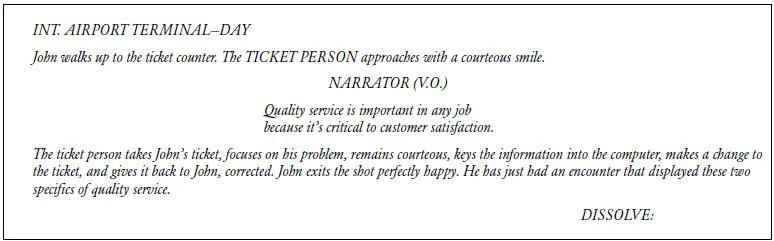
At first glance, this scene might appear to be effective. The ticket person seems to act in a courteous and focused manner, and the scene certainly talks about focus and courtesy. The writer even closes the scene by confirming this with the line, “He has just had an encounter that displayed these two specifics of quality service.”
But viewers will never read the writer’s scene description, including the closing line. They will only see the ticket person approach wearing a smile and go through the motions of writing out John’s ticket. What they will hear will be the scripted narration.
Given these two elements, will they understand that focus and courtesy are the key instructional ele- ments being displayed on the screen? Probably not. They will undoubtedly get a general sense of quality handling from this scene, but they will retain no knowl- edge of the specifics because, although the writer has included the key items in his or her scene description, neither action titles nor dialogue have been included to support the message.
What, then, is the director’s solution to this type of problem? In this case, several possibilities are available for correction.
One solution would be to add action and dialogue that display a sense of focus and courtesy. For instance, several telephone calls or pesky fellow workers might act as distractions to the ticket person. If it became visu- ally clear that the ticket person was consciously ignor- ing these distractions to keep focused on the customer, the point would be made.
The courtesy idea could also be conveyed through additional dialogue and action, such as several courte- ous lines delivered by the ticket person. Another possi- bility would be to add narration and perhaps superimposed titles. For instance, the narration might be rewritten this way:
NARRATOR ( V.O.) Quality service is important in any job because it’s critical to customer satisfaction. In this case, even in the face of constant distractions, the ticket rep keeps her attention focused squarely on John’s problem. She also remains courteous every step of the way.
This additional narration would certainly help make the point. If the scene were also supplemented with superimposed titles that read “Focus” and “Courtesy” as they were mentioned in the narration, its informa- tional clarity would be further enhanced.
A Rule of Thumb
This example is only one of many types of informa- tional problem areas a director may have to work out, but in each case the general rules remain the same: Analyze each scene. Determine if it is informationally sound, not from a print standpoint but from an audio- visual one. If the scene will not be clear when taped, determine what revisions are needed. Revise or suggest revisions to include action, dialogue, narration, and, where appropriate, support titles.
These suggested revisions should be presented to the producer and possibly the client at the outset of the director’s work. If the producer agrees with the sug- gested changes, they can be made, often by the original writer, and the project can move forward. If the pro- ducer disagrees, the director must either disregard the problems or decide whether he or she wants to con- tinue with the project, knowing that it may not meet its objectives in the end.
Character Profiles
Characters are the human elements in a program and thus the most important to audience identification. The director’s challenge is to make characters appear real and engaging. To achieve this goal, he or she must get to know the characters intimately through script analy- sis. In future chapters, we will explore these human aspects of the director’s work in much greater detail. Strictly in terms of the script, however, the director should consider the following two important elements of character profiles: (1) the appearance or “look” and (2) the personalities of the actors who will appear in the program.
In corporate programs, the director will work most often with host and dramatic or humorous profiles.
Host Roles
A host is a common role in corporate media. He or she is a tour guide of sorts, leading the viewer through parts or all of the information being communicated. The director should remember that, although the host looks directly at the camera and talks to the audience, he or she is still a character that must be cast and played accordingly.
A host personality often needs to be friendly, warm, and conversational. His or her appearance or look should complement the content being delivered and the setting established in the script. For instance, if the content of the program concerns instruction on how to supervise service order writers, the host charac- ter might be a supervisor of these types of employees. This role would allow audience members to identify with the host character and view him or her as a credi- ble source of information.
Here’s another example.

This writer’s description seems to create an appro- priate appearance for this character. His personality would seem to be tough, road wise, and no nonsense but also considerate enough to want to pass along what he knows about truck safety to his viewers.
Obviously, a host cast as a ba...
Table of contents
- Front Cover
- Title
- Copyright
- Dedication
- Contents
- Preface and acknowledgments
- I The Corporate Media Evolution
- II The Script
- III Preproduction: The Plan for Success
- IV Production
- V The Director
- VI Postproduction
- Glossary
- Bibliography
- Index
Trusted by 375,005 students
Access to over 1.5 million titles for a fair monthly price.
Study more efficiently using our study tools.
Frequently asked questions
Yes, you can cancel anytime from the Subscription tab in your account settings on the Perlego website. Your subscription will stay active until the end of your current billing period. Learn how to cancel your subscription
No, books cannot be downloaded as external files, such as PDFs, for use outside of Perlego. However, you can download books within the Perlego app for offline reading on mobile or tablet. Learn how to download books offline
Perlego offers two plans: Essential and Complete
- Essential is ideal for learners and professionals who enjoy exploring a wide range of subjects. Access the Essential Library with 800,000+ trusted titles and best-sellers across business, personal growth, and the humanities. Includes unlimited reading time and Standard Read Aloud voice.
- Complete: Perfect for advanced learners and researchers needing full, unrestricted access. Unlock 1.5M+ books across hundreds of subjects, including academic and specialized titles. The Complete Plan also includes advanced features like Premium Read Aloud and Research Assistant.
We are an online textbook subscription service, where you can get access to an entire online library for less than the price of a single book per month. With over 1.5 million books across 990+ topics, we’ve got you covered! Learn about our mission
Look out for the read-aloud symbol on your next book to see if you can listen to it. The read-aloud tool reads text aloud for you, highlighting the text as it is being read. You can pause it, speed it up and slow it down. Learn more about Read Aloud
Yes! You can use the Perlego app on both iOS and Android devices to read anytime, anywhere — even offline. Perfect for commutes or when you’re on the go.
Please note we cannot support devices running on iOS 13 and Android 7 or earlier. Learn more about using the app
Please note we cannot support devices running on iOS 13 and Android 7 or earlier. Learn more about using the app
Yes, you can access Corporate Media Production by Ray DiZazzo in PDF and/or ePUB format, as well as other popular books in Media & Performing Arts & Film & Video. We have over 1.5 million books available in our catalogue for you to explore.