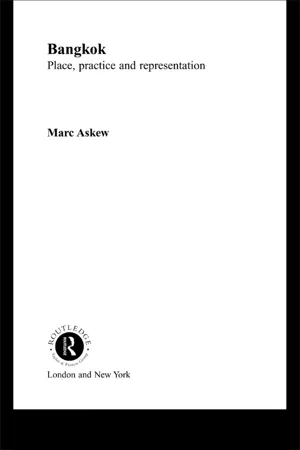
- 376 pages
- English
- ePUB (mobile friendly)
- Available on iOS & Android
eBook - ePub
About this book
Bangkok is one of Asia's most interesting, varied, controversial and challenging cities. It is a city of contradictions, both in its present and past. This unique book examines the development of the city from its earliest days as the seat of the Thai monarchy to its current position as an infamous contemporary metropolis. Adopting insights from anthropology, urban studies and human geography, this is a powerful account of the city and its dynamic spaces. Marc Askew examines the city's variety from the inner-city slums to the rural-urban fringe, and gives us a keen insight into the daily life of the city's inhabitants, be they middle-class suburbanites or sex workers.
Information
Part I
Krung to global city
The dynamics of transformation
1
Cosmology, accumulation and the state
The urbanism of early Bangkok
Introduction: the impress of the past
On the face of it, there seems little in the spectacle of today’s sprawling Thai metropolis to suggest the continuing influence of its past. As in other Southeast Asian mega-cities, the visible dynamics and physical landmarks that dominate today’s cityscape pronounce a distinctively contemporary logic of spatial form, economic accumulation, consumerism and industry. The lifestyles and occupations of its inhabitants share with those of the bustling cities of the region an engagement with the driving imperatives to survive as well as to accumulate the status symbols of a global age, extending from housing and technology to the fashioning of the modern body. Yet Bangkok’s past has not been erased – the very sources of its transformation and its continuing role as a centre of power and status are to be discerned in its history, which has a tangible legacy. The contemporary economic and symbolic functions of Bangkok, its role in the broader sociocultural system and its spatial patterning by institutions and people – in short, its urbanism – articulate in various ways with its origins and the dynamics of its transformation since its foundation as the royal capital over two hundred years ago.
Krung Thep: the palace and the yan
Bangkok was founded as the seat of the new Chakkri dynasty in 1782, following the overthrow of King Taksin who had ruled Siam from the city of Thonburi on the western bank of the Chao Phraya River (1768–82). Taksin had begun the task of reconstituting the Siamese state and extending its power following the massive disruption after the fall of the 400-year-old city and polity of Ayutthaya. The early Chakkri monarchs consolidated this process from the new capital of Krung Thep, founded on the site of an old settlement known as Bang-kok (the water hamlet of the wild plum tree). Two key points should be emphasised in interpreting the political, symbolic and economic significance of Krung Thep from its foundation. First, by virtue of the nature of Siamese kingship, its Indic-derived ideology of legitimacy (ultimately derived from the ancient polity of Cambodia but with significant Theravada Buddhist accretions) and the urbanistic focus of this legitimacy, this new capital was heir to a tradition which fixed the royal city as a symbolic and structural locus of political power, social hierarchy and religious legitimacy. Second, Krung Thep – like its forebear Ayutthaya – maintained the complementary roles of international port city and a centre for the accumulation and conversion of surplus extracted from a subject peasantry (Evers, Korff and Suparb 1987). It was the centre of wealth in the hands of a commercially-orientated governing elite and a cosmopolitan trading entrepôt which hosted a significant population of traders of diverse ethnic and religious backgrounds.
A number of prominent historians of Thai history have argued that the first king of the Chakkri Dynasty (retrospectively named Phra Phuttha Yotfa Chulalok, and later designated Rama I) presided over a period of ideological change. It was expressed in a more explicit Buddhist moral foundation for kingly authority and more secular and cosmopolitan (or bourgeois) attitudes on the part of the elite when compared to the preceding Ayutthayan dynasties (Nithi 1984; Wyatt 1982b). Such changes have been interpreted as flowing from the needs of the new dynasty to demonstrate legitimacy and the necessity of founding the newly consolidated state on a trade-based city. Nonetheless, the foundation of Rama I’s city was marked by a concern to re-establish the symbols, spaces and functions of the old capital of Ayutthaya. The new royal capital was given a sanskritised title which signified the transformation of an ordinary space into the consecrated seat of the chakkravathin – the world conquering, merit-filled monarch (Wenk 1968: 19). Significantly, the name ‘Ayutthaya’ was included in the first city title given in 1782. But in 1786, in a second ceremony (coinciding with the year of Rama I’s recognition by the emperor of China) the title was changed to:
The City of Angels, Great City, the Residence of the Emerald Buddha, Capital of the World Endowed with Nine Precious Gems, the Happy City Abounding in Great Royal Palaces which Resemble the Heavenly Abode Wherein Dwell the Reincarnated Gods, A City Given by Indra and Built by Vishnukarn.
(Sternstein 1982: 11)
Notably, the auspicious title (abbreviated hereafter as Krung Thep) still used familiar terms evoking that of Ayutthaya: ‘Krung Thep Thewarawadi Sri Ayutthaya’ (Dhani 1969). The title evoked a traditional cosmology where Brahmanical and Buddhist elements coexisted.1 The muang of the Thai monarchs took their formal names from the capitals themselves (thus ‘Ayutthaya’, ‘Rattanakosin’), signifying how conceptions of dynasty, capital and polity were inseparable. My use of the term ‘Siam’ for this early period refers simply to the polity (muang) dominated by the Thai- speaking peoples of the Chao Phraya Delta. Since the thirteenth century, Siam (a word probably of Khmer origin) was used in various forms by neighbouring states to refer to the people of the central Thai kingdoms, and later adopted by western powers. But the word was infrequently used by the central Thai and their rulers until the nineteenth century (Chit 1976: 232–5). It was King Mongkut (r. 1851–68) who formally adopted the name Siam (together with a flag of Siam distinctive from his own royal dynastic emblem) in an effort to represent the muang as a territorially-defined state recognisable to the west (Thongchai 1994: 171).
Krung Thep was seen to occupy the centre of the muang (state, polity) just as Lord Indra occupied the centre of the universe. The most crucial event to be ritually enacted prior to the commencement of construction of the new palace and its citadel was the installation of the lak muang (city pillar), which coincided with the establishment of a new dynastic horoscope (Cook 1991: 242–5). Dynasty, capital, muang and history were symbolically fused in this pillar and its ritual foundation. Linked with the Indic linga cult associated with the Hindu god Shiva as well as indigenous Tai cults of tutelary deities, lak muang were essential to establishing the symbolic centres of polities and assuring the well-being of ruling dynasties and the people of their muang (So 1960: 152–4; Terwiel 1978, 1983: 72). King Rama I proclaimed a decree banning popular phallic worship, and on this basis he has been seen as initiating a trend towards the reduction of Brahmanical and animistic influences in the realm; paradoxically, he was anxious to enact a city founding ceremony derived from the same broad tradition. When Prince Mongkut (Rama IV) came to the throne as the fourth incumbent of the dynasty in 1851, he installed a second lak muang because his horoscope did not conform to the foundation dates of the earlier pillar (Tambiah 1976: 227). His son and successor Chulalongkorn (Rama V), whose reign has been generally characterised as one of reform and modernisation along western lines, nonetheless reinforced the centrality of Krung Thep’s lak muang by constructing a new (Khmer-style) pavillion around the pillar and marking its inauguration with a Brahmanic ceremony (Aphar 1982: 14–15).2
While the royal chronicles state that Krung Thep was built to resemble the former capital of Ayutthaya, whose past magnificence was still fresh in the memories of its survivors (Wenk 1968: 18), the siting of the new capital (on the eastern side of the Chao Phraya River opposite King Taksin’s palace at Thonburi) was dictated more by the practical considerations of defence. Nevertheless the general desire to reproduce the familiar spatial and symbolic signifiers of the royal city as an embodiment of the king-centred polity is clear (for which see Naengnoi et al. 1991: 18–19; Terwiel 1983: 72–3). Thus the inner sanctum of the royal palace and its associated royal chapel (Wat Phra Kaeo) with the dynasty’s all-important protective palladium (the sacred Emerald Buddha) were sited on the bulge of land formed by a wide loop in the Chao Phraya River, with its eastern perimeter separated from the rest of the krung (krung is derived from the Khmer word for ‘city’) by a moat. This privileged core was known as Ko Rattanakosin (the Emerald Island of Indra). Within the walled palace (Phraratchawang) which dominated the landscsape of Ko Rattanakosin were located the royal throne halls, the chapel royal and residences of the monarch, his immediate relatives and high officials. In this walled complex the Wang Nai (or inner palace) was reserved for the king’s royal consorts and their dependants. This was the inner sanctum of the monarch’s privileged sexuality and symbolic potency. Aside from the women, it was accessible only to the king, following established law and custom. Outside this citadel was the Wang Na (the ‘Front Palace’) of the second king (the Upharat) and other princes of the blood, as well as important temples patronised by the dynasty. Attempts were made to replicate the structures of the old capital, but there were numerous deviations from the alignments and distribution of key structures of the earlier capital (krung kao).3
Krung Thep and its forbear, Krung Sri Ayutthaya, were sacred cities, but not in the sense that their plans corresponded in every detail to prevailing Hindu/Buddhist cosmological models of the universe. They were, however, exemplary centres. More than any coordinated system of cosmological spatial orientations, the royal city of Krung Thep was sanctified through the sheer accumulation of symbols. The first Chakkri monarch brought hundreds of revered Buddha images to the capital from old temples throughout the realm and the defeated tributary states, lending legitimacy to his rule as a Thammarat, or moral ruler (Akin 1969: 48–9; Suphadradis 1982; Wyatt 1982b: 147). Of supreme importance to the Chakkri dynasty was the Emerald Buddha (Phra Kaeo).4 Popular belief in the sacred power of this palladium was displayed when it was paraded throughout the city as a ritual act of purification during a severe cholera epidemic in the year 1820. Both the socio-political and religious hierarchy symbolised in the royal city were mutually reinforcing and found expression in the organisation of space at different scales: that is, between the spaces in the capital and between the capital and the realm. Beginning in the inner moated precinct, old temples were refurbished and new temples were constructed. These were placed under royal patronage, as distinct from the common temples (many of which predated the foundation of Krung Thep), reinforcing another element of hierarchy in the capital (see Fig. 1.1). The most sacred (saksit) of the realm’s Buddha images were concentrated there. Ritualistic installation of holy and auspicious objects (sing saksit) whether of Buddhist, Brahman or animist origins, gave auspiciousness to the site and protection to the city, the central place of the kingdom’s power and potency (Srisaka 1987). The early Chakkri monarchs, with princes of royal blood and prominent nobles, were keen temple-builders: in this they affirmed that wealth and prominence in the profane world reflected a moral hierarchy of Buddhist merit (see Hanks 1962).
The royal city was a space constituted by royal ceremony. From his inauguration as monarch, King Rama I’s public life was dominated by state ceremony. Ceremonies ranged in scale and audience from the palace-centred tonsure rites of royal family members to larger scale public rituals such as state cremations, temple inaugurations and the annual kathin processions (for the distribution of new robes to monks in the royal temples) (Wenk 1968: 9–15). The early Chakkri monarchs were apparently concerned to strengthen the Buddhist elements of kingship and state ritual (the king as the upholder of the Thammasat, or Buddhist law, and the protector of the monkhood) at the expense of the Brahmanical model of the king as Devarat (God King) and its connections to the cult of Shiva worship (Akin 1969: 43–4; Tambiah 1976: 227–8; Wales 1931: 242–3).
However, Brahmanic-inspired state ceremonies and symbolism invoking the protection of the Hindu gods and the prosperity of the Kingdom persisted throughout the period from the establishment of Krung Thep until the twentieth century (Tambiah 1976: 227; Vella 1978: 13–16).
However, Brahmanic-inspired state ceremonies and symbolism invoking the protection of the Hindu gods and the prosperity of the Kingdom persisted throughout the period from the establishment of Krung Thep until the twentieth century (Tambiah 1976: 227; Vella 1978: 13–16).
We may consider the royal citadel of Krung Thep in its collective material and symbolic dimensions as a ‘text’, or system of signs which aimed to represent and communicate a set of interrelated ideas of kingship, power and social organisation. Following James Duncan’s approach to the discursive construction of the capital of the Kandyan kingdom of Sri Lanka under its pre-colonial rulers, we can see this text as constituted by a number of narratives, including the iconic, the linguistic and the ceremonial – complementary dimensions of symbolisation which cumulatively fashioned an ideal landscape (Duncan 1990: 87–94). This ideal landscape, linked to Brahmanic and Buddhist concepts of kingship and authority, served a number of critical functions, even though it belied the considerable economic and political changes surrounding the formation of the Chakkri dynasty and its capital. First, the imperative to ‘rebuild Ayutthaya’ was a rallying cry for the resurgent Siamese muang (Srisaka and Suchit 1982: 64–70). Second, to the new monarch, who could claim no direct descent from the old royal line, the old polity was the only available model: a restored, yet purified system of Ayutthayan law and religion represented both consolidation and legitimacy. This static and ideal ‘text’ of the royal city (like other ideal models of the state such as those embodied in reestablished law codes) hardly corresponded with the dynamic political and socio-economic realities driving Siam during this period (see Wilson 1980). However the ideal of the eternal royal city of culture and religion was critically important. The Chakkri kings saw themselves, and were seen as, the primary protectors and patrons of the symbolic nucleus of social order and culture – the capital. The idea of the monarchy as the defining focus of culture and history has considerable influence in contemporary state representations of the Thai past and Thai identity.
But Krung Thep was more than a royal space defined by ritual and iconography. It was a port city whose trade was a critical base of the wealth and power of the monarchs and the ruling elite. In this, Krung Thep followed the pattern established by the kingdom of Ayutthaya, whose dominance of the region from the sixteenth century had been based on its advantages as a port polity (Dhiravat 1990; Reid 1993: 62–3). Thonburi and its successor capital of Krung Thep were sited much closer to the Gulf of Siam than Ayutthaya, signifying the importance of strategic security from Burmese aggression.5 Moreover Bang-kok had been the site of a settlement of Chinese traders since the Ayutthaya period and its access to seaborne trade was critically important for the needs of the reconstructed muang.
Thai urbanism had long been marked by an orientation to the outside world and a cosmopolitanism in striking contrast to its subject agrarian hinterland. The space of the city was thus not only framed by the presence of the royal palace and its associated hierarchical iconography, but by its trade: its river anchorages, its shipyards, warehouses and trading settlements of foreign merchants. Under King Taksin (who was himself half-Teochiu), Chinese traders of this speech group were encouraged to settle at his capital, many locating along the opposite shore at Bangkok. When Rama I began construction of his new palace, this group was moved south of the new city wall (constructed around the second moat from 1782), in keeping with the Ayutthayan practice which separated the royal centre of power from trading communities (see Fig. 1.1). Named Sampheng, this sprawling settlement extending along the riverbank was the principal focus of the Chinese merchants – whose networks and skills were essential to the kingdom’s economy – as well as other groups such as Bengali, Gujarati, Tamil and Malay traders.
The population of the capital (both within and without the walled area with the ruling families and numerous functionaries) was diverse, and its composition reflected not only the cosmopolitanism resulting from commerce, but the needs of the court, the fruits of war and state policies of settling exiled populations. The very diversity of the population of the realm and city was considered an index of the glory and power of the monarch, who graciously extended his royal protection (Phraboromaph-othisomphan) over people who entered the realm. Krung Thep’s population changed over time in response to these factors. Aside from the large communities such as the Mon and the Chinese, others included the Thawai (Burmese from Tenassarim), Cambodians, Cham, Hindus and Muslims of the Indian subcontinent, Lao, Malays, Makassarese, Muslims of Persian descent, Portugese and Vietnamese (see e.g. Wyatt 1982b: 145–6). Outside the walled city of the king and court, and beyond the ship anchorages, stretched a patchwork of ordinary settlements, marked by names prefaced with bang (literally ‘water hamlet’) or ban (village). Strung out along the Chao Phraya riverside and its maze of dug-canals and river tributaries, these settlements of Thai and Mon and other ethnic communities occupied floating or st...
Table of contents
- Cover Page
- Title Page
- Copyright Page
- Figures
- Plates
- Tables
- Acknowledgements
- Note on transliteration and Thai names
- Introduction Interpreting Bangkok: place, practice and representation
- Part I: Krung to global city
- Part II: Making Bangkok
- Notes
- Bibliography
Trusted by 375,005 students
Access to over 1.5 million titles for a fair monthly price.
Study more efficiently using our study tools.
Frequently asked questions
Yes, you can cancel anytime from the Subscription tab in your account settings on the Perlego website. Your subscription will stay active until the end of your current billing period. Learn how to cancel your subscription
No, books cannot be downloaded as external files, such as PDFs, for use outside of Perlego. However, you can download books within the Perlego app for offline reading on mobile or tablet. Learn how to download books offline
Perlego offers two plans: Essential and Complete
- Essential is ideal for learners and professionals who enjoy exploring a wide range of subjects. Access the Essential Library with 800,000+ trusted titles and best-sellers across business, personal growth, and the humanities. Includes unlimited reading time and Standard Read Aloud voice.
- Complete: Perfect for advanced learners and researchers needing full, unrestricted access. Unlock 1.5M+ books across hundreds of subjects, including academic and specialized titles. The Complete Plan also includes advanced features like Premium Read Aloud and Research Assistant.
We are an online textbook subscription service, where you can get access to an entire online library for less than the price of a single book per month. With over 1.5 million books across 990+ topics, we’ve got you covered! Learn about our mission
Look out for the read-aloud symbol on your next book to see if you can listen to it. The read-aloud tool reads text aloud for you, highlighting the text as it is being read. You can pause it, speed it up and slow it down. Learn more about Read Aloud
Yes! You can use the Perlego app on both iOS and Android devices to read anytime, anywhere — even offline. Perfect for commutes or when you’re on the go.
Please note we cannot support devices running on iOS 13 and Android 7 or earlier. Learn more about using the app
Please note we cannot support devices running on iOS 13 and Android 7 or earlier. Learn more about using the app
Yes, you can access Bangkok by Marc Askew in PDF and/or ePUB format, as well as other popular books in Social Sciences & Cultural & Social Anthropology. We have over 1.5 million books available in our catalogue for you to explore.