The tenth edition of this acclaimed text continues to provide a lively, comprehensive and up-to-date account of British political institutions, of the way in which they operate, and of the society in which they developed. It includes new sections on the following key areas: the monarchy and the House of Lords the 1997 general election the transformation of the Labour party and the demise of the Tory's the European Union devolution the judicial system Northern Ireland.
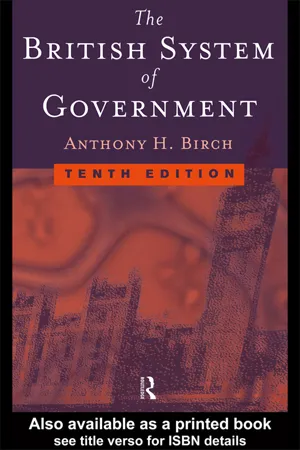
- 304 pages
- English
- ePUB (mobile friendly)
- Available on iOS & Android
eBook - ePub
British System of Government
About this book
Information
PART I: THE SOCIAL BASIS
1: BRITISH SOCIETY AND THE BRITISH PEOPLE
This book is concerned with the nature of British political institutions and the way in which they operate. Both the institutions and their mode of operation have been shaped to a large extent by the nature of the society in which they have developed, and they reflect and embody the habits and assumptions of the people who operate them. This is a general truth about political systems that applies not only to the government of Britain but also to the government of other nations; and not only to the government of nations but also to the government of small societies within nations. It can be seen as clearly as anywhere in the government of voluntary societies. Thus, student organizations tend to be ultra-democratic because students dislike authority, and to have elaborate rules of order because of the ingenuity with which student politicians exploit any ambiguity or loophole in the rules. Church organizations, on the other hand, tend to be dominated by a few leading personalities and to have very loose rules of procedure that reflect the belief that relations between members should be characterized by mutual trust and good faith. Nations are similar to voluntary societies in this respect; how they are governed depends to a large extent on the beliefs and habits of their citizens and the social relations between them. The most appropriate introduction to a study of British government is therefore a short discussion of some of the salient characteristics of British society and the British people.
The component parts of British society
The term ‘Britain’ is slightly ambiguous, being used sometimes as a shorthand equivalent of the political entity called the United Kingdom of Great Britain and Northern Ireland, sometimes as a short version of the social entity called Great Britain, and frequently (by the English) as a synonym for England. As 83 per cent of the people of the United Kingdom live in England, the whole political system is heavily influenced by the character of English society. However, as the state is, strictly speaking, multinational, it is appropriate to begin by saying a word about Ireland, Wales and Scotland.
Ireland is best regarded as England’s oldest colony, having been invaded by the English in the twelfth century and governed in colonial fashion until 1800, with a Governor responsible to London and a local Parliament (in the eighteenth century) composed almost entirely of Anglo-Irish landowners and merchants. Between 1800 and 1922 Ireland was legally part of the United Kingdom, and subject to laws passed by the Westminster Parliament. In the latter year, after a limited but bitter campaign of guerrilla warfare, the greater part of Ireland became an independent country known first as the Irish Free State and now simply as Ireland, leaving the six north-eastern counties as a partially self-governing province of the United Kingdom. Irish society and Irish politics have always been very different from English society and English politics, and strictly speaking they are outside the scope of this book. However, the political violence that broke out in Northern Ireland in 1969 has been kept within bounds only by a large contingent of British troops, and since 1972 the Belfast Parliament has been suspended and the Province has been governed directly from London. In view of these developments the political character and problems of Northern Ireland will be summarized briefly in an appendix (see pp. 264–75).
Wales, like Ireland, was invaded by the English in the twelfth century. It was politically integrated with England in 1536, and from then onwards the two countries were governed as one, with no significant differences between their political institutions until a measure of decentralization was introduced in 1964.
The social integration of Wales and England has inevitably been a more gradual process than their political integration. Until the nineteenth century, the Welsh language was spoken by the great majority of people, although English had been the language of government since 1536 and the Welsh middle classes had adopted both the English language and many aspects of English culture. During the nineteenth century the development of coal-mining and industry in south Wales brought a large influx of English workers, while the development of state education was accompanied by an official campaign to establish English as the universal language of discourse. By 1981 only 19 per cent of the people of Wales claimed any knowledge of Welsh, and it is only in rural areas and a few small towns that the language is used. Traditional Welsh culture has declined along with the language, and it would be easy to conclude that Welsh society will be completely integrated with English society within two or three generations.
Such a conclusion may not be warranted, however. For one thing, a vigorous campaign is being promoted to revive the Welsh language and culture, and the Welsh nationalist party, Plaid Cymru, has had some significant electoral successes since 1967. As a result of its campaigns, the fourth television channel in Wales uses Welsh as its medium. Secondly, there are in fact subtle differences between Welsh and English society, quite apart from the language and the traditional culture of rural Wales. Lacking their own aristocracy, the Welsh tend to be more egalitarian than the English and are considerably more reluctant to vote Conservative. Since the franchise was extended to most working-class men in 1867, the Conservative Party has always had difficulty in winning more than a handful of the Welsh parliamentary constituencies. In the twenty-four elections held between 1900 and 1992, excluding the ‘coupon election’ of 1918, Conservatives gained an average of 5.9 Welsh seats out of a total that varied between 34 and 38. Until 1922 Wales was overwhelmingly Liberal in sentiment and since then it has been overwhelmingly Labour. In addition, Welsh people tend to show more emotion than the English, and this affects their political attitudes and behaviour. A leading student of Welsh politics has observed that ‘Welsh political culture is…shot through with Welsh cultural and national values and is thus inherently conducive to anger and conflict’ (Madgwick 1977:236–7).
The position of Scotland is different again. For several centuries Scotland was an independent state, and when it joined in political union with England and Wales in 1707 it did so by agreement, not by conquest. Moreover, although the Scottish Parliament voted itself out of existence, other Scottish institutions remained intact, including a distinctive legal system, a somewhat distinctive educational system and the Presbyterian Church of Scotland. With this history, it is not surprising that the Scottish people have a secure sense of national identity, which has survived nearly three centuries of political union with England and is now the basis of a lively nationalist party that seeks to regain Scottish independence.
It follows that there is a real sense in which British society is multinational. However, the differences between England, Wales and Scotland are limited in extent. The Industrial Revolution has had a similar impact on each, and they are all highly urbanized. Engineering is the largest single industry in each. There is a high level of personal mobility between the various parts of Britain, and communication statistics reveal an exceptionally high degree of integration between England and Wales and a considerable degree between England and Scotland (see Birch 1977: ch. 3). The centralized nature of British government has further reduced the social differences between the various parts of the country.
It is therefore reasonable, in a brief treatment, to outline the characteristics of British society as if it were one society, even though occasional reservations have to be made to allow for Welsh and Scottish differences. Table 1.1 gives some basic facts about the constituent territories, with Northern Ireland included for comparative purposes.
Some characteristics of British society
As the resolution of conflicts is one of the main functions of government, the nature of the divisions and cleavages in society has a major influence on the character of the political system. Cleavages vary in kind, and one of the most important lessons to be drawn from a study of politics is that conflicts deriving from linguistic, religious or racial cleavages are usually more difficult to resolve than conflicts deriving from economic cleavages, whether the latter be between regions of the country or classes within society. There are two reasons for this difference. The first is that people are locked into their linguistic, religious and racial groups, usually having no wish to change even if they could, whereas people can hope to escape from a depressed region or class by individual mobility. If they themselves cannot escape, they can hope that their children will do so. The second reason is that it is easier for governments to mitigate economic conflicts, by a process of incremental adjustment, than it is for them to mitigate linguistic, religious or racial conflicts.
Table 1.1 The constituent territories of the UK in 1991
The contemporary world provides ample evidence for these generalizations. Linguistic conflicts have created constitutional crises in both Belgium and Canada. Religious conflicts have led to prolonged violence in Northern Ireland, Lebanon and India. Racial conflicts have led to riots in American cities and to bloodshed in many African and Asian states. Economic conflicts, though present in all countries, are normally resolved peacefully by bargaining, wage increases, price controls and adjustments to the tax system.
In this perspective, Britain can be counted as fortunate in that modern British society is relatively free from the most troublesome kinds of cleavage. There is no linguistic cleavage in Britain except in some parts of Wales, and as the Welsh-speakers comprise only 1 per cent of the British population (and can virtually all speak English as well) this does not pose a serious threat to political stability. Religious divisions are no longer of any general significance, largely because of the decline of religious conviction. Only about 5 per cent of the population attend church on a normal Sunday, and the attitude of the great majority of people towards religion is one of indifference. There are a few constituencies in and around Glasgow and Liverpool where the concentration of Roman Catholic voters is so great that the Labour Party, at least, normally nominates a Catholic candidate; but these are areas of heavy Irish immigration, so that the religious dimension to political life there can be regarded as an importation from across the water. In addition to its nominally Christian population, Britain has about 400,000 Jews, 600,000 Hindus and Sikhs and over a million Muslims. However, no statistics are available regarding attendance at synagogues, temples and mosques. The fact that a minority of the Muslims are fundamentalists raises the possibility of social conflict over religious issues, as became apparent in 1989 when the Ayatollah Khomeini of Iran called upon militant Muslims to murder the British author Salman Rushdie on account of some allegedly blasphemous passages in a novel he had written. However, it remains true that, in general, religious loyalties have little impact on British political life. The contrast with Northern Ireland is obvious and there is also a marked difference between Britain and the United States on this matter. In America, politicians are apt to be judged on moralistic grounds, while the strength of religious feeling about the control of abortion was demonstrated by the bombing of twenty-eight abortion clinics by religious zealots during 1986. In Britain, political and religious issues are normally kept separate and the great majority of British voters neither know nor care what religious views (if any) are held by candidates for political office.
The question of race is rather more delicate. For many centuries Britain has had a high degree of ethnic homogeneity, with immigrants arriving only in a trickle and thus easily assimilated. In the nineteenth century, the arrival of large numbers of Irish settlers sometimes created tension in industrial areas, but did not lead to any permanent social problems. In the present century British society has easily absorbed several contingents of European immigrants seeking refuge from the political problems of their own countries. In round numbers, these contingents comprised 150,000 Russian Jews in the years before the First World War, 65,000 German Jews in the 1930s, 100,000 Polish ex-servicemen who stayed on in 1945, and 30,000 Hungarian refugees in 1956. In the late 1950s, however, social tensions and problems resulted from the arrival of considerable numbers of Pakistani, Indian and West Indian immigrants, who until 1962 had unrestricted right of entry to Britain as citizens of Commonwealth countries. As soon as this development came to the attention of the general public, opinion polls showed that over 80 per cent of the public were opposed to it, and in 1962 immigration of this kind was restricted by the Commonwealth Immigrants Act. Subsequent measures have tightened the controls, but by 1997 Britain had 3.1 million Commonwealth immigrants and their descendants and it is officially estimated that by the end of the century the number will be about 3.3 million.
The existence and growth of these ethnic minorities, largely concentrated in a few cities, has given rise to various types of concern. First, there has been concern that the minorities may suffer from racial discrimination. The promotion of good race relations is a matter upon which all the major political parties are agreed, and overt discrimination in almost all fields of activity has been made illegal by successive pieces of legislation, but some covert discrimination in employment undoubtedly occurs. Secondly, there has been concern that the minorities might not become integrated into the British economy and British society, sharpened by the revelation that black children have (for whatever reason) done markedly less well in the British educational system than white children and Asian children have. Thirdly, there have been fears that areas containing sizeable ethnic minorities might be marked by violent conflicts between races, or between minorities and the police. There have in fact been violent clashes between young black citizens and the police in Bristol, Liverpool, Birmingham and parts of London, but few direct clashes between blacks and whites.
Economic divisions with a geographical (as distinct from a class) basis fall into two categories: divisions between urban and rural areas, and divisions between more prosperous and less prosperous regions. Divisions between urban and rural areas are relatively unimportant in Britain because the country is more urbanized than any other country in the world apart from city states like Singapore. The proportion of the total male workforce engaged in agriculture was only 1.8 per cent in June 1996 (the seasonal peak) and is lower than in any other country apart from Kuwait. One of the consequences is that in British politics there is no sharp clash between representatives of urban and rural interests. The farming industry is an important pressure group, but its influence depends on the goodwill of the government and the fact that the country could not easily afford to increase its imports of food, not upon the voting power of people dependent on agriculture for their livelihood.
Regional disparities in prosperity are inevitable in any sizeable country, and in Britain they have been accentuated in recent decades by the decline of several older staple industries such as coal-mining, shipbuilding and textiles. These industries are mainly situated in Wales, Scotland and the north of England, and a political consequence of this is that these regions are more pro-Labour than southern England. This difference has grown significantly since 1980, but it can hardly be called a conflict.
A factor that reduces the impact of regional issues is the centralization of the mass media. There is no other country of Britain’s size in which the press is so dominated by national newspapers. The choice is wide, there being eleven national morning papers that can be delivered to the doorstep throughout Britain; but they are all edited in London. Five of these constitute the serious, ‘quality’ press, with a combined circulation of 2.5 million in 1992. The other six are popular tabloids, with a combined circulation of 11.2 million. It is estimated that 75 per cent of the population over the age of sixteen read one or more of these eleven national dailies. With a handful of exceptions, Welsh and provincial English papers are read in addition to national papers rather than as alternatives to them, and people tend to look to the national press for political news and to their local papers to find out what is on at the cinema. The only papers that can be regarded as alternatives to the national press are the Yorkshire Post (with a circulation of 89,000), the Western Mail (circulation 77,000), the Liverpool Daily Post (circulation 78,000) and the Birmingham Post (circulation 28,000). It will be seen that their combined circulation is insignificant compared with that of the national dailies. The Sunday press is similarly centralized, a readership survey showing that 87 per cent of the population over the age of sixteen read one or more of the nine national Sunday papers, with a combined circulation of 16.2 million.
However, Scotland is an exception to this general rule. It has three important daily papers of its own in the Scotsman, the Glasgow Herald and the Daily Record, as well as several smaller independent dailies and the Scottish editions of British national papers. Statistics show that in Scotland the total circulation of the Scottish-owned daily papers is about the same as that of the London-owned papers, and the Scottish editions of the latter contain a high proportion of Scottish news even though they are now all edited in England.
It is, of course, also important that the main national radio network is owned by the government and that the two main television news programmes are produced by national agencies, one by the BBC and the other by an independent organization that provides a news service for all the commercial television companies.
The consequence of all these factors is that political news is much the same all over the country. In the United States, where sectional differences are considerable, and all newspapers and radio stations are local, it often happens that at any one time people in different parts of the country are concerned with quite different political issues. In the south-western states a prominent issue might be the position of Mexican immigrants; in Texas, the politics of the oil industry; in the midwest, the federal government’s policy towards agriculture; in the north-east it might be foreign policy. As a result, in an election the fortunes of the parties may vary between regions, the Democrats gaining in one part of the country and the Republicans gaining elsewhere.
In Britain, the combined effect of the smallness of the country, the absence of marked sectional differences and the existence of national newspapers is that political localism of this American kind rarely occurs except in Scotland. Local issues do not often make newspaper or television headlines, and when they do they usually make headlines all over the country—at any rate in England and Wales. This state of affairs is partly responsible for the fact that, from 1945 until the 1980s, movements of political opinion were remarkably uniform over the whole of the country, apart from Scotland. If the government of the day lost popularity, the general tendency was for it to lose popularity almost everywhere. If there was a swing from one main party to the other in a general election, this was reflected in all the regions of England and Wales, with minuscule variations.
Scotland followed the general trend from 1945 to 1955, but after that date it veered slowly but steadily to the left, putting the Conservative Party into the position of a permanent minority north of the border. In the 1983 election the Conservatives won only twenty-one of the seventy-two Scottish seats, despite getting a large majority in the country as a whole, while in the 1987 election they held only ten Scottish seats and in 1997 none at all.
In England and Wales uniform swings continued until 1983, when the intervention of the new Social Democratic Party (SDP) made a difference. The SDP, acting in electoral alliance with the Liberal Party, took many more votes from Labour in the south of England than it did in the north. The consequence was that in most of southern England the main battle was between the Conservatives and the Liberal-SDP alliance, with Labour coming third, while elsewhere the traditional Conservative/Labour conflict continued to dominate the polls except where there were local pockets of Liberal strength. In the 1987 election the alliance gained slightly fewer votes, but regional differentiation in voting became even more marked as a consequence of the contrast between the prosperity of much of southern England and the relative poverty of the older industrial areas of northern England and Wales. The Labour Party gained votes in these areas without making any impact on the southern counties, where its record was even poorer than that of the Conservative Party in Scotland. In this way regional economic and social differences have now come to have a very significant impact on the party system.
The class system
It has sometimes been observed that the British are more conscious of considerations of social class in their relations with one another than citizens of other western societies, and some account of the class system is essential in any discussion of the characteristics of British society. However, when people talk of a class system they do not always refer to the same phenomenon. There are in fact three quite different models of what a class system consists of. In one model the difference between classes is conceived as being a difference of power; in another it is a difference of status; and in a third it is a difference of interests.
The view of the class system in terms of power derives from the theories of Karl Marx. In the Marxist model of society the ownership of the means of production determines class identity and class relationships. In an agricultural society the owners of land dominate the landless, who are forced to work on the land for low rewards. In an industrial society the owners of capital become the dominant class, with the landowners relegated to the position of a small rentier class and the great majority of people forced to sell their labour to the capitalists. The majority, known to Marxists as the proletariat, are exploited by the capitalists and cannot escape from their condition of exploitation except by a revolution that would transform society by expropriating the possessions of the capitalist class and establishing a socialist form of industrial organization. Revolutio...
Table of contents
- COVER PAGE
- THE BRITISH SYSTEM OF GOVERNMENT
- TITLE PAGE
- COPYRIGHT PAGE
- ILLUSTRATIONS
- PREFACE TO THE TENTH EDITION
- PART I: THE SOCIAL BASIS
- PART II: THE CONSTITUTIONAL FRAMEWORK
- PART III: THE ACTORS AND THEIR ROLES
- IV: THE PROCESS OF GOVERNMENT
- PART V: THE CITIZEN AND THE GOVERNMENT
- APPENDIX: NOTES ON THE POLITICS OF NORTHERN IRELAND
- BIBLIOGRAPHY
Trusted by 375,005 students
Access to over 1.5 million titles for a fair monthly price.
Study more efficiently using our study tools.
Frequently asked questions
Yes, you can cancel anytime from the Subscription tab in your account settings on the Perlego website. Your subscription will stay active until the end of your current billing period. Learn how to cancel your subscription
No, books cannot be downloaded as external files, such as PDFs, for use outside of Perlego. However, you can download books within the Perlego app for offline reading on mobile or tablet. Learn how to download books offline
Perlego offers two plans: Essential and Complete
- Essential is ideal for learners and professionals who enjoy exploring a wide range of subjects. Access the Essential Library with 800,000+ trusted titles and best-sellers across business, personal growth, and the humanities. Includes unlimited reading time and Standard Read Aloud voice.
- Complete: Perfect for advanced learners and researchers needing full, unrestricted access. Unlock 1.5M+ books across hundreds of subjects, including academic and specialized titles. The Complete Plan also includes advanced features like Premium Read Aloud and Research Assistant.
We are an online textbook subscription service, where you can get access to an entire online library for less than the price of a single book per month. With over 1.5 million books across 990+ topics, we’ve got you covered! Learn about our mission
Look out for the read-aloud symbol on your next book to see if you can listen to it. The read-aloud tool reads text aloud for you, highlighting the text as it is being read. You can pause it, speed it up and slow it down. Learn more about Read Aloud
Yes! You can use the Perlego app on both iOS and Android devices to read anytime, anywhere — even offline. Perfect for commutes or when you’re on the go.
Please note we cannot support devices running on iOS 13 and Android 7 or earlier. Learn more about using the app
Please note we cannot support devices running on iOS 13 and Android 7 or earlier. Learn more about using the app
Yes, you can access British System of Government by Anthony H Birch in PDF and/or ePUB format, as well as other popular books in Politique et relations internationales & Constitutions. We have over 1.5 million books available in our catalogue for you to explore.