- 288 pages
- English
- ePUB (mobile friendly)
- Available on iOS & Android
eBook - ePub
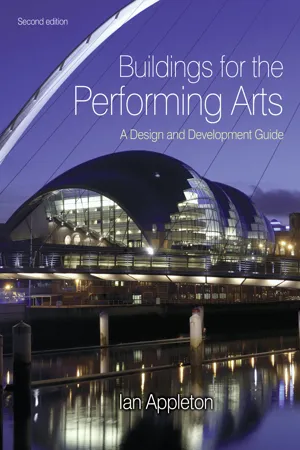
Buildings for the Performing Arts
About this book
This Design and Development Guide is an essential book for those who are involved in the initiation, planning, design and building of facilities for the various performing arts, from local to metropolitan locations. It includes the stages in the development, decisions to be taken, information requirements, feasibility and advice necessary in the design and development of a new or adapted building.
Part one of this guide provides the background information about the organisation of the performing arts, the prevailing issues, the client and various building types. In the second part, the author deals with the components of design and development, identifying the roles of the client, advisors and consultants, the stages to be achieved, including client's proposal feasibility, the process of briefing, design and building and eventually hand-over and opening night, with a consideration of the building use. Studies include the assessment of demand, site requirements, initial brief, building design and financial viability. Information requirements, as design standards, for the auditorium and platform/stage, and the support facilities, are included. Separate studies focus on the adaptation of existing buildings and provision for children and young persons.
THE CONTENT COVERS A WIDE RANGE OF PERFORMING ARTS (CLASSICAL MUSIC, POP/ROCK, JAZZ, MUSICALS, DANCE, DRAMA) AND PROVIDES INFORMATION ON EACH AS AN ART FROM AND NECESSITIES TO HOUSE PERFORMANCES.
Information
PART ONE
The Context
1
Introduction

The performing arts cover forms of music (orchestral, choral, pop/rock and jazz), opera, musicals, dance and drama. This Guide concentrates on these. It is acknowledged that the performing arts also cover music-theatre, musicals, comedies, music-hall, variety, vaudeville, puppet shows, revues, mime, cabaret, folk music, live art, and street performers, as well as experimental theatre, military tattoos and circuses. Essentially though the performing arts are concerned with a space for a live performance experienced by an audience within a set period of time. The space is defined by specific technical and spatial demands and requires a conducive atmosphere for both audience and performer.
The format, an audience focused on the platform or stage, has not changed as an experience since performers first wished to perform and audiences wished to hear and see a performance. Technology has developed, expectations adjusted and experiences have widened, while social aspects, including erosion of social divisions within auditoria and improved status of performers, have reflected changes in the wider society. The expectation is for professional music, dance, drama and other types of performing arts to be available to all in congenial auditoria, and also for facilities to be generally available in the community for amateur groups to perform as a leisure activity.
The performing arts are born of the creative processes of writing plays, composing music, choreographing dance, directing productions and designing settings: realization is found through conductors, musicians, singers, dancers, actors and other performers. All are developing and new music, opera, musicals, dance, drama and other forms of performing art continue to be created. They require the opportunity to be staged within traditional or new methods of presentation, while established works, as well as being staged in traditional and time-honoured ways, are also subject to re-interpretation or presentation in different formats. Experiment in the performing arts may bring new forms of auditorium: electronic music compositions have challenged the requirements of the concert hall whose traditional forms are based on non-amplified acoustic instruments. Similarly promenade drama presentations do not require fixed seating and stage positions, the characteristic of traditional theatre auditoria, while street theatre with only nominal technical backup contrasts with the increasing sophistication of stage machinery and sound and lighting technology for ever larger theatrical productions.
The pattern of provision includes buildings, either for a resident company or for receiving touring companies, owned and managed by local government, commercial enterprises, private trusts and voluntary bodies. The ratio of public and private provision varies according to country – from complete public provision to predominantly commercial enterprises with a variety of combinations in between. Public funding of the performing arts, as examples are relatively low in the USA and relatively high in Germany. The principle, however, of public funding to sustain and support the performing arts is a characteristic of most countries in the developed world, as orchestras, choral groups, opera houses, theatres, etc. rarely balance their books with expenditure exceeding income. They require subsidies as grants from central government agencies and local government as well as commercial sponsorship, and monies from lotteries, foundations and individuals. A consequence has been the close examination of the cultural, social and economic roles of new and existing provision, as well as the adoption of budgeting and marketing techniques and the expansion of income-earning activities to include, for example, conferences to reduce the deficit. Political arguments range from no public intervention to full public control with the actual policy establishing a balance between both, according to the political climate and cultural traditions of a country. The ratio of public to private contribution can change over time with the tension between the conflicting approaches ever present. Justification of support for both capital and revenue funding has included one or more of the following reasons:
• cultural: to safeguard an aspect of cultural heritage; continuity of art forms, display of performing skills and sustaining national, local or ethnic traditions; to retain and improve an existing stock of facilities and established companies for the performing arts, or to provide new facilities to ensure cultural opportunities.
• economic: direct employment of staff and performers; benefits to secondary businesses such as poster and programme printing and material supply; a widening of the tourist and conference market which, in turn, brings money into the town or city; an attraction to encourage relocation, and location of organizations, institutions, industry and commerce in an area with subsequent employment benefits.
• educational: to cultivate an appreciation of the art forms through the exposure of audiences to examples; to form part of an educational programme for schoolchildren, students and those in adult education.
• prestige: international, national, regional, city or town comparison; re-enforcement of regional identity emphasizing dispersal from metropolitan focus.
• quality of life: performing arts as acceptable complementary activities to work and domestic obligations as a positive use of leisure time which enriches life culturally and also socially.
• regeneration: part of a wider programme to revitalize an existing city or town centre or to assist in the formation of a new community, to attract industry, commerce, institutions, housing, and so on.
• cultural democracy: to stimulate and foster participation in the performing arts by all sections of a community, defined locally, as a creative activity.
General policy for the performing arts tends not to be subject to a national or regional plan in the same way as, say, the organization of health care generates a network of facilities. Provision within the performing arts often emerges from local pressure groups in response to local circumstances. However central government agencies and local government have tended to have their own master plan against which a proposal may be evaluated. This is especially the case if public funds – as grants and revenue subsidies – are involved, where evaluation is the basis of accountability. The roles of the local pressure group and particular individuals should be emphasized as a frequent moving force to initiate and sustain interest in new provision or building adaptation.
Public policy over the geography of provision tends to be focused on giving all sections of the population the opportunity to have access to the performing arts. General policy attempts to avoid ad hoc provision to achieve a more coherent plan. The two main areas of concern are the fostering of the highest quality in professional performances and the participation of the public in the performing arts as spectators and amateur performers within local communities. For a given budget, there can be a dilemma over the distribution of funds towards either a concentration on a single major project such as an opera house or a dispersal among community-based projects. This type of dilemma occurs in all sections of public life and debate: invest in the eradication of the common cold experienced by virtually all or a kidney machine for the few, concentrate resources in tertiary education at the expense of primary, and so on. All are concerned with scarce resources and factional interests in the public arena. A distinction for the performing arts lies in their historical and social associations, as well as the values expressed within them: so the content, including the often provocative nature of the performing arts, invades the debate. Actual policy however may be mainly determined by inherited values and facilities: the type of concert hall, theatre, community facility, and so on that are already available; the crisis brought about when a building for a performing art is about to be demolished, an orchestra finds itself on the verge of bankruptcy, and so on.
The history of buildings for the performing arts in the last half century is full of good intentions, and examples can be cited where the project has fallen on fallow ground or held in extended abeyance, relying only on faith rather than the understanding of the economic and social reality and the politics of provision.
2
Types of production
The initial consideration in the design and development of a building for performing arts is the choice...
Table of contents
- Cover Page
- Table Of Contents
- Buildings for the Performing Arts
- Buildings for the Performing Arts
- Preface
- Preface to new edition
- Part One The Context
- 1 Introduction
- 2 Types of production
- 3 Audiences
- 4 Types of client
- 5 Building types
- Part Two Approach to Design and Development
- 6 Design and development
- 7 The client
- 8 Consultants
- 9 Stages in design and development
- Part Three Specific Studies
- 10 Audiences, companies and staff
- 11 Site considerations
- 12 Initial brief: Auditorium and platform/stage
- 13 Initial brief: Support facilities
- 14 Initial brief: Spaces for children and young persons
- 15 Initial brief: Existing buildings for the performing arts
- 16 Building design
- 17 Time-scale
- 18 Financial appraisal
- Appendix 1 References and sources of information
- Appendix 2 Main consultants and clients' advisors
- Index
Trusted by 375,005 students
Access to over 1.5 million titles for a fair monthly price.
Study more efficiently using our study tools.
Frequently asked questions
Yes, you can cancel anytime from the Subscription tab in your account settings on the Perlego website. Your subscription will stay active until the end of your current billing period. Learn how to cancel your subscription
No, books cannot be downloaded as external files, such as PDFs, for use outside of Perlego. However, you can download books within the Perlego app for offline reading on mobile or tablet. Learn how to download books offline
Perlego offers two plans: Essential and Complete
- Essential is ideal for learners and professionals who enjoy exploring a wide range of subjects. Access the Essential Library with 800,000+ trusted titles and best-sellers across business, personal growth, and the humanities. Includes unlimited reading time and Standard Read Aloud voice.
- Complete: Perfect for advanced learners and researchers needing full, unrestricted access. Unlock 1.5M+ books across hundreds of subjects, including academic and specialized titles. The Complete Plan also includes advanced features like Premium Read Aloud and Research Assistant.
We are an online textbook subscription service, where you can get access to an entire online library for less than the price of a single book per month. With over 1.5 million books across 990+ topics, we’ve got you covered! Learn about our mission
Look out for the read-aloud symbol on your next book to see if you can listen to it. The read-aloud tool reads text aloud for you, highlighting the text as it is being read. You can pause it, speed it up and slow it down. Learn more about Read Aloud
Yes! You can use the Perlego app on both iOS and Android devices to read anytime, anywhere — even offline. Perfect for commutes or when you’re on the go.
Please note we cannot support devices running on iOS 13 and Android 7 or earlier. Learn more about using the app
Please note we cannot support devices running on iOS 13 and Android 7 or earlier. Learn more about using the app
Yes, you can access Buildings for the Performing Arts by Ian Appleton in PDF and/or ePUB format, as well as other popular books in Architecture & Architecture General. We have over 1.5 million books available in our catalogue for you to explore.