- 232 pages
- English
- ePUB (mobile friendly)
- Available on iOS & Android
eBook - ePub
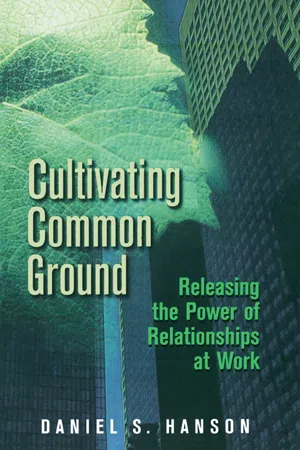
Cultivating Common Ground
About this book
Caring is a nitty-gritty process. Cultivating Common Ground teaches us how to care at work with real life experiences, rather than through conceptual thinking alone. Caring relationships to our work and each other give meaning to our work and provide a powerful source of energy for our organizations. Therefore, we must release relationships from their hiding place in the informal structure of the organization. The way to do that is to work together, to cultivate common ground, in order to make a conscious commitment to hold a life and a task in common. As old structures crumble, we have the opportunity to build caring communities at work. This book explains what went wrong in the first place, names our fears, and provides real-life examples of how to release the power of relationships in the workplace.
Daniel S. Hanson is President of the Fluid Dairy Division of Land O'Lakes, Inc., an instructor at Augsburg College in Minneapolis, and a speaker and author on the subject of organizational change and personal empowerment. Hanson draws on his 30 years experience as a corporate executive for four Fortune 500 companies, his extensive research, and his own life-changing experience to offer practical, hands-on presentations and trainings. He is also the author of A Place To Shine: Emerging From the Shadows at Work, Butterworth-Heinemann, 1996.
"This is a compassionate and powerful call for caring in the workplace. Dan Hanson is right on the mark when he suggests that we need to take courageous steps toward a new, caring workplace. He is one of the best teachers of building community at work you'll ever meet."
--Richard J. Leider, founding partner, The Inventure Group, author, "Repacking Your Bags" and "The Power of Purpose"
"Dan Hanson delves broadly and deeply into the nature of relationships in the workplace. He lays before us the common ground that nourishes results as well as meaning and satisfaction for the human heart and soul. Hanson provides the tools and knowledge we need to cultivate this garden. We are called to fertilize the soil with our own courage."
--Margaret A. Lulic, author, "Who We Could Be at Work"
1 Driving Relationships Underground
Do not cut yourself off from community, but work and be active in the community, with love for your fellow human beings, for what are you all on your own?…HILLEL
If a way to better there be, it lies in taking a full look at the worst.…THOMAS HARDY
1 Our Struggle with Relationships at Work
DOI: 10.4324/9780080503516-1
It later became clear to me that no matter what we do in science or any other area, it will not help if we don’t find a way to be related to each other at a deep level.…David Bohm
If you work in an organization, I don’t need to tell you that the story about the people who grew vegetables is make believe. After all, it is naive to think that people could love and care for each other the way the people who grew vegetables did and still do what is needed to keep the Great Kingdom profitable and growing. Even if it were a true story, the facts of life in the modern organization would be enough to kill the myth.
Life is not as simple as it appears in make believe. In real life the organizational demands for growth and profits override the time and effort it takes to build caring relationships. What’s more, to care is to risk going against the flow of a system that rewards loyalty, individual effort, superior political skills, rational behavior, and hard work. To paraphrase the words of a successful executive who agreed to critique one of the early versions of this book, “Caring too much can be hazardous to one’s career.”
To make matters worse, even when we do take time to care for each other at work our efforts are frequently met with a lackadaisical, care less attitude from those who stand to benefit the most. People bring all kinds of personal baggage with them to work. That’s why managers who have lived inside the organization for any reasonable length of time say that the idea that we can live as one big happy family is an illusion. They say, the best way to get along at work is to leave caring for each other at home or in the church where it belongs. In other words, stick to business.
Caring relationships at work are troublesome in a rational world. Along with caring relationships come claims and responsibilities. And if that isn’t enough to scare us away, add the fact that caring relationships are unpredictable, chaotic, and yes, emotional. We never know what might happen if we care for someone. We might get into all kinds of emotional stuff. As a result, we might find it hard to make tough decisions for the sake of the organization, such as laying off excess people or firing a bad employee. Relationships at work are further complicated by the current issues of diversity and harassment. Many managers are afraid to get close to people for fear they will say the wrong thing or make the wrong gesture. Indeed, caring relationships at work are troublesome. We would rather not deal with them.
For all the foregoing reasons and more, we have for many years pretended that caring relationships between people at work are bad for business. We convinced ourselves that we were better off and would make more rational decisions if we maintained a distance from each other. So we buried our relationships, kept them hidden behind a facade of rational thinking, and became artists at protecting ourselves from each other. On occasion it would appear that we cared. But for the most part our caring was pseudocaring, the kind that doesn’t go below the surface gestures of a friendly “hello” or “How are you?” that we don’t expect to be answered. When someone truly needed a helping hand, we hid behind the invisible shield called “the organization.” After all, we were told, the organization must be profitable and grow. Because what is good for the organization is good for progress, and progress is good for people. After a while, we got so good at denying our relationships that we forgot how to care. Worse yet, we grew to be afraid of each other.
Where Did Caring Relationships Go?
Denying caring relationships at work does not make them go away. In reality, caring relationships were very much a part of the organizations of the industrial era. Unfortunately, these relationships often formed within groups whose very purpose was based on opposition to the dominant system and the managers who were perceived as running it. The members of these groups often saw themselves as victims of a system that tried to keep them in their place. Managers, on the other hand, viewed caring relationships as a phenomenon that occurred at lower levels of the organization or within the “informal” structure and that it was best to keep them under control.
We should not be surprised that informal groups in which people cared for each other formed under the surface of our bureaucratic organizations of the industrial era. Both history and the human sciences provide evidence that it is natural for the human species to work together and care for each other. What’s more, experience bears it out. Later I cite studies that show people actually prefer to work in groups in which people care for each other over groups in which individuals look out for themselves and put the other members down or focus only on the bottom-line profits of the organization and treat people as dispensable resources. Unfortunately, this evidence does not negate the facts of life in the organization, including the fact that in the industrial era we learned to deny our natural drive to work together and to care for each other.
Psychology has taught us that when we deny a drive that we are genetically or socially programmed to pursue, the drive does not go away. Rather, the natural drive resurfaces in another form, often in a different time and place—and frequently in ways that are not necessarily good for us as individuals or as a species. Such is the case with caring relationships. While we were busy trying to prove to ourselves and each other that we didn’t need each other or that our emotions should be kept in tow so that they wouldn’t interfere with rational decisions, people continued to care for each other behind the scenes. We called these caring relationships informal to make certain they were not sanctioned and allowed them to develop only when they did not interfere with the rational goals of the organization.
What Does it Mean to Care?
The spirit of caring to which I keep referring is difficult to describe. It is much like the concept of community. It is more a way of being and living than a concept one can capture in a few short sentences. While trying to define it for myself I ran into more questions than answers— perhaps because the very concept implies a set of paradoxes. Caring implies loving and respecting ourselves as well as others. It requires a commitment both to the individual and to the shared goals of the group. It implies rights but also responsibilities, a nurturing as well as a challenging environment, growth through conflict as well as peace making, belief in the dignity of the person as well as the good of the group as a whole.
As much as we would like it to be so, the spirit of caring is not a feeling or a magical source of energy that emerges just because we agree to love each other or to put our trust in the self-organizing principles of the universe. Caring is a nitty-gritty process that asks those who participate in it to love each other even when others are not very lovable, to make meaning when there is none, to find hope in the face of despair and courage in moments of fear. Indeed, caring sets high moral standards and expects much from those who are part of it. The poignant words of Parker Palmer (1987, p. 20) on community at work are revealing in this matter: “Community is that place where the person you least want to live with always lives…. When that person moves away, someone else arises to take his or her place.”
My experience tells me that Parker Palmer is right. Caring is not easy when people fail to respond to our caring or when they respond in ways that send a message that our caring is not welcome.
It is much easier to pick and choose those we care for, like innocent children or those who are humble and in need.
But caring demands more than a friendly “hello” or a pat on the back. When we care for our work and each other, we lay ourselves open to claims and responsibilities. This might be the very reason we prefer to run away from caring relationships at work or explain why we choose to hide behind the invisible shield called “the organization” when an issue gets sensitive or people become emotional.
Perhaps the best way to discover what caring communities at work are all about is to observe them. A few years ago I embarked on a search to do just that. I was convinced that people still cared. I looked for groups that might exemplify what it means to love and care for each other as well as their work. Not surprising, I found some. But I didn’t find them at the top, where all the noise about shared visions and teamwork is the loudest. Nor did I find them at retreats where a pseudocommunity is manufactured in three days or less and falls apart when the first winds of conflict blow. I found caring work communities where I should have known all along I would find them: in the less formal and often inconspicuous places of the organization where people were working hard to create products and deliver services that would delight their customers; where people were taking time to care for each other; where people were dealing with and learning from the natural conflict that emerges when people are required to work side by side with other people they often never knew before or didn’t much care for at first—much like the people who grew vegetables. I also found the spirit of caring alive and well at the fringes of the organization—in union halls, employee clubs, bowling leagues, and at the local chapters of Toastmasters. In short, I discovered caring communities at work wherever I found people working together with their hands and their hearts as well as their heads, holding a life and a task in common.
A Hunger for Caring Relationships
What did I learn from my search? For one thing, I learned that the spirit of caring at work was still very much alive even though it had been driven underground by the forces of rational thinking, destructive power on the part of an executive elite, and our fear of getting too close to each other. Even more revealing, once I worked my way past the small talk and the tough rhetoric, I discovered a hunger for intimacy at work. This discovery shouldn’t have surprised me given the fact that hunger is a natural response to being shown something we have been starved of, including caring relationships. People at all levels of the organization told me that they wanted to get closer to their work and each other. Many of them were afraid to try, not only because they were led to believe the system wouldn’t let them but also because they weren’t sure how and where to start. I found the fear of intimacy notably more intense, though less openly admitted, at the top of the organization, where the art of social distancing had been practiced to perfection. People, especially managers, just didn’t know how to deal with the delicate issue of human relationships—or where to turn to get past their fear and learn how to care again.
The issue of relationships at work is particularly troublesome for managers—not only because we are the ones who are expected to fix people problems but also because the system itself places unreasonable demands on managers to fix whatever is wrong. I do not mean to negate the reality that some people appear to revel in the power of their position and use it for destructive purposes. However, several of the managers I talked to felt trapped by the organizational imperative for unlimited growth and profits and locked into a lifestyle created by the very rewards they were given for being loyal and committed. They felt cheated of meaningful relationships at work. It was never written anywhere, they told me, but the implied message was that if you wanted to be a manager you were required to behave rationally and not allow your emotions to get in the way. Some managers were told outright never to get too close to “their people.”
Encouraging signs are starting to appear for those who would like to release the power of caring relationships at work. People at all levels of the organization are beginning to speak out about caring. Human relationships at work are getting new press along with concepts such as meaning and spirituality. Indeed, perhaps what we call a search for meaning is really a cry for caring relationships in disguise. Maybe we are beginning to realize that there is no meaning at work or at home without others with whom to share it. Mihaly Csikszentmihalyi, author of several books on discovering meaning and happiness in life, reminds us that the concept of meaning itself includes a connection to others as well as to a purpose (Csikszentmihalyi 1990, 1993). In fact, Csikszentmihalyi’s research showed that the caring and confirming feedback of others, whether they be the people with whom we work or the customers we serve, is the very thing that gives work its meaning.
Caring and The Organizational Imperative for Growth
Unfortunately, every message has its shadow side. So it is with the message to make the workplace healthy again. The voices that call caring relationships out from their hiding places in the informal structure of the organization have been muffled by the very programs designed to fix “the organization.” In fact, judging by what I heard and experienced, many of these programs were driving relationships at work even farther underground. By reorganizing, reinventing, restructuring, remaking, reengineering, and rewhatevering the organization, without knowing what we were doing we were breaking up work groups that had formed caring work communities. In our efforts to bring teamwork into the workplace, we were interfering with the natural process of relationship building that occurs when people are given the opportunity to work together and care for each other.
Why is it that the organizations of the Industrial Era were so hard on caring relationships in the workplace? Perhaps the answer to this question lies in the nature of organizations themselves. They were created in the first place to provide a place to work. As organizations grew, they took on lives of their own. Eventually, profits became more important than providing work. Some organizations grew to be so big and complicated that the people who worked in them no longer knew why the organizations existed and where they were going. Those in power liked to keep it that way. Many people gave up trying to figure it out along the way. Others swore allegiance to the organizational imperatives for growth and profits at the expense of their own relationships at work and home. In essence, we gave away our work. We granted these huge organizations that we created in the first place to provide work the right to tell us why we should work, when we should work, how we should work, and with whom we should work. What’s worse, we became experts at social distancing and mastered the art of protecting ourselves from each other, often killing each others’ songs in the process. We did everything we could to control and limit caring relationships at work. In the process we drove the spirit of caring underground, depriving the organization of a powerful source of energy: caring relationships.
Several years ago W. Edwards Deming, often called the father of the quality movement for his work on improving business processes in both Japan and the United States, warned business leaders that they were out of touch with their customers and their employees. What’s more, he and others after him warned us that the bureaucratic monster organizations we had created were too costly and inefficient in a world of nimble competitors. Unfortunately, the pressure to produce quarterly earnings forced many leaders to respond to only part of this message—the part about being too costly. They went on cost-cutting rampages. Because labor costs were easy to identify and reductions there could fall quickly to the bottom line, people often were the first to go. Companies laid off workers as if they were unwanted flies at a summer picnic. Processes were reengineered. Entire departments and divisions were eliminated or reorganized. Wall Street loved the short-term results.
Recent efforts by managers and owners of organizations in the United States to reduce costs through massive layoffs have had a devastating impact on human relationships at work that had already been damaged by the rational thinking and the individualism of the industrial era. I argue later that these quick-fix programs delivered the final blow to the already-strained relationship between the individual and the organization. Even programs to introduce teams, an effort that on the surface appeared to promote relation ships, often meant that people were required to leave healthy work groups and work on several teams at once while the hierarchy of the organization remained in control. As a customer service manager I interviewed for this book put it: “We are team crazy where I work. People run from team to team like chickens with their heads cut off. In the meantime I lost every friend I had at work.”
For several reasons, the message that caring relationships at work are good for people and organizations never got through to the leaders of many organizations. If anything, many of the programs initiated to make organizations more competitive in a global marketplace drove caring relationships even farther underground. While all this was going on, individuals were admonished to stop depending on an entitlement from the organization, grow up, and take control of their own careers. One consultant I know went around telling people to create their own personal corporation called “Me, Inc.” Relationships were forced to take the back seat one more time.
Strong Selves are made from Caring Relationships
Contrary to what we have been led to believe by some movements within humanistic psychology and the culture of the strong, autonomous individual, an independent self free of intimate relationships is not a strong self. In truth, a strong self is built through strong, healthy relationships. These include relationships to nature, significant others, a personal and social history, special work to do, and special people to do it with. In fact, one of the reasons people feel so frustrated and helpless is that once stable social structures such as the family, the church, the community, and the work group are in transition. People feel as i...
Table of contents
- Cover Page
- Half Title Page
- Title Page
- Copyright Page
- Dedication
- Contents
- Acknowledgements
- Prologue: The People Who Grew Vegetables
- Part 1 Driving Relationships Underground
- Part 2 Bringing Relationships into the Open
- Part 3 Cultivating Common Ground A Process for Building Community at Work
- Part 4 Relationships and the New Organization
- Epilogue: A Weekend with Grandpa
- reference
- Index
Trusted by 375,005 students
Access to over 1.5 million titles for a fair monthly price.
Study more efficiently using our study tools.
Frequently asked questions
Yes, you can cancel anytime from the Subscription tab in your account settings on the Perlego website. Your subscription will stay active until the end of your current billing period. Learn how to cancel your subscription
No, books cannot be downloaded as external files, such as PDFs, for use outside of Perlego. However, you can download books within the Perlego app for offline reading on mobile or tablet. Learn how to download books offline
Perlego offers two plans: Essential and Complete
- Essential is ideal for learners and professionals who enjoy exploring a wide range of subjects. Access the Essential Library with 800,000+ trusted titles and best-sellers across business, personal growth, and the humanities. Includes unlimited reading time and Standard Read Aloud voice.
- Complete: Perfect for advanced learners and researchers needing full, unrestricted access. Unlock 1.5M+ books across hundreds of subjects, including academic and specialized titles. The Complete Plan also includes advanced features like Premium Read Aloud and Research Assistant.
We are an online textbook subscription service, where you can get access to an entire online library for less than the price of a single book per month. With over 1.5 million books across 990+ topics, we’ve got you covered! Learn about our mission
Look out for the read-aloud symbol on your next book to see if you can listen to it. The read-aloud tool reads text aloud for you, highlighting the text as it is being read. You can pause it, speed it up and slow it down. Learn more about Read Aloud
Yes! You can use the Perlego app on both iOS and Android devices to read anytime, anywhere — even offline. Perfect for commutes or when you’re on the go.
Please note we cannot support devices running on iOS 13 and Android 7 or earlier. Learn more about using the app
Please note we cannot support devices running on iOS 13 and Android 7 or earlier. Learn more about using the app
Yes, you can access Cultivating Common Ground by Daniel Hanson in PDF and/or ePUB format, as well as other popular books in Business & Business General. We have over 1.5 million books available in our catalogue for you to explore.